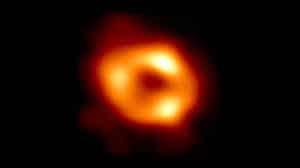
About Sagittarius C (Sgr C)
- It is the star-forming region known situated approximately 300 light-years from the Milky Way’s central supermassive black hole, Sagittarius A*.
- It is revealing a bustling cluster of protostars within an infrared-dark cloud.
- These nascent stars are in the process of accumulating mass, their outflows glowing intensely in the infrared spectrum, akin to embers in a cosmic bonfire.
- The cloud that protostars are emerging from is so dense that the light from stars behind it cannot reach Webb.
- Scattered throughout are smaller infrared-dark clouds, akin to celestial voids against the starry backdrop, signaling the birthplaces of future stars.
- Webb’s Near-Infrared Camera (NIRCam) has detected extensive emissions from ionised hydrogen on the periphery of the dark cloud, highlighted in a striking cyan hue.
Key facts about James Webb Space Telescope
- It was built in collaboration between NASA, the European Space Agency (ESA) and the Canadian Space Agency.
- It was launched in December 2021.
- It is presently at a point in space known as the Sun-Earth L2 Lagrange point.
- Lagrange Point 2 is one of the five points in the orbital plane of the Earth-Sun system.
- It’s the largest, most powerful infrared space telescope ever built.
- Objectives: It will examine every phase of cosmic history, from the Big Bang to the formation of galaxies, stars, and planets to the evolution of our Solar System.
Q1) What are Protostars?
Protostars are young stars within the earliest phase of stellar evolution. Protostars are not yet main-sequence stars as they have not absorbed all the surrounding interstellar gas and have yet to ignite through the fusion of hydrogen into helium.
Source: Heart of Milky Way galaxy has a mysterious structure






 Last updated on April, 2026
→ UPSC Final Result 2025 is now out.
→ UPSC has released UPSC Toppers List 2025 with the Civil Services final result on its official website.
→ Anuj Agnihotri secured AIR 1 in the UPSC Civil Services Examination 2025.
→ UPSC Marksheet 2025 is now out.
→ UPSC Notification 2026 & UPSC IFoS Notification 2026 is now out on the official website at upsconline.nic.in.
→ UPSC Calendar 2026 has been released.
→ Check out the latest UPSC Syllabus 2026 here.
→ UPSC Prelims 2026 will be conducted on 24th May, 2026 & UPSC Mains 2026 will be conducted on 21st August 2026.
→ The UPSC Selection Process is of 3 stages-Prelims, Mains and Interview.
→ Prepare effectively with Vajiram & Ravi’s UPSC Prelims Test Series 2026 featuring full-length mock tests, detailed solutions, and performance analysis.
→ Enroll in Vajiram & Ravi’s UPSC Mains Test Series 2026 for structured answer writing practice, expert evaluation, and exam-oriented feedback.
→ Join Vajiram & Ravi’s Best UPSC Mentorship Program for personalized guidance, strategy planning, and one-to-one support from experienced mentors.
→ Shakti Dubey secures AIR 1 in UPSC CSE Exam 2024.
→ Also check Best UPSC Coaching in India