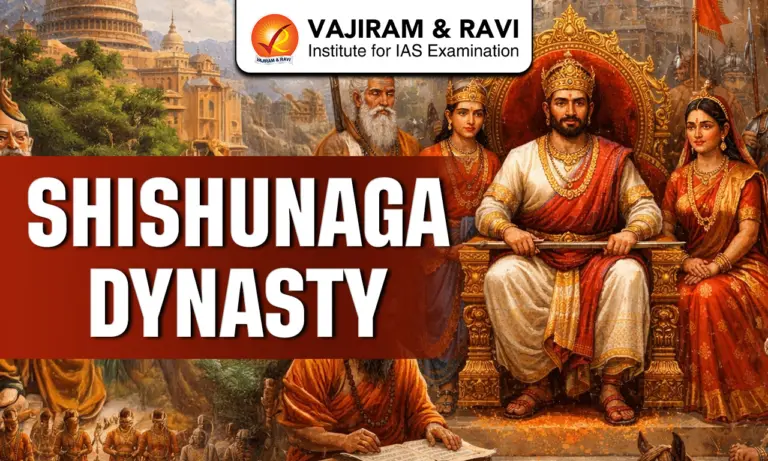
The Shishunaga Dynasty was an early imperial ruling house of Magadha that governed from around 413 BCE to 345 BCE. It succeeded the Haryanka dynasty after a popular revolt against Nāgadāsaka and played a crucial role in consolidating Magadha’s political power. The dynasty expanded territories, integrated Avanti and strengthened administrative systems. It also witnessed key religious developments, including the Second Buddhist Council, before eventually being replaced by the Nanda dynasty.
Shishunaga Dynasty Historical Background
The Shishunaga Dynasty emerged after political instability and public dissatisfaction with the Haryanka rulers, leading to a change in power structure.
- Shishunaga, originally an amatya (minister) of Nāgadāsaka, ascended the throne around 413 BCE after a rebellion.
- Initially, the capital was at Rajgir and Vaishali but later shifted to Pataliputra under Kalashoka.
- Buddhist texts like Mahavamsa place this dynasty after Haryankas, while Puranas present different king lists, showing inconsistencies in chronology and succession records.
Shishunaga Dynasty Administration
The Shishunaga Dynasty strengthened Magadha’s administration and expanded its territory, laying the foundation for future imperial growth.
- Governance: Shishunaga reorganized governance after Haryanka instability, maintaining a structured system supported by provincial administration, including appointing his son as governor of Varanasi.
- Military strength: Magadha’s army included infantry, cavalry, chariots and elephants, supported by abundant natural resources like iron ore and forests, ensuring sustained military campaigns.
- Conquest of Avanti: Shishunaga defeated the powerful Avanti kingdom, ending a century long rivalry and annexing it into Magadha, significantly expanding territorial control and influence.
- Strategic resources: Fertile lands produced surplus grain, enabling maintenance of large armies, while forests provided elephants, strengthening Magadha’s dominance in warfare and logistics.





Shishunaga Dynasty Rulers
The rulers of the Shishunaga Dynasty played key roles in political consolidation, expansion and religious patronage.
- Shishunaga: Founder of the dynasty, he came to power after overthrowing Nāgadāsaka, shifted capitals strategically and achieved major success by defeating Avanti, integrating it into Magadha’s expanding empire.
- Kalashoka (Kakavarna): Successor of Shishunaga, he ruled for about 28 years, shifted the capital to Pataliputra and patronized the Second Buddhist Council at Vaishali around 383 BCE. He divided the empire among his ten sons, possibly allowing simultaneous rule, which weakened centralized authority and contributed to administrative fragmentation in later years.
- Later rulers: Names like Nandivardhana and Mahanandin appear in Puranic lists, but details remain unclear, reflecting limited historical evidence and inconsistencies across sources. However, Mahanandin is widely considered as the last ruler of this dynasty.
Shishunaga Dynasty Society
Social and Religious developments during the Shishunaga Dynasty reflected the diversity and evolving nature of beliefs in eastern India.
- Rise of heterodox sects: Buddhism, Jainism and Ajivikaism flourished in eastern India, where Vedic influence was relatively weaker, encouraging alternative philosophical traditions.
- Continuation of Haryanka policies: Like earlier rulers, Shishunaga kings supported Buddhism and Jainism, ensuring their expansion and institutional development across Magadha.
- Social structure: Society was divided into four varnas, but eastern regions saw reduced Brahmanical dominance, allowing broader acceptance of non Vedic religious practices.
- Religious tolerance: Despite supporting Buddhism and Jainism, rulers did not oppose Hindu traditions, maintaining a balanced approach towards multiple faiths in the kingdom.
Shishunaga Dynasty and Second Buddhist Council
The Second Buddhist Council was a major religious event during the Shishunaga Dynasty, reflecting doctrinal debates within Buddhism.
- The council was held at Vaishali around 383 BCE under King Kalashoka’s patronage, approximately 100 years after Buddha’s Mahaparinirvana.
- Presided over by Sabakami, it aimed to resolve disputes regarding monastic discipline and interpretation of the Vinaya Pitaka among Buddhist monks.
- The council led to division into Sthaviravadins (Theravada) and Mahasanghikas, marking the first major split within the Buddhist Sangha.
- It shaped the future development of Buddhist traditions by formalizing doctrinal differences and influencing the spread of distinct schools of thought.
Shishunaga Dynasty Decline
The decline of the Shishunaga Dynasty was gradual, driven by internal conflicts, weak successors and political instability as highlighted below:
- Kalashoka was reportedly killed by a dagger attack, reflecting internal conspiracies and weakening central authority within the kingdom.
- His ten sons ruled either simultaneously or successively, causing division of power and weakening administrative unity across Magadha.
- Mahanandin is considered as the last ruler. He was overthrown by Mahapadma Nanda, who established the powerful Nanda dynasty around 345 BCE.

 Last updated on March, 2026
→ UPSC Final Result 2025 is now out.
→ UPSC has released UPSC Toppers List 2025 with the Civil Services final result on its official website.
→ Anuj Agnihotri secured AIR 1 in the UPSC Civil Services Examination 2025.
→ UPSC Marksheet 2025 is now out.
→ UPSC Notification 2026 & UPSC IFoS Notification 2026 is now out on the official website at upsconline.nic.in.
→ UPSC Calendar 2026 has been released.
→ Check out the latest UPSC Syllabus 2026 here.
→ UPSC Prelims 2026 will be conducted on 24th May, 2026 & UPSC Mains 2026 will be conducted on 21st August 2026.
→ The UPSC Selection Process is of 3 stages-Prelims, Mains and Interview.
→ Prepare effectively with Vajiram & Ravi’s UPSC Prelims Test Series 2026 featuring full-length mock tests, detailed solutions, and performance analysis.
→ Enroll in Vajiram & Ravi’s UPSC Mains Test Series 2026 for structured answer writing practice, expert evaluation, and exam-oriented feedback.
→ Join Vajiram & Ravi’s Best UPSC Mentorship Program for personalized guidance, strategy planning, and one-to-one support from experienced mentors.
→ Shakti Dubey secures AIR 1 in UPSC CSE Exam 2024.
→ Also check Best UPSC Coaching in India
Shishunaga Dynasty FAQs
Q1. Who founded the Shishunaga Dynasty?+
Q2. What was the capital of the Shishunaga Dynasty?+
Q3. What was the major achievement of Shishunaga?+
Q4. Who was the last ruler of the Shishunaga Dynasty?+
Q5. How did the Shishunaga Dynasty decline?+
Tags: geography geography notes shishunaga dynasty