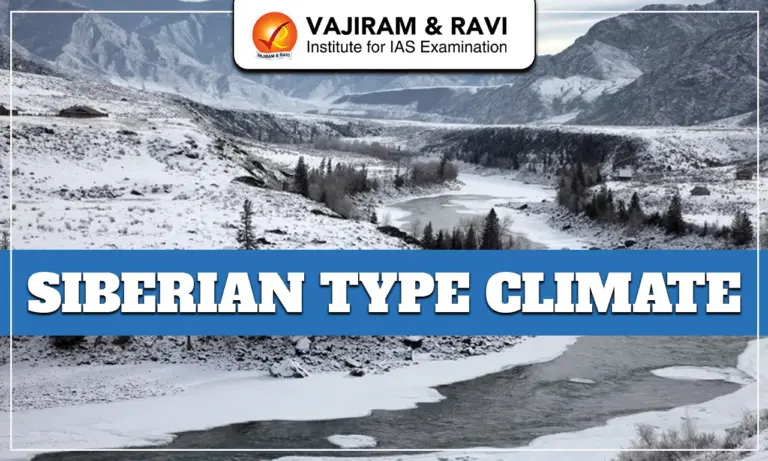
The Siberian Type Climate, also known as the Taiga, Boreal or Continental Subarctic Climate, is one of the coldest inhabited climatic regions of the world. It falls under Köppen’s Dfc, Dfd, Dwc, and Dwd categories, characterised by long, intensely cold winters and short, cool summers. This climate influences global carbon cycles, supports the world’s largest continuous coniferous forest, and plays a critical role in regulating Northern Hemisphere temperatures. The climatic regime is shaped by the Siberian High, continentality, subarctic latitude, and vast landmass of Eurasia.
Siberian Type Climate
The Siberian Type Climate exhibits extreme continentality due to its distance from oceans, leading to high annual temperature ranges of 50 to 60°C, among the highest globally. Winters are controlled by the Siberian High anticyclone, producing dry, stable, and cold conditions. Snow cover persists for 6-8 months. Summer warming is rapid but short-lived, allowing seasonal thaw of permafrost. Annual precipitation is generally low, mostly 38-63 cm, with higher values near mountains and coastal areas. The region also experiences persistent inversion layers and katabatic winds.
Siberian Type Climate Features
The Siberian Type Climate is marked by severe temperature contrasts driven by latitude, continentality, and snow cover.
- Winter: Lasts 6-9 months. January temperatures range from -20°C to -40°C, with areas near Oymyakon and Verkhoyansk recording -67.7°C and -69.8°C, among the coldest on Earth for inhabited regions (World Meteorological Organization).
- Summer: Short, lasting 1 to 3 months. July temperatures remain 10-20°C, allowing limited biological activity and short growing seasons.
- Annual Temperature Range: Can exceed 50-60°C in central Siberia, among the highest on Earth.
- Precipitation: Mostly summer rainfall due to frontal activity; winter precipitation is low due to anticyclonic control, often < 400 mm annually.
- Permafrost: Covers more than two-third of Siberia, with active layers thawing in summer, affecting vegetation and hydrology.





Siberian Type Climate Natural Vegetation
The dominant natural vegetation under Siberian Type Climate is Taiga (Boreal Forest), the world’s largest biome after oceans, covering nearly 17% of land area of Earth..
- Conifer dominance: covered with mostly Coniferous evergreen forest such as Norway spruce (Picea abies), Siberian pine (Pinus sibirica), Siberian fir (Abies sibirica), and larches (Larix sibirica).
- Adaptations: Needle-like leaves, thick bark, conical shape, which minimise snow accumulation and moisture loss.
- Ground Vegetation: Mosses, lichens, sedges; low species diversity due to severe winters.
- Tundra Transition: Northern fringes shift to moss-lichen tundra with dwarf shrubs such as Betula nana, where the climate merges into Arctic Tundra.
Siberian Type Climate Distribution
The Siberian Type Climate covers large subarctic portions of the Northern Hemisphere.
- Russia: Largest extent, spanning Western Siberia (Ob Basin), Central Siberian Plateau, and Eastern Siberia south of the Arctic Circle, ranging from Ural Mountains to the Pacific Ocean.
- Northern Europe: Finland, Sweden, Norway’s inland regions.
- Asia: Parts of Mongolia, northern Kazakhstan, northeastern China (Heilongjiang), extreme northern Japan (Hokkaido).
- North America : Similar Boreal climate exists in Alaska and Canada, forming part of the circumpolar Taiga belt.
Siberian Type Climate Biodiversity
Due to extreme weather conditions, the biodiversity variations and species are usually less in this region. Major Flora and Fauna found in this region are:
- Flora
-
-
- Species diversity is low due to extreme cold.
- Dominant conifers: Larix gmelinii, Pinus sylvestris, Picea obovata.
- Understory: Cloudberry (Rubus chamaemorus), crowberry (Empetrum nigrum), bilberry.
- Moss-lichen carpets are common as seen in the Yamal Peninsula.
-
- Fauna
-
- Large mammals: Siberian tiger (Amur tiger), moose, brown bear, reindeer, lynx, wolverine.
- Birds: Capercaillie, Siberian jay, snowy owl (seasonal).
- Adaptations: Thick fur, hibernation strategies, migration patterns.
- To escape winter, several bird species migrate from Siberia to India, Eg: Siberian Crane, Rubythroat, Stonechat, Gull, Demoiselle Crane, and Greater Flamingo.
- The Barguzin sable was historically significant in fur trade.
Siberian Type Climate Significance
The importance of the Siberian Type Climate region lies in the features and role it plays in the economic and other developments as given below:
- Tourism: Winter tourism: Northern lights in Yakutia; ice festivals in Krasnoyarsk and Harbin. Summer tourism: Lake Baikal (UNESCO site), Altai mountains, trans-Siberian route.
- Economy and Natural Resources: Siberia holds about 70% of Russia’s oil and gas reserves, especially in the Ob and Yenisei basins. It contains major coalfields like the Kuznetsk Basin (Kuzbass). It is rich in gold (Lena Goldfields), diamonds (Mirny mines), and rare earths.
- Forestry and Timber: Taiga forests hold about 45% of global softwood resources. Russia is among the world’s top timber exporters.
- Agriculture: Limited by short growing season; supports hardy crops like barley, rye, oats. Livestock such as reindeer in Yakut and Nenets regions.
- Hydrological Importance: Major rivers: Ob, Yenisei, Lena which account for ~10% of global freshwater runoff. Feed Arctic Ocean circulation and influence global climate systems.
- Climate Regulation: Taiga stores billion tonnes of carbon which play a major role in global carbon balance.
Siberian Type Climate Challenges
The biodiversity of the Siberia Type Climate faces several challenges as listed below:
- Permafrost Thawing: Siberia’s permafrost stores about 1500 billion tonnes of carbon. Warming causes methane release, infrastructure collapse, and ecosystem shifts.
- Way Forward: Monitoring via satellite programs (e.g., ESA’s CryoSat-2). Climate-resilient infrastructure design; reduced global emissions.
- Forest Fires: Increasing frequency: 2021 Siberia fires burned over 18.8 million hectares (Rosleskhoz). Causes carbon release and biodiversity loss.
- Way Forward: Use of remote sensing (MODIS, VIIRS) for early detection. Strengthened fire management, community ranger systems.
- Deforestation and Illegal Logging: Large-scale logging in Krasnoyarsk, Irkutsk, and Khabarovsk regions. Loss of taiga biodiversity and carbon sinks.
- Way Forward: Certification systems (FSC), strict monitoring, community-based forest management.
- Wildlife Threats: Species like the Siberian tiger have faced habitat shrinkage; population fell below 40 individuals in the 1940s. Climate change affects prey availability.
- Way Forward: Protected areas like Sikhote-Alin Biosphere Reserve (1935). Anti-poaching patrols, ecological corridors.
- Human Settlement Constraints: Extreme cold makes construction costly; temperatures in Yakutsk reach -50°C. Disturbed permafrost destabilises housing and transport networks.
- Way Forward: Permafrost-friendly engineering (elevated structures). Urban planning informed by geotechnical surveys.
- Industrial Pollution: Metal smelting (e.g., Norilsk Nickel) emits heavy metals and SO₂. Affects soil, vegetation, and indigenous communities.
- Way Forward: Emission caps, cleaner technology introduction, rehabilitation zones.

 Last updated on March, 2026
→ UPSC Final Result 2025 is now out.
→ UPSC has released UPSC Toppers List 2025 with the Civil Services final result on its official website.
→ Anuj Agnihotri secured AIR 1 in the UPSC Civil Services Examination 2025.
→ UPSC Marksheet 2025 is now out.
→ UPSC Notification 2026 & UPSC IFoS Notification 2026 is now out on the official website at upsconline.nic.in.
→ UPSC Calendar 2026 has been released.
→ Check out the latest UPSC Syllabus 2026 here.
→ UPSC Prelims 2026 will be conducted on 24th May, 2026 & UPSC Mains 2026 will be conducted on 21st August 2026.
→ The UPSC Selection Process is of 3 stages-Prelims, Mains and Interview.
→ Prepare effectively with Vajiram & Ravi’s UPSC Prelims Test Series 2026 featuring full-length mock tests, detailed solutions, and performance analysis.
→ Enroll in Vajiram & Ravi’s UPSC Mains Test Series 2026 for structured answer writing practice, expert evaluation, and exam-oriented feedback.
→ Join Vajiram & Ravi’s Best UPSC Mentorship Program for personalized guidance, strategy planning, and one-to-one support from experienced mentors.
→ Shakti Dubey secures AIR 1 in UPSC CSE Exam 2024.
→ Also check Best UPSC Coaching in India
Siberian Type Climate FAQs
Q1. What is the Siberian Type Climate?+
Q2. Where is the Siberian Type Climate found?+
Q3. Why are winters extremely cold in the Siberian Climate?+
Q4. What kind of vegetation is present in Siberian Type Climate zones?+
Q5. What are the major environmental challenges in Siberian Type Climate regions?+
Tags: siberian type climate