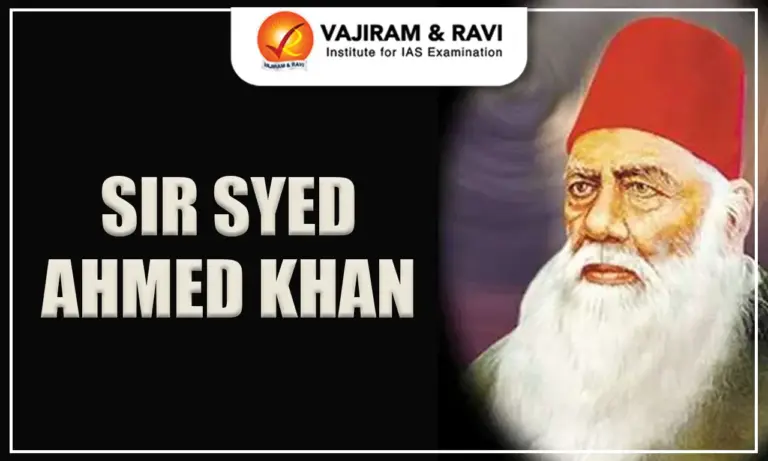
Sir Syed Ahmed Khan was an influential reformer, thinker and educationist of 19th century India. He wrote the booklet ‘Asbab-e-Baghawat-e-Hind’ that talked about the ignorance and aggressive expansion policies at the causes of the revolt and emphasised the importance of modern scientific education for muslims to advance their conditions. He also emphasised on learning English and was against superstition and evil customs existing in society. In this article, we are going to cover Sir Syed Ahmed Khan’s biography, its career, education reforms and legacy in modern education.
Sir Syed Ahmed Khan Biography
Sir Syed Ahmed Khad was born on 17 October 1817 in Delhi during the Mughal Empire and belonged to a family closely associated with the Mughal court, his maternal grandfather, Khwaja Fariduddin was a Wazir in Akbar Shah II’s court and while his paternal grandfather had an administrative position under Emperor Alamgir II. Sir Syed Ahmed Khan’s father, Syed Muhammad Muttaqi was a confidant of Akbar Shah II. Raised in the cultural richness of Mughal Delhi, Sir Syed received both traditional and rational education. He studied the Quran, Persian and Arabic along with mathematics, astronomy and medicine while developing a strong interest in literature, poetry and philosophy.
Sir Syed Ahmed Khan’s Career and Early Contributions
Sir Syed Ahmed Khan joined East India Company in 1838 for service and also served as a jurist in the small causes court at Bijnor. His service came into highlight during the Revolt of 1857 and he remained loyal to the British and saved many European lives. The mutiny deeply affected him and he convinced himself that Indian Muslims needed modern education to progress. His book was called Asbab-e-Baghawat-e-Hind and it talked about how British policies were one of the reasons for the uprising. This made him a rational critic of colonial governance.




Sir Syed Ahmed Khan Educational Reform and Aligarh Movement
After the revolt of 1857, Sir Syed Ahmed Khan changed his focus towards educational and social reforms. He believed that only modern education, blended along with western science and islamic learning could uplift Indian Muslims. In 1863, he founded the Victoria School at Ghazipur and in 1864 he established the Scientific Society to translate western works into Indian languages. His most important contribution was the establishment of Muhammadan Anglo-Oriental College in Aligarh in 1875 that later became Aligarh Muslim University in 1920. The university was an important centre point of the Aligarh Movement that modernised Muslim society through education, social reform and loyalty to the British Crown.
Sir Syed Ahmed Khan Religious and Intellectual Contributions
Sir Syed Ahmed Khan’s work reflects on the progressive and reformist interpretation of Islam. During his early years, he leaned towards orthodoxy and was influenced by sufi thought however, over the period of increased exposure to western ideas, he developed a rationalist approach. He pitched for the reinterpretation of the Quran in light of modern science and reason and also tried to reconcile islamic teachings with contemporary knowledge. His works like Tahdhib-ul-Akhlaq promoted ethical reforms and rational inquiry among Indian Muslims.
Sir Syed Ahmed Khan Literary and Political Works
Sir Syed Ahmed Khan’s texts were all written in Urdu covering topics from history to mechanics. He wrote books like Athar-ul-Sanadeed, a work about the monuments of Delhi, showing his interest in archaeology. During the time and after the revolt of 1857, he wrote influential books like Tarikh-i-Sarkashi-ye-Bijnor and Loyal Muhammadans of India bridging the gaps between Muslims and the British. His works covered topics like education, cooperation and modernisation as the pathways for Muslim Progress in India.
Sir Syed Ahmed Khan Legacy in Modern Education
Sir Syed Ahmed Khan is remembered as the architect of modern Muslim education in India. By setting up Aligarh Movement and establishment of MAO college, he shaped an educated class of Muslims who would engage with both British institutions as well as their own cultural traditions. Most of his students managed to occupy important administrative, academic and political positions in colonial India. He focused on scientific learning, rational interpretation of religion and education of women that left a lasting impact on Indian society.
Sir Syed Ahmed Khan and Muslim Nationalism
Sir Syed Ahmed Khan preached Hindu-Muslim unity and emphasised separate political identities for Muslims, saying that their social and educational needs required distinct representation. He is also credited as an ideological precursor of the Two-Nation Theory that shaped the Pakistan Movement. His central legacy remains in the domain of education and reform. Sir Syed Ahmed Khan’s vision was to harmonize tradition with modernity, religion with science, and faith with reason. He laid the foundations of modern education for Muslims in India, creating a cultural and intellectual awakening that transformed society.

 Last updated on March, 2026
→ UPSC Final Result 2025 is now out.
→ UPSC has released UPSC Toppers List 2025 with the Civil Services final result on its official website.
→ Anuj Agnihotri secured AIR 1 in the UPSC Civil Services Examination 2025.
→ UPSC Marksheet 2025 is now out.
→ UPSC Notification 2026 & UPSC IFoS Notification 2026 is now out on the official website at upsconline.nic.in.
→ UPSC Calendar 2026 has been released.
→ Check out the latest UPSC Syllabus 2026 here.
→ UPSC Prelims 2026 will be conducted on 24th May, 2026 & UPSC Mains 2026 will be conducted on 21st August 2026.
→ The UPSC Selection Process is of 3 stages-Prelims, Mains and Interview.
→ Prepare effectively with Vajiram & Ravi’s UPSC Prelims Test Series 2026 featuring full-length mock tests, detailed solutions, and performance analysis.
→ Enroll in Vajiram & Ravi’s UPSC Mains Test Series 2026 for structured answer writing practice, expert evaluation, and exam-oriented feedback.
→ Join Vajiram & Ravi’s Best UPSC Mentorship Program for personalized guidance, strategy planning, and one-to-one support from experienced mentors.
→ Shakti Dubey secures AIR 1 in UPSC CSE Exam 2024.
→ Also check Best UPSC Coaching in India
Sir Syed Ahmed Khan FAQs
Q1. What is Sir Syed Ahmed Khan famous for?+
Q2. Who is the father of two nation theory?+
Q3. Who gave the title of Sir to Syed Ahmed Khan?+
Q4. Which college was founded by Sir Syed Ahmed Khan and when?+
Q5. What was the first book of Syed Ahmed Khan?+
Tags: sir syed ahmed khan