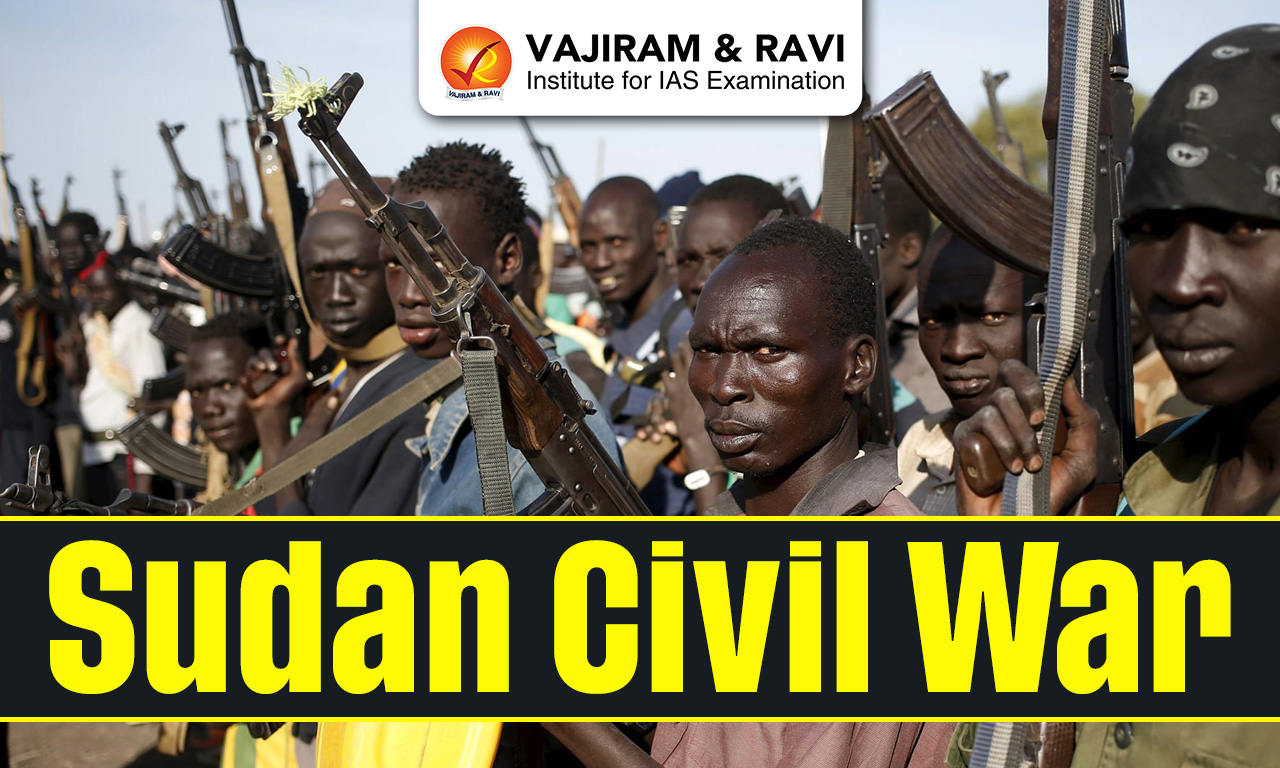
The Sudan Civil War is an ongoing conflict that has caused serious suffering to the people of Sudan. It was started due to a struggle for power between Army leader and Paramilitary leader and has led to widespread of violence and instability across the country. Since then, millions of people have been forced to leave their homes and many are facing problems like hunger, lack of healthcare, and unsafe living conditions. The situation remains hostile with no clear solution in sight.
Sudan Civil War Background
- Long Political Instability: Sudan faced years of instability under Omar al-Bashir, marked by economic problems, lack of freedom, and conflicts like Darfur, until he was removed in 2019 after public protests.
- Failed Democratic Transition: After 2019, a joint civilian–military government was formed, but weak trust and continued military dominance slowed democratic progress.
- Military Coup (2021): In October 2021, Abdel Fattah al-Burhan and Mohamed Hamdan Dagalo carried out a coup, removing the civilian government and taking control.
- Rise of Rival Power Centres: Although they initially worked together, both leaders soon developed differences over control of the country and armed forces.
- Growing Tensions: Disputes, especially over merging RSF into the army, increased mistrust, competition, and conflict between the two sides.
- Start of Civil War (2023): On April 15, 2023, tensions turned into open fighting between SAF and RSF, leading to a full-scale civil war.
Also Read: Spanish Civil War
Sudan Civil War Consequences
The civil war in Sudan has caused massive human suffering, forcing millions of people to leave their homes and live in very difficult conditions. Many people are facing hunger, disease, and lack of basic needs like food, water, and healthcare. The country’s economy and infrastructure have been badly damaged, making daily life extremely hard.
- Control and Spread of Conflict: The war in Sudan has spread across most regions, with SAF controlling eastern and central areas including Khartoum, while RSF dominates western areas like Darfur, with heavy fighting also in Gezira and Kordofan.
- Mass Displacement and Death: Around 14 million people have been displaced, including 4.4 million who fled to countries like Chad, South Sudan, and Egypt, with an estimated 40,000 deaths and many civilians facing violence while escaping.
- Human Rights Violations: Widespread abuses include killings, forced recruitment, and arrests, with women and girls facing severe risks of sexual violence, often used as a weapon in the conflict.
- Severe Food Crisis: About 21 million people face hunger, with famine in some areas, as agriculture is destroyed, crops are lost, and food has become scarce and expensive.
- Collapse of Healthcare System: Hospitals lack basic facilities and staff, disease outbreaks are increasing, and attacks on medical services have made healthcare extremely limited.
- Disruption of Aid Supply: Regional tensions have disrupted supply routes, reducing the ability of aid agencies to deliver food and medicines, worsening the humanitarian crisis.
Also Read: Yemen Civil War


Reasons for the Persistent Conflict in Sudan
- Power Struggle: The conflict in Sudan is mainly due to rivalry between Abdel Fattah al-Burhan (SAF) and Mohamed Hamdan Dagalo (RSF), as both want full control and refuse to compromise.
- Continuous Flow of Weapons: Despite international bans, weapons keep entering the country, helping both sides continue fighting and increasing destruction.
- Ethnic Divisions: The conflict has taken an ethnic form, especially in Darfur, where different communities support different sides, leading to more violence and mistrust.
- Foreign Support: External countries are supporting both sides with money, weapons, and influence, which reduces chances of peace.
- Failure of Peace Talks: Efforts like the Jeddah Declaration have failed due to lack of trust and repeated violations by both sides.
- Weak System and Economic Crisis: Political instability after Omar al-Bashir and problems like poverty and competition for resources have further prolonged the conflict.
About Sudan Geography
- Location: Sudan is a country located in the northeastern part of Africa and is one of the larger countries on the continent.
- Bordering Countries: It shares land borders with several countries including South Sudan, Ethiopia, Eritrea, Egypt, Libya, Chad, and the Central African Republic, making it an important link between North and Central Africa.
- Maritime Border: Sudan also has a coastline along the Red Sea, which is important for trade and transportation.
- Capital City: The capital city of Sudan is Khartoum, which is also the political, cultural, and economic centre of the country.
- Relief and Terrain: The country is mainly made up of vast plains and plateaus, and much of its land is shaped and drained by the Nile River and its tributaries, which play a crucial role in agriculture and settlement.
- Climate: Sudan experiences different types of climate from north to south, with the northern region having a hot desert climate with very little rainfall, gradually changing into semi-arid conditions and then tropical savannah climate with more rainfall in the southern parts.
- Highest Point: The highest point in Sudan is Jabal Marrah, which is located in the Darfur region.
- Major River System: The Nile River is the most important geographical feature of Sudan, flowing from south to north and providing water for agriculture, drinking, and transportation, while also supporting most of the population.
- Natural Resources: Sudan is rich in natural resources such as petroleum and also has smaller reserves of minerals like gold, iron ore, copper, chromium, zinc, tungsten, mica, and silver, along with significant potential for hydropower generation.

 Last updated on Oct, 2026
→ UPSC 2027 Notification will be released on 13 January 2027 at upsconline.nic.in.
→ Check Nobel Prize 2026 Winners List here.
→ Download PIB PRiSM Monthly Magazine 2026 here.
→ Check UPSC Monthly Current Affairs Magazine The Recitals here.
→ Check out the latest UPSC Syllabus here.
→ Download UPSC Model Answers for Mains 2026
→ UPSC Mains Question Paper 2026 is out now for Essay & GS Paper 1, 2, 3 & 4.
→ UPSC Calendar 2027 has been released.
→ Enroll in Vajiram & Ravi’s UPSC Mains Test Series 2027 for structured answer writing practice, expert evaluation, and exam-oriented feedback.
→ Join Vajiram & Ravi’s UPSC Mentorship Program 2027 for personalized guidance, strategy planning, and one-to-one support from experienced mentors.
→ Go through the UPSC Mains Previous Year Papers to enhance your preparation.
→ UPSC has released UPSC Toppers List 2025 with the Civil Services final result on its official website.
→ Also check Best UPSC Coaching in India
Sudan Civil War FAQs
Q1. What is the main cause of the Sudan Civil War?+
Q2. When did the Sudan Civil War begin?+
Q3. What was the background of the conflict?+
Q4. What is the current situation in Sudan?+
Q5. What are the major consequences of the war?+
Tags: geography geography notes sudan civil war