

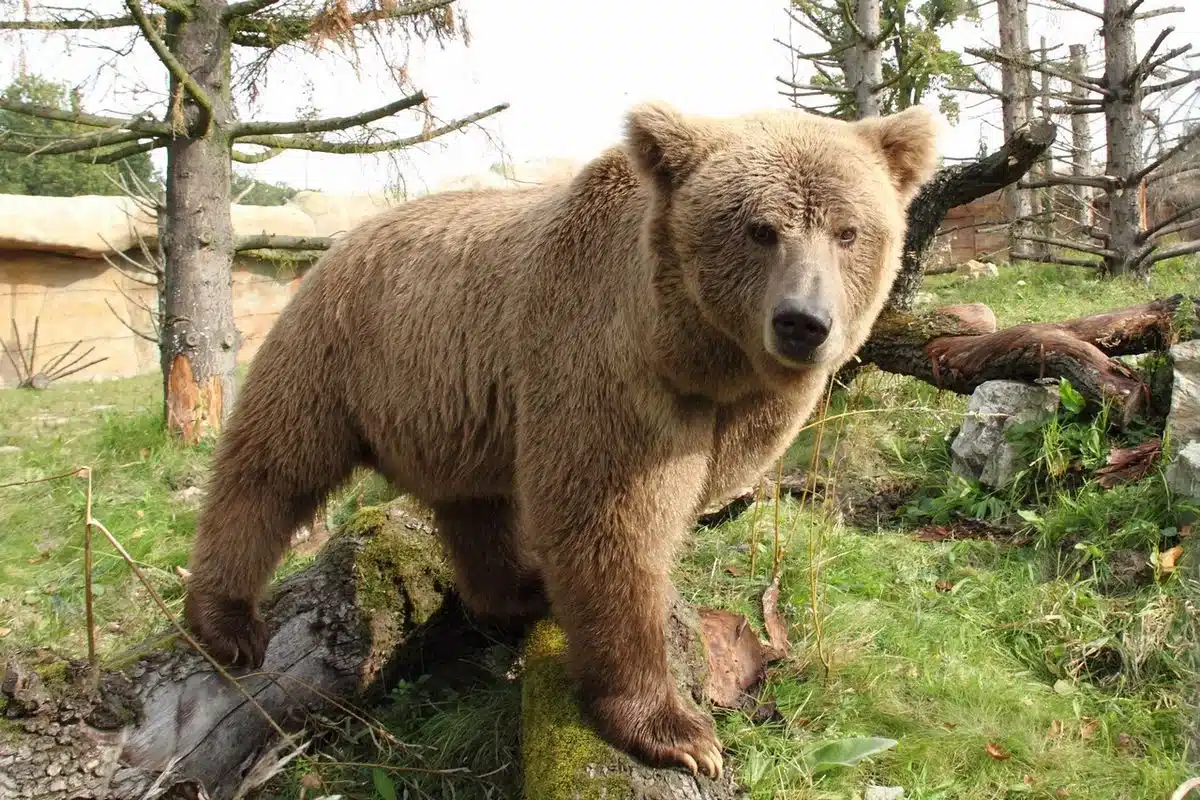
About Tibetan Brown Bear
- The Tibetan brown bear, also known as the Tibetan blue bear, is one of the rarest subspecies of bears in the world and is rarely sighted in the wild.
- Scientific Name: Ursus arctos pruinosus
- Distribution:
- Historically found mainly on the alpine eastern Tibetan plateau (4,500 to 5,000 metres) in eastern Tibet, western China, Nepal, and Bhutan.
- Remaining bears in the wild seem to be confined to eastern Tibet and Bhutan.
- Habitat: It inhabits alpine forests, meadows, and steppes, close to the tree line.
- This rare bear is very different from the more commonly found Himalayan black bear in terms of its appearance, habitat, and behaviour.
- Features:
- It has shaggy, dark brown to black fur, a cream to cinnamon face, and a white collar that broadens from the shoulders to the chest.
- It has small ears covered with long black fur.
- Lifespan: around 20 to 30 years.
- Its sense of smell is much more acute than its hearing and sight.
- They are solitary, but the territories between two Himalayan brown bears have been seen to overlap. They are one of the most terrestrial of the bears.
- It feeds on marmots and alpine vegetation.
- Conservation Status:
- IUCN Red List: Least Concern
- CITES: Appendix I
- Wildlife Protection Act of 1972: Schedule II
Q1) What is the Convention on International Trade in Endangered Species of Wild Fauna and Flora (CITES)?
It is an international agreement between governments that aims to ensure that international trade in wild animals and plants does not threaten their survival. CITES was adopted in 1973 and entered into force in 1975. There are 184 member parties, and trade is regulated in more than 38,000 species. Although CITES is legally binding on the Parties– in other words, they have to implement the Convention–it does not take the place of national laws.
Source: First sight of rare bear Tibetan brown bear in Sikkim makes it first confirmed record




Last updated on February, 2026
→ UPSC Notification 2026 is now out on the official website at upsconline.nic.in.
→ UPSC IFoS Notification 2026 is now out on the official website at upsconline.nic.in.
→ UPSC Calendar 2026 has been released.
→ UPSC Final Result 2025 is expected to be released in the second week of April 2026.
→ Check out the latest UPSC Syllabus 2026 here.
→ Join Vajiram & Ravi’s Interview Guidance Programme for expert help to crack your final UPSC stage.
→ UPSC Mains Result 2025 is now out.
→ UPSC Prelims 2026 will be conducted on 24th May, 2026 & UPSC Mains 2026 will be conducted on 21st August 2026.
→ The UPSC Selection Process is of 3 stages-Prelims, Mains and Interview.
→ Prepare effectively with Vajiram & Ravi’s UPSC Prelims Test Series 2026 featuring full-length mock tests, detailed solutions, and performance analysis.
→ Enroll in Vajiram & Ravi’s UPSC Mains Test Series 2026 for structured answer writing practice, expert evaluation, and exam-oriented feedback.
→ Join Vajiram & Ravi’s Best UPSC Mentorship Program for personalized guidance, strategy planning, and one-to-one support from experienced mentors.
→ Check UPSC Marksheet 2024 Here.
→ UPSC Toppers List 2024 is released now. Shakti Dubey is UPSC AIR 1 2024 Topper.
→ Also check Best UPSC Coaching in India