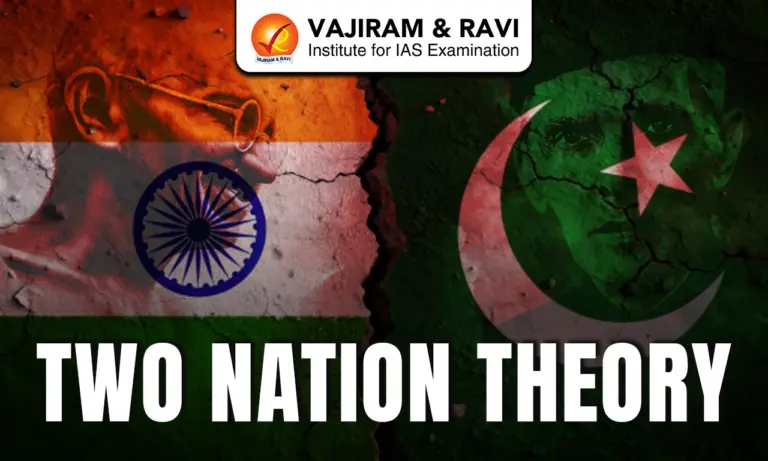
The Two Nation Theory was strongly promoted by Muhammad Ali Jinnah, the leader of the All-India Muslim League, who argued that Muslims and Hindus had distinct identities and political interests. According to him, Muslims needed a separate homeland to safeguard their political and cultural rights.
What is Two Nation Theory?
The Two-Nation Theory stated that religion was the main basis of nationality in the Indian subcontinent. Supporters of this theory believed that Muslims and Hindus belonged to two different civilizations with separate laws, traditions, and social customs.
According to this ideology:
- Muslims and Hindus followed different religions and cultural practices.
- Their social systems, traditions, and historical experiences were different.
- Political representation under a single state could lead to conflict because one community might dominate the other.
Because of these reasons, the theory proposed that Muslims should have their own independent state separate from Hindu-majority India.
Events from 1905 to 1947 Leading to the Two-Nation Theory
Several political developments between 1905 and 1947 contributed to the rise of communal politics and eventually strengthened the Two-Nation Theory.
- Partition of Bengal (1905)
The partition of Bengal was carried out by Lord Curzon in 1905. The province was divided into two parts mainly for administrative reasons, but many Indian leaders believed the British intended to weaken the growing nationalist movement by dividing Hindus and Muslims. This event created communal tensions and is often seen as the first step toward the policy of dividing communities in colonial India. - Morley-Minto Reforms (1909)
The Morley-Minto Reforms introduced the system of separate electorates for Muslims. Under this system, Muslims could vote only for Muslim candidates in reserved constituencies. This reform institutionalized communal representation and reinforced the belief that Hindus and Muslims had different political interests. - Government of India Act 1919 (Montagu-Chelmsford Reforms)
The Government of India Act 1919 expanded the system of communal representation by increasing reserved seats for Muslims and other communities. Although the act introduced limited self-governance through the system of diarchy, it continued the policy of separating communities in political representation. - Non-Cooperation Movement and Khilafat Movement (1919–1922)
During the Non-Cooperation Movement led by Mahatma Gandhi and the Khilafat Movement, there was a temporary phase of Hindu-Muslim unity against British rule. However, after the violent Chauri Chaura incident in 1922, Gandhi decided to withdraw the movement. This decision disappointed many Muslim leaders and gradually weakened the unity between the two communities. - Muhammad Iqbal’s Proposal for a Muslim State (1930)
In 1930, Muhammad Iqbal proposed the idea of a separate Muslim state in north-western India during his presidential address to the All-India Muslim League. He argued that Muslims and Hindus had distinct cultural and political identities and therefore required separate political arrangements. - Communal Award (1932)
The Communal Award introduced by Ramsay MacDonald further strengthened communal representation by extending separate electorates to several communities. This policy deepened divisions among different religious groups and encouraged communal politics. - Lahore Resolution (1940)
In 1940, the Lahore Resolution passed by the Muslim League under the leadership of Muhammad Ali Jinnah formally demanded the creation of independent states for Muslims in the north-western and eastern regions of India. This resolution became the political foundation for the demand for Pakistan. - Cripps Mission (1942)
The Cripps Mission proposed granting dominion status to India after World War II and allowed provinces the option to separate from the Indian Union. Although the mission failed, it indirectly strengthened the possibility of partition. - Direct Action Day (1946)
On 16 August 1946, the Muslim League declared Direct Action Day to press for the creation of Pakistan. This led to large-scale communal riots in cities such as Kolkata, Mumbai, and other parts of India, intensifying tensions between Hindus and Muslims. - Mountbatten Plan and Partition (1947)
Finally, Lord Mountbatten announced the 3 June Plan, which accepted the demand for partition. As a result, two independent dominions, India and Pakistan, were created in August 1947, marking the culmination of the Two-Nation Theory.





Two Nation Theory Impact
- Partition of the Subcontinent (1947): The theory resulted in the division of India and the creation of Pakistan after the end of British colonial rule.
- Mass Migration of Population: Millions of Hindus, Muslims, and Sikhs migrated across the newly formed borders, making it one of the largest human migrations in history.
- Communal Violence and Loss of Lives: The partition triggered widespread communal riots in several regions, causing significant loss of life and property.
- Long-Term Political Tensions: The division created long-term political and diplomatic tensions between India and Pakistan.
- Formation of National Identities: The theory influenced the development of separate national identities based on religion and political ideology in the subcontinent.

 Last updated on March, 2026
→ UPSC Final Result 2025 is now out.
→ UPSC has released UPSC Toppers List 2025 with the Civil Services final result on its official website.
→ Anuj Agnihotri secured AIR 1 in the UPSC Civil Services Examination 2025.
→ UPSC Marksheet 2025 is now out.
→ UPSC Notification 2026 & UPSC IFoS Notification 2026 is now out on the official website at upsconline.nic.in.
→ UPSC Calendar 2026 has been released.
→ Check out the latest UPSC Syllabus 2026 here.
→ UPSC Prelims 2026 will be conducted on 24th May, 2026 & UPSC Mains 2026 will be conducted on 21st August 2026.
→ The UPSC Selection Process is of 3 stages-Prelims, Mains and Interview.
→ Prepare effectively with Vajiram & Ravi’s UPSC Prelims Test Series 2026 featuring full-length mock tests, detailed solutions, and performance analysis.
→ Enroll in Vajiram & Ravi’s UPSC Mains Test Series 2026 for structured answer writing practice, expert evaluation, and exam-oriented feedback.
→ Join Vajiram & Ravi’s Best UPSC Mentorship Program for personalized guidance, strategy planning, and one-to-one support from experienced mentors.
→ Shakti Dubey secures AIR 1 in UPSC CSE Exam 2024.
→ Also check Best UPSC Coaching in India
Two Nation Theory FAQs
Q1. What is the Two-Nation Theory?+
Q2. Who proposed the Two-Nation Theory?+
Q3. When was the Two-Nation Theory formally expressed?+
Q4. What were the main reasons behind the Two-Nation Theory?+
Q5. What was the result of the Two-Nation Theory?+
Tags: history two nation theory