U.S. Supreme Court Curbs Trump’s Emergency Tariff Powers

Trump’s Emergency Tariff Powers

Trump’s Emergency Tariff Powers Latest News

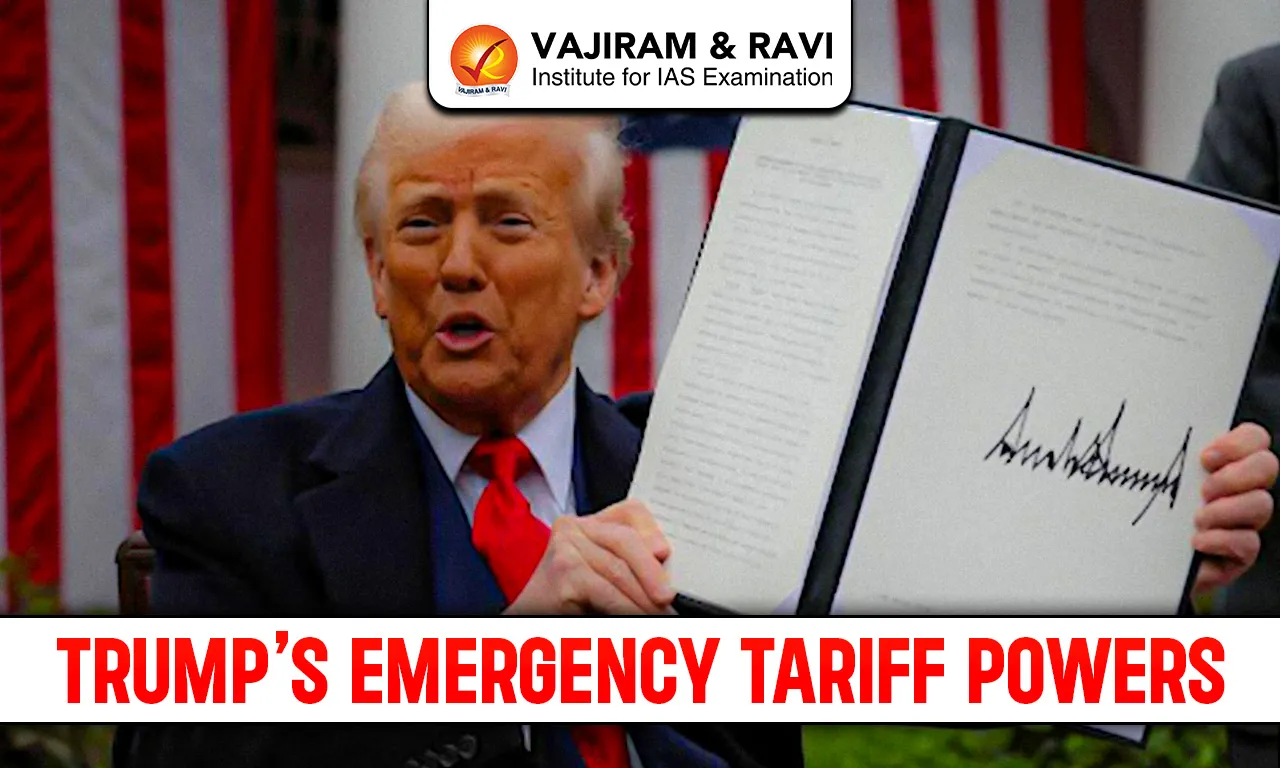
  • The U.S. Supreme Court, in a 6–3 ruling, struck down President Donald Trump’s sweeping tariffs imposed under the International Emergency Economic Powers Act (IEEPA), 1977.
  • The judgment marks a critical moment in the debate over separation of powers, executive overreach, and the future of U.S. trade policy. 
  • The ruling has significant implications for the global economy, including countries like India, which have been directly affected by U.S. tariff measures.

Constitutional Issue - Executive vs Legislative Authority

  • Core constitutional principle:
    • The U.S. Constitution grants Congress the authority to levy taxes and tariffs, not the President.
    • Trump invoked IEEPA, a law meant for national emergencies, to impose tariffs without Congressional approval.
    • The Court upheld a lower court ruling stating that this action exceeded presidential authority.
  • Nature of IEEPA:
    • Enacted in 1977 under President Jimmy Carter, it was historically used to freeze assets, impose sanctions. It does not explicitly mention tariffs.
    • Trump became the first President to use IEEPA to impose tariffs.

Trump’s Tariff Strategy - Economic and Foreign Policy Tool

  • Trade war and economic leverage:
    • Trump used tariffs as a revenue-generating instrument (estimated $300 billion annually if fully retained). 
    • It is used as a foreign policy tool, a means to renegotiate trade deals, and a pressure mechanism against China, Canada, Mexico, India, and Brazil.
  • “Liberation Day” tariffs (April 2, 2025):
    • Announced “reciprocal tariffs” on most trading partners.
    • Justified under a “national emergency” related to trade deficits.
    • Also invoked IEEPA citing fentanyl trafficking and migration concerns.
  • Economic impact:
    • Over $175 billion collected under IEEPA-based tariffs (Penn-Wharton estimate).
    • $195 billion net customs duty receipts in FY 2025 (record high).
    • Refund liability likely after the Supreme Court ruling.
    • Created global market uncertainty and financial volatility.

Legal Challenges and Federal Pushback

  • Three lawsuits challenged the tariffs -
    • Small importing businesses.
    • 12 U.S. states (including Arizona, Colorado, New York).
    • Federal rulings against the administration.
  • The Court reaffirmed national emergency powers cannot become a substitute for legislative trade authority.

Alternative Tariff Mechanisms - Sections 122, 301, and 232

  • After the ruling, Trump indicated he would explore other statutory options. For example,
  • Section 122 (Trade Act, 1974): 
    • It allows up to 15% tariff to address serious balance-of-payments deficits. Never used before, it is valid for 150 days, unless extended by Congress.
    • Trump signaled a 10% global tariff under this provision.
  • Section 301 (Trade Act, 1974):
    • It is a targeted and investigation-based (not sweeping) provision, triggered when the U.S. Trade Representative (USTR) finds “unfair trade practices”.
    • Previously used against India over the Digital Services Tax (2020). Later resolved under OECD global minimum tax framework.
  • Section 232 (Trade Expansion Act, 1962):
    • It allows tariffs on national security grounds, and it is sector-specific (steel, aluminium, automobiles, etc.).
    • India currently faces 232 tariffs on steel, aluminium, automobiles, and copper derivatives.
    • Some relief possible under the recent U.S.-India trade understanding, including:
      • Tariff removal on certain aircraft parts.
      • Preferential TRQ (Tariff Rate Quota) for automotive parts.
      • Negotiations in generic pharmaceuticals.

Broader Implications

  • For the U.S. political system: Reassertion of judicial review. Curtailment of expansive executive authority. Reinforcement of Congressional primacy in taxation.
  • For Global trade: Potential rollback or restructuring of tariff regimes. Increased uncertainty in the short term. Possible shift toward more rules-based trade measures. Affects WTO dynamics and global trade governance.
  • For India: Relief potential in select sectors (aircraft parts, auto components). Continued exposure to 232 tariffs. Trade diplomacy becomes critical. Strategic balancing amid U.S.–China competition.

Challenges and Way Forward

  • Conflict: Between Executive-Legislative branches over trade authority. Strengthening Congressional oversight in trade policy.
  • Risk: Of renewed protectionism under alternative provisions. Greater adherence to multilateral trade norms (WTO-consistent measures). Targeted, transparent use of national security provisions.
  • Instability: Of the global supply chain. Diplomatic engagement to prevent tariff escalation. For India, proactive trade negotiations and diversification of export markets is the way ahead.

Conclusion

  • The Supreme Court’s ruling marks a pivotal constitutional correction in the United States, reinforcing the doctrine that emergency powers cannot be stretched into instruments of broad economic policy. 
  • For the global economy — and countries like India — the decision may reduce tariff unpredictability, but the era of strategic trade weaponisation is far from over. 
  • The episode underscores a larger global trend: trade policy is increasingly intertwined with national security, domestic politics, and geopolitical rivalry.

Source: TH | TH

Trump’s Emergency Tariff Powers FAQs

Q1: What are the constitutional issues involved in the U.S. Supreme Court’s ruling against Trump’s tariffs?

Ans: The ruling reaffirmed that taxation and tariff powers rest with Congress, limiting executive overreach under emergency powers.

Q2: How did the use of tariffs under IEEPA reflect the growing trend of trade weaponisation?

Ans: The tariffs transformed trade policy into a coercive foreign policy tool, linking economic measures with geopolitical leverage.

Q3: What are Section 301 and Section 232 of U.S. trade law?

Ans: Section 301 targets unfair trade practices through investigation, while Section 232 permits sector-specific tariffs on national security grounds.

Q4: What are the implications of the U.S. Supreme Court judgment on global trade governance?

Ans: It may restore greater predictability and legislative oversight in trade policy, reducing unilateral protectionism.

Q5: What is the impact of U.S. tariff policies on India’s trade interests?

Ans: While India faces sectoral tariffs under Section 232, recent trade negotiations offer selective relief.
US-Iran Tensions and Oil Prices: Strait of Hormuz Risks for India

Strait of Hormuz

Strait of Hormuz Latest News

  • International oil prices have climbed to a six-month high amid rising US-Iran tensions and fears of potential American military strikes on Tehran. Although recent nuclear talks in Geneva showed limited progress, no concrete breakthrough has emerged to ease concerns. 
  • The US has increased its military presence in the region, and President Donald Trump’s statement giving Iran 10–15 days to agree to a “meaningful deal” has been widely viewed as an ultimatum, intensifying market anxiety over possible supply disruptions.

Strait of Hormuz: A Critical Chokepoint

  • Oil markets are nervous that any US military action against Iran could disrupt supplies from the Gulf, which dominates global exports. 
    • Brent crude has already risen above $71 per barrel, up over 12% in a month, reflecting market anxiety.
    • Future price movements hinge on whether the US undertakes military action and how Iran responds. 
    • Prices could ease if diplomacy prevails, or spike sharply—possibly into triple digits—if conflict escalates regionally.
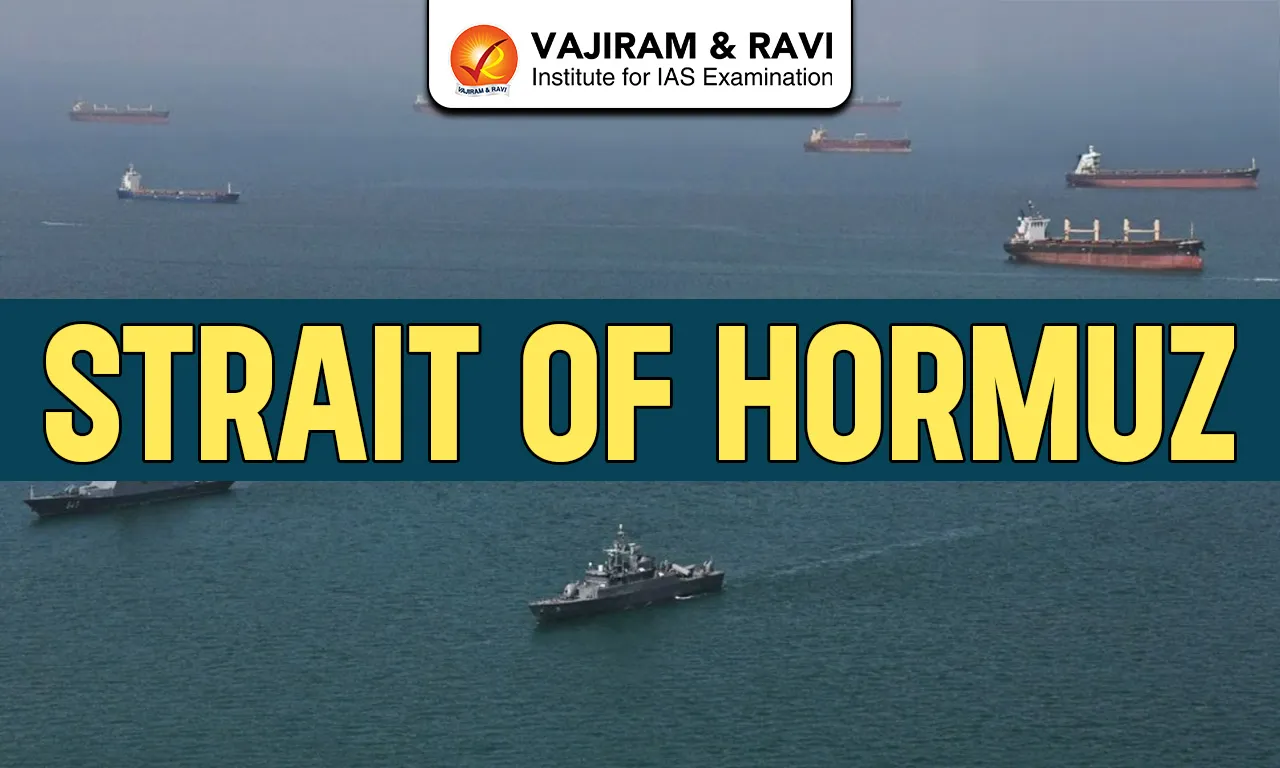
  • The key concern is the Strait of Hormuz, a vital transit route for global oil and gas. If Iran blocks or disrupts the strait, energy flows could be severely affected.
  • Major producers such as Saudi Arabia, Iraq, the UAE, and Kuwait depend heavily on Hormuz for exports. 
  • Despite strained ties with Tehran, Gulf nations are engaging diplomatically to prevent escalation. 

Implications for India

  • Rising Import Bill - India imports around 2 billion barrels of oil annually. Every $1 rise in crude prices adds roughly $2 billion to its annual import bill.
  • Strategic Vulnerability - Over 40% of India’s crude imports pass through the Strait of Hormuz. As the world’s third-largest oil consumer, meeting more than 88% of its needs through imports, India faces significant energy security risks if supplies are disrupted.

Strait of Hormuz: The World’s Key Energy Chokepoint

  • Described by the US Energy Information Administration as the most important oil transit chokepoint, the Strait of Hormuz handles nearly one-fifth of global petroleum consumption and LNG trade
  • Around 15 million barrels of crude and 20% of global LNG volumes pass through it daily, linking the Persian Gulf to global markets.

Escalation Risks and Limited Alternatives

  • With US-Iran tensions rising, oil markets fear disruptions not just to Iranian supplies but to wider Gulf exports. 
  • Though some bypass pipelines exist, their capacity is limited. Even at full use, about 9 million barrels per day—around 9% of global demand—would remain vulnerable during a major conflict.
  • Iran has repeatedly threatened to block the strait or target tankers. 
  • Additionally, proxy attacks from Yemen on vessels in the Bab el-Mandeb—another critical chokepoint connecting the Red Sea to the Arabian Sea—pose further risks to global energy flows.

Strait of Hormuz: Blockade Risks and Strategic Calculations

  • Although Iran often threatens to close the Strait of Hormuz, analysts say a complete blockade would be self-defeating. 
  • It could alienate China—its key oil buyer—strain ties with Oman, and invite international military retaliation.
  • Despite these deterrents, risks persist. If Tehran feels existentially threatened, it may escalate. 
  • Any disruption in this globally critical energy corridor would sharply raise oil prices and damage the fragile global economy.

Oil Price Scenarios if Conflict Escalates

  • Limited Disruption: Iranian Shipments Targeted - If the US or Israel disrupts Iranian oil exports alone, analysts project oil prices might rise by around $10–$12 per barrel as buyers like China seek alternative supply sources.
  • Strait of Hormuz Disruption - If Iran moves to throttle oil flows through the Strait of Hormuz—a chokepoint for roughly 20% of global oil and LNG trade—prices could exceed $90 per barrel.
  • Attacks on Iranian Oil Facilities - Should military action target Iranian refineries, platforms, or terminals and keep Iranian supply off the market for longer, oil prices could top $100 per barrel amid broader escalation risk.
  • Broad Regional Conflict - In the worst case, if Iran directly attacks major Arab Gulf oil infrastructure or the conflict spreads, prices could surge past $130 per barrel, rivaling spikes seen after major geopolitical shocks.
  • Strategic Dilemma for Policymakers - Leaders face a challenge: confronting Iran may risk supply disruptions and sharp price spikes, while restrained action could embolden adversaries—making oil market volatility a key strategic variable.

Source: IE

Strait of Hormuz FAQs

Q1: Why is the Strait of Hormuz important to global oil markets?

Ans: The Strait of Hormuz handles nearly one-fifth of global petroleum consumption and LNG trade, making it the world’s most critical oil transit chokepoint.

Q2: How could US-Iran conflict affect oil prices?

Ans: If conflict disrupts flows through the Strait of Hormuz, oil prices could rise above $90 or even cross $130 per barrel in worst-case scenarios.

Q3: Why would Iran avoid fully blocking the Strait of Hormuz?

Ans: A blockade of the Strait of Hormuz could alienate China, strain relations with Oman, and invite international military retaliation, making it politically risky for Iran

Q4: What are the risks for India?

Ans: Over 40% of India’s crude imports pass through the Strait of Hormuz, and every $1 oil price rise adds roughly $2 billion to India’s annual import bill.

Q5: What are the possible oil disruption scenarios?

Ans: Scenarios range from limited Iranian export disruptions to full Strait of Hormuz blockage or regional escalation, potentially triggering historic oil price spikes.

PAC Flags Gaps in SANKALP Scheme Implementation

SANKALP Scheme

SANKALP Scheme Latest News

  • The Public Accounts Committee (PAC) has criticised the government for poorly planned and slow SANKALP Scheme Implementation, citing findings from a CAG report. 

Overview of the SANKALP Scheme

  • The Skill Acquisition and Knowledge Awareness for Livelihood Promotion (SANKALP) scheme is a flagship programme of the Ministry of Skill Development and Entrepreneurship. 
  • It was approved by the Cabinet Committee on Economic Affairs (CCEA) in October 2017 with a total outlay of Rs. 4,455 crore.
  • The scheme was launched in January 2018 and was originally scheduled for completion by March 2023. It was later extended to March 2024.
  • SANKALP was designed to strengthen short-term skill training across India through:
    • Improved institutional frameworks
    • Better industry linkages
    • Inclusion of marginalised communities
    • Enhanced monitoring and governance systems
  • The broader objective was to improve employability outcomes and create a more demand-driven skilling ecosystem aligned with industry requirements.

Funding Structure of the Scheme

  • The financial design of SANKALP involved a mix of domestic and external funding sources:
    • Rs. 3,300 crore through a World Bank loan
    • Rs. 660 crore through State leverage
    • Rs. 495 crore through industry participation
  • The scheme aimed to use outcome-based financing and performance-linked incentives to strengthen skill development at both national and State levels.
  • However, the Comptroller and Auditor General (CAG) found significant shortfalls in financial utilisation and implementation efficiency.

CAG Findings on Financial and Physical Progress

  • According to the CAG report examined by the PAC, only 44% of the budgeted provision under the SANKALP scheme was disbursed between 2017-18 and 2023-24.
  • Further, against the first tranche of the World Bank loan of $250 million, Rs. 1,606.15 crore (86%) was disbursed by the World Bank. However, the Ministry utilised only Rs. 850.71 crore as of December 2023. The CAG also highlighted:
    • Weak adherence to implementation guidelines
    • Sluggish pace of execution
    • Lack of preparedness before commencement of the loan period
  • The audit pointed to “non-preparedness” within the Ministry as a key reason for delays.

Observations of the Public Accounts Committee

  • The Public Accounts Committee described the scheme’s implementation as “lackadaisical”.
  • During its examination of the CAG report, the PAC raised several critical concerns:
  • Absence of Central Monitoring Mechanism
    • Members questioned why there was no robust central monitoring system to track implementation across States.
    • Given that skill development involves coordination between the Centre, States, and private sector partners, monitoring gaps can significantly undermine outcomes.
  • Lack of Due Diligence
    • The Committee flagged inadequate due diligence before the rollout of the scheme. This suggests that institutional readiness and administrative capacity were not fully assessed prior to loan utilisation.
  • Missing Roadmap for School-Level Skilling
    • MPs also noted the absence of a clear roadmap to integrate skilling into the school curriculum from primary to higher secondary levels.
    • This is particularly significant in light of the National Education Policy (NEP) 2020, which emphasises vocational education from an early stage. The lack of alignment between skilling schemes and education reform weakens long-term employability goals.

Broader Context of Skill Development in India

  • India’s demographic dividend presents both an opportunity and a challenge. With a large youth population entering the workforce, skill development is central to economic growth and social mobility.
  • Schemes such as Pradhan Mantri Kaushal Vikas Yojana (PMKVY) and SANKALP aim to improve the quality, scale, and relevance of skill training. However, issues such as the following continue to affect the outcomes:
    • Fragmented implementation
    • Weak industry alignment
    • Inadequate monitoring
    • Underutilisation of funds
  • The SANKALP experience underscores the importance of institutional preparedness, data-driven evaluation, and inter-ministerial coordination.

Source: TH

SANKALP Scheme FAQs

Q1: What is the SANKALP scheme?

Ans: It is a flagship skill development programme aimed at strengthening short-term training and institutional frameworks.

Q2: What was the total outlay of the SANKALP scheme?

Ans: The scheme was approved with a total outlay of Rs. 4,455 crore.

Q3: What did the CAG report highlight about the scheme?

Ans: It flagged only 44% fund disbursal and significant delays in implementation.

Q4: What concerns did the PAC raise?

Ans: The PAC criticised weak monitoring, lack of preparedness, and absence of a roadmap for school-level skilling integration.

Q5: Why is SANKALP significant for India’s development?

Ans: It aims to improve employability and strengthen India’s skill ecosystem, which is crucial for leveraging the demographic dividend.

Trump’s Board of Peace: Why India Joined as an Observer

Board of Peace

Board of Peace Latest News

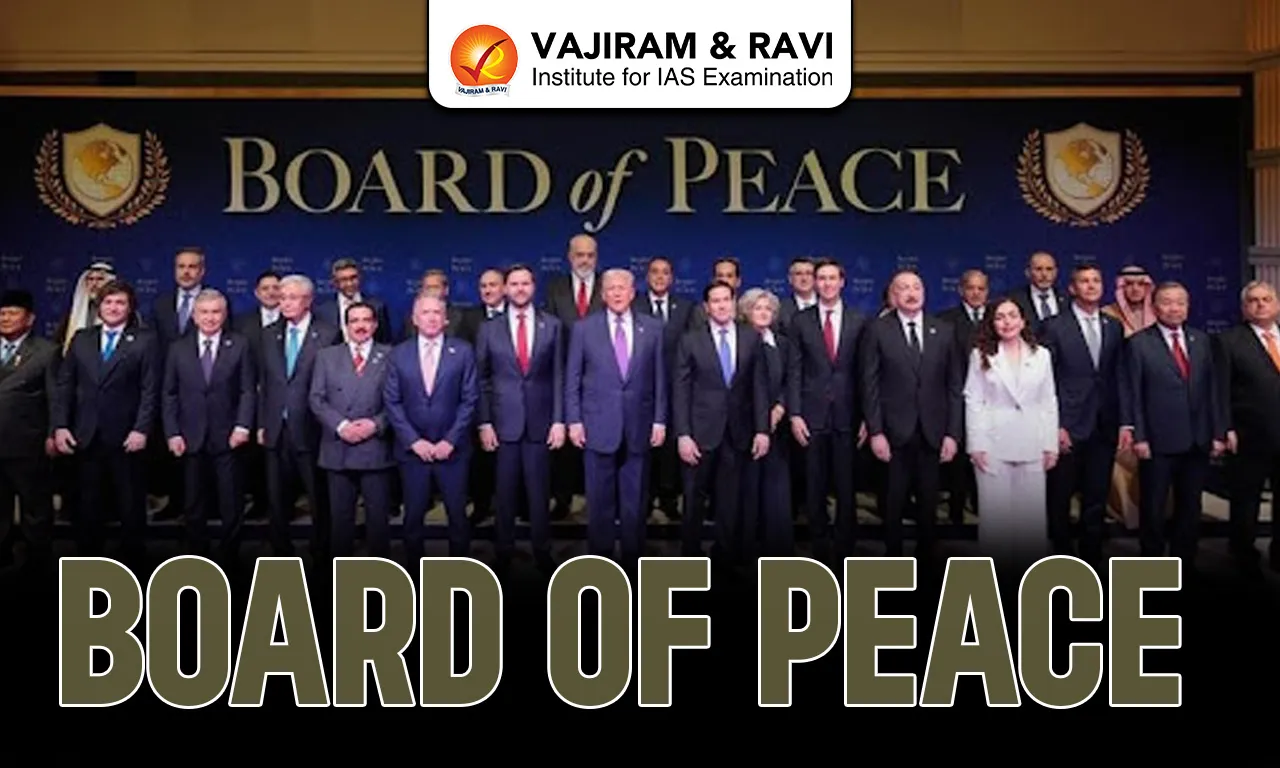
  • The US President Donald Trump’s “Board of Peace” held its first meeting in Washington to discuss Gaza’s reconstruction, with India participating as an observer. 
  • New Delhi said it supports the Gaza Peace Plan and efforts aligned with UNSC Resolution 2803.
  • Initially announced to end the Israel-Gaza war, the board’s expanded mandate to address “global conflict” has drawn criticism for potentially sidelining the UN. 
  • While 27 countries joined the body, India chose not to become a member. By attending as an observer, India signalled cautious engagement—supporting diplomatic efforts without fully endorsing a controversial initiative, especially amid evolving ties with the US.

Composition of the Board of Peace

  • The 27-member board includes key West Asian nations such as Israel, Egypt, Jordan, Saudi Arabia, UAE, Qatar, Turkey, and Bahrain. 
  • Other members include Argentina, Hungary, Vietnam, Cambodia, and Pakistan, whose Prime Minister Shehbaz Sharif attended the inaugural meeting.

Observer Participation

  • Twenty-two countries joined as observers, including the UK, Germany, Italy, Norway, Switzerland, Poland, the Netherlands, Japan, Oman, and the European Union. 
  • India participated as an observer, represented by its Deputy Chief of Mission in Washington, Namgya Khampa, after weighing diplomatic considerations.

Financial Commitments Announced

  • Pledges from Members - President Trump announced that nine member countries had collectively pledged $7 billion for Gaza’s relief and reconstruction efforts.
  • US Contribution - The United States pledged an additional $10 billion for the Board of Peace, though specific allocations were not detailed. Trump described the funding as an investment in regional stability and harmony.

Observer Status as a Strategic Off-Ramp

  • India initially stayed away when President Trump unveiled the Board of Peace in Davos, choosing to assess its membership and direction. 
  • With the first meeting held, the board’s composition has become clearer—featuring key West Asian states, Trump’s ideological allies, and countries seeking closer ties with the US, but notably excluding permanent UN Security Council members such as Russia, China, France, and the UK, which limits its legitimacy.
  • New Delhi is also weighing the initiative’s durability, viewing it largely as Trump’s personal project that may lose relevance after his term. 
  • Concerns about policy unpredictability further shape India’s cautious approach. 
  • By participating as an observer, India maintains diplomatic engagement while preserving flexibility and an exit option.

Balancing Multilateral Commitments

  • India is cautious that the Board of Peace could evolve into a parallel platform that sidelines the United Nations. 
  • Although Trump has said the board will work “in conjunction with the UN,” its broad mandate and vague charter raise concerns in New Delhi.
  • While initially framed around Gaza’s reconstruction, the board’s charter does not explicitly limit its scope. 
  • Trump has described it as a body “for the world,” prompting worries that it could intervene in other conflicts.

India-Pakistan Factor

  • Trump’s Mediation Claims - Trump reiterated claims that he prevented escalation between India and Pakistan, including alleged tariff threats—assertions India has consistently rejected.
  • Why Observer Status Matters - With Pakistan a board member, India sees value in maintaining observer status to monitor discussions and prevent any attempts to internationalise the India-Pakistan issue. Staying completely out could risk being excluded from potential decisions.

Regional Diplomacy and Strategic Interests

  • Upcoming Diplomatic Engagements - India’s participation comes ahead of the Prime Minister’s visit to Israel and ongoing ceasefire negotiations. India continues to support a two-state solution and seeks regional stability.
  • Economic Stakes - Peace in West Asia would advance initiatives such as the India-Middle East-Europe Economic Corridor. Observer status provides India a strategic vantage point without committing to formal negotiations.

Calibrated Outreach to Trump

  • As India and the United States work to stabilise ties—finalising an interim trade deal framework and cooperating on initiatives like Pax Silica—New Delhi is mindful of President Trump’s unpredictability. 
  • Joining the Board of Peace as an observer allows India to avoid signalling disengagement or slighting Washington, while still limiting formal commitment. 
  • The move reflects a cautious diplomatic balance: maintaining goodwill with the US without fully endorsing a controversial initiative.

Source: IE | TH

Board of Peace FAQs

Q1: Why did India join the Board of Peace as an observer?

Ans: India joined the Board of Peace as an observer to maintain diplomatic engagement with the US while avoiding full endorsement of a controversial initiative that may overlap with UN mechanisms.

Q2: Who are the main members of the Board of Peace?

Ans: The Board of Peace includes 27 countries such as Israel, Saudi Arabia, UAE, Egypt, Pakistan, Argentina, and Hungary, while India and several others joined only as observers.

Q3: Why is India cautious about the Board of Peace?

Ans: India is cautious because the Board of Peace could evolve into a parallel platform undermining the UN and potentially intervene in broader conflicts beyond Gaza.

Q4: How does Pakistan’s membership affect India’s decision?

Ans: Pakistan’s presence in the Board of Peace makes observer status strategically important for India to monitor discussions and prevent internationalisation of bilateral issues.

Q5: How does this relate to India-US ties?

Ans: India’s observer participation in the Board of Peace reflects outreach to the US amid trade negotiations and strategic cooperation, while retaining diplomatic flexibility.

Enquire Now