C. Rajagopalachari Legacy: Temple Entry Reformer and Hindi Policy Critic Honoured at Rashtrapati Bhavan

C. Rajagopalachari

C. Rajagopalachari Latest News

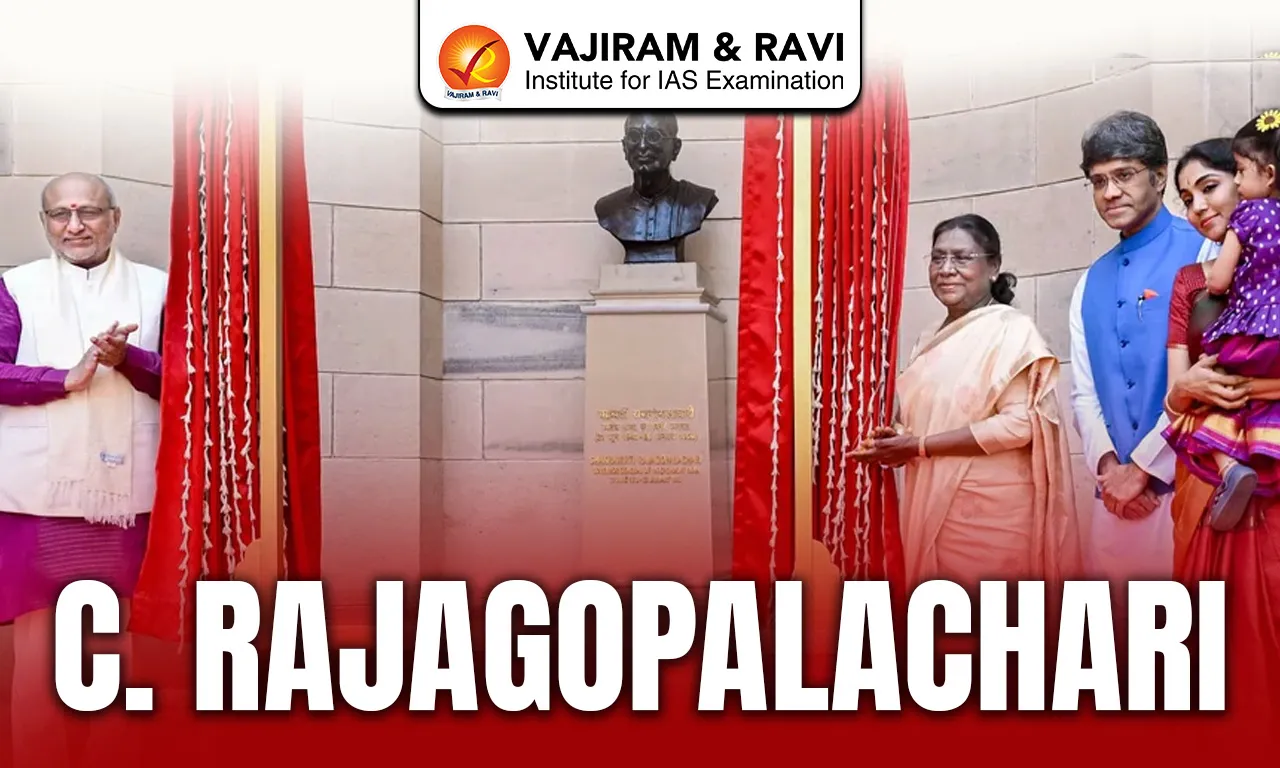
  • President Droupadi Murmu unveiled a statue of C. Rajagopalachari (Rajaji) in the central courtyard of Rashtrapati Bhavan, replacing the bust of British architect Edwin Lutyens
  • The decision, announced by PM Modi, highlighted Rajaji’s legacy of public service, self-restraint, and independent thinking.
  • The move symbolically honours Rajaji’s enduring political and moral influence, recognising him not merely as a statesman but as a leader who viewed power as a responsibility rather than a privilege.

C. Rajagopalachari’s Early Role in the Freedom Movement

  • C. Rajagopalachari (Rajaji), born in December 1878 in Thorapalli, Tamil Nadu, grew up in a Tamil-speaking Brahmin family. 
  • Entry into National Politics - Rajaji attended the 1906 Calcutta and 1907 Surat sessions of the Indian National Congress, marking his early engagement with the national movement.
  • Rise in Local Leadership - In 1911, he was elected to the Salem Municipal Council. By 1916, he had joined Annie Besant’s Home Rule League and established its Salem unit. In 1917, he became Chairman of the Salem Municipal Council, reflecting his growing political prominence.
  • Move to Madras and Meeting with Gandhi - In 1919, Rajaji shifted to Madras to expand his public role. There, he met Mahatma Gandhi during his visit, a turning point that would deepen Rajaji’s involvement in the Independence movement.

C. Rajagopalachari: Freedom Struggle and the Rajaji Formula

  • Rowlatt and Non-Cooperation Movements (1919–20) - Rajaji was an early supporter of the Rowlatt Satyagraha in 1919. He later led the Non-Cooperation Movement in Tamil Nadu, giving up his successful legal practice and advocating boycott of elections, institutions, and official titles.
  • Salt Satyagraha in the South (1930) - In April 1930, he led the historic march from Trichy to Vedaranyam as part of the Salt Satyagraha. He was arrested multiple times for defying colonial authorities and distributing satyagraha material.
  • Differences During the Quit India Movement (1942) - While a close associate of Mahatma Gandhi, Rajaji differed with him during the Quit India Movement. He doubted that Britain would leave merely in response to slogans and instead advocated a negotiated settlement with the Muslim League.

The Rajaji (CR) Formula

  • Rajaji proposed a Congress–Muslim League agreement, later known as the Rajaji Formula, which Gandhi agreed to consider.
  • Key Provisions
    • The Muslim League would cooperate in forming a provisional government.
    • Congress would accept a post-independence plebiscite in Muslim-majority districts of the North-West and East to decide on Pakistan.
    • In case of partition, mutual agreements would safeguard defence, commerce, and communications.
    • In 1944, Rajaji conveyed Gandhi’s acceptance of the proposal to Muhammad Ali Jinnah. 
    • However, Jinnah rejected it, arguing that the proposed Pakistan was smaller than demanded and conditional upon a plebiscite and treaty arrangements.

Rajagopalachari on Hindi Policy and Temple Entry Reform

  • As Premier of Madras in 1938, Rajaji introduced compulsory Hindi for Classes 6–8, describing it as “chutney on a leaf — to be tasted or left alone.” 
  • Students would not fail for poor performance. However, the move triggered widespread protests.
  • During the anti-Hindi agitations of 1965, Rajaji strongly opposed making Hindi the sole official language. 
  • He criticised its imposition by majority force, arguing English functioned more effectively as a neutral link language. His objection was to coercion, not to Hindi itself.

Champion of Temple Entry and Social Reform

  • Rajaji supported M. C. Rajah’s Bill to remove social disabilities against Dalits, making discrimination in jobs, education, and public access punishable. 
  • He also backed measures enabling temples to be opened to Dalits by majority approval.
  • Though supportive, Rajaji limited the Temple Entry measure initially to the Malabar district, likely to avoid provoking orthodox backlash amid the Hindi controversy.

The Meenakshi Temple Breakthrough (1939)

  • When trustees of the Meenakshi Temple in Madurai showed willingness to admit Dalits but feared legal consequences, Rajaji promised protective legislation. 
  • On July 8, 1939, Dalits entered the temple with official approval.
  • Facing legal challenges and demands for ritual purification, Rajaji introduced the Temple Entry Authorisation and Indemnity Bill (1939), protecting officials who permitted temple access.
  • Soon, several temples in Tanjore and other regions opened their doors to Dalits.

Reformist Outlook

  • Responding to scriptural objections at Srirangam, Rajaji remarked that sacred texts were like an “infinite ocean” from which one could draw either wisdom or prejudice.
  • His stance reflected a reformist vision balancing tradition with social justice while navigating political sensitivities.

Rajaji and the Swatantra Party: A Liberal Alternative to Congress

  • After serving as Home Minister under Jawaharlal Nehru (1950–51), Rajaji grew increasingly critical of Congress policies by the mid-1950s. 
  • He feared that the party’s dominance and statist, centralising approach could weaken democratic balance.
  • Rajaji argued that democracy required a strong Opposition to act as a corrective “brake” on excessive state control. 
  • He believed only a conservative—or, as he preferred, constitutional—party could provide a true democratic counterweight to Congress.

Formation of the Swatantra Party (1959)

  • In August 1959, Rajaji founded the Swatantra Party (Freedom Party). 
  • It evolved from earlier platforms like the Forum for Free Enterprise (1956) and the All India Agriculturalists’ Federation (1958).
  • The Swatantra Party championed free enterprise but rejected unregulated 19th-century laissez-faire capitalism.
  • Rajaji opposed “coercive Soviet-type planning,” advocating regulation and guidance instead of extensive state ownership.
  • Despite promoting liberal economic principles, the party faced criticism. Nehru and others portrayed it as representing feudal and elite interests, dismissing it as a party of “Lords, castles and Zamindars.”

Rajaji’s Enduring Significance

  • Replacing a colonial-era statue with that of C. Rajagopalachari at Rashtrapati Bhavan aligns with the emphasis on cultural nationalism and reinterpreting colonial legacies.

A Bridge from Colonial to Republican India

  • He became Premier under the Government of India Act, 1935.
  • He succeeded Lord Mountbatten as Governor-General in 1948 — the only Indian to hold the post.
  • He served as Chief Minister of Madras (1952–1954).
  • His career reflected India’s transition from colonial rule to sovereign republic.

Intellectual and Cultural Contributions

  • Rajaji is also remembered for his accessible retellings of the Ramayana and Mahabharata, which remain widely read.
  • Rajaji’s conservative outlook, particularly his critique of Nehruvian socialism, resonates with contemporary political currents, including the BJP’s economic and ideological positioning.
  • Respected by both Mahatma Gandhi and Jawaharlal Nehru, Rajaji was awarded the Bharat Ratna in 1954 and accorded a state funeral in 1972.
  • His life exemplified “principled flexibility” in politics — balancing conviction with pragmatic adaptation.

Source: IE

C. Rajagopalachari FAQs

Q1: Why is C. Rajagopalachari legacy significant today?

Ans: C. Rajagopalachari legacy represents principled politics, temple entry reform, opposition to coercive language policy, and advocacy of economic liberalism through the Swatantra Party.

Q2: What was C. Rajagopalachari’s role in temple entry reform?

Ans: C. Rajagopalachari legacy includes strong support for Dalit temple entry, protective legislation in 1939, and backing social reform despite orthodox resistance.

Q3: How did C. Rajagopalachari view the Hindi policy?

Ans: C. Rajagopalachari legacy shows he opposed Hindi imposition, supporting linguistic balance and retaining English as a neutral link language.

Q4: What was the Rajaji Formula?

Ans: C. Rajagopalachari legacy includes proposing the Rajaji Formula, suggesting a plebiscite-based solution to the Congress–Muslim League deadlock before Partition.

Q5: Why did Rajagopalachari found the Swatantra Party?

Ans: C. Rajagopalachari legacy reflects his belief in free enterprise and democratic opposition, leading to the formation of the Swatantra Party in 1959.
India–Israel Relations: PM Modi’s Tel Aviv Visit and the Strategic Evolution of Ties

India–Israel Relations

India–Israel Relations Latest News

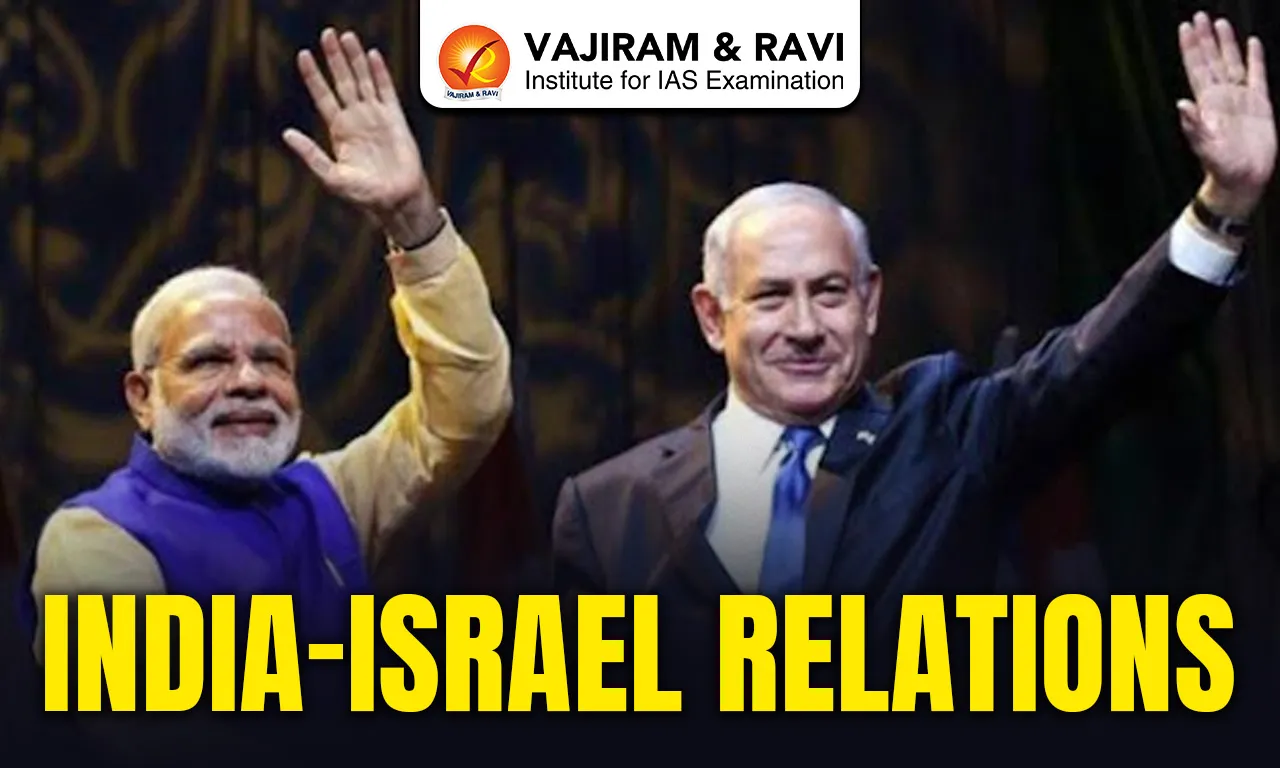
  • Prime Minister Narendra Modi is on an official visit to Israel, marking his first trip there since his landmark 2017 visit (the first-ever by an Indian Prime Minister after diplomatic ties were established). 
    • That visit elevated India-Israel relations into the open and strengthened bilateral cooperation.
  • However, the current visit takes place in a far more tense regional context, with concerns over a possible US-Iran conflict and a fragile ceasefire in Gaza. 
  • Against this backdrop, the visit highlights the evolution of India-Israel ties and underscores their growing strategic significance.

The Early Years: Recognition Without Full Ties

  • India recognised the state of Israel soon after its creation in 1948
  • However, full diplomatic relations were delayed for over four decades due to political sensitivities and regional considerations.
    • In January 1992, during Palestinian President Yasser Arafat’s visit to India, Prime Minister P V Narasimha Rao conveyed that diplomatic ties with Israel could strengthen India’s ability to influence the Palestinian cause.
    • Arafat publicly respected India’s sovereign decision, paving the way for a historic shift.
  • India formally established diplomatic relations with Israel on January 29, 1992 — a move that marked a decisive turning point in bilateral relations.

Growing Defence Cooperation

  • India had sourced Israeli weapons during the 1962 war with China, though engagement remained limited and episodic.
  • During the Kargil conflict, Israel swiftly supplied precision bombs from its emergency stockpiles to the Indian Air Force. 
  • This timely support significantly strengthened defence ties.

Political Engagement Deepens (2000–2003)

  • In 2000, India organised high-profile visits to Israel, including External Affairs Minister Jaswant Singh and Home Minister L K Advani.
  • To address domestic political concerns, leaders across party lines — including Jyoti Basu and Najma Heptullah — also visited Israel.
  • Israeli Prime Minister Ariel Sharon’s visit to India in September 2003 further consolidated defence and security cooperation.
  • Later, the then External Affairs Minister S M Krishna visited Israel in 2012. 
  • Public discussions focused on science and technology, agriculture, and commerce, while strategic defence ties were kept relatively low-profile.

India–Israel Relations After 2014

  • After assuming office in 2014, Prime Minister Narendra Modi brought India-Israel ties into the open. 
  • He met Prime Minister Benjamin Netanyahu in New York in September 2014 — the first such meeting in a decade — signalling renewed political engagement.

High-Level Political Exchanges

  • Home Minister Rajnath Singh visited Israel in 2014.
  • President Pranab Mukherjee made the first-ever Indian Presidential visit in 2015.
  • External Affairs Minister Sushma Swaraj followed in 2016.
  • Over the past decade, several Indian ministers and parliamentarians have also visited Israel.

The 2017 Breakthrough Visit

  • PM Modi’s 2017 visit was historic not only as the first by an Indian Prime Minister but also because he skipped the customary stop in Palestine, signalling a more confident and independent diplomatic stance.
  • His current visit similarly focuses solely on Tel Aviv.

Reciprocal Engagement

  • Prime Minister Netanyahu visited India in January 2018, reinforcing bilateral ties.
  • Since Netanyahu’s re-election, the two leaders have spoken at least 10 times in three years, reflecting sustained high-level engagement.

Expanding Strategic and Economic Cooperation

  • India and Israel have deepened defence ties, evident during Operation Sindoor, and enhanced cooperation in cybersecurity, highlighted during the Pegasus disclosures.
  • In November 2025, both sides signed defence pacts and launched negotiations for a free trade agreement. Cooperation now spans sectors such as artificial intelligence, agriculture, and advanced technologies.

A Shifting Geopolitical Landscape

  • Since PM Modi’s first visit in 2017, West Asia’s geopolitical dynamics have changed significantly. 
  • Israel and several Arab nations have moved toward normalisation under the Abraham Accords signed during Donald Trump’s first term.

Gaza War and Fragile Ceasefire

  • The Hamas attack on October 7, 2023 triggered a prolonged war in Gaza, resulting in massive casualties and destruction.
  • An uneasy truce now holds under a US-backed peace plan, with the key challenge being the disarmament of Hamas.

Rising Iran Tensions

  • Tensions with Iran have intensified following a 12-day Israel-Iran conflict in June 2025, during which the US struck Iranian nuclear facilities.
  • The US has since increased its military presence around Iran, further destabilising the region.

India’s Diplomatic Tightrope

  • PM Modi’s visit comes amid regional turmoil, making it a sensitive diplomatic move. New Delhi must carefully balance costs and benefits.

Importance of Israel for India

  • A crucial defence and security partner.
  • A key economic partner in the India-Middle East-Europe Economic Corridor.
  • A significant regional political player with expanding ties in West Asia.

Regional Sensitivities

  • Iran and other regional nations are closely observing India’s growing proximity to Israel and assessing its implications for their own ties with New Delhi.
  • Prime Minister Benjamin Netanyahu, facing political pressure at home, is projecting the visit as a diplomatic success.

Conclusion

  • PM Modi’s Israel visit unfolds in a volatile regional environment and will be closely watched across West Asia. It reflects India’s effort to navigate complex geopolitical realities while safeguarding its strategic and economic interests.

Source: IE | IE

India–Israel Relations FAQs

Q1: Why are India–Israel relations strategically important?

Ans: India–Israel relations are vital for defence cooperation, cybersecurity, technology, agriculture, and economic connectivity through the India-Middle East-Europe Economic Corridor.

Q2: How did India–Israel relations evolve historically?

Ans: India–Israel relations formally began in 1992, strengthened through defence cooperation during Kargil, and expanded into technology and trade partnerships after 2014.

Q3: What made Modi’s 2017 visit historic?

Ans: India–Israel relations entered a new phase in 2017 when PM Modi made the first standalone visit to Israel, skipping Palestine and signalling strategic maturity.

Q4: How do regional tensions affect India–Israel relations?

Ans: India–Israel relations are shaped by Gaza conflict, Iran tensions, Abraham Accords, and US involvement, requiring careful diplomatic balancing by New Delhi.

Q5: What sectors define modern India–Israel relations?

Ans: Modern India–Israel relations span defence, AI, cybersecurity, agriculture, free trade negotiations, and joint innovation initiatives.

Kerala to Keralam – Constitutional Process and Cultural Assertion

Kerala to Keralam

Kerala to Keralam Latest News

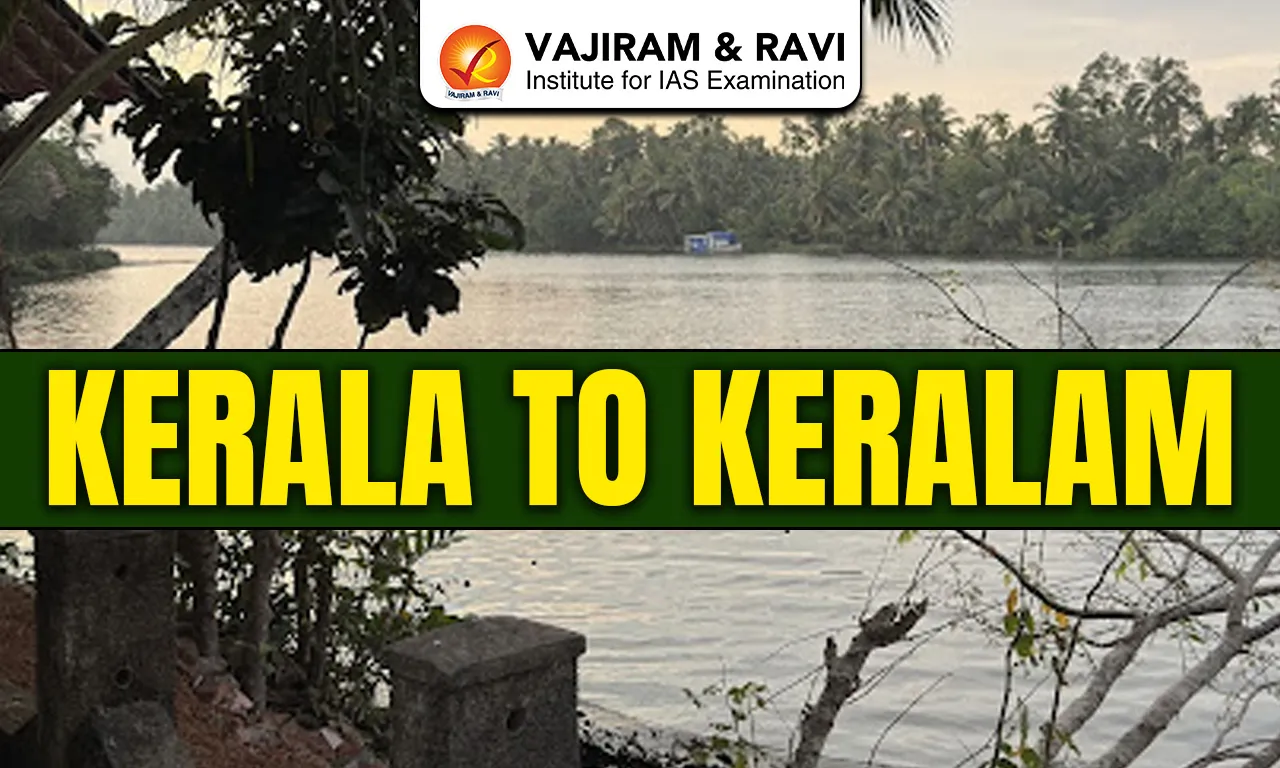
  • The Union Cabinet has approved the proposal to rename the State of Kerala as Keralam, reflecting the linguistic and cultural identity of the Malayalam-speaking population. 
  • The proposed Kerala (Alteration of Name) Bill, 2026 will now be referred to the Kerala Legislative Assembly under Article 3 of the Constitution, after which Parliament will consider the amendment to the First Schedule.
  • The move follows resolutions passed unanimously by the Kerala Assembly in 2023 and 2024 and is seen as an assertion of linguistic identity and historical continuity.

Procedure for Renaming a State

  • Constitutional/ legal basis: Article 3 of the Constitution empowers Parliament to form new states, alter boundaries, change names of states.
  • Steps involved:
    • Proposal initiated by the state government.
    • Examination by the Ministry of Home Affairs (MHA).
    • Consultation with departments such as Intelligence Bureau, Survey of India, Registrar General of India, Department of Posts, Ministry of Railways.
    • The President refers the Bill to the State Legislature for views.
    • Introduction and passage of Bill in Parliament.
    • Presidential assent and notification.
  • Current status:
    • The Union Cabinet has approved the proposal.
    • The President will refer the Kerala (Alteration of Name) Bill, 2026 to the Kerala Assembly.
    • After receiving the Assembly’s views, the Bill will be introduced in Parliament.

Rationale Behind Renaming

  • Linguistic identity: Kerala was created on 1 November 1956 during linguistic reorganisation of states. The state's name in Malayalam is Keralam. Kerala Piravi Day commemorates the state's formation.
  • Constitutional discrepancy: The First Schedule lists the state as "Kerala". Assembly resolutions sought correction to "Keralam".
  • Correction of earlier resolution: The 2023 resolution attempted changes in all Eighth Schedule languages, but technical discrepancies required a fresh resolution in 2024.

Historical Background

  • Origin of the name "Keralam": Several theories exist -
    • Mention in Ashoka’s Rock Edict II (257 BCE) as Keralaputra, linked to the Chera dynasty.
    • Derived from Cheram, referring to the ancient Chera kingdom. Scholar Herman Gundert linked "Keralam" to Cheram, meaning "joined land". "Alam" denotes land or region.
  • Movement for a unified Kerala:
    • Aikya Kerala movement: Began in the 1920s, demanding unification of Malayalam-speaking areas - Malabar, Kochi, Travancore.
    • Formation of Kerala: Travancore and Kochi merged in 1949. State Reorganisation Commission (Fazl Ali Commission) recommended formation of Kerala. Kerala officially formed in 1956 on linguistic basis.

Administrative and Political Dimensions

  • Union Cabinet decision: The name change decision was approved at the first Cabinet meeting held at Seva Teerth (new PMO complex). It is seen as reflecting the “will of the people”, and is supported across political parties in Kerala.
  • Seva Sankalp resolution: The cabinet adopted a governance pledge inspired by "Nagrik Devo Bhava", emphasising citizen-centric governance, transparency and service orientation.

Concerns and Significance

  • Concerns/ challenges:
    • Administrative adjustments: Changes required in official records, government documents, maps and surveys, educational materials, etc.
    • Past proposals have failed: 2018 proposal to rename West Bengal as Bangla was rejected due to similarity with Bangladesh.
    • Political timing: Decision comes ahead of Kerala Assembly elections, raising political interpretations.
  • Significance:
    • Cultural significance: Reinforces linguistic federalism. Strengthens regional identity within the Union.
    • Federalism dimension: Demonstrates cooperative federalism - State initiative, Central approval, Parliamentary process.
    • Historical continuity: Aligns constitutional nomenclature with historical usage.

Conclusion

  • The proposed renaming of Kerala to Keralam represents a symbolic but significant exercise in linguistic federalism and cultural recognition. 
  • While the change requires constitutional formalities and administrative adjustments, it aligns the state's constitutional identity with its historical and linguistic reality, reinforcing India's pluralistic federal structure.

Source: IEIE

Kerala to Keralam FAQs

Q1: What is the constitutional procedure for renaming a state in India?

Ans: Renaming a state requires a law passed by Parliament under Article 3 of the Constitution.

Q2: What is the significance of the proposal to rename Kerala as Keralam?

Ans: The renaming reflects linguistic identity and aligns the constitutional name of the state with its Malayalam usage, strengthening linguistic federalism.

Q3: What are the historical roots of the demand for a unified Kerala state?

Ans: The Aikya Kerala movement of the 1920s sought to unite Malayalam-speaking regions.

Q4: Why does renaming a state require constitutional amendment while renaming cities does not?

Ans: State names are listed in the First Schedule of the Constitution, whereas city names can be changed through executive decisions.

Q5: What are the administrative challenges associated with renaming a state in India?

Ans: Renaming requires extensive updates to official records, legal documents, maps, and government databases across multiple institutions.

The Evolving Nature of Trade Agreements – Explained

Trade Agreements

Trade Agreements Latest News

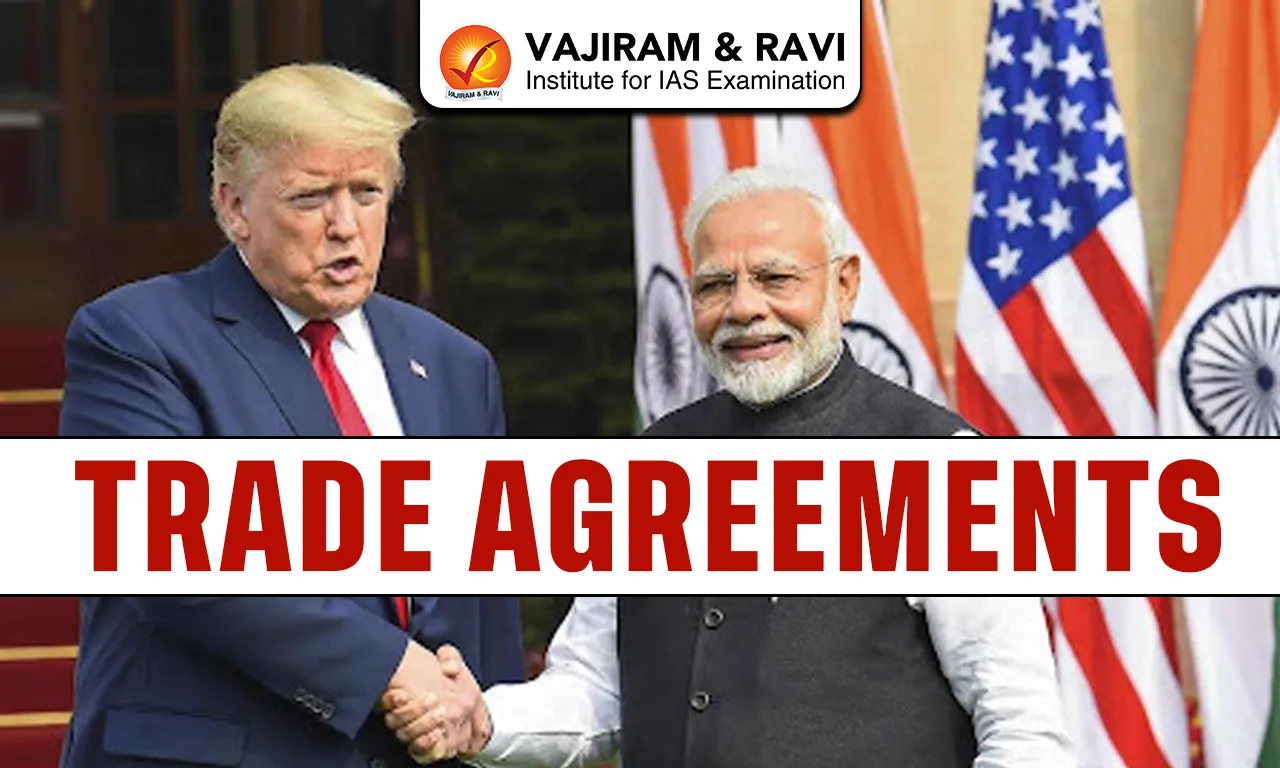
  • The evolving nature of trade agreements has gained attention after the United States signed several “Agreements on Reciprocal Trade” (ARTs), including a proposed deal with India, raising questions about their compatibility with WTO rules. 

Trade Agreements and Global Trade Governance

  • Trade agreements formalise economic relations between countries by reducing tariffs, setting regulatory standards, and facilitating market access. 
  • Traditionally, international trade governance has revolved around the multilateral framework established under the General Agreement on Tariffs and Trade (GATT) and later the World Trade Organisation (WTO).
  • However, recent developments indicate the emergence of new forms of trade arrangements that differ from conventional Free Trade Agreements (FTAs). 
  • The U.S., under President Donald Trump, has labelled its recent deals as “Agreements on Reciprocal Trade” (ARTs), creating what appears to be a new typology in international trade law.
  • This shift has significant implications for global trade multilateralism.

Multilateral Trade Framework under GATT and WTO

  • The GATT, established in 1947, laid the foundation for a non-discriminatory global trading regime. 
  • Its core principle is the Most-Favoured-Nation (MFN) rule, which mandates that any trade concession granted to one member must be extended to all other WTO members.
  • The formation of the WTO in 1995 institutionalised this framework by:
    • Expanding coverage from goods to services (GATS) and intellectual property (TRIPS).
    • Creating a binding dispute settlement mechanism.
    • Adopting a one-country-one-vote decision-making principle.
  • For developing countries, the WTO system provides a platform to negotiate collectively and challenge unfair trade practices.
  • Multilateralism, therefore, is designed to ensure predictability, transparency, and fairness in global trade.

Preferential Trade Agreements and WTO Exceptions

  • While the WTO is built on non-discrimination, it permits certain exceptions under Article XXIV of GATT. These include Free Trade Agreements (FTAs) & Customs Unions (CUs).
  • Such arrangements allow countries to grant preferential tariff treatment to specific partners without extending the same to all WTO members. However, these agreements must meet strict conditions:
    • They must cover “substantially all trade” between members.
    • Customs unions must adopt a common external tariff.
  • Over the past three decades, FTAs have proliferated. Examples include large regional groupings such as the Regional Comprehensive Economic Partnership (RCEP). 
  • Many modern FTAs are WTO-plus, meaning they extend beyond tariff reductions to include labour standards, environmental commitments, and investment protection.
  • Although FTAs deviate from MFN principles, they are notified to the WTO, allowing scrutiny and transparency.

Agreements on Reciprocal Trade

  • The ARTs introduced by the U.S. represent a departure from established WTO-compatible FTAs. Key features include:
    • They are not signed under Article XXIV of GATT.
    • They are not notified to the WTO.
    • They operate independently of multilateral oversight.
  • ARTs reflect an “America First” trade policy. While the U.S. continues to impose tariffs that may not align with WTO commitments, partner countries are reportedly pressured into reducing or eliminating tariffs on U.S. goods.
  • This asymmetry raises concerns about fairness and legal legitimacy.

WTO-Plus and One-Sided Provisions

  • ARTs also contain WTO-plus and unilateral clauses that expand obligations for partner countries. For instance:
    • Certain provisions reportedly require partner countries to adopt complementary trade restrictions if the U.S. invokes national security measures.
    • Some ARTs restrict data sovereignty by prohibiting customs duties on electronic transmissions.
  • These provisions may bind smaller economies more tightly to U.S. strategic and economic interests.
  • Unlike WTO-compliant FTAs, ARTs do not provide an institutional mechanism for third-party review or dispute settlement within the WTO framework. This reduces transparency and weakens global oversight.

Implications for India and Developing Countries

  • India has traditionally supported multilateralism while simultaneously pursuing bilateral FTAs with partners such as the EU, the U.K., and Australia.
  • The proposed India-U.S. trade deal raises important policy questions:
    • Should India enter into an ART-style agreement that may fall outside WTO norms?
    • How can India safeguard tariff policy autonomy and digital sovereignty?
    • What are the long-term implications for developing countries if multilateral rules are bypassed?
  • Developing countries benefit from the WTO’s collective bargaining structure. A shift toward unilateral or reciprocal trade arrangements may fragment global trade governance and reduce policy space for smaller economies.

Broader Trends in Trade Governance

  • The global trading system is witnessing three parallel trends:
    • Multilateral stagnation due to deadlock in WTO negotiations and weakening of the dispute settlement system.
    • Rise of bilateral and regional FTAs, many of which are comprehensive and WTO-plus.
    • Emergence of unilateral reciprocal deals, which may not conform to WTO norms.
  • This evolution reflects geopolitical competition and strategic economic policymaking.
  • If ART-style agreements become widespread, they may undermine the foundational principle of non-discrimination and erode the legitimacy of the WTO.

Source: TH

Trade Agreements FAQs

Q1: What is the core principle of the WTO trading system?

Ans: The WTO is based on the Most-Favoured-Nation (MFN) principle of non-discrimination.

Q2: What does Article XXIV of GATT allow?

Ans: It permits Free Trade Agreements and Customs Unions as exceptions to MFN rules.

Q3: What are Agreements on Reciprocal Trade (ARTs)?

Ans: ARTs are bilateral trade deals signed by the U.S. that operate outside Article XXIV of GATT and are not notified to the WTO.

Q4: How do ARTs differ from conventional FTAs?

Ans: Unlike FTAs, ARTs lack WTO linkage, oversight, and adherence to multilateral conditions.

Q5: Why are ARTs considered legally controversial?

Ans: They may violate WTO obligations and bypass established multilateral trade norms.

Enquire Now