BRICS and the Global South – Building Resilience Against the Weaponisation of Technology and Critical Minerals

BRICS and the Global South

BRICS and the Global South Latest News

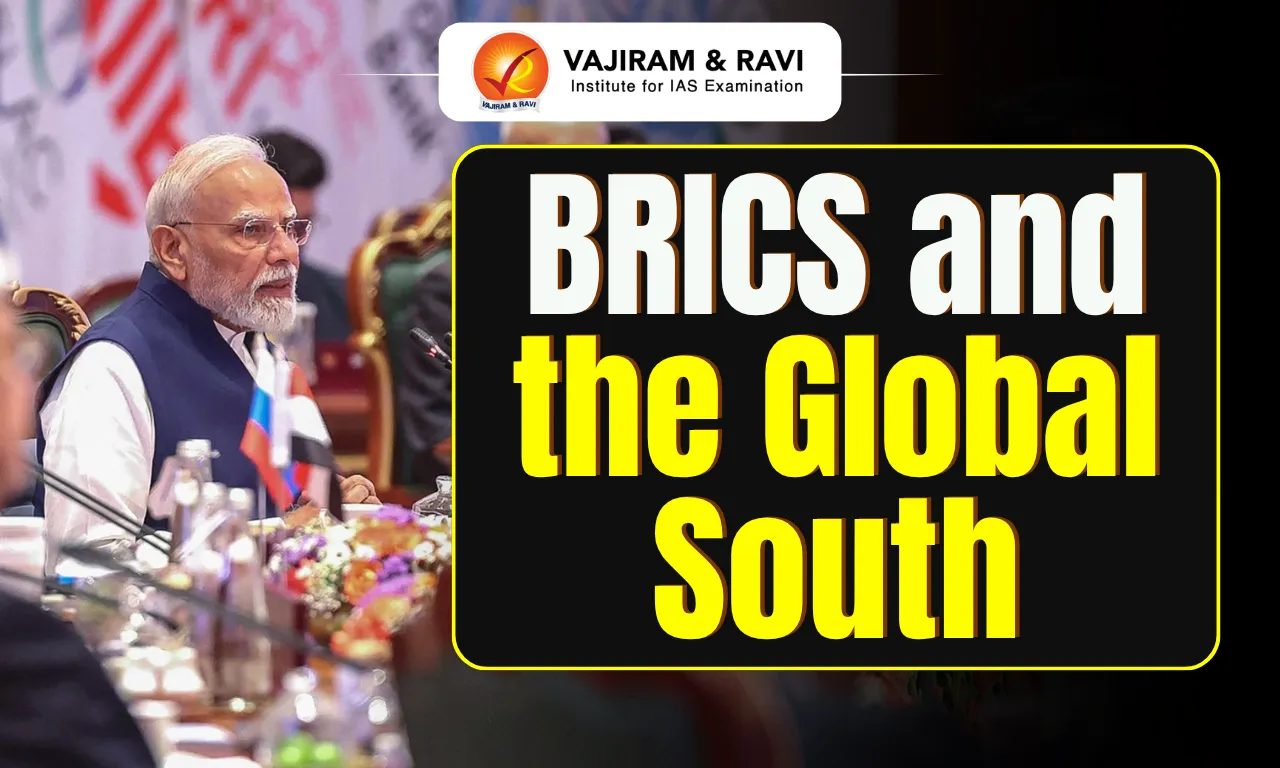
  • At the concluding session of the BRICS Summit hosted by India, the Indian Prime Minister warned that the weaponisation of technology and critical minerals could undermine collective progress
  • Without naming any country, the remarks come amid concerns over China’s dominant position in critical-mineral processing and restrictions affecting the supply of rare earths and advanced technologies.
  • India’s BRICS chairship centred on four pillars—Resilience, Innovation, Cooperation and Sustainability—with an emphasis on making BRICS a platform for inclusive global growth, particularly for the Global South.

Critical Minerals and Technology

  • Critical minerals are increasingly central to clean energy, electronics, defence, semiconductors and advanced manufacturing. 
  • Excessive concentration of their processing and supply chains creates strategic vulnerabilities.
  • Modi stressed that weaponising technology and critical minerals can hinder shared development. 
  • The New Delhi Declaration consequently called for -
    • Reliable, diversified, resilient and just critical-mineral supply chains.
    • Greater value addition and benefit sharing.
    • Economic diversification in resource-rich countries.
    • Respect for countries’ sovereign rights over their mineral resources.
  • India’s position reflects a broader push for supply-chain diversification, strategic autonomy and technology inclusivity.

BRICS as a Platform for the Global South

  • The Indian PM highlighted the growing confidence of developing countries in BRICS because their voices are heard, experiences respected and solutions developed jointly rather than imposed upon them.
  • This reflects India’s effort to position BRICS as a mechanism for reformed and more representative global governance. 
  • The grouping’s diversity is presented as a strength that can facilitate cooperation among countries with different developmental realities.
  • The emphasis is therefore shifting from merely articulating grievances of the Global South towards creating practical, scalable and accessible solutions.

Four Pillars of India’s BRICS Chairship

  • Resilience:
    • The increasing frequency of conflicts, pandemics, climate disasters and supply-chain disruptions demonstrates the vulnerability of an interconnected world. 
    • Crises originating in one region can rapidly produce global consequences.
    • India highlighted -
      • BRICS Integrated Early Warning System for prevention and response to infectious diseases.
      • Early Warning Data Integration Guidelines for disaster management.
      • BRICS Logistics Supply Chain Cooperation Framework to strengthen reliability and resilience of supply chains.
    • The broader objective is to move from crisis response to anticipatory governance, through early identification, preparedness and prompt action.
  • Innovation:
    • India sought to use innovation for inclusive development through -
      • BRICS Incubator Network to connect start-ups and incubators.
      • BRICS Startup Innovation Fund to promote innovative and scalable solutions.
      • BRICS Network on Digital Agriculture, linking AI, geospatial technology and Digital Public Infrastructure (DPI) with farmers’ needs.
    • This approach seeks to ensure that emerging technologies are not confined to technologically advanced economies but contribute directly to agricultural productivity and livelihoods.
  • Cooperation and wider participation:
    • India stressed that BRICS cooperation should extend beyond governments to entrepreneurs, farmers, researchers, women, youth and ordinary citizens.
    • Key initiatives include - 
      • BRICS CONNECT for skills, employability, women’s workforce participation, social security and capacity building.
      • BRICS MSME Cooperation Portal to connect small enterprises with knowledge, finance and markets.
      • BRICS Urban Mobility Hub for sharing urban best practices.
    • This represents a shift towards people-centric and multi-stakeholder cooperation.
  • Sustainability:
    • India emphasised the need to balance human development with environmental protection, keeping intergenerational equity at the centre of sustainable development.
    • Initiatives include - 
      • BRICS Digital Centre of Excellence for smart grids and energy storage.
      • Centres of Excellence for Agro-Ecology and Regenerative Agriculture, connecting traditional knowledge with modern science.
    • These initiatives seek to make clean-energy systems more reliable, efficient and accessible.

Way Forward

  • As BRICS enters its third decade, its credibility will increasingly depend on translating declarations into concrete, measurable outcomes
  • Priorities should include diversified critical-mineral supply chains, responsible technology governance, resilient logistics, inclusive digitalisation and stronger participation of developing countries.

Conclusion

  • India’s BRICS chairship seeks to transform the grouping from a forum for political coordination into an “ecosystem of solutions”. 
  • Its central challenge is to ensure that technology, critical minerals and economic integration become instruments of shared prosperity rather than geopolitical leverage. 
  • For the Global South, BRICS can contribute most effectively when cooperation remains inclusive, sovereign, sustainable and development-oriented.

Source: ToIHT

BRICS and the Global South FAQs

Q1: How can the weaponisation of critical minerals undermine global economic security?

Ans: It can create strategic dependencies, disrupt clean-energy and high-tech industries, and provide geopolitical leverage.

Q2: What is the significance of India’s emphasis on technology inclusivity within BRICS?

Ans: It seeks to make AI, Digital Public Infrastructure and emerging technologies accessible and adaptable.

Q3: How does the BRICS Integrated Early Warning System strengthen resilience?

Ans: By enabling early identification, data integration, preparedness and coordinated response to infectious diseases and disasters.

Q4: How can BRICS contribute to inclusive growth in the Global South?

Ans: Through technology transfer, resilient supply chains, MSME cooperation, start-up networks, etc.

Q5: Why is balancing human development with environmental sustainability important for BRICS?

Ans: It advances intergenerational equity by promoting clean energy, smart grids, energy storage, etc.
India EU FTA – 1.64 Million Tonne Steel Quota and New EU Import Regime

India EU FTA

India EU FTA Latest News

  • India has secured country-specific tariff-rate quotas (TRQs) of about 1.64 million tonnes of steel products annually under its proposed Free Trade Agreement (FTA) with the European Union (EU).

About Tariff-Rate Quota

  • A Tariff-Rate Quota (TRQ) is a trade policy instrument that allows a specified quantity of a product to enter a market at a preferential or lower tariff rate. Imports beyond the specified quota are subject to a higher tariff.
  • In the India–EU arrangement, country-specific quotas provide Indian steel exporters with defined access to the EU market. 
  • Steel exported outside the applicable quota will face the duties prescribed under the EU's new steel regime.
  • TRQs therefore combine market access with domestic industry protection.

India's Steel Quota under the FTA

  • India has secured a total country-specific quota of 1,641,470 tonnes annually. This comprises:
    • 946,616 tonnes under the Most Favoured Nation (MFN) component
    • 694,853 tonnes under the FTA component
  • India currently exports approximately 4 million tonnes of steel annually to the EU, making the quota an important consideration for the country's steel industry.
  • The negotiated access is particularly significant because steel imports entering the EU outside the applicable quotas will attract a 50% tariff under the new regime.

EU's New Steel Import Regime

  • The EU's new Steel Regulation came into force on July 1, 2026. 
  • It replaced the temporary safeguard measures introduced in 2018, which expired in June 2026, after reaching the maximum eight-year period permitted for temporary safeguards under World Trade Organisation (WTO) rules.
  • The new regime seeks to protect the European steel industry from the effects of global overcapacity and potentially low-priced imports. It provides:
    • Duty-free tariff quotas of 18.3 million tonnes
    • A 50% duty on imports outside the applicable quotas
    • A melt-and-pour requirement aimed at improving transparency regarding the origin and production of steel
  • Under the new system, MFN quotas are allocated based on each exporting country's average share of EU imports in individual product categories during 2022-24.

Steel Products Covered

  • The country-specific quotas cover a broad range of steel products, including:
  • Non-alloy and alloy hot-rolled sheets and strips. 
    • Cold-rolled sheets
    • Metallic-coated sheets
    • Organic-coated sheets 
    • Tin mill products
    • Quarto plates
    • Stainless steel products
    • Merchant bars and light sections
    • Reinforcing bars
    • Wire rods
    • Pipes and tubes
  • The largest Indian country-specific quota is for non-alloy and other alloy hot-rolled sheets and strips, at 509,605 tonnes.
  • This consists of 299,197 tonnes under the MFN component and 210,408 tonnes under the FTA component.
  • Other significant quotas include 218,658 tonnes for cold-rolled sheets, 197,860 tonnes for metallic-coated sheets, and 186,038 tonnes for organic-coated sheets.

News Summary

  • The negotiated steel access is significant because the EU is simultaneously strengthening protection for its domestic steel industry.
  • The 1.64-million-tonne country-specific quota gives Indian exporters predictable access to the EU market despite the new 50% out-of-quota tariff. 
  • Of the total quota, nearly 6.95 lakh tonnes will receive access under the FTA component, while around 9.47 lakh tonnes will fall under the MFN component.
  • The agreement also contains mechanisms to prevent India from being disadvantaged if the EU subsequently provides more favourable quota access to another FTA partner.
  • India will have access to additional quota volumes in product categories where it already has a country-specific quota. 
  • These additional volumes will be allocated through competition among eligible EU FTA partners having country-specific quotas.
  • For categories without an Indian country-specific quota, Indian exporters can access residual quotas, including general residual quotas and preferential quotas reserved for EU FTA partners.
  • The EU has committed to administering the TRQs in a transparent, objective and non-discriminatory manner and making relevant information regarding their administration publicly available.

Review Mechanism

  • The agreement provides for periodic review of the negotiated quotas.
  • The first review will begin one year after the FTA enters into force, followed by subsequent reviews every five years. 
  • These reviews will consider market developments, quota utilisation and changes in the EU's steel regime.
  • The agreement also provides for consultation with India if the EU proposes amendments to Product Specific Rules (PSRs) for products covered under its Steel Regulation.

Significance for India

  • The arrangement provides Indian steel exporters with greater certainty and predictability in a major export market.
  • At the same time, the benefits will depend on effective utilisation of the quotas. Since India currently exports around 4 million tonnes of steel annually to the EU, the negotiated access does not cover the entirety of existing exports.
  • For Indian steel producers, therefore, the FTA provides an opportunity to preserve and expand market access while encouraging greater competitiveness, product diversification and compliance with evolving European trade regulations.

Source: ET | TH

India EU FTA FAQs

Q1: How much country-specific steel quota has India secured under the India–EU FTA?

Ans: India has secured a total country-specific quota of 1,641,470 tonnes of steel products annually.

Q2: How much of India's quota is under the FTA component?

Ans: 694,853 tonnes of the total quota is under the FTA component.

Q3: What tariff applies to steel imports outside the EU's applicable quotas?

Ans: Steel imports entering the EU outside the applicable quotas will face a 50% tariff under the new regime.

Q4: When did the EU's new Steel Regulation come into force?

Ans: The EU's new Steel Regulation came into force on July 1, 2026.

Q5: When will the steel quotas be reviewed?

Ans: The first review will begin one year after the FTA enters into force, followed by reviews every five years.

NDB and BRICS: How India Can Strengthen BRICS Without Strengthening China

NDB and BRICS

NDB and BRICS Latest News

  • BRICS leaders gathered at Bharat Mandapam in New Delhi on September 12, 2026, with India holding the chair. 
  • Against this backdrop, analysts argue that India should focus on the New Development Bank (NDB) as the most practical avenue for BRICS cooperation. 
  • Strengthening the NDB through greater capital, wider membership and local-currency lending can make the grouping relevant without advancing Beijing's strategic position.

The Representation Grievance

  • BRICS' economic and demographic weight has not translated into institutional influence:
    • In 2011, the five original members contributed 20 per cent of global GDP but held only 11 per cent of voting share at the IMF.
    • Today, the expanded grouping accounts for nearly 40 per cent of global GDP and 55 per cent of the world's population, yet its IMF voting share has barely grown.

Why BRICS Lacks a Coherent Identity

  • The grouping is divided over its purpose. Russia, China and Iran want it to be anti-West. India, Brazil and South Africa see it as non-West. 
  • Given these divergences and the importance of India-US ties, Delhi cannot join the Beijing-Moscow de-dollarisation campaign. Doing so would worsen already strained relations with Washington and would be unsustainable in the medium term.
  • India's approach must therefore work within the constraints of membership: maximising the grouping's potential without strengthening Beijing. 
  • Within these limits, the NDB offers real possibilities.

The NDB: BRICS' Most Tangible Tool

  • The NDB was established by BRICS countries in 2015 to mobilise resources for infrastructure and sustainable development projects in BRICS and other emerging markets and developing countries. 
  • It is the grouping's most concrete instrument, and one that can contribute to the global financial order without directly challenging American predominance.

The NDB's Underperformance

  • Despite a decade in operation, the NDB has lagged well behind its peer, the Asian Infrastructure Investment Bank (AIIB), established around the same time:
    • Projects approved – 139 (NDB); 350 (AIIB)
    • Commitments ~$43 billion (NDB); ~$69 billion (AIIB)
    • Members - Mostly core members (NDB); 111 approved members (AIIB)
    • Credit rating - AA/AA+ (NDB); AAA (AIIB)
  • Additional weaknesses:
    • Stagnant asset growth restricts lending capacity.
    • Disbursement is exceptionally slow. Only about $20 billion of approved loans has actually been disbursed.
    • China and India together account for 51 per cent of the active portfolio. 
    • Transport infrastructure takes the largest share (38 per cent), followed by COVID-19 emergency assistance (25 per cent).

Breaking the Asset Bottleneck

  • One solution is for the five founders to raise their paid-up capital. But this faces obstacles:
    • Russia, heavily sanctioned, cannot match higher commitments.
    • Sanctions have strained the bank's credit standing and raised its dollar funding costs.
    • Ironically, though Moscow and Beijing champion de-dollarisation, the NDB has extended no new credit to Russia since March 2022 to protect its AA/AA+ rating.
    • The bank's rules mandate equal voting shares among founders, so capital expansion is effectively held hostage by its financially weakest member.
    • New members can bring fresh capital, but the founders' collective voting share cannot fall below 55 per cent.

What the NDB Has Done for India

  • The bank has served India well. It has committed nearly $10 billion across 32 projects, including metro rail systems and the Delhi-Ghaziabad-Meerut Regional Rapid Transit System (RRTS) corridor
  • Expanding the NDB to match other multilateral lenders would require extending such benefits to many more emerging markets and developing countries.

The Local-Currency Advantage

  • A notable strength of the NDB is its preference for local-currency lending. This appeals to emerging economies facing sustained foreign-exchange volatility due to global military and economic wars. 
  • It offers a way to reduce reliance on the dollar without replacing it as the currency for trade invoicing.
  • The bank's 2022-26 General Strategy commits to 30 per cent of lending and borrowing in members' local currencies, though most remains in dollars. 
  • However, existing local-currency activity is heavily skewed towards the Renminbi. The NDB recently priced a ¥7 billion (about $1.04 billion) three-year Panda bond in the China Interbank bond market. 

Pushing the Rupee Bond

  • Analysts urge India to push the long-delayed rupee bond over the line. 
  • A rupee bond programme was floated in March 2026 to mobilise around Rs 25,000 crore over five years
  • Since the 2026 New Delhi Declaration did not include a meaningful agreement on mobilising the NDB, India's BRICS focus next year should be on simpler fixes to local-currency challenges.

Conclusion

  • Unlike the Shanghai Cooperation Organisation, whose recent summit produced bare-minimum outcomes, BRICS has tangible economic tools and its widest membership ever. 
  • In a world drifting towards "subscription multilateralism," exemplified by Washington's pay-to-shape-the-rules Board of Peace, these concrete arrangements are what will set BRICS apart.

Source: TH | HT

NDB and BRICS FAQs

Q1: What is the NDB’s role in BRICS?

Ans: The NDB and BRICS are closely linked because the bank is the grouping’s most tangible economic instrument for infrastructure and sustainable development financing.

Q2: Why should India focus on the NDB?

Ans: India can use the NDB and BRICS framework to strengthen practical economic cooperation without directly challenging American predominance or advancing Beijing’s strategic position.

Q3: How has the NDB performed compared with AIIB?

Ans: The NDB and BRICS development agenda has underperformed AIIB, with fewer approved projects, lower commitments, fewer members and a weaker credit rating.

Q4: How can local-currency lending strengthen NDB and BRICS?

Ans: Local-currency lending through NDB and BRICS can reduce emerging economies’ dependence on dollar financing while avoiding an attempt to replace the dollar entirely.

Q5: What should India do to make BRICS more relevant?

Ans: India should strengthen NDB and BRICS cooperation by expanding membership, increasing capital, promoting rupee bonds and addressing practical local-currency financing challenges.

Copper Prices Hit Record High: How Tariffs and Stockpiling Are Driving the Rally

Copper Prices

Copper Prices Latest News

  • Copper prices recently rose to an all-time high of $14,708 per tonne, even though the global economic outlook is uncertain because of trade disputes, the conflict in West Asia and general instability. 
  • Three-month copper futures on the London Metal Exchange (LME) stayed above $14,000 per tonne for most of August before climbing further in September. 
  • As per the experts, this rally is driven less by economic optimism and more by anticipation of US tariffs on refined copper.

A Rally After Volatility

  • The rise follows a turbulent period:
    • Copper crossed $12,000 per tonne in December 2025, recording its biggest annual gain since 2009.
    • Prices cooled to $11,929.5 per tonne in March 2026 amid fears that higher energy costs from the West Asia conflict would slow global growth and weaken demand for industrial commodities.
  • The current surge has reversed that decline sharply.

Why Copper Prices Matter

  • Copper, often called the "red metal", is essential to the modern economy. Its uses span:
    • Housing and manufacturing
    • Power grids and clean energy
    • Artificial intelligence infrastructure
    • Defence
  • Because of this wide industrial use, copper prices are treated as a barometer of economic health. 
  • Rising prices normally signal robust growth, while falling prices raise fears of a slowdown. 
  • Copper is sometimes nicknamed "Dr Copper" for this reason. However, the present rally tells a different story.

The Real Driver: Anticipation of US Tariffs

  • Industry insiders say the surge stems mainly from concerns over potential US tariffs that could take effect from January 2027. These expected duties are already reshaping trade flows and inventories.
  • The tariff picture so far:
    • In August 2025, President Donald Trump imposed a 50 per cent tariff on semi-finished and derivative copper imports.
    • Refined copper has so far been exempt.
    • A proposal now exists to impose a 15 per cent tariff on refined copper imports from January 2027, rising to 30 per cent in 2028.

Stockpiling and the Inventory Shift

  • In anticipation of tariffs, traders are moving copper out of LME warehouses into US COMEX (Commodity Exchange) warehouses. 
  • This has created a shortage of tradeable copper stocks on the LME and pushed futures prices up. 
  • The current inventory distribution highlights the imbalance:
    • LME: about 2,65,000 tonnes
    • Shanghai Futures Exchange (SHFE): about 63,000 tonnes
    • US COMEX: about 7,00,000 tonnes
  • Refined copper has been "front-loaded" into the US market amid tariff uncertainty, while low inventories in London and Shanghai indicate tighter availability outside the US.

The Arbitrage Factor

  • The price gap between exchanges has created arbitrage opportunities. Arbitrage arises when the same commodity is priced differently in two markets. 
  • Traders buy copper in the cheaper market and sell it simultaneously in the costlier one, profiting from the difference. 
    • The current LME-COMEX gap is estimated at $400–500 per tonne.
  • However, industry sources stress that arbitrage is only a secondary factor. The primary driver is stockpiling ahead of the expected tariff.

Supply Constraints and the Outlook

  • Analysts identified two additional reasons for elevated prices: constrained mine supply and the ongoing geographical rebalancing of inventories
    • Chile’s copper shipments fell to their lowest level in more than a year in August despite the sharp increase in prices.
  • But they also flagged a downside risk. If the US tariff is delayed significantly or set lower than expected, the inventory flows could reverse. 
  • Accumulated US stocks would then flood global markets, pushing prices down and squeezing the profitability of upstream producers.

Other Factors

  • AI and data centres: The rapid expansion of artificial intelligence infrastructure is creating additional demand for copper. 
    • Data centres use the metal in power systems, cooling infrastructure and network equipment.
  • Power grids and renewable energy: Global investments in electricity transmission and distribution networks, renewable energy projects and battery storage are also supporting copper demand as economies expand electrification.
  • Electric vehicles: EVs require significantly more copper than conventional internal combustion engine vehicles, with industry estimates suggesting they use roughly six times as much copper.

Conclusion

  • The record copper price is a product of tariff anticipation, cross-border stockpiling and supply constraints rather than strong economic fundamentals. 
  • This shows how trade policy can distort commodity markets independent of demand. 
  • For India, which is racing alongside China and the US to secure copper supplies, sustained high prices raise input costs for power, infrastructure and clean energy sectors.

Source: IE | CNBC

Copper Prices FAQs

Q1: Why have copper prices reached a record high?

Ans: Copper prices reached a record high mainly because traders anticipate US tariffs, triggering stockpiling and inventory shifts rather than reflecting strong global economic growth.

Q2: How are US tariffs affecting copper prices?

Ans: Expected US tariffs are reshaping trade flows and inventories, pushing traders to move copper into American warehouses and contributing to higher copper prices.

Q3: How does stockpiling influence copper prices?

Ans: Stockpiling reduces tradeable copper stocks in LME warehouses, tightening availability outside the US and contributing significantly to higher copper prices and futures.

Q4: What role does arbitrage play in copper prices?

Ans: Arbitrage affects copper prices when traders exploit exchange price differences, although analysts consider it secondary compared with tariff-driven stockpiling and inventory movements.

Q5: Why are high copper prices important for India?

Ans: High copper prices can raise India’s input costs for power, infrastructure and clean-energy projects as the country competes globally to secure supplies.

Enquire Now