Kishau Multipurpose Project: Six States Sign MoU for Yamuna Storage Dam

Kishau Multipurpose Project

Kishau Multipurpose Project Latest News

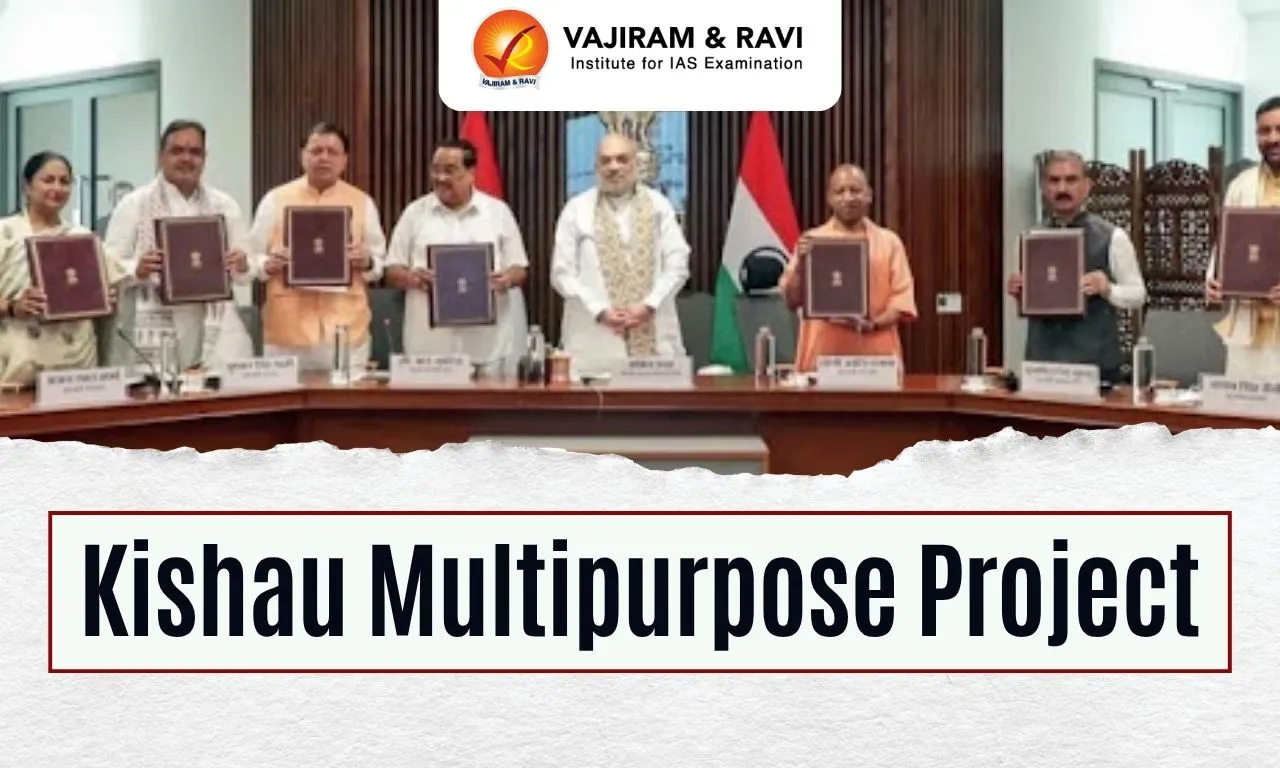
  • Recently, the chief ministers of six states signed a memorandum of understanding (MoU) in New Delhi to pave the way for the long-pending Kishau Multipurpose Project.
  • The Rs 15,000-crore project has been stalled for eight years over cost-sharing disputes. The project will now go before the Union Cabinet for approval.
  • The signatories were Himachal Pradesh CM, Uttarakhand CM, Uttar Pradesh CM, Haryana CM, Rajasthan CM and Delhi CM.
  • The agreement follows a meeting chaired by Union Home Minister where the six states agreed in principle to move ahead.

What the Project Is

  • The Kishau Multipurpose Project is a proposed dam and hydropower project on the Tons River, a major tributary of the Yamuna. 
  • Key features:
    • Location: along the Himachal Pradesh–Uttarakhand border, straddling Sirmaur district (HP) and Dehradun district (Uttarakhand)
    • Dam: 232.6-metre-high concrete gravity dam
    • Power: 422 MW capacity, generating 1,476 million units of clean hydropower
    • Irrigation potential: about 97,076 hectares
    • Water supply: drinking and industrial water to Haryana, Delhi, Rajasthan and Uttar Pradesh
    • Storage: capacity of 1,786 million cubic metres (MCM), with live storage of about 1,324 MCM

Why the Dam Was Needed

  • Kishau is one of three storage projects planned in the upper reaches of the Yamuna and its tributaries under an MoU signed in May 1994 by the Yamuna basin states: undivided Uttar Pradesh, Haryana, Rajasthan, Himachal Pradesh and the NCT of Delhi. 
  • The other two, Lakhwar and Renukaji, already have MoUs signed and are under implementation.
  • These projects were required because there are no storage facilities on the Upper Yamuna, from its source at the Yamunotri glacier to the Okhla barrage in Delhi, a catchment of about 30,000 square kilometres.

Yamuna Water Allocation under the 1994 MoU

  • Of the 11.983 billion cubic metres (BCM) of annual utilisable Yamuna water:
    • Haryana: 5.730 BCM
    • Uttar Pradesh: 4.032 BCM
    • Rajasthan: 1.119 BCM
    • Delhi: 0.724 BCM
    • Himachal Pradesh: 0.378 BCM
  • After Uttarakhand was carved out in 2000, undivided UP's 4.032 BCM was split as 3.721 BCM for UP and 0.311 BCM for Uttarakhand.

Why the MoU Was Delayed for Eight Years

  • Himachal Pradesh held out on two grounds:
    • Cost burden: Under an earlier arrangement, the previous state government agreed to contribute about Rs 800 crore, mainly for the power component. The current government rejected this as against Himachal's financial interest.
    • Disproportionate benefits: Himachal argued it should not invest heavily in a project whose water benefits would flow largely to downstream states like Delhi, Haryana and Rajasthan, while it bore the burden of submergence and displacement.
  • A 2020 feasibility study estimated that about 2,950 hectares would be submerged, affecting 17 villages and around 5,500 people across Himachal Pradesh and Uttarakhand.

How the Breakthrough Was Achieved

  • In June 2026, the Centre announced it would bear 90 per cent of the project's water component cost, with the six states sharing the remaining 10 per cent. 
  • A special mechanism was devised for Himachal Pradesh:
    • Himachal's allocated water share will be transferred to Delhi and Rajasthan.
    • In return, Delhi and Rajasthan will bear Himachal's share of the power component cost in a 75:25 ratio.
    • Himachal, which does not currently need the power, will receive payment for supplying electricity to neighbouring states.

Water Benefits to States

  • Storage allocation (MCM): Haryana 633, Uttar Pradesh 411, Rajasthan 124, Delhi 80, Uttarakhand 34, with a share for Himachal that is now being transferred.
  • Flow benefits (cusecs): Haryana 836, Uttar Pradesh 543.2, Rajasthan 163.52, Delhi 105.28.

Significance for the Yamuna

  • A key objective is to augment Yamuna flows through regulated storage and release from the Kishau reservoir. 
  • The Centre and the states have linked the project to the wider goal of Yamuna rejuvenation, expecting the additional flow to improve the availability of cleaner water in the river alongside irrigation, drinking water and power benefits.

Conclusion

  • The Kishau MoU resolves a decade-old federal deadlock through generous central funding and an innovative cost-benefit swap for Himachal Pradesh. 
  • It marks a significant step towards Upper Yamuna storage, water security for northern states and Yamuna rejuvenation. Implementation must now address submergence, displacement and rehabilitation with equal seriousness.

Source: IE | ITV | MC

Kishau Multipurpose Project FAQs

Q1: What is the Kishau Multipurpose Project?

Ans: The Kishau Multipurpose Project is a proposed dam and hydropower project on the Tons River, a major tributary of the Yamuna.

Q2: Why was the Kishau Multipurpose Project delayed?

Ans: The Kishau Multipurpose Project was delayed mainly because Himachal Pradesh opposed its financial burden and argued that downstream states received disproportionate water benefits.

Q3: How was the Kishau Multipurpose Project deadlock resolved?

Ans: The Kishau Multipurpose Project deadlock was addressed after the Centre agreed to fund 90% of the water component, with states sharing the remainder.

Q4: What are the major benefits of the Kishau Multipurpose Project?

Ans: The Kishau Multipurpose Project will provide hydropower, irrigation and drinking and industrial water while regulating Yamuna flows through reservoir storage and releases.

Q5: How will the Kishau Multipurpose Project benefit the Yamuna?

Ans: The Kishau Multipurpose Project aims to augment Yamuna flows through regulated storage, potentially improving cleaner water availability alongside irrigation, drinking water and power benefits.
Insolvency and Bankruptcy Code (IBC) Under the Scanner

Insolvency and Bankruptcy Code (IBC)

Insolvency and Bankruptcy Code (IBC) Latest News

  • The Enforcement Directorate (ED) has identified frauds and malpractices in insolvency proceedings under the Insolvency and Bankruptcy Code (IBC), 2016 as a key operational priority. 
  • Its focus comes amid concerns that the insolvency process can sometimes be manipulated to enable promoters or related parties to regain control of distressed assets at artificially low valuations, causing large losses to creditors.

The Subhash Chandra Case

  • The issue gained prominence following the National Company Law Tribunal (NCLT)’s August 25 settlement order in the Subhash Chandra case.
  • In this case, personal insolvency proceedings were allowed to be settled for ₹6.25 crore against admitted claims of ₹22,006.57 crore. 
  • A five-member NCLT special bench subsequently stayed the order on September 1.

ED Identifies Key IBC Fraud Risks

  • At its 36th Quarterly Conference of Zonal Officers, held in Bengaluru on September 14–15, the ED highlighted the need to uncover fraud under the IBC and Prevention of Money Laundering Act (PMLA).
  • The agency identified recurring malpractices such as -
    • Circumvention of Section 29A of the IBC to enable ineligible promoters or connected parties to participate in resolution.
    • Inflation of related-party claims, potentially influencing the distribution of insolvency proceeds.
    • Manipulation of the Committee of Creditors (CoC).
    • Asset stripping before or during insolvency proceedings.
    • Artificially large haircuts, allowing promoters or related parties to regain control of assets at substantially reduced prices.
  • Section 29A is intended to prevent defaulting promoters, wilful defaulters and specified connected persons from bidding for the assets of their own companies during insolvency.

The Problem of Deep Haircuts

  • A central concern is the extent to which creditors recover their dues through the IBC process.
  • Between FY2021-22 and FY2025-26, 1,077 cases were resolved, with creditors recovering about ₹2.47 lakh crore, equivalent to an average recovery of around 29% of admitted claims.
  • Recovery rates have also fluctuated significantly, for example, 24% in FY22; 39% in FY23; 28% in FY24; 37% in FY25; and 20% in FY26.
  • The decline to 20% in FY26, the lowest in five years, has intensified concerns about asset valuation, transparency and creditor recovery.
  • Banks have pointed to divergent valuation methodologies, inadequate accounting of assets and limited transparency as factors that may contribute to excessive haircuts.

Resolution vs Recovery - The Core Debate

  • The IBC's primary objective is resolution of distressed businesses rather than merely recovery of outstanding debt. 
  • Reviving a viable company as a going concern can preserve employment, productive capacity and economic value.
  • However, excessively low recoveries raise questions about whether the process is adequately protecting creditors and preventing value destruction.
  • The challenge is therefore to balance - Insolvency resolution → preservation of economic value → maximisation of creditor recovery → prevention of abuse of the process.

IBC-PMLA Legal Tensions

  • The ED has also examined the interaction between -
    • Section 14 of the IBC — provides a moratorium that temporarily restricts specified legal proceedings against the corporate debtor.
    • Section 32A of the IBC — provides specified immunity from prosecution for the corporate debtor and protection for its assets after a qualifying change of control to an unrelated successful resolution applicant.
    • PMLA — empowers authorities to attach and confiscate proceeds of crime.
  • This creates a potential legal tension where an insolvency process could allegedly be used to shield assets connected with money laundering or frustrate criminal investigations.

ED’s Proposed Enforcement Strategy

    • The ED has directed its regional offices to -
      • Identify red flags in insolvency proceedings.
      • Obtain applications concerning preferential, undervalued, fraudulent and extortionate transactions from Resolution Professionals.
      • File intervention applications before tribunals wherever necessary.
      • Initiate independent PMLA investigations against the masterminds behind fraudulent transactions.
      • Improve coordination with State police and other enforcement agencies.
      • Pursue restitution of attached/confiscated assets to legitimate victims.
      • Ensure valuation of confirmed attached properties by government-approved valuers.
  • Alchemist Limited case - A case study:
    • The ED also cited a case in which its intervention before the NCLT resulted in termination of the insolvency process. 
    • While the ED was investigating an alleged ₹1,842-crore financial scandal and money-laundering offences, an operational creditor initiated insolvency proceedings against the company.
    • The NCLT subsequently terminated the CIRP, observing prima facie concerns regarding -
      • Domination of the CoC by accused group entities;
      • Alleged layering of funds;
      • Misuse of the insolvency mechanism;
      • Potential use of Section 32A immunity to frustrate PMLA proceedings; and
      • Lack of a genuine objective of insolvency resolution.
    • The case illustrates the risk of using the IBC as a legal channel for siphoning or legitimising illicit funds rather than as a genuine mechanism for corporate restructuring.

Conclusion

Enforcement must preserve the IBC’s fundamental objective of time-bound resolution and revival of viable businesses, without allowing criminal investigations to unnecessarily undermine legitimate insolvency proceedings.

Source: IE

Insolvency and Bankruptcy Code (IBC) FAQs

Q1: What are the major forms of malpractice identified in IBC proceedings?

Ans: Circumvention of Section 29A, inflation of related-party claims, CoC manipulation, asset stripping, etc.

Q2: What is the significance of Section 29A of the IBC?

Ans: It prevents defaulting promoters, wilful defaulters and specified connected persons from participating in the resolution process.

Q3: What is the key legal tension between the IBC and PMLA?

Ans: The IBC’s Section 14 and Section 32A can conflict with PMLA’s powers to investigate, attach and confiscate proceeds of crime.

Q4: Why are deep haircuts under the IBC a concern for creditors?

Ans: Excessive haircuts can result from valuation deficiencies, inadequate asset disclosure and opaque processes.

Q5: How can misuse of the IBC for financial fraud be curbed?

Ans: Stronger Section 29A scrutiny, transparent valuation, independent CoCs, detection of related-party transactions, etc.

Dedicated Freight Corridors – Backbone of India’s Logistics Revolution

Dedicated Freight Corridors

Dedicated Freight Corridors Latest News

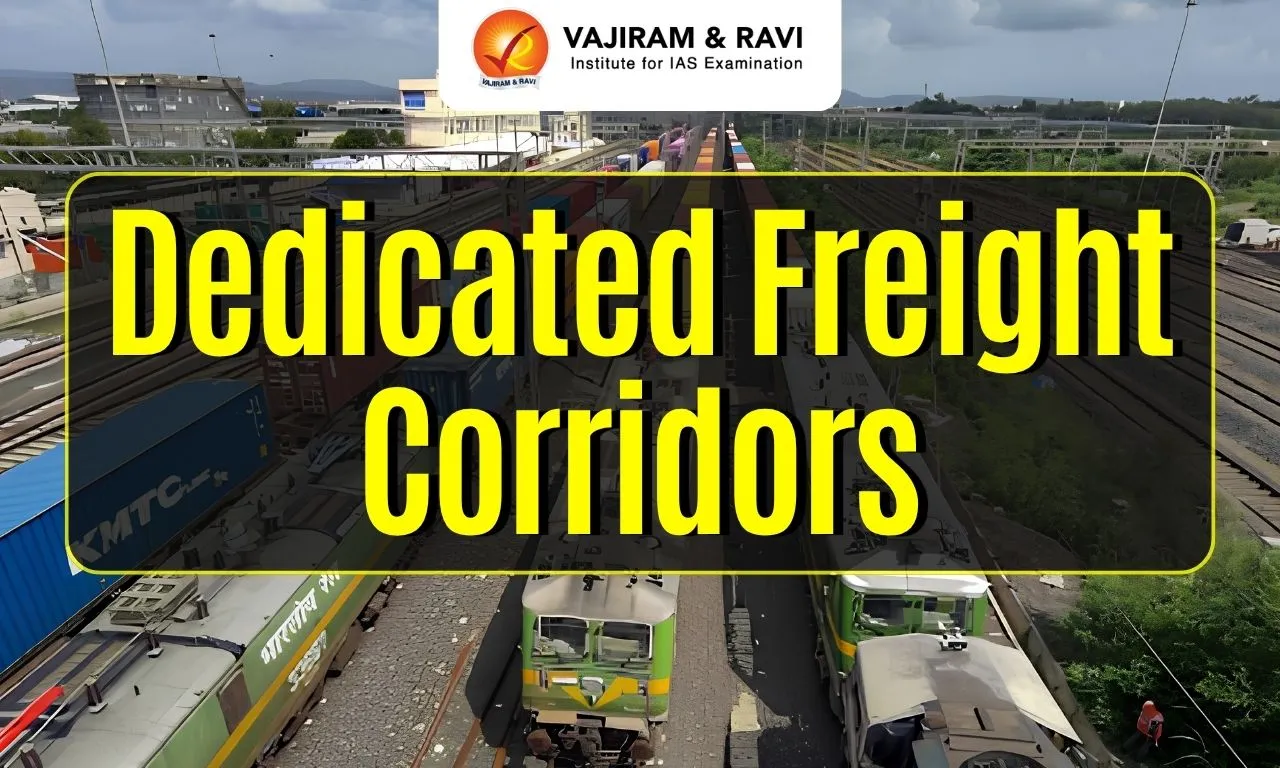
  • India has effectively completed a 2,843-km dedicated freight rail backbone, comprising the 1,506-km Western Dedicated Freight Corridor (WDFC) from Dadri to Jawaharlal Nehru Port Terminal (JNPT) and the 1,337-km Eastern Dedicated Freight Corridor (EDFC) from Ludhiana to Sonnagar.

About Dedicated Freight Corridors

  • Dedicated Freight Corridors (DFCs) are specialised railway routes designed primarily for the movement of freight. 
  • Unlike conventional railway networks, where passenger and freight trains share tracks, DFCs provide dedicated capacity for goods transportation.
  • They are designed to accommodate longer, heavier and double-stack container trains, thereby increasing freight-carrying capacity and improving operational efficiency.
  • The two operational corridors have complementary economic roles:
    • EDFC: Strengthens the mineral and industrial axis connecting northern India with eastern mineral-producing regions. 
    • WDFC: Strengthens the manufacturing and export axis connecting northern industrial regions with western ports. 
  • The Dadri-JNPT journey is expected to reduce travel time from approximately 66 hours to 58 hours.

PM GatiShakti and Multimodal Connectivity

  • Launched in 2021, PM GatiShakti is a GIS-based National Master Plan designed to improve multimodal connectivity to economic zones.
  • It integrates satellite imagery, geospatial databases and infrastructure project information to improve coordination between different ministries and agencies.
  • According to the source, 58 Central Ministries/Departments and all 36 States and Union Territories have been onboarded, with around 22,000 data layers integrated.
  • The Network Planning Group has evaluated 352 infrastructure projects worth Rs. 16.1 lakh crore, of which 201 have been sanctioned, and 167 are under implementation.

How DFCs Can Transform Logistics

  • The primary benefit of DFCs is the creation of additional capacity on the conventional railway network by diverting freight traffic onto dedicated routes.
  • Average DFC traffic increased from 247 trains per day in 2023-24 to 443 trains per day in August 2026. The WDFC alone was carrying around 210 trains per day, equivalent to approximately 88% of its capacity even before full commissioning.
  • This can generate wider productivity gains through:
    • Lower inventory and working-capital requirements
    • Improved inventory-to-sales ratios
    • Reduced road congestion and fuel consumption
    • Lower logistics-related emissions
    • Greater reliability of exports
    • Expansion of manufacturers' market radius
    • Higher factory utilisation
    • Improved port productivity

Integration with Ports and Industrial Corridors

  • The larger opportunity lies in integrating DFCs with Sagarmala, Bharatmala and multimodal logistics parks.
  • Sagarmala focuses on port-led development and includes 12 major ports and around 200 non-major ports. It has identified 294 rail and road connectivity projects, of which 84 have been completed, and 66 are under implementation.
  • The WDFC's economic influence can therefore extend beyond JNPT by connecting with western ports such as Mundra, Kandla, Pipavav and Hazira, and eventually Vadhavan.
  • This integration can transform the WDFC from a Delhi-Mumbai rail connection into a broader North-West India maritime trade corridor.

Economic Significance

  • India's logistics costs were estimated at 7.97% of GDP in 2023-24, equivalent to approximately Rs. 24.01 lakh crore.
  • Average freight costs were estimated at:
    • Rail: Rs. 1.96 per tonne-km
    • Road: Rs. 11.03 per tonne-km
    • Waterways: Rs. 1.80 per tonne-km
  • Consequently, shifting suitable long-distance freight from roads to dedicated rail corridors can generate substantial transportation-cost savings.

Sectors Likely to Benefit

  • The WDFC passes through important manufacturing regions of Haryana, Rajasthan, Gujarat and Maharashtra, creating potential benefits for Automobiles and auto components, Engineering goods, Textiles and apparel, Chemicals & Consumer goods.
  • For automobile manufacturers and exporters along the NCR-Gujarat-Maharashtra axis, reliable rail connectivity can improve movement of vehicles, components and industrial inputs towards western ports.
  • Gujarat's petrochemical and manufacturing clusters can also benefit from stronger port-rail connectivity and high-capacity freight evacuation.

Future Expansion

  • The Railways have identified three additional corridors for detailed project report examination:
    • East Coast Corridor: Kharagpur-Vijayawada
    • East-West Corridor: Including Palghar-Bhusawal-Nagpur-Kharagpur-Dankuni and Rajkharsawan-Kalipahari-Andal
    • North-South Corridor: Vijayawada-Nagpur-Itarsi
  • The 2,052-km Dankuni-Surat DFC identified in Budget 2026-27 could create another east-west freight spine connecting India's mineral and industrial heartland with Gujarat's ports and manufacturing base.

Way Forward

  • The success of DFCs will ultimately depend on last-mile connectivity, port evacuation, terminal capacity, warehousing, road interfaces and customs efficiency.
  • India's logistics transformation must therefore be measured not merely by the speed of freight trains but by the speed and efficiency of the entire logistics chain.

Source: TH

Dedicated Freight Corridors FAQs

Q1: What are Dedicated Freight Corridors (DFCs)?

Ans: Dedicated Freight Corridors are specialised railway routes designed exclusively for freight movement, allowing longer and heavier trains to operate with greater efficiency.

Q2: How long are India's two operational DFCs?

Ans: India has two operational DFCs covering about 2,843 km, comprising the 1,506-km Western DFC and the 1,337-km Eastern DFC.

Q3: What is the route of the Western Dedicated Freight Corridor?

Ans: The Western DFC connects Dadri in Uttar Pradesh with Jawaharlal Nehru Port Terminal in Maharashtra, passing through major industrial regions of northern and western India.

Q4: What is the significance of Dedicated Freight Corridors for India's logistics sector?

Ans: DFCs can reduce freight transportation costs, improve delivery reliability, decongest conventional railway routes and strengthen connectivity between industrial centres and ports.

Q5: How are DFCs linked with PM GatiShakti?

Ans: DFCs complement PM GatiShakti by providing high-capacity rail connectivity within an integrated multimodal infrastructure network involving roads, ports, waterways and logistics facilities.

Weapons in Space: US Admission and the Legal Vacuum in Outer Space

Weapons in Space

Weapons in Space Latest News

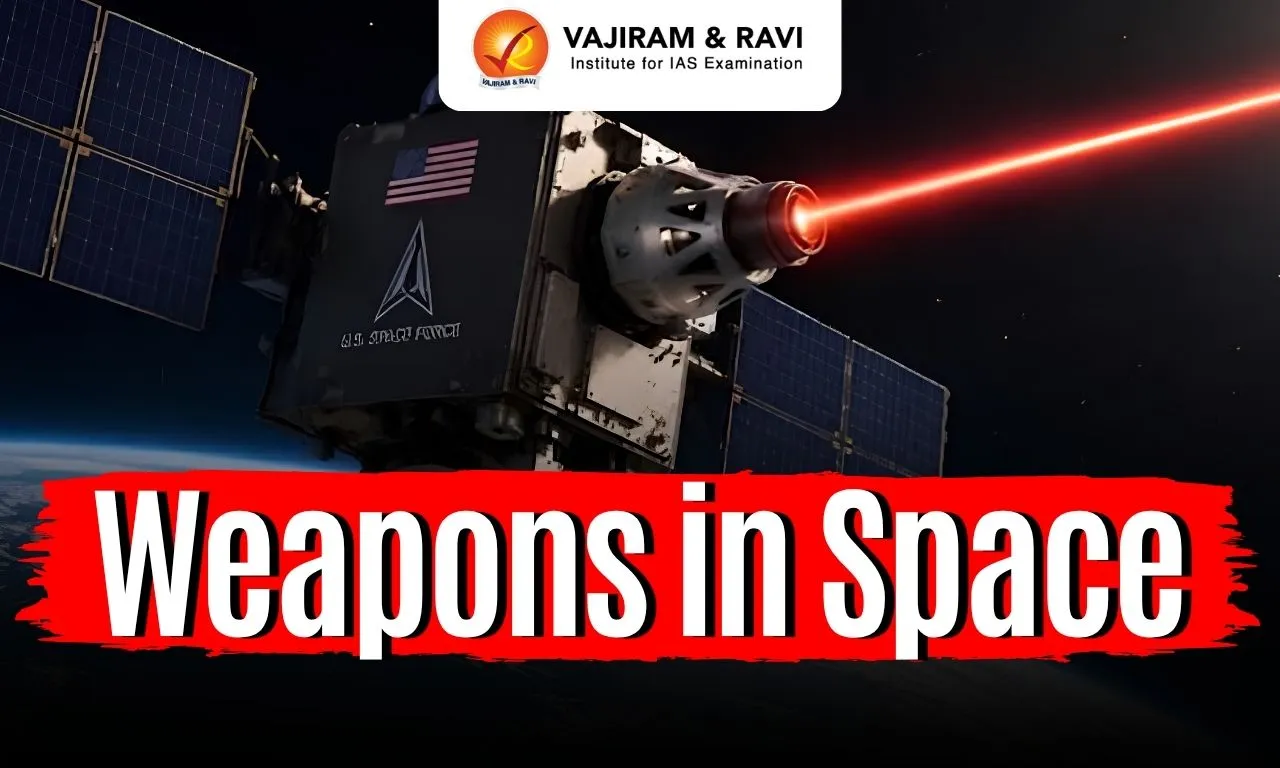
  • The United States has publicly admitted that it has active weapons deployed in space. This is the first such admission by any country and has sparked a fresh global debate. 
  • US Air Force Secretary said at a conference in Maryland that the US now has "on-orbit space control weapons" capable of defending its joint forces against hostile adversary action. The US did not reveal the nature of the weapons or when they were deployed.

Reactions from China and Russia

  • The two countries the US considers its space adversaries responded immediately:
    • China urged the US to stop expanding its military capabilities and preparing for war in outer space.
    • Russia called for keeping space free of weapons and expressed hope for broad international consolidation towards the complete demilitarisation of space.
  • Ironically, the US itself accuses China and Russia of building counterspace capabilities to track and target US forces. 
  • It should be noted that the US Space Force was set up in 2019 during President Donald Trump's first term.

What Weaponisation of Space Means

  • Though this is the first public admission, the capabilities are neither new nor a revelation. Military use of outer space covers several categories:
    • Earth-to-space: Launching a missile from Earth to destroy enemy satellites or other space assets
    • Space-to-Earth: Sending weapons from space to destroy ground-based targets
    • Space-to-space: Using space-based weapons to target other space-based assets
  • It is unclear which category the newly acknowledged US weapons fall into.

Kinetic and Non-Kinetic Weapons

  • Space weapons need not be "kinetic", that is, capable of physical destruction. Non-kinetic methods can be equally effective in conflict:
    • Disrupting or jamming communications between an enemy's space and Earth-based systems.
    • Attacking cyber-networks that control space assets.
  • Several countries have developed some or all of these capabilities, though not all have been tested or demonstrated.

Demonstrated Capabilities So Far

  • Anti-satellite (ASAT) tests are the most open demonstration of space weapons. Four countries have conducted them: the United States, Russia, China and India. 
  • Each targeted its own non-functional satellite, but the ability to completely destroy a space asset remains the most dramatic use of space weapons to date.
  • Non-kinetic examples include:
    • Just before Russia's attack on Ukraine in February 2022, Russian hackers gained control of ground stations of the Viasat satellite, which provided internet services to Ukrainian subscribers, including military agencies.
    • Russia has reportedly attempted to block GPS signals in Ukraine.

The Legal Ambiguity

  • All countries emphasise peaceful use of space and urge each other not to militarise it. 
  • Yet no international law explicitly prohibits the deployment or use of conventional weapons or tactics in space.
  • The Outer Space Treaty, 1967 remains the most relevant law on the subject. Its scope and gaps:
    • It bars countries from carrying or placing nuclear weapons or other weapons of mass destruction in space.
    • It is silent on conventional weapons and weapons targeting physical infrastructure in space.
    • It says nothing about Earth-to-space weapons, which were still a distant prospect in the 1960s.

Failed Attempts at Regulation

  • Efforts to create a binding framework have lacked support from major space powers:
    • Around 2008, China and Russia jointly proposed a "Prevention of the Placement of Weapons in Outer Space" (PPWT) treaty to ban all weapons in space, not just WMDs. 
    • It excluded Earth-to-space weapons and never came to fruition.
    • Discussions on "Prevention of an Arms Race in Outer Space" (PAROS) at the UN Conference on Disarmament have not produced any treaty.

The Artemis Accords

  • The Artemis Accords, an initiative of NASA and the US State Department, are a voluntary code of conduct for space exploration with over 70 signatories, including India. 
  • All cooperative activities are meant to be for peaceful purposes. However, nothing in the Accords prevents signatories from deploying or using weapons in space.

Conclusion

  • The US admission formalises what has long been an open secret: outer space is already militarised. The 1967 Outer Space Treaty bans only weapons of mass destruction, leaving conventional and non-kinetic weapons unregulated. 
  • With PPWT and PAROS stalled, the world lacks a binding framework to prevent a space arms race. 
  • For India, a demonstrated ASAT power and Artemis signatory, the challenge is to protect its growing space assets while pushing for credible international norms.

Source: IE | IT | FP

Weapons in Space FAQs

Q1: Why has the issue of weapons in space gained attention?

Ans: Weapons in Space gained attention after the US publicly acknowledged deploying on-orbit space-control weapons, without disclosing their nature or deployment timeline.

Q2: What are the different categories of weapons in space?

Ans: Weapons in Space can involve Earth-to-space, space-to-Earth and space-to-space systems, targeting satellites, ground-based assets or other space-based infrastructure.

Q3: Are all weapons in space kinetic?

Ans: Weapons in Space need not be kinetic; non-kinetic methods can include communications jamming and cyberattacks against networks controlling space-based assets.

Q4: Does international law prohibit weapons in space?

Ans: International law on weapons in space remains incomplete because the Outer Space Treaty prohibits WMDs but does not explicitly prohibit conventional weapons.

Q5: What is the significance of the Artemis Accords for weapons in space?

Ans: The Artemis Accords promote peaceful space exploration, but their voluntary framework does not prevent signatories from deploying or using weapons in space.

Enquire Now