Exercise Aarogya Setu

Exercise Aarogya Setu

Exercise Aarogya Setu Latest News

In a landmark initiative, the Indian Army recently organised the maiden Exercise Aarogya Setu at Rupai, Doomdooma in the Tinsukia district of Assam.

About Exercise Aarogya Setu

  • It was organised by the Indian Army at Rupai, Doomdooma, in the Tinsukia district of Assam.
  • A first of its kind, it marked a civil-military medical fusion exercise in the region.
  • The event aimed at strengthening cooperation between the Army Medical Corps, reputed senior civil doctors from leading hospitals, and PHCs of Tinsukia and the Northern Frontier Railway Hospital, Tinsukia.
  • The focus of the exercise was on how Army and Civil medical fraternities can work together during disasters and war-like situations.
  • A special highlight was the participation of a doctor from the Northern Frontier Railway Hospital, who introduced the concept of train ambulances —a life-saving facility.
  • The presentation drew great interest and sparked discussions on innovative methods of large-scale casualty evacuation.
  • Doctors from both sides discussed how civil institutions can extend crucial support to Army medical authorities.

Source: NEN

Exercise Aarogya Setu FAQs

Q1: Exercise Aarogya Setu was organised by which institution?

Ans: Indian Army

Q2: Where was Exercise Aarogya Setu conducted?

Ans: Doomdooma, Tinsukia district, Assam

Q3: What was the key focus of Exercise Aarogya Setu?

Ans: Civil-military medical fusion during disasters and war-like situations.

Psephology

Psephology

Psephology Latest News

The Supreme Court recently stayed criminal proceedings initiated against psephologist Sanjay Kumar for a social media post concerning an erroneous analysis of the 2024 Maharashtra Assembly election.

About Psephology

  • Psephology is a branch of political science that deals with the scientific analysis of elections or polls.
  • This field is dedicated to offering a meticulous quantitative analysis of elections. 
  • The toolbox of psephology encompasses a variety of instruments employed for the statistical examination of election data. 
  • These invaluable tools include voting data, opinion polls, campaign insights, and related datasets. 
  • Those who wield the expertise of psephology are known as Psephologists.
  • Psephologists study the patterns of elections, using past voting figures and their percentage, public opinion polls and other related information. 
  • They estimate the results of the public opinion for the future elections using statistical applications. 
  • India does not have an actual post called ‘Psephologist’. 
  • However, some major parties have in-house analysts who can be called Psephologists
  • Several accomplished media editors, political analysts, and marketing research scientists double up as Psephologists.

Source: TH

Psephology FAQs

Q1: Psephology is a branch of which discipline?

Ans: Political Science

Q2: Who are experts in the scientific analysis of elections called?

Ans: Psephologists

Q3: What is the main focus of Psephology?

Ans: Predicting election outcomes.

Shipki La Pass

Shipki La Pass

Shipki-La Pass Latest News

China has agreed in principle to the proposal of resuming trade through Shipki-La in Kinnaur district of Himachal Pradesh during the recent visit of its Foreign Minister Wang Yi to India.

About Shipki-La Pass

  • It is a motorable mountain pass situated at an altitude of 3,930 meters, bordering India and China in tribal district of Kinnaur in Himachal Pradesh.
  • It also serves as the boundary post on the frontier between China and India.
  • It is one of the highest motorable passes.
  • Through this pass the Sutlej River (known as Langqen Zangbo in Tibet) enters India, has long served as a vital trade corridor between India and Tibet.
  • The old name of Shipki La was Pema La, or Shared Gate, also known as Shared Pass.
  • It was declared the Line of Actual Control post-1962, and later, the Indo-Tibetan Border Police named it Shipki La.
  • Shipki La Pass Significance: The opening of Shipki La to tourists is part of a broader strategy to stimulate economic growth in Kinnaur and Lahaul-Spiti, which share a 240-km border with China.

Source: TH

Shipki La Pass FAQs

Q1: Where is the Shipki La pass located?

Ans: Kinnaur district

Q2: Which is the longest pass in India?

Ans: Umling La or Umlingla Pas

Vaquita

Vaquita

Vaquita Latest News

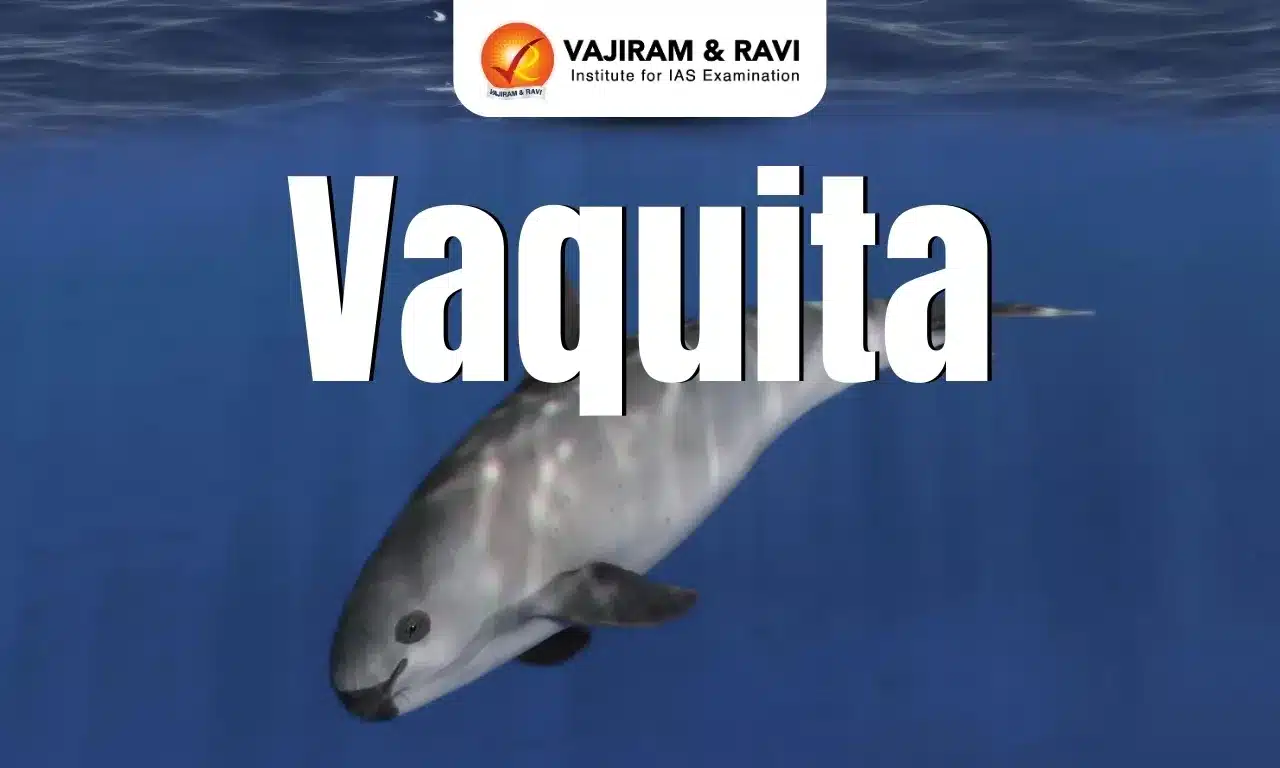
A report by the North American Environmental Commission has criticized Mexico for failing to protect the endangered vaquita porpoise, with only 10 remaining.

About Vaquita

  • It is a shy member and the smallest of the porpoise family.
  • Vaquitas are the most endangered of the world’s marine mammals.

Distribution of Vaquita

  • It is the smallest range of any whale, dolphin, or porpoise.
  • It lives in the northern part of the Gulf of California, an area that is rich in fish and shrimp. 
  • It is most commonly sighted in shallow waters up to 50 metres deep.

Features of Vaquita

  • Vaquitas are the smallest cetaceans—the group that includes dolphins, porpoises,
  • Although they do visually resemble dolphins, their closest relatives, vaquitas, have chunkier bodies and rounded heads with no snouts.
  • Their dorsal fins are unique in that they are taller and wider than most other porpoises.
  • Known for their elusive nature, vaquitas tend to shy away from boats and human activity.
  • Vaquitas communicate using echolocation (or sonar) by emitting high-frequency clicks.
  • Conservation Status: Critically Endangered (IUCN)
  • Threats: The decrease in the vaquita population is also related to the totoaba, a large fish that also only lives in the Gulf of California.

Source: DTE

Vaquita FAQs

Q1: What are cetaceans?

Ans: These are a group of marine mammals that include whales, dolphins, and porpoises. They are well-adapted to life in aquatic environments.

Q2: What is the echolocation?

Ans: Echolocation, or sonar, is the use of sound waves to determine the location of objects.

National Youth Award

National Youth Award

National Youth Award Latest News

The Ministry of Youth Affairs & Sports, Government of India, invited nominations for the National Youth Award (NYA) 2024.

About National Youth Award

  • It is sponsored by the Ministry of Youth Affairs.
  • It is for the Indian youth for their tremendous and outstanding work in social service.
  • This award is to motivate young persons to achieve excellence in the field of national development or social service
  • It aims to motivate young persons (aged between 15 – 29 years) to achieve excellence in the field of national development or social service;
    • To encourage young people to develop a sense of responsibility to the community and thus to improve their own personal potential as good citizens; and
    • To give recognition to the outstanding work done by voluntary organizations working with the youth for national development and/or social service.
  • The National Youth Awards are conferred usually during the National Youth Festival.
  • The award is given in two categories: Individual Category and Organisation Category
  • The number of awards given each year would ordinarily not exceed 20 for individual category and five for organization category. It may, however, vary at the discretion of the sanctioning authority in deserving case.
  • Prize money: Award to individuals will comprise a medal, a certificate and award money of ₹1,00,000/-. Award to voluntary youth organizations will comprise a medal, a certificate and award money of ₹3,00,000/-.
  • Eligibility for Award:
    • Individuals/organisations who have shown identifiable excellent work for youth in different fields of development activities and social service such as health, research and innovation, culture, promotion of human rights, art and literature, tourism, traditional medicine, active citizenship, community service, sports and academic excellence, and smart learning are encouraged.

Source: PIB

National Youth Award FAQs

Q1: Who is eligible for National Youth Award?

Ans: The applicant should have done extraordinarily identifiable social work.

Q2: What is the age limit for National Youth Award?

Ans: 15 – 29 years

Fiji

Fiji

Fiji Latest News

India will provide training and equipment to upgrade Fiji’s maritime security, Prime Minister said recently.

About Fiji

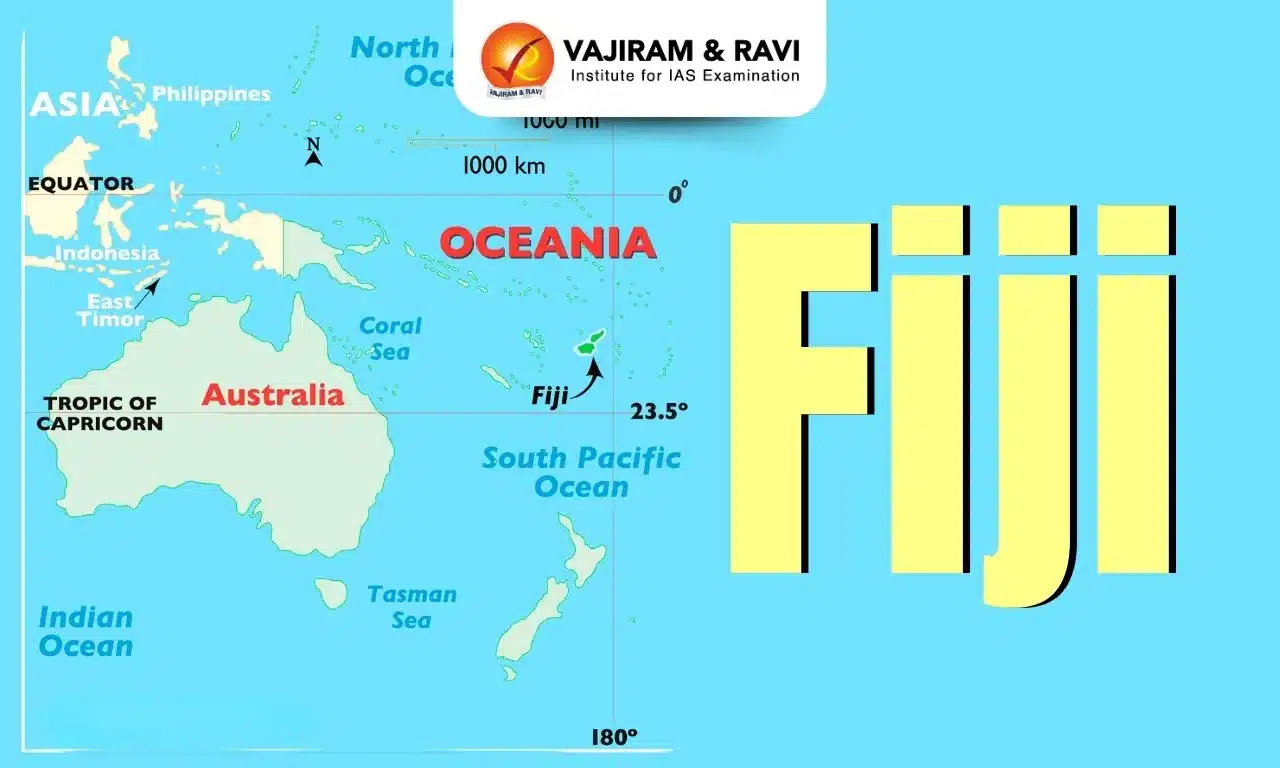
  • It is a country located in the South Pacific Ocean, surrounding the Koro Sea, to the northeast of New Zealand and southwest of Hawaii.
  • It is an archipelago consisting of some 300 islands and 540 islets scattered over about 1,000,000 square miles (3,000,000 sq.km).
  • It does not share land borders with any other country. 
  • Of the 300 islands, about 100 are inhabited. 
  • The capital, Suva, is on the southeast coast of the largest island, Viti Levu (“Great Fiji”).
    • Viti Levu accounts for more than half of Fiji’s land area.
    • This region is characterized by rugged terrain, with a central mountain range that includes the country’s highest peak, Mount Tomanivi, standing at 1,324 m (4,344 ft). 
  • Fiji has a complex geologic history and the islands are largely the product of volcanic action, sedimentary deposit, and formations of coral. 
  • Almost half of Fiji’s total area remains forested, while dry grasslands are found in western areas of the large islands.
  • The majority of Fijians are of mixed Melanesian-Polynesian ancestry, with a large South Asian minority
  • Languages: English (official), Fijian.
  • Currency: Fiji dollar. 

Source: TH

Fiji FAQs

Q1: Fiji is located in which part of the world?

Ans: South Pacific Ocean

Q2: What is the capital of Fiji?

Ans: Suva

Q3: Which is the highest peak in Fiji?

Ans: Mount Tomanivi

Q4: The majority of Fijians are of which ancestry?

Ans: Mixed Melanesian-Polynesian.

Minicoy Island

Minicoy Island

Minicoy Island Latest News

A 12-year-old tigress, which had been sick and roaming near the forest boundary in the Singara forest range of the Mudumalai Tiger Reserve (MTR), died recently.

About Minicoy Island

  • Minicoy, locally known as Maliku, is the second largest and southernmost island in Lakshadweep.
  • Minicoy is famous for coral reefs and white sand beaches amidst the vast expanse of the Arabian sea.
  • It is  crescent-shaped and has an area of 4.80 sq.km.
  • This island lies near the 9-degree channel, which is one of the busiest shipping routes and is about 130 km from the northernmost island of the Maldives. 
  • It has a very large lagoon on the western side, measuring about 6 km across the two entrances, one on the west and the other on the northernmost point. The lagoon area is 30.60 sq.km.
  • The island is about 2 m above the mean sea level on the western side and about 3 to 4 m on the eastern side, and is 11 km long.
  • The lighthouse of the island is one of the oldest and was constructed in 1885. 
  • Minicoy is set apart from the Northern group of islands by its culture.
  • The main attraction of the island is its carefully arranged villages, known as ‘Avah’. 
    • Each Avah has its own internal organization headed by a Moopan, around which the life of the community rests.
    • Every village has its own village house. In total there are 10 villages on the island.
  • The languages spoken are Hindi, English, Malayalam, and Mahal. Minicoy being the only people in India speaking Mahal as a linguistic minority.
  • The folk dances of Minicoy are ‘Lava’, Thaara’, ‘Dandi’, ‘Fuli’ and ‘Bandiya’.

Source: TOI

Minicoy Island FAQs

Q1: Minicoy Island, locally known as Maliku, is part of which Union Territory?

Ans: Lakshadweep

Q2: Minicoy is located near which important maritime route?

Ans: 9-Degree Channel

Q3: What are the traditional villages of Minicoy Island called?

Ans: Avah

Archaeological Survey of India

Archaeological Survey of India

Archaeological Survey of India Latest News

The Archaeological Survey of India (ASI) has once again drawn public scrutiny following the controversial transfer of archaeologist K. Amarnath Ramakrishna.

About Archaeological Survey of India

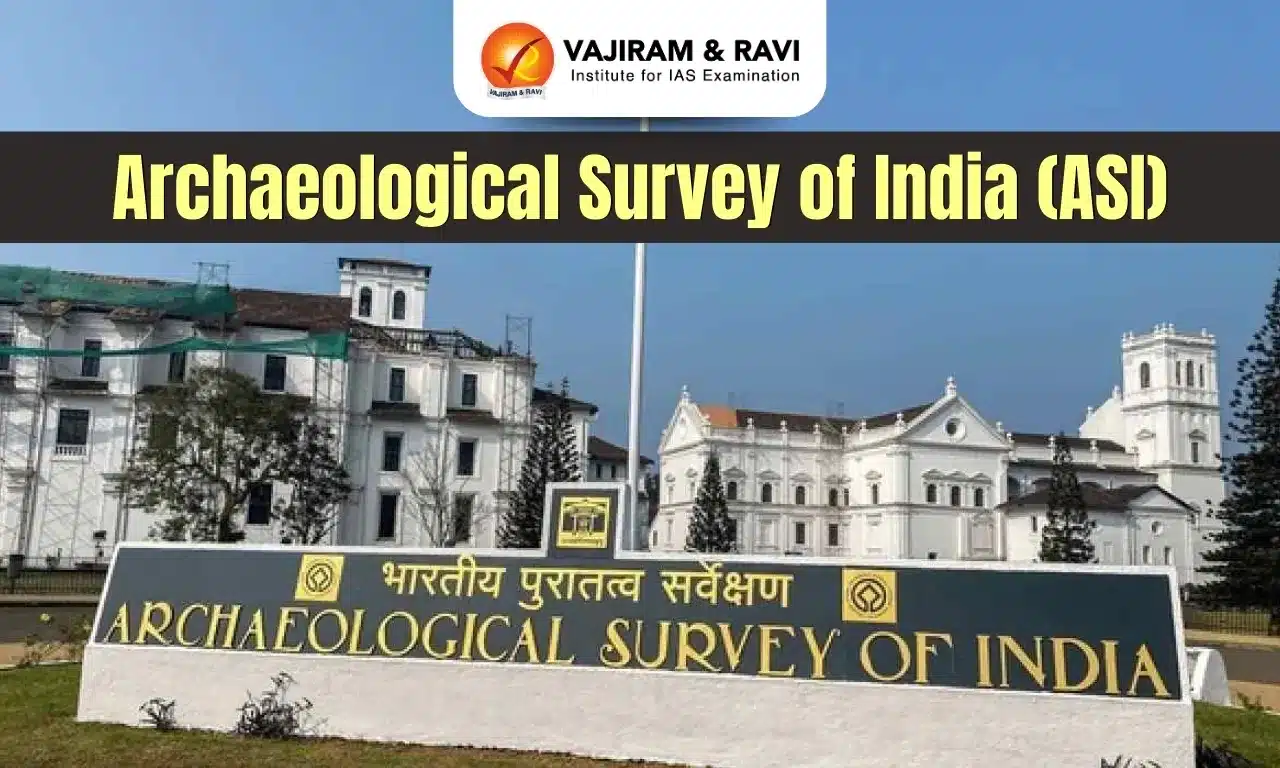
  • ASI, under the Ministry of Culture, Government of India, is a premier organisation for archaeological research and protection of the tangible heritage of the nation. 
  • It was established in 1861 by Sir Alexander Cunningham, with its headquarters in New Delhi. 
  • After independence, it was established as a statutory body under the Ancient Monuments and Archaeological Sites and Remains Act, 1958 (AMASR Act).
  • The prime concern of ASI is the maintenance of ancient monuments, archaeological sites, and remains of national importance. 
  • Besides, it regulates all archaeological activities in the country as per the provisions of the AMASR Act. 
  • It also regulates the Antiquities and Art Treasure Act, 1972. 
  • The Central Government has declared 3679 monuments and sites as of national importance, and ASI shoulders the responsibility of protecting and maintaining them.
  • The organization has a large workforce of trained archaeologists, conservators, epigraphists, architects, and scientists for conducting archaeological research projects through its Circles, Museums, Excavation Branches, Prehistory Branch, Epigraphy Branches, Science Branch, Horticulture Branch, Building Survey Project, Temple Survey Projects, and Underwater Archaeology Wing.

Source: TH

Archaeological Survey of India FAQs

Q1: The Archaeological Survey of India (ASI) functions under which Ministry?

Ans: Ministry of Culture

Q2: Who established the Archaeological Survey of India in 1861?

Ans: Sir Alexander Cunningham

Q3: Where is the headquarters of the Archaeological Survey of India located?

Ans: New Delhi

Q4: Under which Act did Archaeological Survey of India become a statutory body after Independence?

Ans: Ancient Monuments and Archaeological Sites and Remains Act, 1958

Anamalai Tiger Reserve

Anamalai Tiger Reserve

Anamalai Tiger Reserve Latest News

A year-long study by the Tamil Nadu Forest Department has identified that at least eight species of fireflies light up Anamalai Tiger Reserve forests with their bioluminescence.

About Anamalai Tiger Reserve

  • Location: It is a protected area located at an altitude of 1400 m in the Anamalai Hills of Pollachi and Coimbatore District of Tamil Nadu.
  • It lies south of the Palakkad gap in the Southern Western Ghats. 
  • It is surrounded by the Parambikulum Tiger Reserve on the east, Chinnar Wildlife Sanctuary, and Eravikulum National Park on the southwestern side.
  • The reserve is also surrounded by the Nenmara, Vazhachal, Malayattur, and Marayur reserved forests of Kerala.
  • It was declared a tiger reserve in the year 2007.
  • It is inhabited by six indigenous communities viz., Kadar, Muduvar, Malasar, Malai malasar, Eravalar and Pulayar.
  • Vegetation: It supports diverse habitat types, viz. Wet evergreen forests, semi-evergreen forests, moist deciduous, dry deciduous, dry thorn, and shola forests. Other unique habitats like montane grasslands, savannah and marshy grasslands are also present.
  • Flora: The reserve is rich in wild relatives of cultivated species like mango, jackfruit, wild plantain, ginger (Zingiber officinale), turmeric, pepper (Piper longum), cardamom, etc.
  • Fauna: The important wild animals of the reserve include: Tiger, Asiatic elephant, Sambar, Spotted deer, Barking deer, Jackal, Leopard, Jungle cat, etc

Source: TH

Anamalai Tiger Reserve FAQs

Q1: In which state is Anamalai Tiger Reserve located?

Ans: Tamil Nadu

Q2: Which river flows in Anamalai Tiger Reserve?

Ans: It is home to several rivers, such as Aliyar, Uppar, and Nirar.

INS Udaygiri and INS Himgiri

INS Udaygiri and INS Himgiri

INS Udaygiri and INS Himgiri

Indian Navy is set to commission the latest state of the art Project 17A multi-mission stealth frigates Udaygiri and Himgiri at Naval Base, Visakhapatnam, on 26 Aug 2025. 

About INS Udaygiri and INS Himgiri

  • Udaygiri and Himgiri are built under the Project 17 (Shivalik) class frigates.
  • Udaygiri, built by Mazagon Dock Shipbuilders Ltd. (MDL), Mumbai, and Himgiri, constructed by Garden Reach Shipbuilders & Engineers (GRSE), Kolkata, showcase the nation’s growing shipbuilding prowess, as well as, the synergy between India’s premier defence shipyards. 
  • Both frigates were designed in-house by the Indian Navy’s Warship Design Bureau (WDB).
  • Upon commissioning, the two frigates will join the Eastern Fleet, strengthening India’s ability to safeguard its maritime interests across the Indian Ocean Region.

Features of INS Udaygiri and INS Himgiri

  • The ships feature modern Combined Diesel or Gas (CODOG) propulsion plants, state of the art Integrated Platform Management System and a suite of advanced weapons and sensors developed by Indian manufacturers.
  • The ships, with about 75% indigenous content, supported by hundreds of indigenous MSMEs, align with the Government’s vision of Aatmanirbhar Bharat in defence manufacturing.
  • Udaygiri also holds the distinction of being the fastest ship of her class to be delivered post-launch, a result of the modular construction methodology adopted by Indian shipyards.
  • Both these vessels incorporate significant improvements in design, stealth, weapon and sensors systems and are capable of executing full spectrum of maritime missions in Blue Water conditions.
  • Significance: The commissioning of these two will augment the Navy’s combat readiness and reaffirm India’s resolve to achieve self-reliance in warship design and construction.

Source: PIB

INS Udaygiri and INS Himgiri FAQs

Q1: Under which project is the naval ship Himgiri constructed and launched?

Ans: PROJECT 17A

Q2: Which was the first ship of Project 17A?

Ans: INS Nilgiri

Enquire Now