Impatiens Selvasinghii

Impatiens Selvasinghii

Impatiens Selvasinghii Latest News

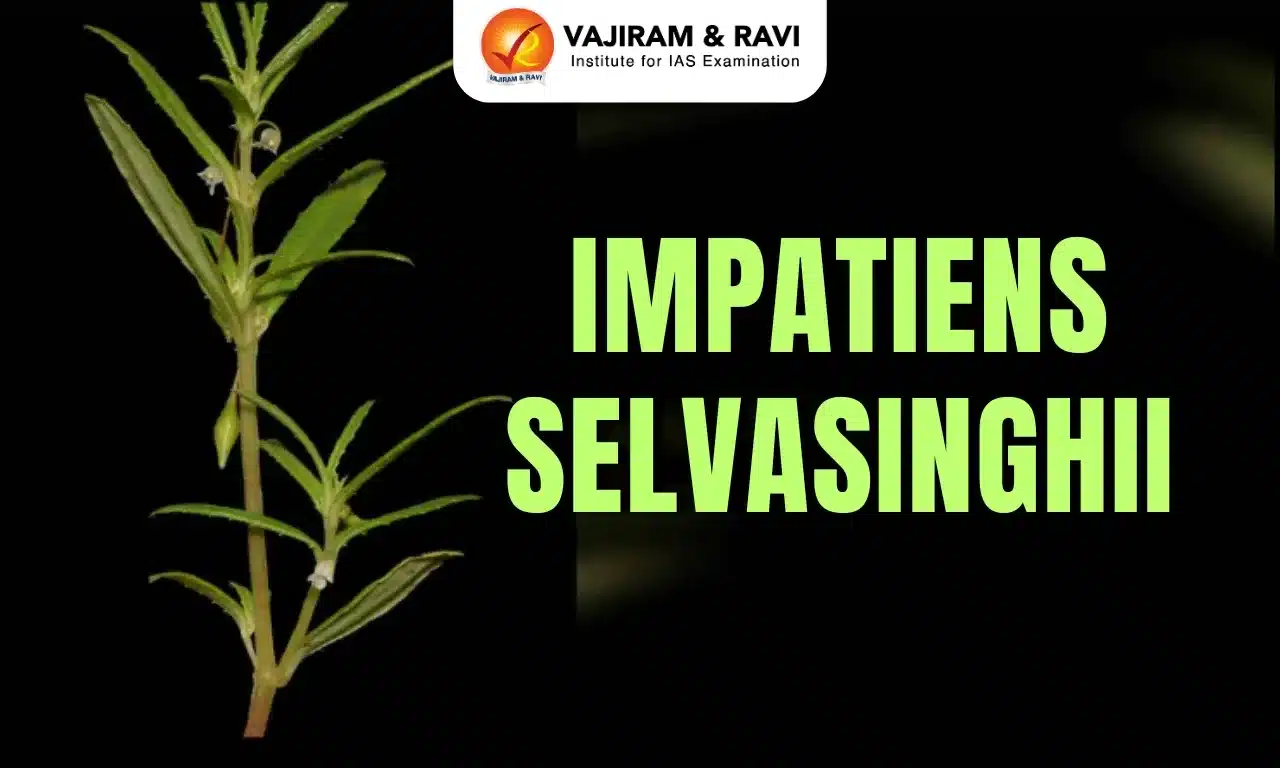
Researchers recently found a new plant species named Impatiens selvasinghii in the Kudremukh range of the Western Ghats.

About Impatiens Selvasinghii

  • It is a new species of flowering plant.
  • It was discovered in the Kudremukh range of the Western Ghats in Karnataka at an altitude of 1,630 meters.
  • It is named after an associate professor of botany at Madras Christian College.
  • It is one of the smallest flowered balsams from the Western Ghats. Small insects are dependent on this plant.
  • It has an exceptionally small flower size and prominently-lobed wing petals, which makes it unique.
  • In India, the genus Impatiens is represented by more than 280 taxa, chiefly distributed in the Eastern Himalayas and Western Ghats. 
    • Over 210 taxa are endemic to India, of which 130 are endemic to the Western Ghats, and 80% of taxa in the Western Ghats are categorized as endangered.

Source: TOI

Impatiens Selvasinghii FAQs

Q1: Where was the new species Impatiens selvasinghii discovered?

Ans: It was discovered in the Kudremukh range of the Western Ghats in Karnataka.

Q2: Who is Impatiens selvasinghii named after?

Ans: A professor at Madras Christian College.

Q3: What unique feature makes Impatiens selvasinghii distinct among balsams?

Ans: Exceptionally small flowers and prominently-lobed wing petals.

Q4: What percentage of Impatiens taxa in the Western Ghats are categorized as endangered?

Ans: 80%

Adi Yuva Fellowship & Adi Karmayogi Volunteers Programme

Adi Yuva Fellowship & Adi Karmayogi Volunteers Programme

Adi Yuva Fellowship & Adi Karmayogi Volunteers Programme Latest News

Recently, the Ministry of Tribal Affairs, in partnership with the United Nations in India, launched the Adi Yuva Fellowship and the Adi Karmayogi Volunteers Programme under the Adi Karmayogi Abhiyan.

About Adi Yuva Fellowship

  • It is supported by United Nations India.
  • It is a first-of-its-kind programme designed to empower tribal youth through structured learning, mentorship, and career development.

Features of Adi Yuva Fellowship

  • Under this initiative selected tribal youth will undertake a 12-month paid Fellowship, with a tailored learning plan that balances knowledge-building, on-the-job experience, and reflective practice.
  • Allowances: Fellows will receive monthly allowances, comprehensive health and life insurance, and access to high-quality UN and commercial learning platforms.
  • This programme will link Fellows to national skilling and employability schemes such as PMKVY 4.0, NAPS, and PM Viksit Bharat Rozgar Yojana.
  • Selection process: The fellows will be selected through a competitive process and placed with UN agencies at the national, state, and district levels.

Adi Karmayogi Volunteers Programme

  • It is supported by UNFPA.
  • Objective: It will equip tribal youth to act as catalysts for grassroots change and strengthen last-mile service delivery in tribal regions.
  • 82 UN Community Volunteers as Adi karmayogi Volunteers have been deployed across 82 blocks in 13 districts of Madhya Pradesh and Rajasthan for an intensive two-month grassroots engagement.
  • Volunteers will support Village Vision 2030 planning, awareness drives, outreach, and improved access to schemes and services.

Source: PIB

Adi Yuva Fellowship & Adi Karmayogi Volunteers Programme FAQs

Q1: What is the primary objective of the Adi Karmayogi Abhiyan?

Ans: It aims to empower tribal communities and strengthen responsive governance

Q2: Which the nodal ministry for the implementation of the Adi Karmayogi Abhiyan?

Ans: Ministry of Tribal Affairs

Smog Eating Photocatalytic Coatings

Smog Eating Photocatalytic Coatings

Smog Eating Photocatalytic Coatings Latest News

The Delhi government will conduct a time-bound study on “smog-eating” photocatalytic coatings in Delhi to combat air pollution.

About Smog Eating Photocatalytic Coatings

  • It is designed to neutralise harmful gases like nitrogen dioxide and volatile hydrocarbons that contribute to toxic air.
  • It usually uses titanium dioxide as a coating which has advantages for being low-cost and chemically stable.
    • Titanium dioxide is also known for its compatibility with traditional construction materials.
    • It has been “demonstrated that TiO₂-based photocatalytically active construction materials can be useful for gaseous depollution and environmental cleaning processes.
  • Photocatalytic activity helps fight pollution by breaking down harmful substances and organic waste into less toxic or harmless matters using light energy, thereby making air and water cleaner.

What is Smog?

  • Smog is used to refer to a type of air pollution caused by a combination of smoke (and other pollutants) and fog.
  • Smog encompasses a broad category of air pollutants created through a multitude of processes that relate specifically to the atmospheric conditions of the formation region. 
  • Two distinct types of smog are recognized: 
    • Sulfurous smog: It results from a high concentration of sulfur oxides in the air and is caused by the use of sulfur-bearing fossil fuels, particularly coal.
    • Photochemical smog: It occurs most prominently in urban areas that have large numbers of automobiles.

Source: New India Express

Smog Eating Photocatalytic Coatings FAQs

Q1: How do smog-eating photocatalytic coatings work?

Ans: They break down pollutants into harmless compounds through photocatalysis

Q2: Which material is commonly used in smog-eating photocatalytic coatings?

Ans: Titanium dioxide (TiO₂)

Fishing Cat

Fishing Cat

Fishing Cat Latest News

Marking a significant addition to Ramgarh Vishdhari Tiger Reserve's (RVTR) small cat population, forest officials said a Fishing Cat (Prionailurus viverrinus) was recently seen on camera for the first time inside the reserve.

About Fishing Cat

  • It is a stocky and powerfully built medium-sized wild cat species.
  • Scientific Name: Prionailurus viverrinus

Fishing Cat Distribution

  • It is native to South and Southeast Asia.
  • They inhabit the peninsular region of India, Sri Lanka, Malaysia, Thailand, Java, and Pakistan.
  • In India, fishing cats are mainly found in the mangrove forests of the Sundarbans, on the foothills of the Himalayas along the Ganga and Brahmaputra river valleys, and in the Western Ghats.
  • It is the state animal of West Bengal.

Fishing Cat Habitat

  • They are found in a variety of wetland habitats, including mangrove forests, swamps, marshes, and other areas near water sources. 
  • The species is adapted to both fresh and saltwater habitats, and is able to tolerate a wide range of weather conditions, from tropical rain forests to temperate regions.

Fishing Cat Features

  • Fishing cats are powerfully built with short limbs and a stocky body. 
  • They stand 15-16 inches tall and reach lengths of 38-47 inches. 
  • They have a long head and a short tail that is roughly one-third the length of their body. 
  • Their fur is coarse and brownish gray in color with distinctive dark markings.
  • The markings are a combination of both spots and stripes. These spots are arranged longitudinally across the body. 
  • Six to eight dark lines run from above the eyes between the ears over the crown to the nape of the neck.
  • The ears are short and round and the back side is black. 
  • The fishing cat is an adept swimmer and enters water frequently to prey on fish, as its name suggests. It is known to even dive to catch fish.
  • They show strong sexual dimorphism. Males are considerably larger. 
  • They are nocturnal

Fishing Cat Conservation Status

It is classified as 'Vulnerable' under the IUCN Red List.

Source: TOI

Fishing Cat FAQ's

Q1: Where are Fishing Cats primarily distributed?

Ans: It is native to South and Southeast Asia and inhabit the peninsular region of India, Sri Lanka, Malaysia, Thailand, Java, and Pakistan.

Q2: Which Indian state has declared the Fishing Cat as its state animal?

Ans: West Bengal

Q3: What is the IUCN conservation status of the Fishing Cat?

Ans: Vulnerable

Tropical Forests Forever Facility

Tropical Forests Forever Facility

Tropical Forests Forever Facility Latest News

Brazil will become the first country to announce an investment in the Tropical Forests Forever Facility.

About Tropical Forests Forever Facility

  • It is an innovative multilateral global permanent fund dedicated to supporting tropical forest conservation over the long-term.
  • It is a global initiative led by the Government of Brazil.
  • The idea for the fund was presented by the Brazilian government in 2023, at COP28 in the United Arab Emirates.
  • Goal: The TFFF is a blended finance structure that seeks to mobilize US$125 billion in capital from public and private sector sources.
  • The fund would invest the money into a diversified portfolio that generates a return that is higher than its cost of capital.
  • This would be used to pay the tropical forest countries (TFC) a fixed amount of money per hectare of standing forest.

Financial Mechanism of Tropical Forests Forever Facility

  • It aims to raise capital from two main sources, sponsors and market investors through financial markets by issuing debt instruments such as bonds. 
  • Sponsors: Sponsors would be the ‘high income’ countries as classified by the World Bank, along with philanthropies. (account for 20 per cent of the total corpus)
  • Market Investors: Institutional investors, sovereign wealth funds, and endowments (account for 80 per cent of the total corpus) investing through debt instruments.
  • Fund Management: Funds are managed via a Multilateral Development Bank (MDB), e.g., World Bank.

Source: DD News

Tropical Forests Forever Facility FAQs

Q1: What is the primary objective of the Tropical Forest Forever Facility (TFFF)?

Ans: To conserve and restore tropical forests

Q2: What is the target amount the Tropical Forest Forever Facility aims to raise?

Ans: USD 125 billion

Barren Island

Barren Island

Barren Island Latest News

Minor volcanic eruptions were noticed twice in a span of eight days at Barren Island in Andaman and Nicobar Islands recently.

About Barren Island

  • It is a volcanic island located in the Andaman Sea.
  • Popularly known as a submarine emergent volcano, the island is a part of the Indian union territory of the Andaman and Nicobar Islands.  
  • It lies about 138 kilometers northeast of the territory’s capital, Port Blair.
  • It lies above the subduction zone of India and Burmese plates.
  • It is the only active volcano in the Indian subcontinent.  Also, along a chain of volcanoes from Sumatra to Myanmar, this is the only active volcano. 
  • This island is about three kilometers in diameter and has a big crater of the volcano, about half a kilometer away from the shore. 
  • It is a stratovolcano composed of lava, rock fragments, and volcanic ash.
  • It has erupted multiple times in recent history, with the most recent significant eruptions occurring in 2017.
  • It is inhabited by humans. Only a small population of goats, birds, bats, and rats are living under harsh conditions.

Source: PRINT

Barren Island FAQs

Q1: Where is Barren Island located?

Ans: It is a part of the Indian union territory of the Andaman and Nicobar Islands located in the Andaman Sea.

Q2: Does anyone live on Barren Island?

Ans: It is inhabited by humans.

Q3: Barren Island lies above the subduction zone of which tectonic plates?

Ans: It lies above the subduction zone of India and Burmese plates.

Q4: What type of volcano is Barren Island?

Ans: Stratovolcano

Paradip Port

Paradip Port

Paradip Port Latest News

A decomposed body was discovered in a coal wagon at Paradip port's coal handling plant, marking the second such incident recently.

About Paradip Port

  • It is one of the major ports of India.
  • It is the only major port in the State of Odisha, situated 210 nautical miles south of Kolkata and 260 nautical miles north of Visakhapatnam.
  • It is situated on the Bay of Bengal on the delta of the Mahanadi River at the mouth of one of its branches. 
  • It is strategically situated so as to serve a vast hinterland spreading over the states of Odisha, Jharkhand, Chhattisgarh, Madhya Pradesh, Uttar Pradesh, Bihar, and West Bengal. 
  • The Port of Paradip, an autonomous body under the Major Port Trusts Act, 1963, functioning under the Ministry of Ports, Shipping & Waterways, is administered by a Board of Trustees set up by the Government of India headed by the Chairman. 
    • The Trustees of the Trust Board are nominated by the Government of India from various users of the Port such as shippers, ship owners, Government Departments concerned and also port labour. 
  • Paradip port enjoys the advantages of soft underwater soil, so that it can be deepened to any depth depending upon the need. 
  • At present Paradip Port is handling various cargo like Crude Oil, POL products, Iron Ore, Thermal Coal, Chrome Ore, Coking Coal, Manganese Ore, Charge Chrome, Ferro Chrome, Ferro Manganese, Limestone, Hard Coke, Ingots and Moulds, Billets, Finished Steel, Scrap, Fertilizer, Fertilizer Raw Material, Clinker, Gypsum, Project Cargo and Containers. 
  • The Port is now equipped with 16 (sixteen) berths, 3 (three) Single Point Moorings (SPM), 1 (one) Ro-Ro Jetty, a well maintained Approach and Entrance Channel having 17.1 Mtrs minimum depth.
  • Paradip Port achieved a milestone by joining the 150 million metric tonne (MMT) club and maintaining its top position in cargo handling among India’s major ports by recording 150.41 MMT cargo in 2024-25.

Source: TOI

Paradip Port FAQs

Q1: In which state is Paradip Port located?

Ans: It is located in Odisha.

Q2: Paradip Port is situated on which river delta?

Ans: Mahanadi River

Q3: What geographical advantage does Paradip Port have?

Ans: It has soft underwater soil, allowing deepening as needed.

Logistics Ease Across Different States (LEADS) 2025

Logistics Ease Across Different States (LEADS) 2025

Logistics Ease Across Different States (LEADS) 2025 Latest News

Recently, the Union Minister for Commerce and Industry launched the Logistics Ease Across Different States (LEADS) 2025 in New Delhi. 

About Logistics Ease Across Different States (LEADS) 2025

  • It represents a significant milestone in benchmarking logistics performance across States and Union Territories.
  • It was conceived on the lines of the Logistics Performance Index of World Bank in 2018
  • It is prepared by the Department for Promotion of Industry and Internal Trade (DPIIT), Ministry of Commerce and Industry.
  • LEADS 2025 Framework is as follows
    • Objective Indicator: It consists of regulatory and institutional support and logistics enablers.
    • Perception indicators: It consists of Logistics Infrastructure, Logistics Services, Operating and Regulatory Environment, introduced Sustainable Logistics.
    • Two major features of LEADS 2025 are
      • Performance assessment of 5–7 key corridors based on journey time, truck speed, and waiting periods.
      • API-enabled evaluation of section-wise speeds on major road corridors
  • Significance: It supports India’s vision of a globally competitive and future-ready logistics ecosystem.

Source: PIB

Logistics Ease Across Different States (LEADS) 2025 FAQs

Q1: Which ministry releases the LEADS report?

Ans: Ministry of Commerce and Industry

Q2: How are states categorized in the LEADS report?

Ans: Achievers, Fast Movers, and Aspirers

International Criminal Court

International Criminal Court

International Criminal Court Latest News

Recently, the military-led West African nations of Burkina Faso, Mali and Niger announced their withdrawal from the International Criminal Court.

About International Criminal Court

  • It was established by an international agreement, the Rome Statute, on 17 July 1998.
  • The Rome Statute sets out the Court’s jurisdiction, structures, and functions.
  • The Statute entered into force on 1 July 2002.
  • It is the only permanent international criminal tribunal.
  • Mandate: ICC investigates and, where warranted, tries individuals charged with the gravest crimes of concern to the international community: genocide, war crimes, crimes against humanity, and the crime of aggression. 
  • Members: There are 125 member countries, (China, India, Israel, Russia, and the United Statee are not ICC parties).
  • Funding: The Court is funded by contributions from the States Parties and by voluntary contributions from Governments, international organizations, individuals, corporations, and other entities.

Composition of International Criminal Court

  • Judges: The court has eighteen judges, each from a different member country, elected to non-renewable nine-year terms.
  • The Presidency: Consists of three judges (the President and two Vice-Presidents) elected from among the judges. It represents the Court to the outside world and helps with the organization of the work of the judges.
  • Office of the Prosecutor (OTP): OTP is responsible for receiving referrals and any substantiated information on crimes within the jurisdiction of the Court. OTP examines these referrals and information, conducts investigations, and conducts prosecutions before the Court.
  • Registry: It provides administrative and operational support to the Chambers and the Office of the Prosecutor.

Jurisdiction of International Criminal Court

  • Unlike the International Court of Justice (ICJ), which hears disputes between states, the ICC handles prosecutions of individuals.
  • The ICC is only competent to hear a case if:
    • The country where the offence was committed is a party to the Rome Statute; or
    • The perpetrator’s country of origin is a party to the Rome Statute.
    • The ICC may only exercise its jurisdiction if the national court is unable or unwilling to do so.
    • The ICC only has jurisdiction over offences committed after the Statute’s entry into force on 1 July 2002.

Source: TH

International Criminal Court FAQs

Q1: Where is the International Criminal Court headquarter?

Ans: Hague, Netherlands

Q2: Which treaty established the ICC?

Ans: Rome Statute

Sarcophagus

Sarcophagus

Sarcophagus Latest News

The first-ever scientific dating of a sarcophagus (terracotta coffin) found recently in Kilnamandi village in Tiruvannamalai district indicates that Tamil Nadu might have had trade contact with the north during the time of the Late Harappan civilisation.

About Sarcophagus

  • Used to bury leaders and wealthy residents in ancient Egypt, Rome, and Greece, a sarcophagus is a coffin or a container to hold a coffin. 
  • They were intended to be displayed above ground, but they were sometimes entombed or placed in burial chambers.
  • The word "sarcophagus" comes from ancient Greek words. Sarx means "flesh," and phagein means "to eat." So, "sarcophagus" literally means "flesh-eating." 
  • This name came from a special type of limestone that people believed could help bodies decompose quickly.
  • First used in Ancient Egypt and Ancient Greece, the sarcophagus gradually became popular throughout the ancient world. 
    • The earliest stone sarcophagi were used by Egyptian pharaohs of the 3rd dynasty, which reigned from about 2686 to 2613 B.C.E.
  • It carried over through the later years of European society, often used for high status members of the clergy, government, or aristocracy.
  • Features:
    • They differ in detail from one culture to another. 
    • They are almost always made of stone, limestone being the most popular, but sometimes of granite, sandstone, or marble.
    • Sarcophagi were elaborately decorated with carvings, images, and writing, usually including the name of the person who died.
  • Archaeological Significance:
    • Sarcophagi are important artifacts for archaeologists and historians because they provide insights into the art, culture, and beliefs of the societies that created them.
    • The carvings and inscriptions on sarcophagi often contain valuable historical information.
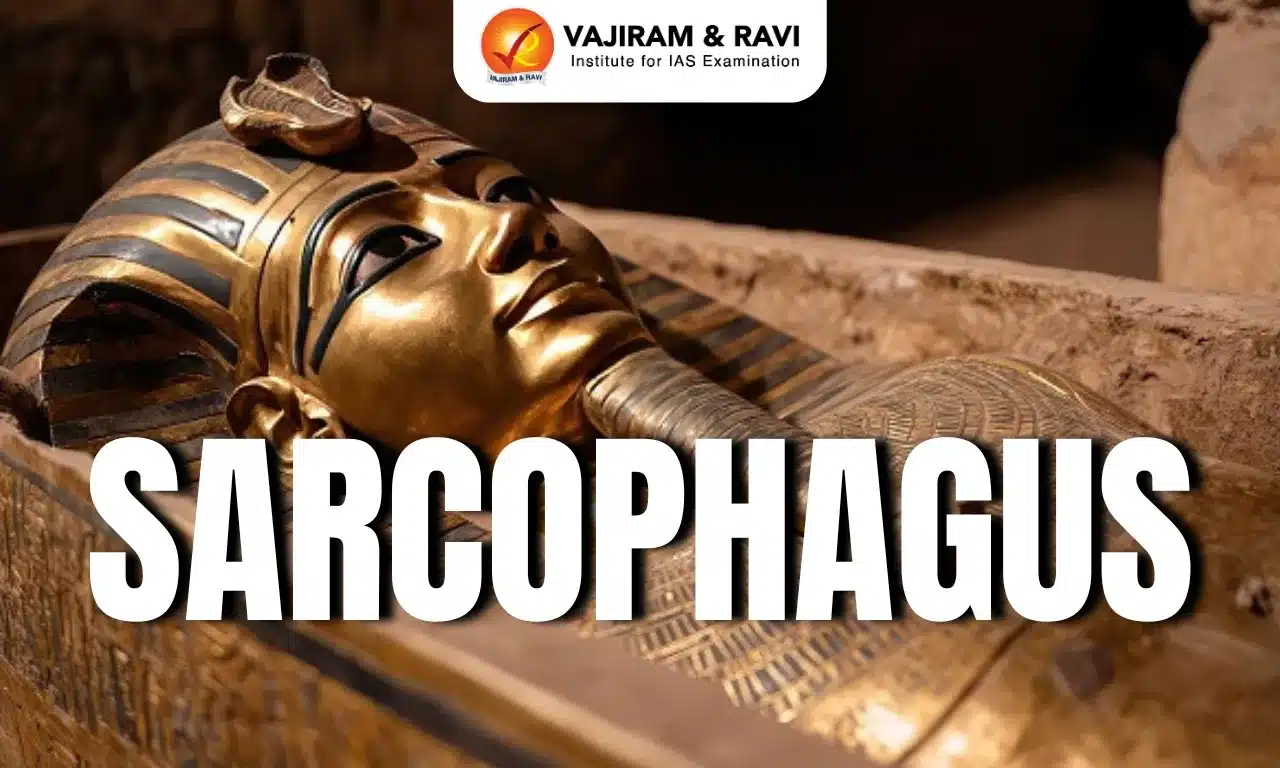
  • Example: The most famous Egyptian sarcophagus is perhaps the golden sarcophagus of King Tutankhamun.

Source: TOI

Sarcophagus FAQs

Q1: What is a Sarcophagus?

Ans: Sarcophagus is a coffin or a container to hold a coffin.

Q2: Which ancient civilization first used stone sarcophagi?

Ans: Ancient Egypt

Q3: Where were sarcophagi typically placed?

Ans: They were intended to be displayed above ground, but they were sometimes entombed or placed in burial chambers.

Q4: Besides Egypt, which other ancient civilizations commonly used sarcophagi?

Ans: Greece and Rome

Enquire Now