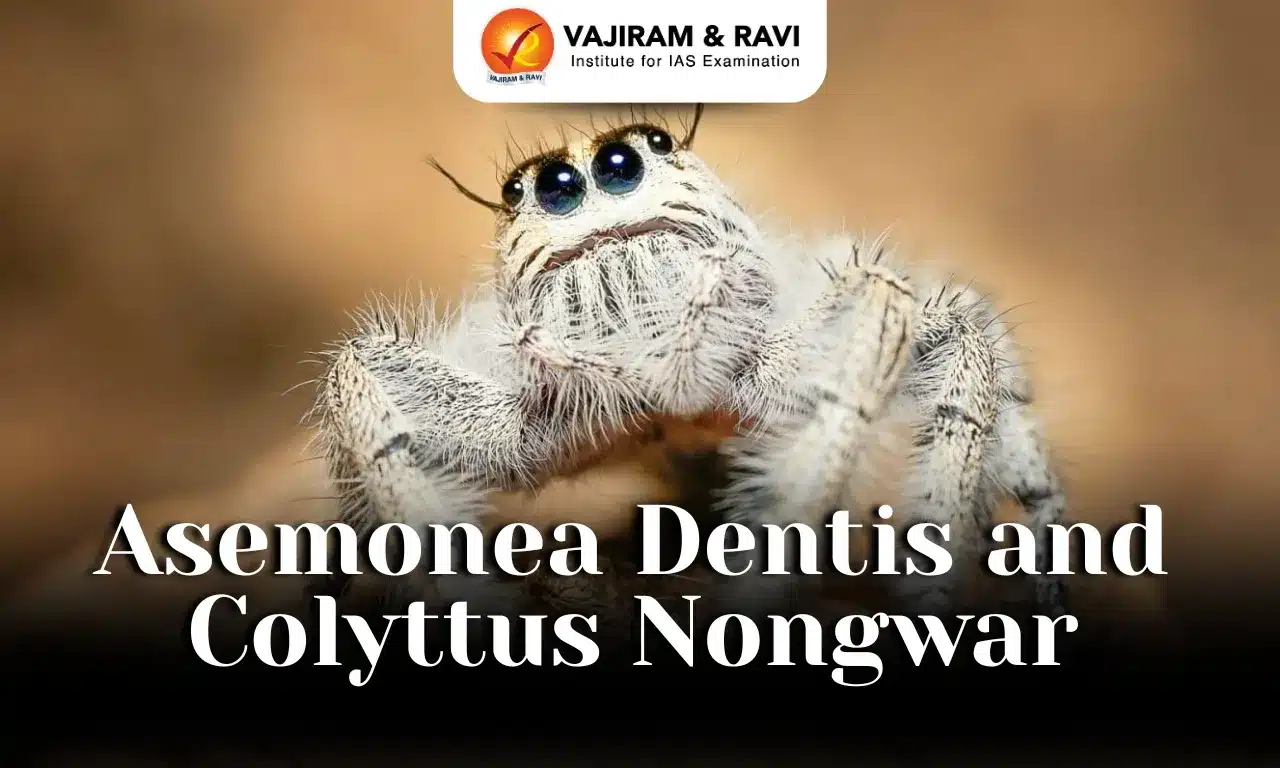
Asemonea dentis and Colyttus nongwar Latest News
Scientists of the Zoological Survey of India (ZSI) recently identified two new species of jumping spiders, Asemonea dentis and Colyttus nongwar, in the forested terrains of the Northeast.
About Asemonea dentis and Colyttus nongwar
- These are two new species of jumping spiders discovered in Meghalaya.
- Both species belong to the Salticidae family, the tribe of “jumping spiders” known for their sharp vision, rapid reflexes and predatory precision.
- Unlike traditional web-weavers, these spiders stalk their prey with stealth before springing in a split-second leap.
- Asemonea dentis:
- Only the third Indian species identified under the Asemonea genus, a group that remains sparsely documented in the country.
- The species is named ‘dentis’ for a distinctive tooth-like projection on the male’s palpal femur.
- Males carry a greenish-brown body marked by a pale-yellow V-shaped pattern on the abdomen.
- Females, by contrast, appear creamy white with delicate black markings.
- Colyttus nongwar:
- It is the second Indian member of the little-known Oriental genus Colyttus.
- It draws its name from Nongwar, the Khasi Hills village where it was documented.
- Both sexes display an oval, reddish-brown carapace and a light-brown abdomen framed by a creamy band at the front and five crisp chevron-shaped patches toward the rear.
Source: TELE
Asemonea dentis and Colyttus nongwar FAQs
Q1: Asemonea dentis and Colyttus nongwar were recently discovered in which Indian state?
Ans: Meghalaya
Q2: Asemonea dentis and Colyttus nongwar belong to which family of spiders?
Ans: Both species belong to the Salticidae family, the tribe of “jumping spiders”.
Q3: Jumping spiders (Salticidae) are particularly known for which characteristic?
Ans: Excellent vision and rapid predatory leaps.
Q4: How do jumping spiders like Asemonea dentis and Colyttus nongwar typically hunt?
Ans: These spiders stalk their prey with stealth before springing in a split-second leap.