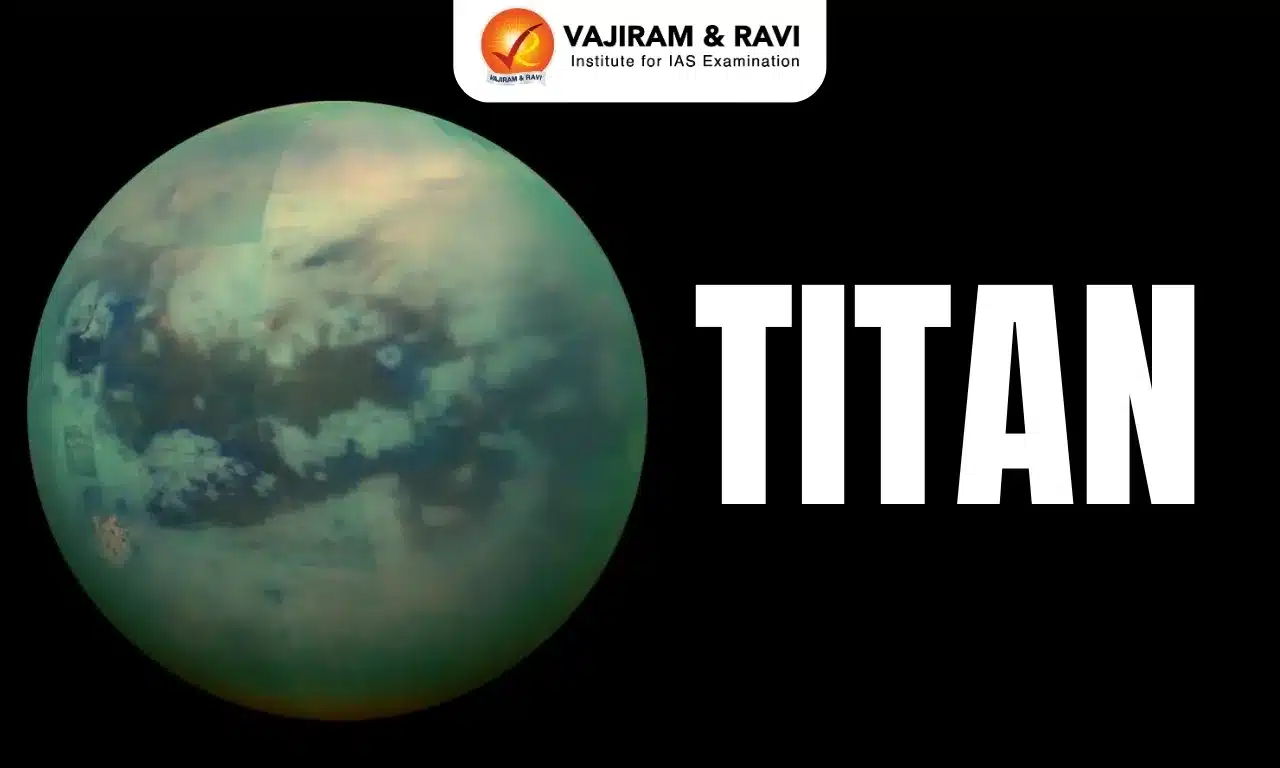
Titan

Titan

Titan Latest News

Saturn's largest moon, Titan, may not have a subsurface ocean after all, according to a re-examination of data captured by NASA's Cassini spacecraft, which flew by Titan dozens of times starting in 2004.

About Titan

  • Titan is Saturn's largest moon. 
  • Dutch astronomer Christiaan Huygens discovered Titan on March 25, 1655
  • It is the second largest moon in our solar system. Only Jupiter's moon Ganymede is larger, by just 2 percent. 
  • It has a radius of about 2,575 kilometers, and is nearly 50 percent wider than Earth’s moon.
  • It is the only moon in the solar system with a dense atmosphere.
  • It's the only world besides Earth that has standing bodies of liquid, including rivers, lakes, and seas, on its surface.
  • Like Earth, Titan’s atmosphere is primarily nitrogen, plus a small amount of methane.
  • It is the sole other place in the solar system known to have an earth-like cycle of liquids raining from clouds, flowing across its surface, filling lakes and seas, and evaporating back into the sky (akin to Earth’s water cycle). 
  • Titan takes 15 days and 22 hours to complete a full orbit of Saturn.
  • Titan is also tidally locked in synchronous rotation with Saturn, meaning that, like Earth’s Moon, Titan always shows the same face to the planet as it orbits. 

Key Facts about Cassini Spacecraft

  • It is a joint project of NASA, the European Space Agency, and the Italian Space Agency (ASI).
  • Cassini was a sophisticated robotic spacecraft sent to study Saturn and its complex system of rings and moons in unprecedented detail.
  • It was launched on October 15, 1997. It was one of the largest interplanetary spacecraft.
  • The mission consisted of NASA’s Cassini orbiter, which was the first space probe to orbit Saturn, and the ESA’s Huygens probe, which landed on Titan, Saturn’s largest moon.

Source: SA

Titan FAQs

Q1: Titan is the largest moon of which planet?

Ans: Saturn

Q2: What is the approximate radius of Titan?

Ans: 2,575 km

Q3: Which gas makes up most of Titan’s atmosphere?

Ans: Like Earth, Titan’s atmosphere is primarily nitrogen, plus a small amount of methane.

Q4: What makes Titan unique in terms of surface liquids?

Ans: It's the only world besides Earth that has standing bodies of liquid, including rivers, lakes, and seas, on its surface.

Q5: Is Titan tidally locked with Saturn?

Ans: Yes, Titan is tidally locked, meaning it always shows the same face to Saturn.

Rashtriya Prerna Sthal

Rashtriya Prerna Sthal

Rashtriya Prerna Sthal Latest News

The Prime Minister recently inaugurated the Rashtra Prerna Sthal in Lucknow, Uttar Pradesh, dedicated to the life and ideals of former Prime Minister Atal Bihari Vajpayee, marking his 101st birth anniversary.

About Rashtriya Prerna Sthal

  • It has been developed as a landmark national memorial and inspirational complex of enduring national significance.
  • It has been dedicated to the life and ideals of former Prime Minister Shri Atal Bihari Vajpayee.
  • It is located on the banks of the Gomti River in Lucknow, Uttar Pradesh. 
  • It is spread across 65 acres. 
  • The sprawling complex also features 65-foot-high bronze statues of BJP ideologues Syama Prasad Mookerjee and Pandit Deendayal Upadhyaya, alongside Vajpayee. 
    • Each statue weighs 42 tonnes and has a water body surrounding their platforms.
  • Constructed at an approximate cost of ₹230 crore, the complex is envisioned as a permanent national asset dedicated to fostering leadership values, national service, cultural consciousness, and public inspiration.
  • The complex houses a state-of-the-art museum designed in the shape of a lotus flower. It spans approximately 98,000 square feet. 
  • It features five galleries and 12 interpretation walls depicting the lives, struggles, and ideologies of the three leaders.

Source: DDN

Rashtriya Prerna Sthal FAQs

Q1: Rashtriya Prerna Sthal has been dedicated to the life and ideals of which former Prime Minister?

Ans: It has been dedicated to the life and ideals of former Prime Minister Shri Atal Bihari Vajpayee.

Q2: Where is Rashtriya Prerna Sthal located?

Ans: It is located on the banks of the Gomti River in Lucknow, Uttar Pradesh.

Q3: Which leaders have 65-foot-high bronze statues at Rashtriya Prerna Sthal?

Ans: Rashtriya Prerna Sthal features 65-foot-high bronze statues of BJP ideologues Syama Prasad Mookerjee and Pandit Deendayal Upadhyaya, alongside Vajpayee.

Quality Council of India (QCI)

Quality Council of India

Quality Council of India Latest News

The Quality Council of India (QCI) recently announced a comprehensive set of next-generation quality reforms aimed at strengthening India’s quality ecosystem across healthcare, laboratories, MSMEs, and manufacturing sectors.

About Quality Council of India 

  • It is a non-profit autonomous organisation registered under Societies Registration Act XXI of 1860.
  • It was set up in 1997 jointly by the Government of India and the Indian Industry, represented by the three premier industry associations, i.e., 
  • Associated Chambers of Commerce and Industry of India (ASSOCHAM)
  • Confederation of Indian Industry (CII)
  • Federation of Indian Chambers of Commerce and Industry (FICCI).
  • It is under the administrative control of the Department for Promotion of Industry and Internal Trade (DPIIT), Ministry of Commerce and Industry.
  • Functions:
    • It works as the national accreditation body.
    • It has been established to create a mechanism for independent third-party assessment of products, services, and processes.
    • It also promotes the adoption of quality standards relating to Quality Management Systems, Food Safety Management Systems, and Product Certification and Inspection Bodies through the accreditation services provided by the National Accreditation Board for Certification Bodies (NABCB). 
    • It plays a pivotal role at the national level in propagating, adoption, and adherence to quality standards in all important spheres of activities.
    • It leads a nationwide quality movement in the country through the National Quality Campaign.
  • Boards/divisions under QCI:
    • National Accreditation Board for Testing & Calibration Laboratories (NABL)
    • National Accreditation Board for Hospitals & Healthcare Providers (NABH)
    • National Accreditation Board for Education & Training (NABET)
    • National Accreditation Board for Certification Bodies (NABCB) 
    • National Board for Quality Promotion (NBQP).
  • Every board is functionally independent and works within its area of expertise.
  • The council comprises 38 members, with equal representation from the government, industries, and other stakeholders.

Source: DDN

Quality Council of India FAQs

Q1: What type of organisation is the Quality Council of India (QCI)?

Ans: It is a non-profit autonomous organisation registered under the Societies Registration Act, 1860.

Q2: When was the Quality Council of India (QCI) established?

Ans: It was established in 1997.

Q3: Which bodies jointly set up the Quality Council of India (QCI)?

Ans: The Government of India along with ASSOCHAM, CII, and FICCI.

Q4: Under which ministry does the Quality Council of India (QCI) function?

Ans: Under the Department for Promotion of Industry and Internal Trade (DPIIT), Ministry of Commerce and Industry.

Q5: What is the main role of Quality Council of India (QCI) in India?

Ans: It acts as the national accreditation body.

Camellia sinensis

Camellia sinensis

Camellia sinensis Latest News

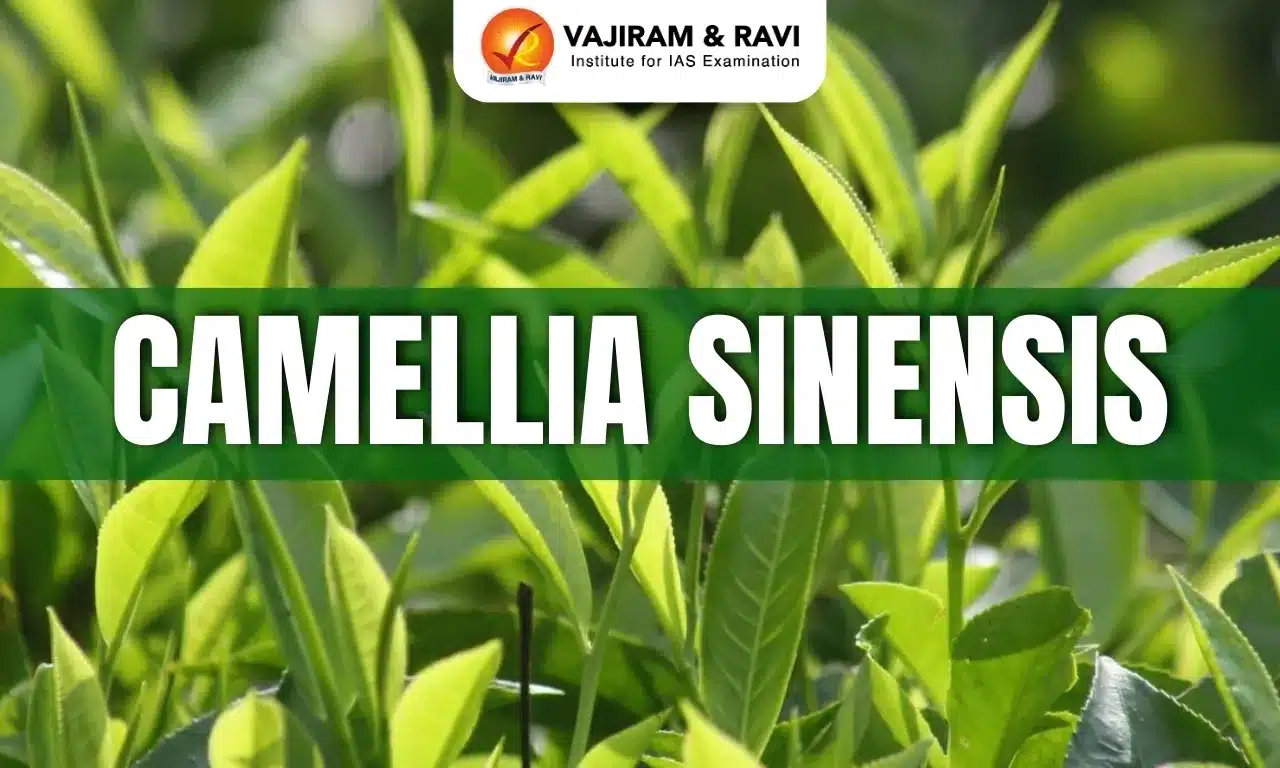
Recently, the Food Safety and Standards Authority of India (FSSAI) issued a clarification that a beverage qualifies to be called tea only if it is derived from the plant Camellia sinensis.

About Camellia sinensis

  • It belongs to the family Theaceae, commonly known as the tea plant.
  • It is the source of various types of tea including green tea, black tea, and oolong tea. 
  • It is a shrub or evergreen tree up to 16 m in height. 
  • It is widely cultivated in mountain slopes, altitude up to 2200 m.
  • Required Climatic Conditions
    • Temperature: Range of 15°C–23°C (optimal growth)
    • Climate: Warm and humid climate with at least 5 hours of sunlight daily
    • Rainfall: Annual rainfall of 150–300 cm, evenly distributed
    • Soil: Slightly acidic, calcium-free soil with porous sub-soil
    • Terrain: Sloping terrain to ensure proper drainage
  • Reproduction: Camellia species flowers are complete, bisexual, i.e., with functional male (androecium) and female (gynoecium), including stamens, carpels and ovary. 
  • Global Distribution: Cultivated in Subtropical and warm temperate zones of South-east Asia
  • It is mainly grown in Bangladesh, Bhutan, China, India, Japan, Korea and Malaysia.

Types of Tea Produced in India

  • Green tea: Oxidation is prevented by quickly heating (steaming or pan-frying) the leaves after plucking to keep them green.
  • Oolong Tea: Partially oxidized, falling between green and black teas in flavour and colour.
  • Black tea: It is fully oxidized before drying, resulting in its characteristic dark colour and strong taste.
  • White tea: Minimal processing, often just withered and dried, preserves its delicate nature.

Source: TH

Camellia sinensis FAQs

Q1: What is Camellia sinensis?

Ans: A species of tea plant

Q2: Black tea is produced from?

Ans: Fermented leaves of Camellia sinensis

Kimberly Process

Kimberly Process

Kimberly Process Latest News

Recently, the Kimberley Process (KP) Plenary has selected India to assume the chairmanship of the Kimberley Process from 1 January 2026.

About Kimberly Process

  • It is a tripartite initiative involving governments, the international diamond industry and civil society.
  • Aim: It is aimed at preventing the trade in “conflict diamonds”.
    • Conflict diamonds are rough diamonds used by rebel groups or their allies to finance conflicts that undermine legitimate governments, (As defined in United Nations Security Council resolutions).
  • Governance: Each year, the Vice-Chair becomes the Chair the next year. Chair and Vice-Chair are appointed by Plenary consensus.
  • Participants: It currently has 60 participants representing 86 countries, with the European Union counting as a single participant.
  • This will be the third time India has been entrusted with the chair of the Kimberley Process.

What is Kimberley Process Certification Scheme (KPCS)

  • It is the mechanism the KP uses to prevent the trade of conflict diamonds.
  • It was launched in 2003, which is enforced individually by KP Participant countries to ensure that rough diamonds in the legitimate supply chain are KP-compliant. 
  • Since 2003, India has been actively participating in the KPCS process. 
    • Department of Commerce is the nodal Department
    • Gem & Jewellery Export Promotion Council (GJEPC) is designated as the KPCS Importing and Exporting Authority in India.
    • GJEPC is responsible for issuing KP Certificates and is also the custodian of KP Certificates received in the country.

Source: PIB

Kimberly Process FAQs

Q1: What is the main goal of the Kimberly Process?

Ans: To prevent conflict diamonds from entering the market

Q2: Why is India a significant player in the Kimberly Process?

Ans: It is because India is a major diamond cutting and polishing hub in the world.

Valmiki Tiger Reserve

Valmiki Tiger Reserve (VTR)

Valmiki Tiger Reserve Latest News

The tiger population in the Valmiki Tiger Reserve in West Champaran district has increased more than sevenfold over a 15-year period, rising from eight in 2010 to 54 in the last census conducted in 2022.

About Valmiki Tiger Reserve

  • Location: It is located at the India-Nepal border in the northern part of the West Champaran District of Bihar. 
  • It forms the easternmost limit of the Himalayan Terai forests in India and is the only tiger reserve of Bihar.
  • It comprises the Valmiki National Park and the Valmiki Wild Sanctuary.
  • Situated in the Gangetic Plains bio-geographic zone of the country, the forest has a combination of Bhabar and Terai tracts.
  • Bordered by: It is surrounded by the Royal Chitwan National Park of Nepal in the north and the river Gandak on the western side, with the Himalayan mountains as a backdrop.
  • Drainage: The rivers Gandak, Pandai, Manor, Harha, Masan, and Bhapsa flow through various parts of the reserve.
  • Vegetation: The reserve boasts a variety of vegetation types, including tropical wet deciduous forests, grasslands, savannas, and riverine forests. 
  • Flora: Sal trees dominate the forests, but the region also features species like teak, bamboo, semal, and khair.
  • Fauna: Tiger, leopard, fishing cat, leopard cat, sambar, hog deer, spotted deer, black buck, gaur, sloth bear, langur, rhesus monkey, etc.

Source: TOI

Valmiki Tiger Reserve FAQ's

Q1: Where is Valmiki Tiger Reserve located?

Ans: West Champaran, Bihar

Q2: Which river forms the western boundary of Valmiki Tiger Reserve?

Ans: Gandak

Vitamin C

Vitamin C

Vitamin C Latest News

Recent research suggests that large doses of vitamin C may provide our lungs with a degree of protection from the harmful effects of fine particles in the air.

About Vitamin C

  • Vitamin C, also known as ascorbic acid, is a water-soluble vitamin.
  • Function
    • It is needed for the growth and repair of tissues in all parts of your body. It is used to:
      • Form an important protein called collagen, used to make skin, tendons, ligaments, and blood vessels.
      • Heal wounds and form scar tissue.
      • Repair and maintain cartilage, bones, and teeth.
      • Aid in the absorption of iron.
    • It is a powerful antioxidant that can neutralize harmful free radicals.
    • It helps make several hormones and chemical messengers used in the brain and nerves.
  • The body doesn't make vitamin C. It comes from the diet. 
  • Sources
    • Vitamin C comes from fruits and vegetables. 
    • Good sources include citrus, red and green peppers, tomatoes, broccoli, and greens. 
    • Some juices and cereals have added vitamin C.
  • Vitamin C is sensitive to heat, so some of its nutritional benefits can be lost during cooking. Raw foods are more beneficial as dietary sources.
  • Vitamin C is not stored in your body, so deficiency can happen quickly.
  • Sometimes, vitamin C deficiency can lead to scurvy.
    • Scurvy symptoms and signs can include anemia, exhaustion, spontaneous bleeding, limb pain, swelling, and sometimes ulceration of the gums and loss of teeth.

Source: SA

Vitamin C FAQ's

Q1: What is another name for Vitamin C?

Ans: Vitamin C is also known as ascorbic acid.

Q2: Is Vitamin C water-soluble or fat-soluble?

Ans: Vitamin C is water-soluble.

Q3: Does the human body produce Vitamin C on its own?

Ans: No, the body does not make Vitamin C; it must come from the diet.

Q4: Which are the good sources of Vitamin C?

Ans: Good sources include citrus, red and green peppers, tomatoes, broccoli, and greens.

Q5: Is Vitamin C sensitive to heat?

Ans: es, Vitamin C is sensitive to heat and can be lost during cooking.

Minamitori Island

Minamitori Island

Minamitori Island Latest News

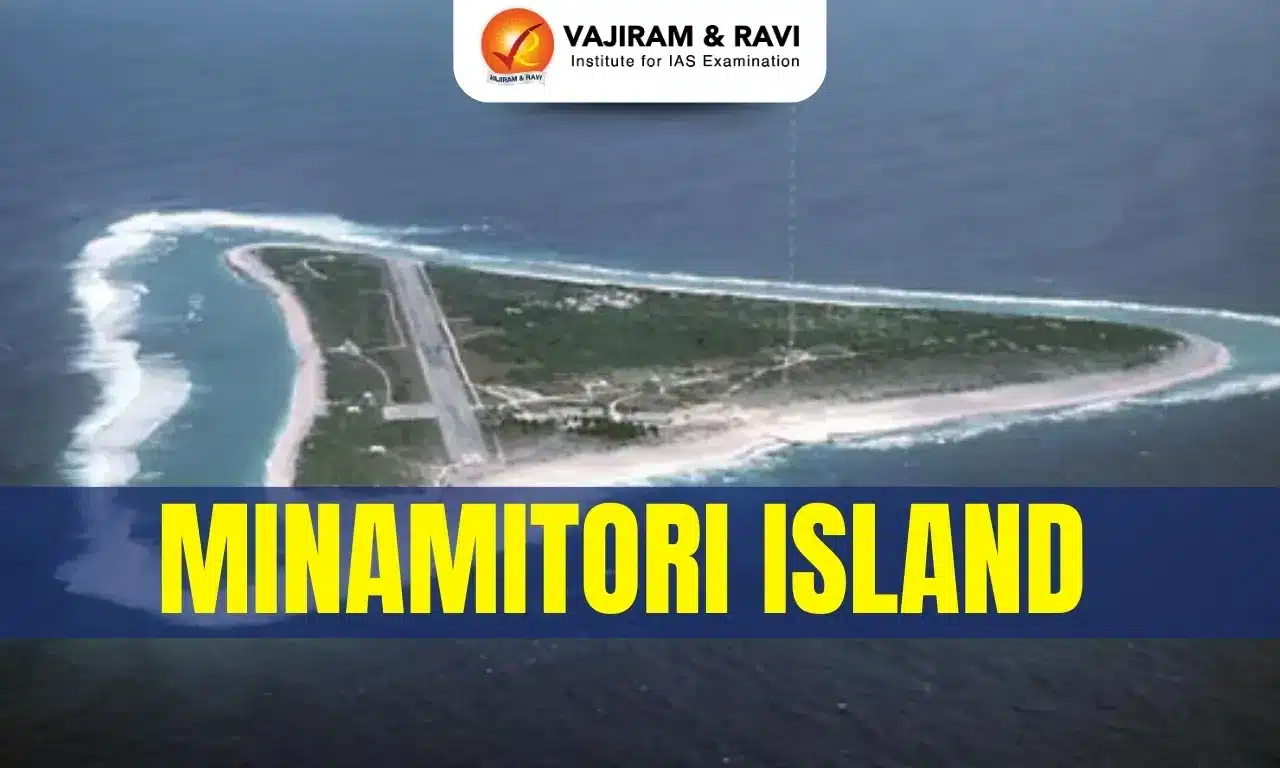
Japan will conduct test mining of rare-earth-rich mud from the deep seabed off Minamitori Island

About Minamitori Island

  • It is also known as Marcus Island, is an isolated Japanese coral atoll in the northwestern Pacific Ocean.
  • It is at the easternmost edge of Japan, the island is the first in Japan to see the sun rise.
  • It lies 1,950 km southeast of central Tokyo.

Topography and Formation of Minamitori Island

  • It is the summit of a giant seamount rising from the seafloor located on the Marcus-Necker Ridge, and the only land of it in Japan on the Pacific Plate.
  • Climate: It is in the transitional zone between tropical and subtropical climates, has an oceanic climate with an average annual temperature of around 25.6°C.
  • Resources: Valuable marine mineral resources like rare-earth muds and cobalt-rich crust have been discovered in the waters surrounding the Minamitorishima Island.

What is Rare-earth mud?

  • Rare-earth muds are pelagic muds made by accumulated remains of plankton in which a large amount of rare-earth is contained.
  • It contains significant amounts of minerals such as neodymium and dysprosium, which are used in high-performance magnets for motors and power generators.
  • It is distributed across the ocean floor as a thin layer and cannot be excavated deeply like coal. 

Source: Reuters

Minamitori Island FAQs

Q1: Where is Minamitori Island located?

Ans: Pacific Ocean

Q2: What is found around Minamitori Island?

Ans: Rare earth deposits

Himalayan Red Fox

Himalayan Red Fox

Himalayan Red Fox Latest News

A brief roadside encounter with a Himalayan red fox near Pangong Tso in Ladakh has captivated social media users recently, but the viral clip has also prompted a cautionary note from wildlife officials about the hidden risks of human interference.

About Himalayan Red Fox

  • The Himalayan Red Fox, a subspecies of the widespread red fox (Vulpes vulpes), is one of the most adaptable predators of the high-altitude landscapes. 
  • Scientific Name: Vulpes vulpes montana

Himalayan Red Fox Distribution

  • It is native to the Himalayan mountain range in India, Nepal, Bhutan, and Tibet.
  • It has a wide distribution in the Indian Himalayan region, including the states of Jammu and Kashmir, Himachal Pradesh, Uttarakhand, Sikkim, and Arunachal Pradesh.

Himalayan Red Fox Habitat

  • Highly adaptable, the red fox inhabits altitudes ranging from 2,500 to 5,000 meters.
  • They are known to occupy a variety of habitats, including alpine meadows, grasslands, forests, and agricultural lands.

Himalayan Red Fox Features

  • It is a medium-sized mammal, with a body length of 50-90 cm and a tail length of 30-45 cm. 
  • Adults typically weigh between 4-7 kg, with males being slightly larger and heavier than females.
  • The coat of the Himalayan red fox is typically rusty-red in color, with white underparts and a distinctive white-tipped tail. 
  • The fur is dense and insulating, providing protection against the harsh, cold weather.
  • It is an agile and fast runner, capable of reaching speeds of up to 60 km/hr. 
  • They are also good climbers and swimmers.
  • It is a solitary and nocturnal animal.
  • An opportunistic feeder, its diet includes rodents, birds, insects, fruits, and even carrion.

Himalayan Red Fox Conservation Status

It is classified as 'Least Concern' under the IUCN Red List.

Key Facts about Pangong Tso

  • Pangong Tso, or Pangong Lake, is a long, narrow, endorheic (landlocked) lake situated at a height of more than 14,000 ft (4,350 meters) in the Ladakh Himalayas.
  • The lake is 5 kilometers wide and 134 kilometers long, with one-third of it lying in India & the other two-thirds in China. 
  • It is the world’s highest saltwater lake.
  • The lake is also very deep and reaches a maximum depth of almost 328 feet.
  • It is also known to change colors, appearing blue, green, and red at different times.

Source: ETVB

Himalayan Red Fox FAQs

Q1: Himalayan Red Fox is native to which region?

Ans: It is native to the Himalayan mountain range in India, Nepal, Bhutan, and Tibet.

Q2: Why does the Himalayan Red Fox have dense fur?

Ans: To provide insulation against harsh, cold weather.

Q3: Is the Himalayan Red Fox solitary or social in nature?

Ans: It is solitary.

Q4: What is the IUCN conservation status of the Himalayan Red Fox?

Ans: Least Concern.

Tsunami Ready Recognition Programme

Tsunami Ready Recognition Programme

Tsunami Ready Recognition Programme  Latest News

India would soon have over 100 tsunami-ready villages among the Indian Ocean region under the Tsunami Ready Recognition Programme.

About Tsunami Ready Recognition Programme

  • It is an international community-based recognition programme developed by Intergovermental Oceanographic Commission (IOC) of UNESCO.
  • Aim: It aims to build resilient communities through awareness and preparedness strategies that will protect life, livelihoods and property from tsunamis in different regions.
  • The main goal of the Programme is to improve coastal community preparedness for tsunamis and to minimize the loss of life, livelihoods and property.
    • This is achieved through a collaborative effort to meet a standard level of tsunami preparedness through the fulfilment of a set of established indicators. 
  • Methodology used
    • To get this recognition, communities must meet all 12 indicators, which cover Assessment, Preparedness, and Response, will be recognized as ‘Tsunami Ready’ by the UNESCO/IOC.
    • Tsunami-ready village is certified to the ones that have high awareness about tsunami, hazard preparedness and mapping, public display of evacuation maps, 24-hour warning systems, participation in mock drills among others.
    • The recognition is renewable every four years.

Source: IE

Tsunami Ready Recognition Programme FAQs

Q1: What is the Tsunami Ready Recognition Programme?

Ans: A programme to promote tsunami preparedness

Q2: Which organization initiated the Tsunami Ready Recognition Programme?

Ans: UNESCO-IOC

Enquire Now