Global Capability Centres (GCCs)

Global Capability Centres

Global Capability Centres Latest News

Global Capability Centres (GCCs) are now the primary engine sustaining India’s technology job market, contrasting sharply with the hiring slowdown witnessed by large IT firms in the country.

About Global Capability Centres 

  • Global Capability Centres (GCCs), or Captive Centres, are offshore offices or subsidiaries set up by multinational corporations (MNCs) to handle various business processes and services. 
  • GCCs connect organizations to a global pool of top-tier talent, equipped with the latest technology and training needed to stay ahead of industry trends, continually innovate, and create sustained growth. 
  • These centres are responsible for a wide range of tasks, including IT support, research and development (R&D), data analytics, finance, human resources, and other back-office functions. 
  • Over time, many GCCs have evolved from being simple support centres to becoming strategic hubs that drive innovation and high-value business functions.
  • GCCs in India:
    • Earlier, GCCs were established in India primarily to reap cost benefits. 
    • Customer support, data processing, and IT services that these centres mainly focused on. 
    • Due to its abundant skilled labour force and lower operational cost, India proved to be an ideal location for setting up GCCs. 
    • However, GCCs have evolved over time to expand massively and now include critical business functions such as R&D, analytics, digital transformation, and innovation.
    • India now hosts 1,850 GCCs employing almost two million professionals.
    • India is projected to have more than 2,400 GCCs by 2030 and employ more than three million workers to achieve a $125 billion market size, signalling a transition into strategic ‘enterprise AI brains.’
    • Key GCC hubs are located in Bengaluru, Hyderabad, Pune, Chennai, Mumbai, and the National Capital Region (NCR).

Source: TH

Global Capability Centres FAQs

Q1: What are Global Capability Centres (GCCs)?

Ans: GCCs are offshore offices or subsidiaries set up by multinational corporations (MNCs) to handle various business processes and services.

Q2: Why were Global Capability Centres (GCCs) initially established in India?

Ans: GCCs were established in India primarily to reap cost benefits.

Q3: Approximately how many GCCs currently operate in India?

Ans: 1,850

T Chamaeleontis

T Chamaeleontis

T Chamaeleontis Latest News

Recently, astronomers used archival spectroscopic data from NASA’s James Webb Space Telescope Mid Infrared Instrument (MIRI) to study polycyclic aromatic hydrocarbons (PAHs) in the spectrum of the young star T Chamaeleontis.

About T Chamaeleontis

  • It is a young but sun-like star in the small southern constellation of Chamaeleon.
  • It is located about 350 light-years from Earth.
  • It can be found in the southern celestial hemisphere.
  • It is approximately 70 % of the size of the Sun and temperature on its surface is around 5111 K (4838 °C).
  • It is surrounded by a planet-forming disk called circumstellar disk that contains a wide gap—likely carved out by an emerging protoplanet.
    • Normally, the dense inner regions of such disks act like a protective wall or veil blocking much of the star’s ultraviolet light from reaching the colder, outer regions.
  • Significance: This gap makes the system a key target for studying how young planets interact with their natal disks and shape their surrounding environments during the early stages of planet formation.

What are Polycyclic Aromatic Hydrocarbons (PAHs)?

  • These are flat, ring-shaped molecules of carbon and hydrogen.
  • They make up a fifth of all carbon in interstellar space.
  • Origin: There is a hypothesis that meteors brought PAHs from space to young earth and created the first building blocks of life, attaching important value to their ability to survive in space.
  • Properties of Polycyclic aromatic hydrocarbons
    • They have a relatively low solubility in water but are highly lipophilic and are soluble in most organic solvents.
    • These hydrocarbons, on earth, are formed through incomplete combustion or pyrolysis of organic materials, such as fossil fuels and biomass.
    • When PAHs collide with other particles or absorb high-energy radiation, they can have more internal energy than their weakest chemical bond can handle.

Source: PIB

T Chamaeleontis FAQs

Q1: What is T Chamaeleontis?

Ans: A star in the Chamaeleon constellation

Q2: What is unique about T Chamaeleontis' circumstellar disk?

Ans: T Chamaeleontis' circumstellar disk has a wide gap, likely caused by a protoplanet.

Santhali Language

Santhali Language

Santhali Language Latest News

President Droupadi Murmu recently released the Constitution of India in the Santhali language at a function held at the Rashtrapati Bhavan here.

About Santhali Language

  • The Santhali language, which was included in the Eighth Schedule of the Constitution through the 92nd Amendment Act, 2003, is one of the most ancient living languages of India.
  • It is spoken by a significant number of tribal people in Jharkhand, Odisha, West Bengal, and Bihar.
  • It is primarily used by the Santhal tribal community. 
  • It is also spoken in Nepal and Bangladesh.
  • In India, it is spoken by an estimated 7 million people, according to recent census data.
  • It is a member of the Munda branch of the Austroasiatic language family, which is an ancient family of languages spoken across parts of South and Southeast Asia. 
  • It is quite distinct from the Indo-European language family of languages spoken in much of India.
  • It is closely related to other Munda languages, such as Ho, Mundari, and Korku. 
    • These languages share common features such as their agglutinative nature (where words are formed by stringing together smaller units of meaning) and their use of tones.
  • Santhali has a unique and rich tradition, with its own script and oral literature, reflecting the culture and beliefs of the Santhal tribe.
  • Santhali uses the Ol Chiki script, a writing system that was developed in 1925 by Pandit Raghunath Murmu, a Santhal scholar and writer.

Source: TH

Santhali Language FAQs

Q1: The Santhali language was added to the Eighth Schedule of the Constitution through which Amendment Act?

Ans: 92nd Amendment Act, 2003

Q2: Santhali belongs to which language family?

Ans: Austroasiatic (Munda branch)

Q3: Santhali is primarily spoken by which tribal community?

Ans: Santhal tribe

Q4: In addition to India, Santhali is also spoken in which countries?

Ans: Nepal and Bangladesh

Veer Bal Diwas

Veer Bal Diwas

Veer Bal Diwas Latest News

Recently, the Prime Minister addressed the Veer Bal Diwas programme in New Delhi.

About Veer Bal Diwas

  • It is observed on December 26 every year, starting in 2022.
  • It is commemorated in remembrance of the martyrdom of Guru Gobind Singh ji’s (the tenth Sikh Guru) sons Sahibzada Zorawar Singh ji and Sahibzada Fateh Singh ji. 
  • The objective is to honour the bravery of the two young heroes of the country.

Historical Context of Veer Bal Diwas

  • Guru Gobind Singh, along with his family and disciples, were compelled to flee as the Mughal Army encircled the Anandpur fort.
  • During the chaos, Guru Gobind Singh’s youngest sons, Zorawar Singh and Fateh Singh, were captured by the Mughal forces.
  • The two young boys courageously refused to abandon their faith, and consequently they were bricked alive on December 26, 1704.

Key facts about Guru Gobind Singh

  • Guru Gobind Singh was the 10th Sikh guru, following the demise of his father, Guru Tegh Bahadur, the ninth Sikh Guru.
  • Contribution to Sikh religion
    • He is renowned for founding the principles of Khalsa or the Five ‘K’s i.e kesh (uncut hair), kanga (wooden comb), kara (iron or steel bracelet), kirpan (dagger) and kachera (short breeches).
    • He fought against the Mughals in the battle of Muktsar in 1705.
    • He declared Guru Granth Sahib as Sikhism’s holy scripture in 1708, before his death.

Source: PIB

Veer Bal Diwas FAQs

Q1: Whose sacrifice is Veer Bal Diwas dedicated to?

Ans: Guru Gobind Singh Ji's sons

Q2: When is Veer Bal Diwas observed?

Ans: December 26

Lantana camara

Lantana camara

Lantana camara Latest News

A silent invasion of Lantana camara is underway in large parts of the world and global warming has made things easier for Lantana, helping it spread faster.

About Lantana camara

  • It is an annual or perennial, small, broadleaf evergreen shrub in the verbena family.
  • It is an invasive alien plant species.
  • Origin: It is native to the tropical and sub-tropical regions of Central and South America.
  • It is an exotic weed that aggressively proliferates and forms a dense mesh of bushes.
  • In India, it was first introduced in the early 18th century as an ornamental plant by the British and since then, it has invaded almost all the tropical areas across the country.

Impact of Lantana camara on Environment

  • Lantana grows in a notoriously aggressive way, releasing chemicals into the soil that suppress other vegetation.
  • Its leaves, flowers, and berries contain toxins that make them harmful to livestock.
  • Its roots dig deep into the soil and spread wide in search of water and nutrients.
  • Its timber is used for making furniture and also as fuelwood, etc.
  • Its biomass can be used to produce organic compost and vermicompost, which will be better for organic farming.

Source: TH

Lantana camara FAQs

Q1: Why is Lantana camara harmful to livestock?

Ans: Its leaves, flowers, and berries are toxic

Q2: When was Lantana camara introduced to India?

Ans: Early 18th century

National Council for Cement and Building Materials

National Council for Cement and Building Materials

National Council for Cement and Building Materials Latest News

Recently, the Global Cement and Concrete Association (GCCA) India–NCB Carbon Uptake Report was released on the occasion of the 63rd Foundation Day of the National Council for Cement and Building Materials (NCB).

About National Council for Cement and Building Materials

  • It was established in 1962 as an apex research and development organization.
  • Objective: To promote research and scientific work connected with cement and building materials trade and industry.
  • It functions under the administrative control of Department for Promotion of Industry and Internal Trade (DPIIT), Ministry of Commerce and Industry, Govt. of India.
  • It has its corporate centre and main laboratories located at Ballabgarh (near New Delhi).
  • It has a well established regional centre at Hyderabad and a Centres at Ahmedabad (Gujarat) & Bhubaneswar.

Functions of National Council for Cement and Building Materials

  • NCB’s areas of work span over the entire spectrum of cement manufacturing and usage.
  • It serves as the nodal agency for providing the Government the necessary support for formulation of its policy and planning activities related to growth and development of cement industry.
  • It is devoted to protecting the interests of consumers of cement and concrete in the country.

Source: PIB

National Council for Cement and Building Materials FAQs

Q1: Under which ministry does National Council for Cement and Building Materials operate?

Ans: Ministry of Commerce and Industry

Q2: What is the primary objective of the National Council for Cement and Building Materials?

Ans: To develop technologies for durable infrastructure and affordable housing.

Exclusive Economic Zone (EEZ)

Exclusive Economic Zone (EEZ)

Exclusive Economic Zone (EEZ) Latest News

Fisher-folk recently urged the Centre to include their representatives in policymaking bodies so that their practical expertise can be utilized, without which the goal of responsible fishing in the Exclusive Economic Zone (EEZ) cannot be achieved.

About Exclusive Economic Zone (EEZ)

  • An EEZ is an area of the ocean, generally extending 200 nautical miles (230 miles) beyond a nation’s territorial sea, within which a coastal nation has jurisdiction over both living and nonliving resources.
  • The concept of an exclusive economic zone (EEZ) was adopted through the 1982 United Nations Convention on the Law of the Sea. 
  • Under international law, within its defined EEZ, a coastal nation has:
    • Sovereign rights for the purpose of exploring, exploiting, conserving, and managing natural resources of the seabed, subsoil, and waters above it.
    • Jurisdiction as provided for in international law with regard to the establishment and use of artificial islands, installations, and structures; marine scientific research; and the protection and preservation of the marine environment.
    • Other rights and duties provided for under international law.
  • UNCLOS (United Nations Convention on the Law of the Sea) indicates that the coastal state determines the acceptable level of fishing quotas in its EEZ, with a focus on sustainable management. 
  • The coastal state is entitled to fish the entire quota or to award the surplus to other countries. 
  • Provisions under UNCLOS also provide for the regular exchange of information about the populations of resources in an EEZ in order to promote international scientific cooperation.
  • EEZs have also been used to determine which country is responsible for removing marine hazards such as space debris.
  • UNCLOS establishes rights for how other countries may access the waters in an EEZ.
    • Other States have the right for their ships and aircraft to traverse the EEZ and its airspace and to lay cables and pipelines.

What is the Territorial Sea?

  • The territorial sea (also called territorial waters), under the UNCLOS, is that area of the sea immediately adjacent to the shores of a country and subject to the territorial jurisdiction of that country.
  • Extend: The territorial sea extends to a limit of 12 nautical miles from the baseline of a country’s coast. 
  • Importance of Territorial waters:
    • Within its territorial waters, a country exercises full sovereignty over the air space above the sea and over the seabed and subsoil. 
    • The government can legislate on matters concerning the safety of navigation, the preservation of the environment, and the prevention, reduction, and control of pollution within its territorial waters.
    • Resource use within the territorial sea is strictly reserved to the coastal nation.
    • All countries have the right of innocent passage (passage that is not prejudicial to the security of the coastal country) through the territorial sea of another country, although there is no right of innocent airspace passage.

Source: TH

Exclusive Economic Zone (EEZ) FAQs

Q1: What is the Exclusive Economic Zone (EEZ)?

Ans: It is an area of the ocean, generally extending 200 nautical miles (230 miles) beyond a nation’s territorial sea, within which a coastal nation has jurisdiction over both living and nonliving resources.

Q2: What sovereign rights does a coastal state enjoy within its Exclusive Economic Zone (EEZ)?

Ans: It has sovereign rights to explore, exploit, conserve, and manage natural resources of the seabed, subsoil, and waters above it.

Q3: What rights do other states have within another country’s Exclusive Economic Zone (EEZ)?

Ans: They have the right to traverse the waters and airspace and to lay cables and pipelines.

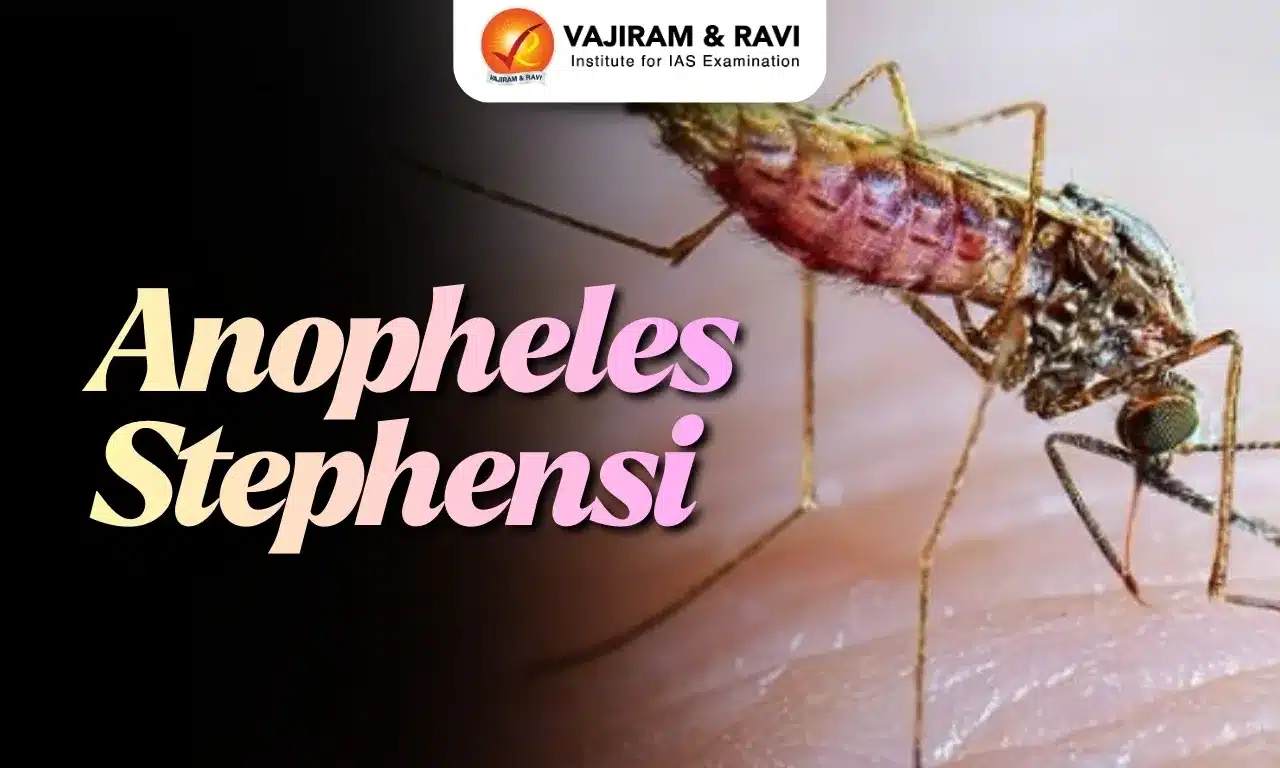
Anopheles stephensi

Anopheles stephensi

Anopheles stephensi Latest News

Urban malaria, driven largely by the spread of invasive vector Anopheles stephensi in metropolitan areas like Delhi, has emerged as a national concern threatening India’s goal of eliminating the mosquito-borne disease by 2030, according to the Health Ministry’s recently released Malaria Elimination Technical Report, 2025.

About Anopheles stephensi

  • It is an invasive mosquito species originating from parts of Southeast Asia and the Arabian Peninsula.
  • It is a major malaria vector.
  • It has recently spread to parts of Africa, posing a growing public-health concern.
  • Unlike most malaria vectors, it is adept at colonizing urban environments.
  • It can breed in tiny amounts of water year-round and has made a comfortable home in urban areas.
  • Throughout its natural range, Anopheles stephensi is an important vector for both Plasmodium falciparum and Plasmodium vivax.
  • In urban areas, An. stephensi is found throughout the year but is most abundant in the summer months (between June and August), which coincides with the peak period of malaria transmission.

Source: TH

Anopheles stephensi FAQs

Q1: What is Anopheles stephensi?

Ans: Anopheles stephensi is an invasive mosquito species and a major vector of malaria.

Q2: Where did Anopheles stephensi originally come from?

Ans: It originated from parts of Southeast Asia and the Arabian Peninsula.

Q3: What makes Anopheles stephensi different from most other malaria vectors?

Ans: It is highly adapted to colonizing urban environments.

Q4: Which malaria parasites are transmitted by Anopheles stephensi?

Ans: It transmits both Plasmodium falciparum and Plasmodium vivax.

Kanger Valley National Park

Kanger Valley National Park

Kanger Valley National Park Latest News

The Chhattisgarh government has stepped up efforts to secure the famed Kanger Valley National Park in Bastar in the state, the official status of a UNESCO (United Nations Educational, Scientific and Cultural Organization) World Heritage Site.

About Kanger Valley National Park

  • It is located in Jagdalpur in the Bastar district of Chhattisgarh state.
  • The National Park derives its name from the Kanger River, which flows centrally from the Northwest to the Southeast direction. 
    • The Kanger River is a tributary of the Kolab River, which ultimately joins the Godavari River.
  • The total area of the National Park is 200 sq.km. 
  • Topography: It features low flatlands, gentle slopes, steep inclines, plateaus, deep gorges, valleys, and winding stream courses. 
  • Tirathgarh Falls, which originates from the Kanger River, presents an enchanting view falling from a height of 150 feet. 
  • The national park has more than 15 limestone caves, including the famous Kotumsar, Kailash, and Dandak caves.
  • Flora: Blend of mixed moist deciduous type of forests with the predominance of Sal, teak, and bamboo.
  • Fauna:
    • Major wild animals include tigers, mouse deer, leopards, wildcat, sambar, chital, barking deer, langurs, jackals, rhesus macaque, flying squirrel, etc.
    • The aerial fauna at the park consists of common hill myna, red jungle fowl, spotted owlet, racket-tailed drongos, parrots, etc.

Source: DC

Kanger Valley National Park FAQs

Q1: Kanger Valley National Park is loacted in which state?

Ans: It is located in Jagdalpur in the Bastar district of Chhattisgarh state.

Q2: From which river does Kanger Valley National Park get its name?

Ans: It derives its name from the Kanger River.

Q3: The Kanger River is a tributary of which river?

Ans: The Kanger River is a tributary of the Kolab River, which ultimately joins the Godavari River.

Rabies

Rabies

Rabies Latest News

According to a paper published in One Health, of the 59,000 rabies-mediated human deaths in the world every year, India represents a third, around 20,000, and more than any other country.

About Rabies

  • Rabies is a vaccine-preventable, zoonotic, viral disease.
  • It is caused by the Rabies virus (RABV) which affects the central nervous system.
  • Rabies infects mammals, including dogs, cats, livestock and wildlife.
  • It is one of the neglected tropical diseases (NTD) that predominantly affects already marginalized, poor, and vulnerable populations.
  • Transmission: Rabies spreads to people and animals via saliva, usually through bites, scratches, or direct contact with mucosa (e.g. eyes, mouth, or open wounds).
  • Clinically, it has two forms: 
    • Furious rabies: It is characterized by hyperactivity and hallucinations.
    • Paralytic rabies: It is characterized by paralysis and coma.

Symptoms of Rabies

  • The incubation period for rabies is typically 2–3 months but may vary from one week to one year.
  • Initial symptoms include generic signs like fever, pain, and unusual or unexplained tingling, pricking, or burning sensations at the wound site. 
  • As the virus moves to the central nervous system, progressive and fatal inflammation of the brain and spinal cord develops. 
  • Once the virus infects the central nervous system and clinical symptoms appear, rabies is fatal in 100% of cases.
  • Prevention: Vaccinating dogs, including puppies, is the most cost-effective strategy for preventing rabies in people because it stops the transmission at its source.

Source: TH

Rabies FAQs

Q1: What is the causative agent of Rabies?

Ans: Virus

Q2: India's National Rabies Control Programme aims to eliminate Rabies by?

Ans: 2030

Enquire Now