International Renewable Energy Agency

International Renewable Energy Agency

International Renewable Energy Agency Latest News

Recently, the Union Minister for New and Renewable Energy delivered India’s national statement at the 16th Assembly of the International Renewable Energy Agency (IRENA) in Abu Dhabi, United Arab Emirates.

About International Renewable Energy Agency

  • It is an intergovernmental organisation that was founded in 2009 to support countries in their transition to a sustainable energy future.
  • It serves as the principal platform for international cooperation, a centre of excellence, and a repository of policy, technology, resource and financial knowledge on renewable energy
  • Member countries: It has 170 Members (169 States and the European Union). India is also one of the founder members of IRENA.

Governance of International Renewable Energy Agency

  • Assembly: It is IRENA’s ultimate decision-making authority, made up of one representative from each Member. 
  • Council: It is composed of 21 Member States elected for a two-year term and is accountable to the Assembly.
  • Council members serve on a rotating basis to ensure the effective participation of both developing and developed countries and a fair and equitable geographical distribution.
  • Secretariat: It comprises the Director-General and his staff, provides administrative and technical support to the Assembly, the Council and their subsidiary bodies.
  • Its headquarter is in Abu Dhabi, United Arab Emirates.
  • It is an official United Nations observer.

Source: PIB

International Renewable Energy Agency FAQs

Q1: Where is IRENA headquartered?

Ans: Abu Dhabi

Q2: What is IRENA's primary objective?

Ans: Promote adoption of renewable energy

Bhairav Battalions

Bhairav Battalions

Bhairav Battalions Latest News

For the first time, the Indian Army’s newly raised Bhairav Battalion will march down Kartavya Path and salute the Supreme Commander during the Republic Day parade.

About Bhairav Battalions

  • They are a new class of compact, high-tech combat units of the Indian Army.
  • Each battalion comprises approximately 250 soldiers, drawing personnel from infantry, artillery, air defence, signals, and other combat support arms.
  • They are specially equipped for swift, surprise, and high-impact operations in diverse combat environments.
  • Unlike Para Special Forces, which handle strategic missions deep inside enemy territory, Bhairav Battalions are positioned closer to the border.
  • Their job is to handle tactical, fast-breaking situations, the kind that require immediate response rather than detailed planning.
  • In the Army’s own words, Bhairav units are built to “fight tonight”, meaning they must be ready to move at short notice, often without waiting for larger formations.
  • The Bhairav units will act as a bridge between Special Forces and regular infantry, aimed at freeing up Special Forces for more critical assignments.
  • The battalions are being placed under corps and division-level formations, especially in sectors considered sensitive, Rajasthan, Jammu, Ladakh, and the Northeast.
  • Their structure allows them to be deployed for multi-domain tasks, a mix of ground action, drone operations, and electronic support.
  • With nearly 15 battalions already raised and plans for up to 25, the Bhairav formation is becoming a permanent part of India’s defence structure.

Source: IS

Bhairav Battalions FAQs

Q1: What are Bhairav Battalions?

Ans: They are a new class of compact, high-tech combat units of the Indian Army.

Q2: How many soldiers are there in a Bhairav Battalion?

Ans: Each battalion comprises approximately 250 soldiers, drawing personnel from infantry, artillery, air defence, signals, and other combat support arms.

Q3: What type of operations are Bhairav Battalions designed for?

Ans: Swift, surprise, and high-impact operations.

Q4: How are Bhairav Battalions different from Para Special Forces?

Ans: They handle tactical, immediate-response situations rather than deep strategic missions.

Q5: In which regions are Bhairav Battalions primarily deployed?

Ans: Rajasthan, Jammu, Ladakh, and the Northeast.

Nelapattu Bird Sanctuary

Nelapattu Bird Sanctuary

Nelapattu Bird Sanctuary Latest News

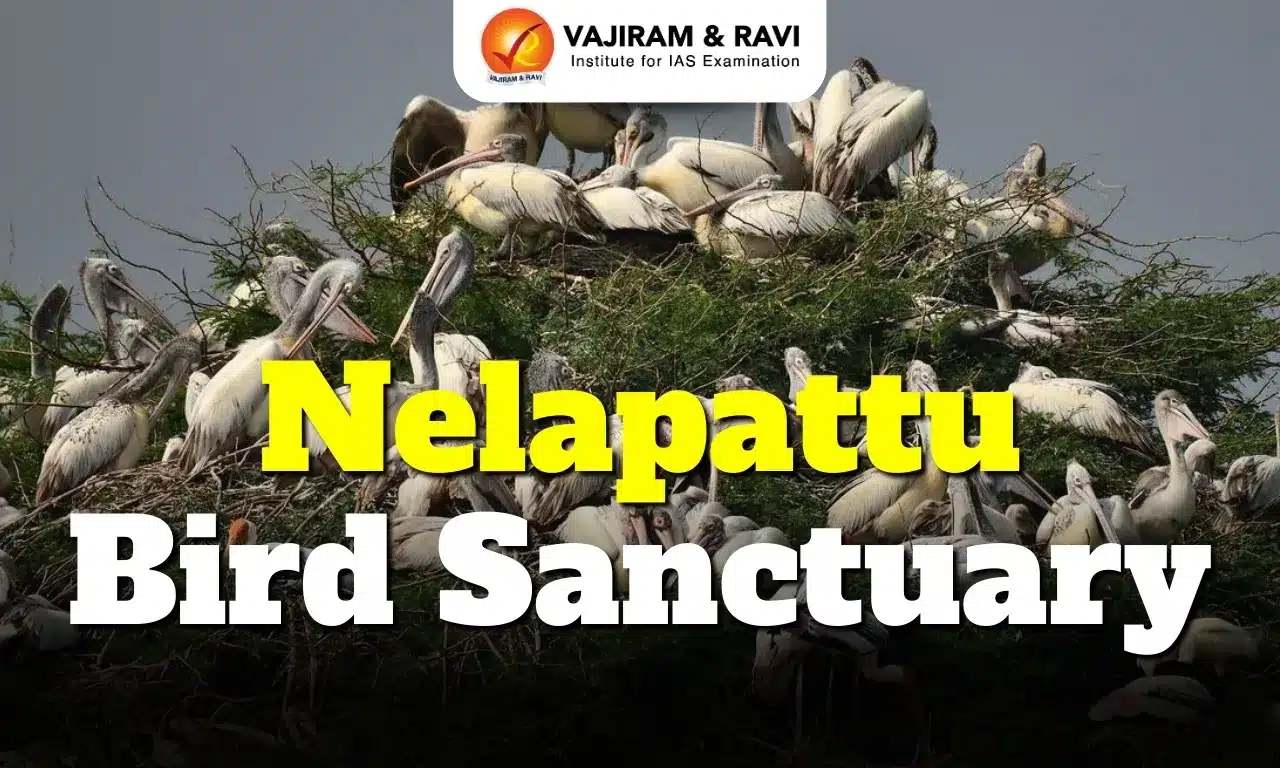
Recently, the Flamingo Festival attracted many families to Nelapattu Bird Sanctuary near Sullurpeta in Andhra Pradesh.

About Nelapattu Bird Sanctuary

  • Location: It is located in the state of Andhra Pradesh.
  • It is situated just near the Pulicat Lake, which is the second-largest salt lake in all of India.
  • It is an important breeding site for spot-billed pelicans.
  • Vegetation: The sanctuary is filled with significant plant communities like the Barringtonia swamp forests and the southern dry evergreen scrub.
  • Flora: Plants like Buchnania angustifolia, barringtonia actutangula, Acacia arabica, Albizzia amara, Borassus flabellifer, Euphorbia antiquorum, etc are found here.
  • Fauna:  In addition to the spot-billed pelican, it is an important breeding site for black-headed ibis, Asian openbill, black-crowned night heron, and little cormorant.

Source: TH

Nelapattu Bird Sanctuary FAQs

Q1: Where is the Nelapattu Bird Sanctuary located?

Ans: Andhra Pradesh

Q2: When was the Nelapattu Bird Sanctuary established?

Ans: 1976

Pradhan Mantri-Rashtriya Krishi Vikas Yojana

Pradhan Mantri-Rashtriya Krishi Vikas Yojana

Pradhan Mantri-Rashtriya Krishi Vikas Yojana Latest News

The Union Ministry of Agriculture has proposed to merge three separate ongoing schemes with its flagship Pradhan Mantri-Rashtriya Krishi Vikas Yojana.

About Pradhan Mantri-Rashtriya Krishi Vikas Yojana

  • It is a Centrally Sponsored Schemes (CSS) operating under the Ministry of Agriculture and Farmers Welfare.
  • It is aimed at accelerating agricultural growth and improving farmers’ income.

Objectives of Pradhan Mantri Rashtriya Krishi Vikas Yojana

  • To encourage states to increase public investment in agriculture and allied sectors.
  • To enhance agricultural productivity and overall farm growth.
  • To strengthen agricultural and post-harvest infrastructure and reduce losses.
  • To promote diversification into high-value crops, horticulture, livestock, and fisheries.
  • To encourage adoption of modern, innovative, and climate-resilient farming practices.
  • To reduce regional disparities in agricultural development.

Features  of Pradhan Mantri Rashtriya Krishi Vikas Yojana

  • State-Led and Decentralized Approach: States have the flexibility to plan and implement agricultural projects according to local priorities.
  • Growth-Oriented Scheme: The scheme aims to achieve a sustained annual growth rate of around 4 percent in agriculture and allied sectors.
  • Wide Sectoral Coverage: It supports crop production, horticulture, livestock, fisheries, organic farming, agricultural research, and marketing infrastructure.
  • Incentive-Based Funding: States receive financial assistance based on their commitment to increasing public investment in agriculture.

Funding Pattern of Pradhan Mantri Rashtriya Krishi Vikas Yojana

  • General States: 60 percent Centre and 40 percent State
  • North-Eastern and Hilly States: 90 percent Centre and 10 percent State
  • Union Territories: 100 percent central funding.

Source: IE

Pradhan Mantri-Rashtriya Krishi Vikas Yojana FAQs

Q1: What is the primary objective of PM-RKVY?

Ans: To enhance agricultural productivity and farmers' income

Q2: Which ministry implements PM-RKVY?

Ans: Ministry of Agriculture

Osteoarthritis

Osteoarthritis

Osteoarthritis Latest News

In a promising breakthrough, scientists at Stanford University recently identified a key protein called 15-PGDH linked to cartilage loss during aging, offering hope for new treatments for osteoarthritis.

About Osteoarthritis

  • Arthritis is a general term that means inflammation of the joints.
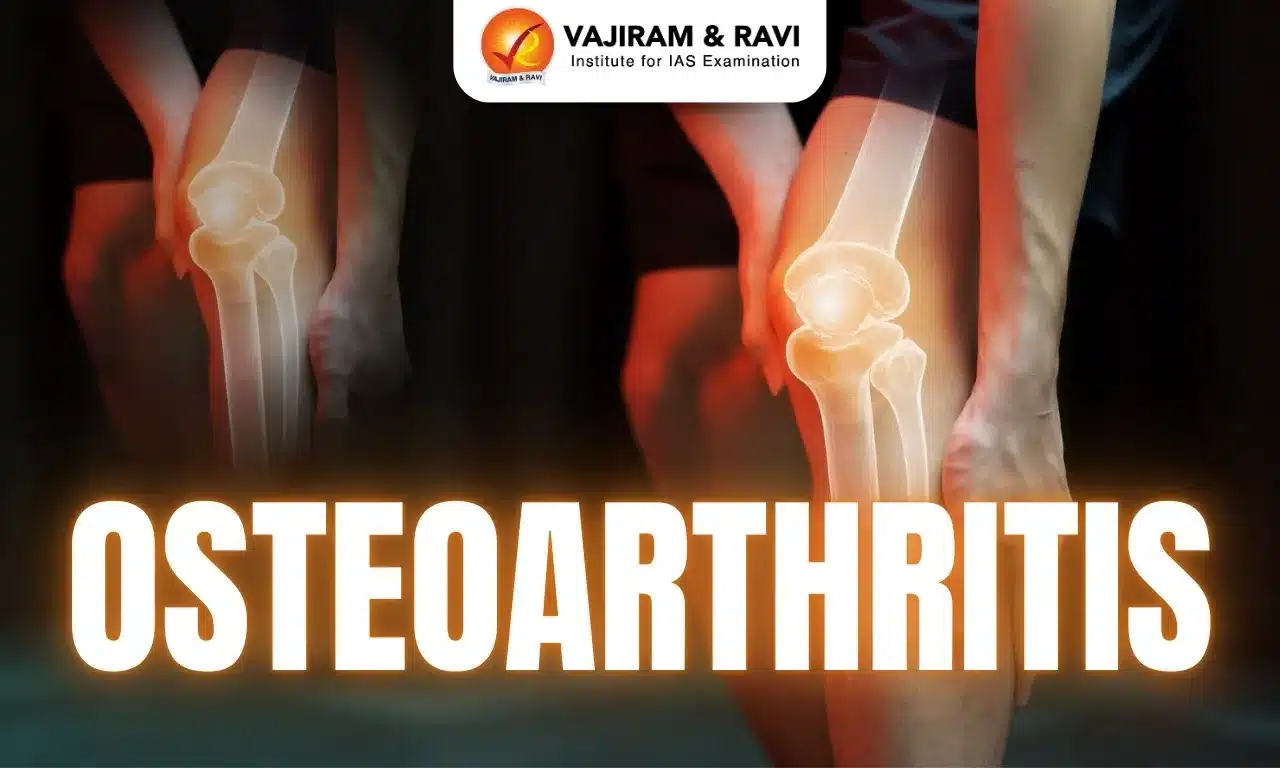
  • Osteoarthritis (OA), commonly known as wear-and-tear arthritis, is the most common type of arthritis.
  • What Causes OA?
    • It is associated with a breakdown of cartilage in joints.
    • Cartilage is a firm, rubbery material that covers the ends of bones in normal joints. 
    • Its main function is to reduce friction in the joints and serve as a "shock absorber.
    • The shock-absorbing quality of normal cartilage comes from its ability to change shape when compressed (flattened or pressed together).
    • Osteoarthritis causes the cartilage in a joint to become stiff and lose its elasticity, making it more susceptible to damage. 
    • Over time, the cartilage may wear away in some areas, greatly decreasing its ability to act as a shock absorber. 
    • As the cartilage deteriorates, tendons and ligaments stretch, causing pain. 
    • If the condition worsens, the bones could rub against each other.
  • It commonly occurs in the weight-bearing joints of the hips, knees, and spine. 
  • It also affects the fingers, thumbs, neck, and large toe.
  • It usually does not affect other joints unless previous injury, excessive stress, or an underlying disorder of cartilage is involved.
  • It is more likely to develop as people age. But it can affect much younger people, too, especially those who have had a prior joint injury.
  • Symptoms: Symptoms of osteoarthritis most often develop gradually and include:
    • Joint aching and soreness, especially with movement
    • Pain after overuse or after long periods of inactivity
    • Stiffness after periods of rest
    • Bony enlargements in the middle and end joints of the fingers (which may or may not be painful)
    • Joint swelling
  • Treatment
    • Although there is no cure for osteoarthritis, there are many treatment options available to help manage pain and keep people active.
    • As a last resort, a damaged joint may be surgically fused or replaced with one made of a combination of metal, plastic, and/or ceramic.

Source: NDTV

Osteoarthritis FAQs

Q1: What does the term arthritis mean?

Ans: It means inflammation of the joints.

Q2: What is osteoarthritis (OA)?

Ans: Osteoarthritis is the most common type of arthritis, often called wear-and-tear arthritis.

Q3: What is the main cause of osteoarthritis?

Ans: It is caused by the breakdown of cartilage in the joints.

Q4: What is cartilage?

Ans: Cartilage is a firm, rubbery material that covers the ends of bones in normal joints.

Q5: Which joints are most commonly affected by osteoarthritis?

Ans: Weight-bearing joints like the hips, knees, and spine.

PSLV-C62 Mission

PSLV-C62 Mission

PSLV-C62 Mission Latest News

ISRO’s PSLV-C62 mission experienced an anomaly at the end of the PS3 stage, and a detailed investigation has been launched to analyze the issue.

About PSLV-C62 Mission

  • It is a multi-payload mission of the Indian Space Research Organisation (ISRO) that carries one primary satellite and 18 secondary payloads into space.
  • It is ISRO’s first space launch of 2026.
  • It is scheduled to lift off from Sriharikota.
  • The mission's primary payload is the earth observation satellite EOS-N1 (codenamed ‘Anvesha’), an hyperspectral imaging satellite developed primarily for the Defence Research and Development Organisation (DRDO) for strategic purposes.
    • Unlike conventional imaging satellites, hyperspectral satellites can “see” the Earth in hundreds of wavelengths, allowing them to identify materials and objects with far greater precision.
    • This capability makes EOS-N1 a high-value asset for national security, border surveillance and strategic monitoring. 
    • At the same time, the satellite will also be used for civilian applications such as agriculture planning, urban mapping, mineral detection, and environmental monitoring.
  • PSLV-C62 also carries Europe's Kestrel Initial Demonstrator (KID), an experimental mission involving a small re-entry capsule developed in collaboration with a Spanish startup. 
    • The capsule is expected to re-enter Earth’s atmosphere and splash down in the South Pacific Ocean.
  • Additionally, 17 commercial payloads from startups and research institutions across India, Mauritius, Luxembourg, the UAE, Singapore, Europe, and the United States are manifested for the PSLV-C62 Mission.
  • Several Indian startups and academic institutions are also flying their satellites. 
    • These include OrbitAID Aerospace’s AayulSAT, CV Raman Global University’s CGUSAT-1, Dhruva Space’s DA-1, Space Kidz India’s SR-2, Assam Don Bosco University’s Lachit-1, Akshath Aerospace’s Solaras-S4, and Dayanand Sagar University’s DSAT-1.
  • Bengaluru-based OrbitAID Aerospace’s AayulSAT stands out as a historic first. 
    • It is India’s maiden on-orbit satellite refuelling payload. 
    • The mission aims to demonstrate technologies that could extend the operational life of satellites by enabling in-orbit servicing and refuelling.
    • Such capabilities are seen as crucial for tackling space debris and improving sustainability in Earth’s increasingly crowded orbital environment.

Source: MC

PSLV-C62 Mission FAQs

Q1: What is the PSLV-C62 Mission?

Ans: It is a multi-payload mission of ISRO carrying one primary satellite and 18 secondary payloads.

Q2: What is the primary payload of the PSLV-C62 Mission?

Ans: The Earth observation satellite EOS-N1 (codenamed Anvesha).

Q3: For which organisation was EOS-N1 primarily developed?

Ans: The Defence Research and Development Organisation (DRDO).

Q4: Which European experimental payload is carried onboard PSLV-C62?

Ans: Kestrel Initial Demonstrator (KID).

Charophytes

Charophytes

Charophytes Latest News

Research conducted at 27 test lakes in northeastern Germany revealed that the abundance of charophytes increased. 

About Charophytes

  • Charophytes are a type of green algae.
  • Fossils of Charophytes have been found going back to the Silurian Period (443 million years ago).
    • This was the period when plants moved from water to land—and Charophytes are considered the closest living relatives to land plants.
  • Habitat: Charophytes grow in silt, mud, peat or sand, often as the first plants to colonize newly-cleared areas.
  • Distribution: These “plants” are found on all continents except Antarctica.

Features of Charophyte

  • They have no true leaves, stems nor fruits.
  • These are generally submergent and are loosely attached to the sediment by thin rhizome- like structures called ‘holdfasts’.
  • Seeds can remain dormant for years.
  • Charophytes have been found in water as deep as 213 feet.
  • They are unable to grow or are restricted in growth in turbid or murky waters.

Benefits of Charophyte

  • Charophytes are underwater plants that play a crucial role in the water quality and biodiversity of lakes;
  • They stabilize the lake bed, produce oxygen, promote water clarity, and provide habitat for numerous aquatic organisms.

Source: PHYS

Charophytes FAQs

Q1: Charophytes are considered the closest relatives of?

Ans: Land plants

Q2: What are Charophytes?

Ans: A group of freshwater green algae

Hatti Tribe

Hatti Tribe

Hatti Tribe Latest News

"Boda Tyohar", the biggest annual festival of the Hati tribe in Himachal Pradesh's Sirmour and celebrated by over three lakh community members, recently commenced with traditional fervour.

About Hatti Tribe

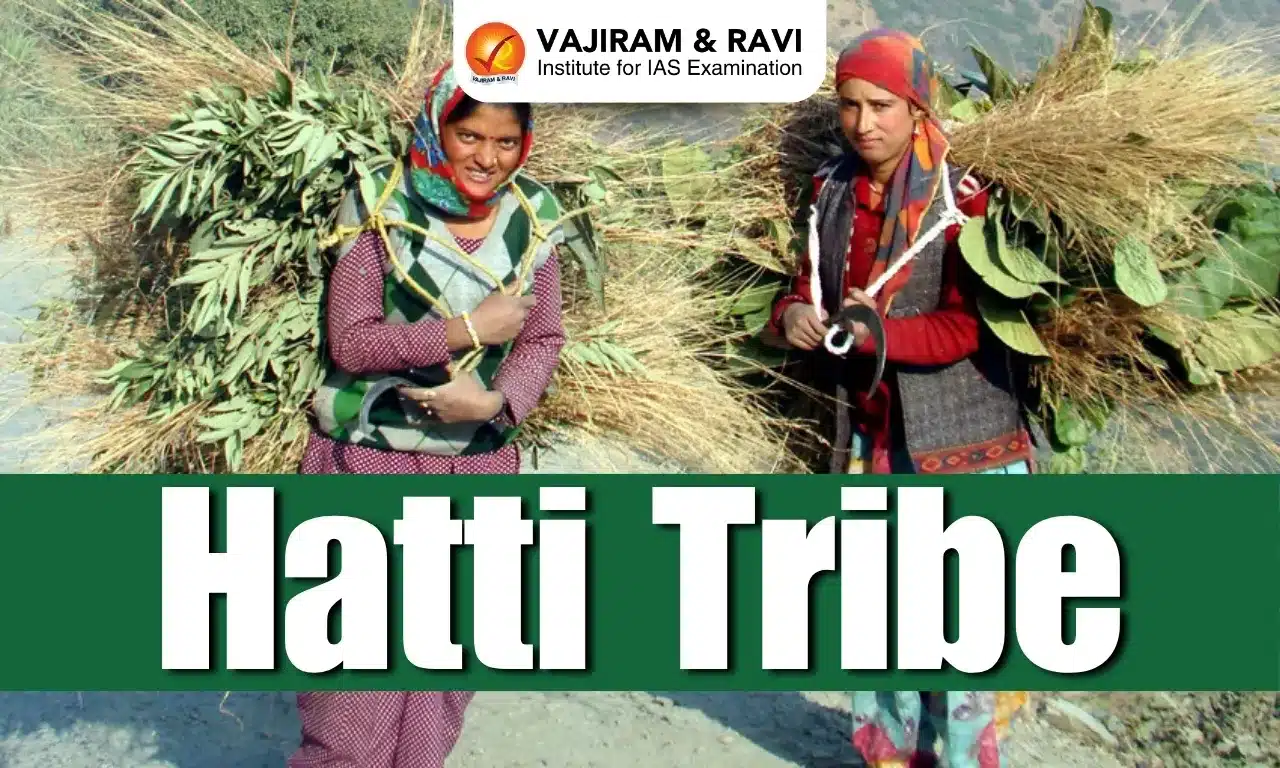
  • The Hattis are a close-knit community who take their name from their age-old professional practice of selling their homegrown crops at small markets called ‘Haat’ in nearby cities.
  • Hatti men traditionally don distinctive white headgear on ceremonial occasions.
  • These tribal people reside in the Himachal-Uttarakhand border in the basin of the Giri and Tons rivers, both tributaries of the Yamuna.
  • There are two main Hatti clans: one in the Trans-Giri area of the Sirmaur district in Himachal Pradesh and the other in Jaunsar Bawar of Uttarakhand.
  • The two Hatti clans have similar traditions, and intermarriages are common.
  • Jodidara is a traditional form of polyandrous marriage practised among the Hatti tribe in Himachal Pradesh, where a woman marries two or more brothers.
    • Polyandry is legally recognised in Himachal Pradesh under revenue laws.
  • Harris is governed by a traditional council called ‘khumbli’ which decides community matters.
  • Economy: The Hatti population relies on agriculture for livelihood and bare subsistence since their climate is ideal for growing “Cash Crops.”
  • Population: According to the 2011 census, members of the community numbered 2.5 lakh, but at present the population of the Hattis is estimated at around 3 lakhs.
  • In 2023, the Indian government granted Scheduled Tribe (ST) status to the Hatti community in Himachal Pradesh.
  • The Jaunsar-Bawar region of Uttarakhand was granted tribal status in 1967.
  • Boda Tyohar, also called Magho ko Tyohar, is the biggest annual festival of the Hatti tribe.

Source: HT

Hatti Tribe FAQs

Q1: Who are the Hattis?

Ans: The Hattis are a close-knit tribal community named after their traditional practice of selling homegrown crops at small markets called Haat.

Q2: Where do the Hatti tribal people mainly reside?

Ans: They live along the Himachal–Uttarakhand border in the basin of the Giri and Tons rivers.

Q3: Which traditional council governs the Hatti community?

Ans: The community is governed by a traditional council called khumbli.

Q4: What is the main livelihood of the Hatti tribe?

Ans: Agriculture is the primary source of livelihood.

Q5: What is the biggest annual festival of the Hatti tribe?

Ans: Boda Tyohar.

Context Window in AI

Context Window in AI

Context Window in AI Latest News

In the context of artificial intelligence (AI), specifically large language models (LLMs) like GPT-5 and Claude, the context window is the maximum amount of text the model can consider at any one time while generating a response.

About Context Window in AI

  • The context window of an artificial intelligence (AI) model measures how much information the AI model can remember, working similarly to humans’ short-term memory.
  • AI models don’t read words; instead, they read chunks of characters called tokens.
  • Context Window is the amount of text, in tokens, that the model can consider or “remember” at any one time. 
  • A larger context window enables an AI model to process longer inputs and incorporate a greater amount of information into each output.
  • large language model’s (LLM’s) context window can be thought of as the equivalent of its working memory. 
  • It determines how long of a conversation it can carry out without forgetting details from earlier in the exchange. 
  • It also determines the maximum size of documents or code samples that it can process at once. 
  • When a prompt, conversation, document, or code base exceeds an AI model’s context window, it must be truncated or summarized for the model to proceed. 
  • Generally speaking, increasing an LLM’s context window size translates to increased accuracy, fewer hallucinations, more coherent model responses, longer conversations and an improved ability to analyze longer sequences of data.
  • However, increasing context length is not without tradeoffs: it often entails increased computational power requirements—and therefore increased costs—and a potential increase in vulnerability to adversarial attacks.

Source: TH

Context Window in AI FAQs

Q1: What does the context window of an AI model measure?

Ans: It measures how much information the AI model can remember, similar to short-term memory.

Q2: How is an AI model’s context window comparable to human memory?

Ans: It works like human short-term or working memory.

Q3: What are tokens in AI models?

Ans: They are chunks of characters that AI models process instead of full words.

Q4: What is a context window in AI?

Ans: It is the amount of text, measured in tokens, that a model can consider at one time.

Q5: How does a larger context window benefit an AI model?

Ans: It allows the model to process longer inputs and use more information in each output.

Central Groundwater Board (CGWB)

Central Ground Water Board

Central Ground Water Board Latest News

The Central Ground Water Board (CGWB) recently stated in its Annual Ground Water Quality Report-2025 that Andhra Pradesh is one of the States facing widespread contamination of groundwater as per the BIS standards.

About Central Ground Water Board

  • It is a multidisciplinary scientific organization of the Department of Water Resources, River Development and Ganga Rejuvenation, Ministry of Jal Shakti, Government of India.
  • It is the National Apex Agency entrusted with the responsibilities of providing scientific inputs for management, exploration, monitoring, assessment, augmentation, and regulation of groundwater resources of the country.
  • It was established in 1970 by renaming the Exploratory Tube wells Organization under the Ministry of Agriculture, Government of India. 
  • It was merged with the Ground Water Wing of the Geological Survey of India during 1972.
  • Mandate: Develop and disseminate technologies and monitor and implement national policies for the scientific and sustainable development and management of India’s groundwater resources.
  • Organization Setup:
    • It is headed by the Chairman and has five members.
    • CGWB is a multidisciplinary scientific organization consisting of Hydrogeologists, Geophysicists, Chemists, Hydrologists, Hydrometeorologists, and Engineers.
    • It has four main wings, namely 
      • Sustainable Management & Liaison (SML)
      • Survey, Assessment & Monitoring (SAM)
      • Exploratory Drilling & Materials Management (ED&MM)
      • Water Quality & Training and Technology Transfer (WQ&TT). 
    • Headquarters: Bhujal Bhawan, Faridabad, Haryana.

Major Activities of the Central Ground Water Board

  • National Aquifer Mapping and Management (NAQUIM) involving the preparation of Aquifer Maps and Management Plans.
  • Groundwater explorations to delineate groundwater-worthy areas and potential aquifers.
  • Geophysical surveys to delineate groundwater bearing zones, etc.
  • Periodic assessment of the country’s groundwater resources.
  • Monitoring of groundwater levels and quality through groundwater observation wells.
  • Dissemination of Ground Water Data and knowledge.
  • Groundwater modelling.
  • GIS and Remote sensing.
  • Regulation and control of groundwater development and management by Central Ground Water Authority (CGWA) in coordination with State Government Organizations.
  • Coordination with the State Government with a view to establish benchmark methodologies for groundwater studies.
  • R&D studies in the ground water sector and application and operationalization of new technologies/techniques for groundwater investigation, development, and management.
  • Water conservation and artificial recharge to groundwater.
  • Capacity building and knowledge transfer.

Source: TH

Central Ground Water Board FAQs

Q1: What is the Central Ground Water Board (CGWB)?

Ans: It is a multidisciplinary scientific organization under the Ministry of Jal Shakti, Government of India.

Q2: What responsibilities are entrusted to Central Ground Water Board (CGWB)?

Ans: Management, exploration, monitoring, assessment, augmentation, and regulation of groundwater resources.

Q3: Where is the headquarters of Central Ground Water Board (CGWB) located?

Ans: Bhujal Bhawan, Faridabad, Haryana.

Q4: What kind of professionals work in Central Ground Water Board (CGWB)?

Ans: Hydrogeologists, Geophysicists, Chemists, Hydrologists, Hydrometeorologists, and Engineers.

Graphene

Graphene

Graphene Latest News

Recently, researchers developed a flexible graphene-based capacitive sensor fabricated on a paper substrate using pencil-drawn interdigitated electrodes (IDEs).

About Graphene

  • It is an allotrope of carbon, along with diamond and graphite. 
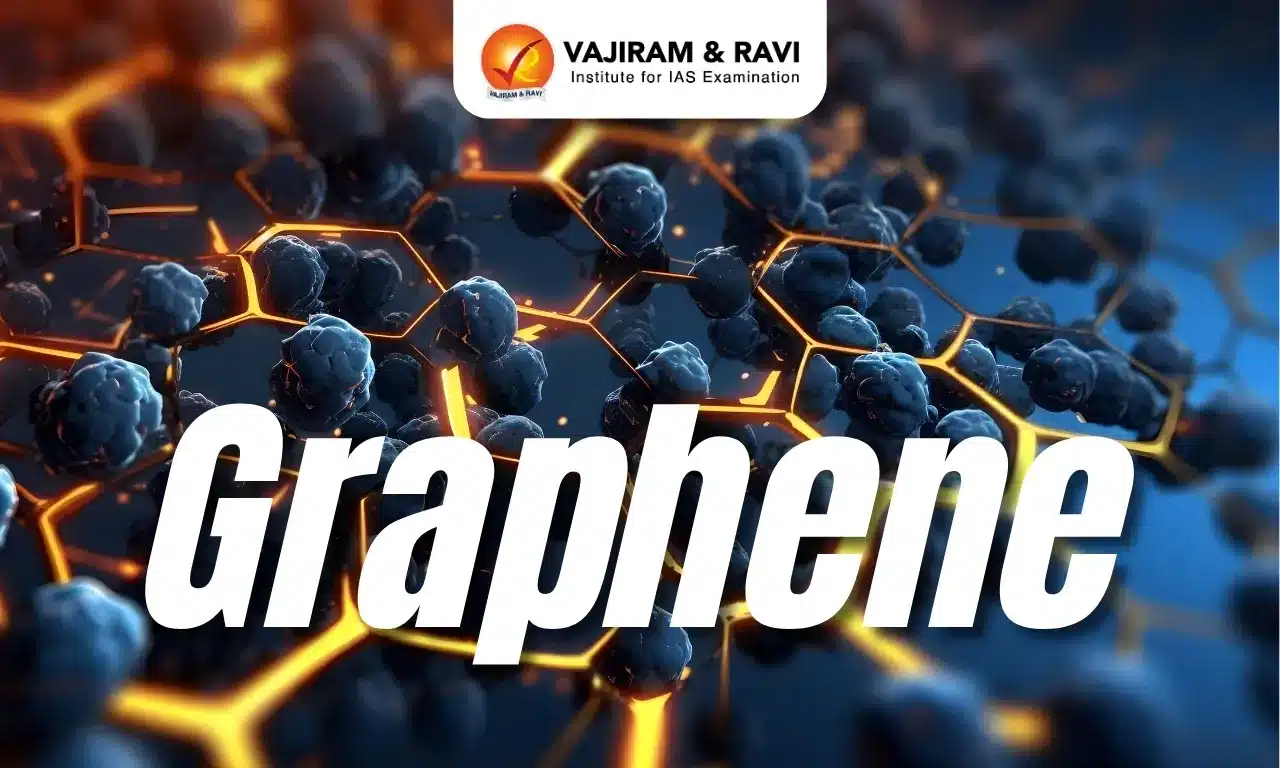
  • It is a two-dimensional material consisting of a single layer of carbon atoms arranged in a honeycomb structure. 
  • The stacked form of graphene is graphite.
  • Graphene was first isolated in 2004. Since then, graphene has found hundreds of innovative applications, from sensors and electronics to energy storage and healthcare.

Properties of Graphene

  • Thickness: Graphene is the world’s thinnest material – it is only one atom thick, one million times thinner than a human hair.
  • Strength: It is 200 times stronger than steel but six times lighter. 
  • Flexibility: It is extremely flexible and stretchable.
  • Conductivity: It is an excellent electrical and thermal conductor.
  • Transparency: It is almost perfectly transparent since it only absorbs 2% of light.
  • It is impermeable to gases, even those as light as hydrogen or helium.

Source: PIB

Graphene FAQs

Q1: What is Graphene composed of?

Ans: Carbon atoms in a hexagonal lattice

Q2: What is a notable property of Graphene?

Ans: High strength and flexibility

Enquire Now