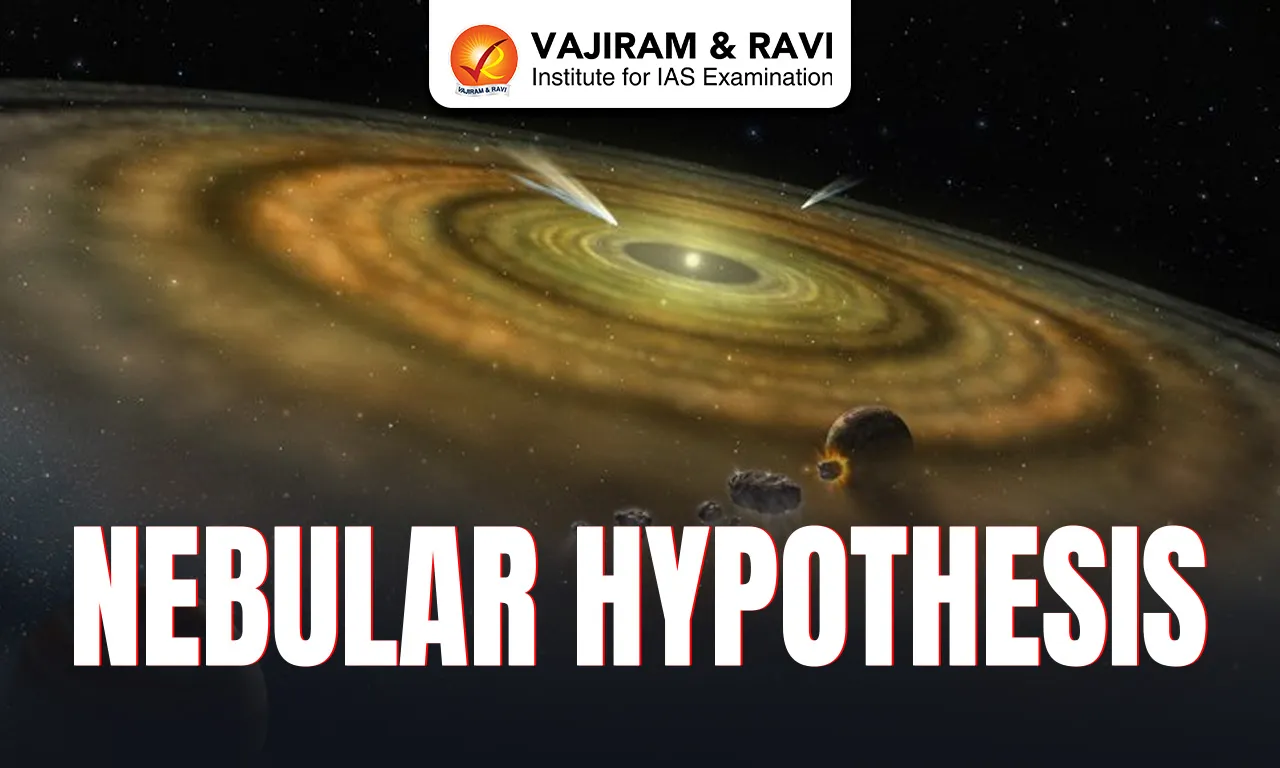
The Nebular Hypothesis is one of the earliest scientific theories that explains how the Solar System was formed. It describes how the Sun, planets, and other celestial bodies developed from a massive cloud of gas and dust called a nebula. This theory was first proposed by philosophers and scientists like Immanuel Kant and Pierre-Simon Laplace in the 18th century. Even today, it forms the base of modern theories related to planetary formation.
What is Nebula?
A nebula is a large cloud of gas, dust, and other cosmic particles found in outer space. These clouds are often considered the birthplace of stars and planetary systems.
Nebulae are mainly made of hydrogen and helium gases, along with small amounts of other elements. They are formed when stars explode or when gas and dust gather together due to gravitational forces. Some nebulae glow because of nearby stars, while others appear dark because they block light.
Also Read: Star Formation
Nebular Hypothesis of Kant
The Nebular Hypothesis of Kant was proposed by Immanuel Kant, a German philosopher, in 1755. He suggested that the Solar System was formed from a large rotating cloud of gas and dust.
- Kant believed that the universe was originally made of cold, solid, and unmoving particles.
- These particles collided due to gravitational force, which produced heat and started motion.
- The motion created angular momentum, causing the particles to rotate.
- Gradually, this rotating mass developed into a hot nebula.
- As the nebula rotated faster, it generated centrifugal force, which led to the formation of rings of matter.
- These rings cooled down and eventually formed planets and satellites.
- Kant accepted the existence of primordial matter, but he did not explain where this matter originated.
- He also failed to explain the source of energy that caused the particles to start moving.
Nebular Hypothesis of Laplace
The Nebular Hypothesis of Laplace was introduced by French mathematician Pierre-Simon Laplace in 1796. He expanded Kant’s ideas and gave a more detailed explanation of planetary formation.
- Pierre-Simon Laplace expanded Kant’s theory and suggested that the nebula was made of gases instead of solid particles.
- He believed that all celestial bodies, including the Sun, planets, stars, and asteroids, were formed from a nebula cloud.
- Initially, there was a massive cloud made of hydrogen, helium, and dust particles, similar in size to the present Solar System.
- As the nebula rotated rapidly, lighter gases like hydrogen and helium moved toward the centre.
- Continuous collisions among gases led to fusion reactions, which formed the Sun.
- Heavier elements moved away from the centre, which resulted in the formation of planets.
- The Sun mainly consists of lighter elements, while planets are made of heavier materials.
- The planets later formed smaller nebulas around them.
- Continuous rotation, friction, and fusion led to the development of a disk-shaped cloud, forming planets and satellites.
Nebular Hypothesis of Laplace Criticism
- Laplace did not explain the origin of the nebula, including the source of its heat and motion.
- The theory failed to clarify why the nebula produced a specific number of rings and planets.
- It is difficult to believe that an entire ring of matter could condense into a single planet.
- According to dynamical theory, rings would likely break into several pieces, forming multiple planets.
- Due to weak cohesion among nebula particles, ring formation should have been continuous, not occasional as suggested by Laplace.
- If the Sun was the remaining centre of the nebula, it should show a bulge at the equator, but such a bulge is not observed.
- If planets formed from nebula gases, they should initially exist in liquid form, which would make stable rotation and revolution difficult.
- Only solid bodies can maintain stable orbits and shapes during rotation.
- According to the theory, all satellites should rotate in the same direction as their planets, but some satellites of Jupiter and Saturn rotate in opposite directions.
Nebular Hypothesis FAQs
Q1: What is the Nebular Hypothesis?
Ans: The Nebular Hypothesis is a scientific theory that explains the formation of the Solar System from a large rotating cloud of gas and dust known as a nebula.
Q2: Who proposed the Nebular Hypothesis?
Ans: The theory was first proposed by Immanuel Kant in 1755 and later modified and expanded by Pierre-Simon Laplace in 1796.
Q3: What is a nebula?
Ans: A nebula is a huge cloud of gas, dust, and cosmic particles in space. It is considered the birthplace of stars and planetary systems.
Q4: How did Kant explain the origin of the Solar System?
Ans: Kant believed the Solar System formed from cold solid particles that collided due to gravity, generating heat and motion.
Q5: How did Laplace modify Kant’s theory?
Ans: Laplace suggested that the nebula was made of hot gases instead of solid particles. He explained that rapid rotation caused rings of matter to separate from the nebula, which later formed planets.