Tangkhul Hui and Kombai

Tangkhul Hui and Kombai

Tangkhul Hui and Kombai Latest News

Assam Rifles, the country's oldest paramilitary force, is preparing dog squads comprising Tangkhul Hui and Kombai, two indigenous breeds from Manipur and Tamil Nadu, respectively, along with the imported breeds.

About Tangkhul Hui

  • Tangkhul Hui, also known as Haofa, is a breed of dog raised by the Tangkhul people in the Ukhrul district of Manipur.
  • It is originally a sighthound dog that was developed as a hunting companion. 
  • It is also considered by some as a guard dog due to its strong will and protective instinct.
  • It is a large sized dog with a strong body, powerful jaws, deep and broad chest and erect ears. 
  • Their innocent face, cropped ears, dark complexion, and bulging black eyes give them the look of a black Indian bear.
  • They are very resistant to diseases. 
  • The population of purebred Haofa is steadily declining, making it increasingly rare to find dogs of original lineage.

About Kombai

  • It is an ancient Indian dog breed that originated in the Kombai region of Tamil Nadu.
  • Also known as the Indian Bore Hound or Combai, it has been used for centuries by local tribes for guarding property and hunting wild boar and other large game.
  • Known for its bravery and loyalty, the Kombai was historically prized by South Indian royalty and warriors for protection and combat. 
  • It was even used in military contexts during regional conflicts
  • It is a muscular, athletic dog with a deep chest, broad head, and strong limbs built for strength and endurance. 
  • Its coat is short, smooth, and dense, usually in reddish-brown (tan) or dark brown shades, often with a black mask.
  • It has a slightly arched back, curved tail, and erect or semi-pricked ears, giving it an alert and formidable look.
  • It is generally hardy and disease-resistant.

Source: DH

Tangkhul Hui and Kombai FAQs

Q1: What is Tangkhul Hui?

Ans: It is a breed of dog raised by the Tangkhul people in the Ukhrul district of Manipur.

Q2: What is Tangkhul Hui also known as?

Ans: Tangkhul Hui is also known as Haofa.

Q3: What type of dog is the Tangkhul Hui originally?

Ans: It is originally a sighthound developed as a hunting companion.

Q4: Where did the Kombai dog breed originate?

Ans: It originated in the Kombai region of Tamil Nadu.

Q5: For what purposes has the Kombai traditionally been used?

Ans: It has been used for guarding property and hunting wild boar and other large game.

Air-Ships Based High-Altitude Pseudo-Satellite (AS-HAPS)

Air-Ships Based High-Altitude Pseudo-Satellite (AS-HAPS)

Air-Ships Based High-Altitude Pseudo-Satellite (AS-HAPS) Latest News

The Defence Acquisition Council recently granted Acceptance of Necessity to the procurement of Air-Ships Based High-Altitude Pseudo-Satellite (AS-HAPS) for the Indian Air Force.

About Air-Ships Based High-Altitude Pseudo-Satellite (AS-HAPS)

  • HAPS are solar-powered unmanned aerial vehicles designed to operate in the stratosphere at altitudes of approximately 18-20 kilometres, nearly double the cruising altitude of commercial aircraft.
  • Unlike conventional satellites that orbit at least 200 km above Earth and require expensive rocket launches, HAPS platforms can remain airborne for months or even years using solar power during the day and high-density batteries at night.
  • This gives them satellite-like capabilities at a fraction of the cost, hence the term "pseudo satellite."
  • HAPS hovers persistently over specific locations, providing real-time monitoring of border areas to detect changes or movements.
  • Equipped with high-definition optical and infrared cameras, state-of-the-art sensors, these aerial platforms are suitable for round-the-clock missions, border patrolling, target tracking, maritime surveillance and navigation, and even missile detection.
  • India and HAPS:
  • India has been developing indigenous HAPS capability through the National Aerospace Laboratories in Bengaluru. 
  • In February 2024, NAL successfully tested a scaled-down prototype at the Challakere Aeronautical Test Range in Karnataka's Chitradurga district.
  • The 23-kg prototype, with a wingspan of 12 metres, flew for about eight and a half hours at an altitude of 3 km, meeting or exceeding all performance metrics.

Source: SM

Air-Ships Based High-Altitude Pseudo-Satellite FAQs

Q1: What is an Air-Ships Based High-Altitude Pseudo-Satellite (AS-HAPS)?

Ans: It is a solar-powered unmanned aerial vehicle designed to operate in the stratosphere with satellite-like capabilities.

Q2: At what altitude do High-Altitude Pseudo-Satellite (AS-HAPS) operate?

Ans: HAPS operate at altitudes of approximately 18–20 kilometres in the stratosphere.

Q3: How are High-Altitude Pseudo-Satellite (AS-HAPS) different from conventional satellites?

Ans: Unlike satellites that orbit at least 200 km above Earth and require rocket launches, HAPS remain in the stratosphere and do not need rockets.

Quorum Sensing

Quorum Sensing

Quorum Sensing Latest News

The phenomenon of bacterial communication, or “quorum sensing” could indeed be a game changer for medicine, by opening new avenues to develop anti-quorum sensing therapies instead of antibiotics.

About Quorum Sensing

  • It is a mechanism by which bacteria regulate gene expression in accordance with population density through the use of signal molecules. 
  • Quorum sensing allows bacteria populations to communicate and coordinate group behaviour and commonly is used by pathogens (disease-causing organisms) in disease and infection processes. 
  • Bacterial activity involving quorum sensing was first observed in the mid-1960s by Hungarian-born microbiologist Alexander Tomasz in his studies of the ability of Pneumococcus (later known as Streptococcus pneumoniae) to take up free DNA from its environment.
  • Standard quorum-sensing pathways consist of bacteria populations, signal molecules, and behavioral genes. 
  • The signal molecules, known as autoinducers, are secreted into the environment by bacteria and gradually increase in concentration as the bacteria population grows. 
  • After reaching a certain concentration threshold, the molecules become detectable to bacteria populations, which then activate corresponding response genes that regulate various behaviours, such as virulence, horizontal gene transfer, biofilm formation, and competence (the ability to take up DNA). 
  • Since many of these processes are effective only at certain population sizes, quorum sensing is a key behaviour-coordination mechanism in many microbes.
  • Although quorum sensing is common among bacteria, the precise sensing system and class of quorum-sensing compounds used may differ. 
  • In addition, the manner in which different types of bacteria apply quorum sensing varies greatly. 
    • For example, the bacterium Pseudomonas aeruginosa, which can cause pneumonia and blood infections, uses quorum sensing to regulate disease mechanisms.
    • In other organisms, quorum sensing is used for symbiotic processes and cell growth; an example is the nitrogen-fixation mechanism of the bacterium Rhizobium leguminosarum.

Source: TH

Quorum Sensing FAQs

Q1: What is quorum sensing?

Ans: Quorum sensing is a mechanism by which bacteria regulate gene expression according to population density using signal molecules.

Q2: How do bacteria coordinate their group behaviour through quorum sensing?

Ans: They communicate using chemical signal molecules that increase in concentration as the population grows.

Q3: Who first observed bacterial activity involving quorum sensing?

Ans: It was first observed by Alexander Tomasz in the mid-1960s.

Q4: What are the main components of a standard quorum-sensing pathway?

Ans: It consists of bacterial populations, signal molecules, and behavioral genes.

Himalayan Tahr

Himalayan Tahr

Himalayan Tahr Latest News

From alpine slopes to waste sites: Garbage is an emerging threat to the Himalayan Tahr in the Himalayas.

About Himalayan Tahr

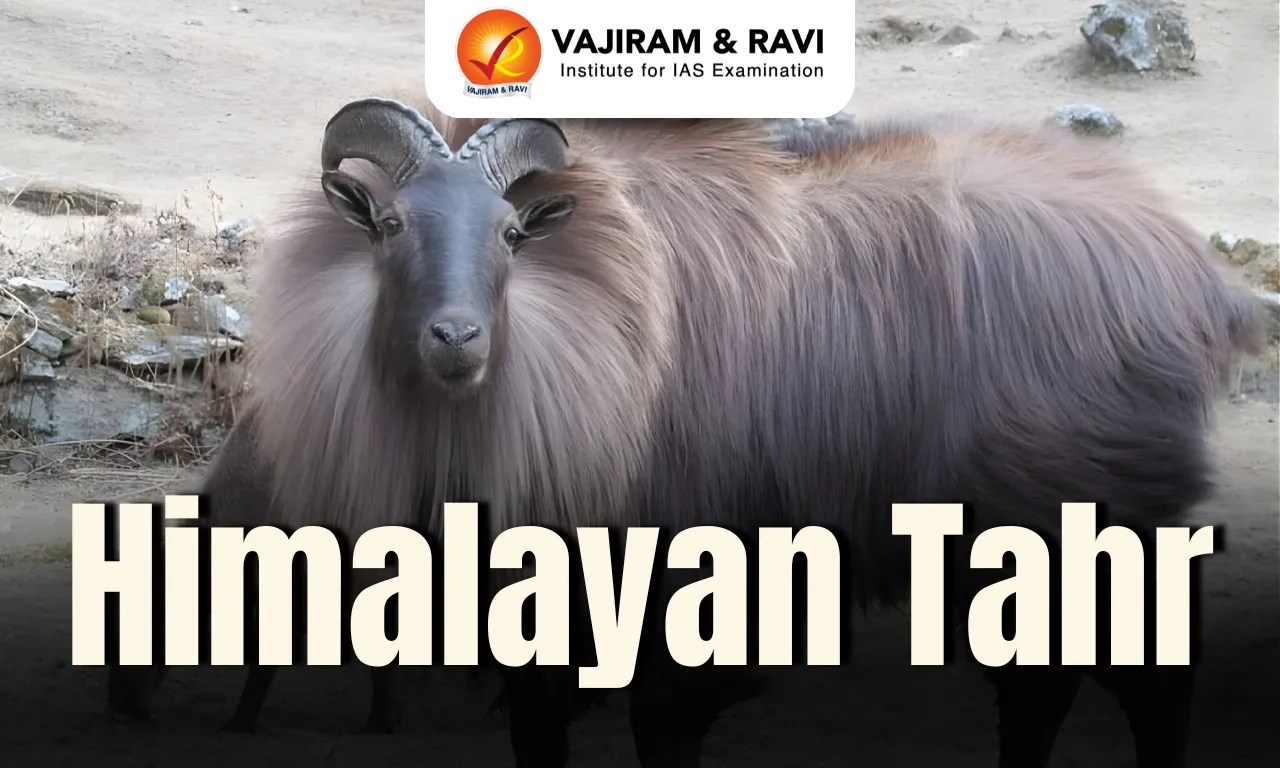
  • It is a large hoofed mammal that lives in the Himalayas.
  • Scientific Name: Hemitragus jemlahicus

Himalayan Tahr Habitat and Distribution

  • It is found in southern Tibet, northern India, western Bhutan, and Nepal. 
  • They are made for living in cool, rocky mountain areas. 
  • In the Himalayas, they are mostly found on slopes between 2,500 and 5,000 meters high. 

Himalayan Tahr Features

  • An average male tahr weighs about 73 kg, while females weigh around 36 kg. 
  • They are shorter in height than they are long. 
  • They have a small head, small pointed ears, and large eyes. 
  • Their horns are different between males and females. 
  • Male horns can grow up to 46 cm long. Females are smaller and have smaller horns.
  • The horns curve backward, which helps prevent injuries when males fight during mating season.
  • Their bodies are perfect for the cold Himalayan weather. They have thick, reddish wool coats and thick undercoats.
  • As an ungulate, the Himalayan tahr has an even number of toes. They can grip both smooth and rough surfaces.

Himalayan Tahr Conservation Status

It is classified as 'Near Threatened' under the IUCN Red List.

Source: DTE

Himalayan Tahr FAQs

Q1: What is the Himalayan Tahr?

Ans: The Himalayan Tahr is a large hoofed mammal that lives in the Himalayas.

Q2: Where is the Himalayan Tahr found?

Ans: It is found in southern Tibet, northern India, western Bhutan, and Nepal.

Q3: At what altitude is the Himalayan Tahr mostly found in the Himalayas?

Ans: It is mostly found on slopes between 2,500 and 5,000 meters.

Q4: What is the IUCN Red List status of the Himalayan Tahr?

Ans: It is listed as Near Threatened.

National Medicinal Plants Board

National Medicinal Plants Board

National Medicinal Plants Board Latest News

The National Medicinal Plants Board (NMPB), under the Ministry of Ayush organised a one-day Chintan Shivir at Vigyan Bhawan in New Delhi.

About National Medicinal Plants Board

  • It was set up in 2000 by the Government of India.
  • Nodal Ministry: It is working as a section of Ministry of AYUSH (Ayurveda, Yoga & Naturopathy, Unani, Siddha & Homoeopathy), 
  • Mandate: To develop an appropriate mechanism for coordination between various ministries/ departments/ organizations in India and  implement  support policies/programs for overall growth of the medicinal plants sector both at the Central /State and International level.
  • Objective: Main objective is the development of the medicinal plants sector through developing a strong coordination between various ministries/ departments/ organizations for implementation of policies / programs on medicinal plants.

Functions of National Medicinal Plants Board

  • It focuses on in-situ & ex-situ conservation and augmenting local medicinal plants and aromatic species of medical significance.
  • It also promotes research & development, capacity building through training, raising awareness through promotional activities like creation of Home/School herbal gardens.
  • It encourages the protection of patent rights and IPR.
  • Identification, Inventorisation and Quantification of medicinal plants.

Source: DD News

National Medicinal Plants Board FAQs

Q1: Under which ministry does the National Medicinal Plants Board operate?

Ans: Ministry of AYUSH

Q2: What is the primary objective of the National Medicinal Plants Board?

Ans: Promoting cultivation and conservation of medicinal plants

Sangtam Community

Sangtam Community

Sangtam Community Latest News

Recently, the apex body of Nagaland’s Sangtam community has passed a resolution to protect pangolins.

About Sangtam Community

  • The Sangtam tribe is one of the sixteen major tribes of Nagaland.
  • They are one of the major Naga ethnic groups in Northeast India.
  • They are concentrated in the Kiphire and Tuensang districts of Nagaland, bordering Myanmar. 

Socio-Political Life of the Sangtams

  • Clans: There are six major clans amongst the Sangtams- Dhongrü, Jingrü, Langtidhongrü/ Langkidhongrü, Mungzarü, Anarü/Yingphidhongrü and Rudidhongrü clans.
  • Language: The common dialect of the Sangtams is known as Sangtamyu which is spoken by around 90% of the population.
  • The Sangtam people traditionally practice jhum cultivation (shifting agriculture), which remains central to their livelihood.
  • They follow a patriarchal system of lineage and inheritance as well.
  • Festivals:
    • Mongmong: The predominant theme of the festival is the worship of the God of the house and the three cooking stones in the fireplace. 
    • Tsohsuh: It is commonly known as ‘vi thung’ festival and is celebrated during the spring season in the month of March.
    • HüNAPUNGBI: It is celebrated especially for children.

Source: TH

Sangtam Community FAQs

Q1: Where is the Sangtam community primarily located?

Ans: Nagaland

Q2: Which language does the Sangtam community speak?

Ans: Sangtam language (Tibeto-Burman language family)

AgriStack

AgriStack

AgriStack Latest News

Recently, the Finance Minister announced the launch of Bharat-VISTAAR, a multilingual AI tool to integrate the AgriStack portals and the ICAR package on agricultural practices with AI systems.

About  AgriStack

  • AgriStack is a Digital Public Infrastructure (DPI) for the farm sector.
  • It is an initiative under the Digital Agriculture Mission (DAM), and was approved by the Union Cabinet in September, 2024.
  • The AgriStack comprises three foundational registries or databases in the agriculture sector: 
    • The Farmer Registry, Geo-referenced village maps and the Crop Sown Registry, all created and maintained by the State Governments or Union Territories.
  • Farmer Registry
    • Under the AgriStack, farmers are given digital identities (Farmer ID) which are linked dynamically to the State’s land records, livestock ownership, crops sown, demographic details, family details, schemes and benefits availed.
    • Target: The government aims to create digital identities for 11 crore farmers.
    • The Centre has allocated financial support to states to create their respective registries under the Special Assistance to States for Capital Investment
    • Advantage: A farmer would be able to access benefits and services digitally.
    • The Centre aims to complete the Farmer Registry with dynamic Records of Rights (RoR) synchronisation by March 2027. In the North Eastern States, the target was set to March 2028.
  • Crop Sown Registry
    • It includes details on crops planted by farmers.
    • This is recorded through mobile-based Digital Crop Surveys on the ground each season.
    • A pilot on the Digital Crop Survey was conducted in 11 states to develop the Crop Sown Registry in 2023-24.
  • Geo-referenced Village Maps data
    • It comprises geographic information of land records linked with their locations (latitudes and longitudes).
    • The target is to cover all villages by March 2027.

Source: IE

AgriStack FAQs

Q1: What is AgriStack?

Ans: A set of digital public infrastructure for agriculture

Q2: What is the primary goal of AgriStack?

Ans: To create a unified digital ecosystem for agriculture

Ayushman Sahakar Scheme

Ayushman Sahakar Scheme

Ayushman Sahakar Scheme Latest News

Recently, the Union Minister for Home and Cooperation informed the Rajya Sabha about the Ayushman sahakar scheme.

About Ayushman Sahakar Scheme

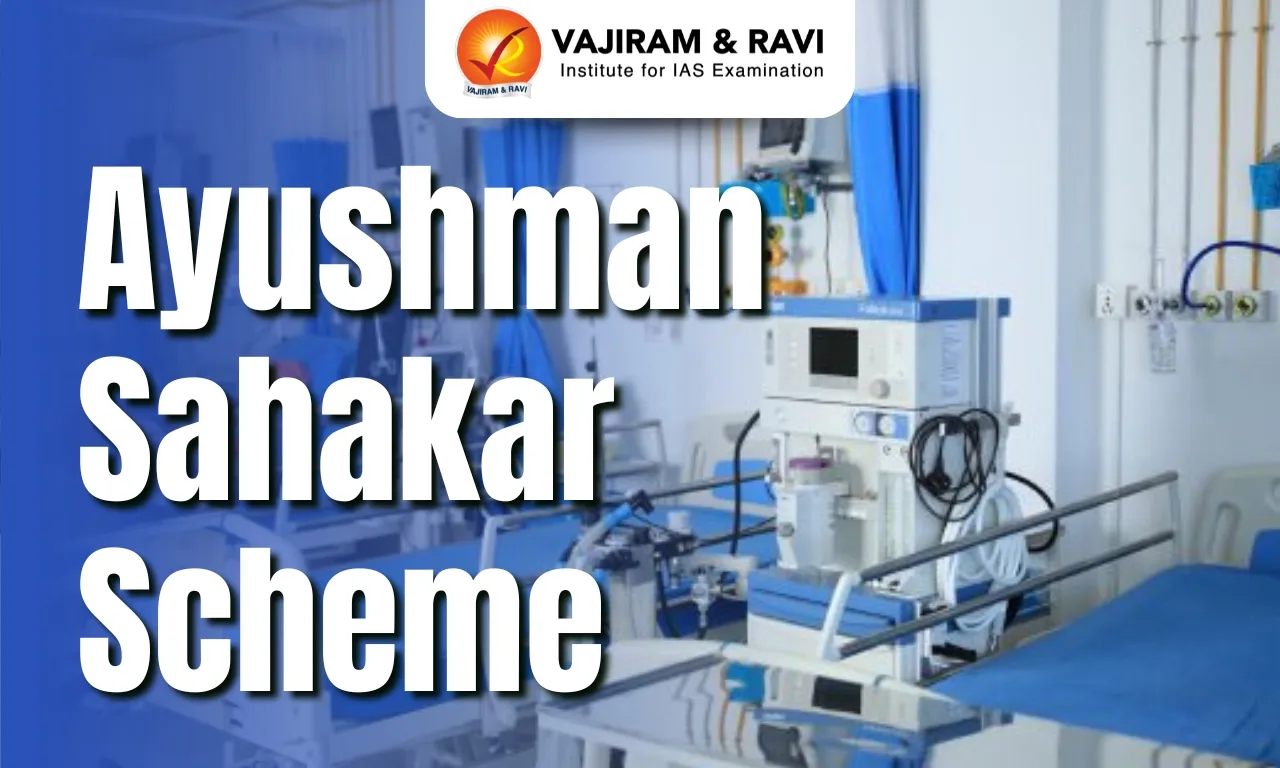
  • It is a scheme of the National Cooperative Development Corporation for financial assistance to cooperatives on holistic healthcare infrastructure, education and services.

Objectives of the Ayushman Sahakar Scheme

  • To assist provision of affordable and holistic healthcare through hospitals / healthcare / education facilities by cooperative societies,
  • To assist promotion of AYUSH facilities by cooperative societies,
  • To assist cooperative societies meet the objectives of National Health Policy,
  • To assist cooperative societies participate in the National Digital Health Mission,
  • To assist cooperative societies provide comprehensive healthcare including education, services, insurance and activities related thereto.

Features of Ayushman Sahakar Scheme

  • Eligibility: Any Cooperative Society registered under any State/ Multi State Cooperative Societies Act in the country, with suitable provision in the bye-laws to undertake services related to hospital/ healthcare/ health education.
  • Loan Period: Up to 8 years, including 1 - 2 years moratorium on payment of principal, depending on the type of project and its ability to generate revenue.
  • Incentive:  1 % interest rebate in case of borrower cooperative society where women members are in majority.
  • The Ayushman Sahakar fund has a corpus of Rs. 10,000 crores which could be used for funding the cooperatives. 
  • Support the modernisation of cooperative healthcare facilities.
  • Support the establishment of healthcare infrastructures like clinics, diagnostics centres and hospitals.

 Source: PIB

Ayushman Sahakar Scheme FAQs

Q1: What is the primary objective of the Ayushman Sahakar Scheme?

Ans: To support cooperatives in healthcare infrastructure development

Q2: What kind of support does the Ayushman Sahakar Scheme offer?

Ans: Term loans for healthcare infrastructure development

Vidyanjali Initiative

Vidyanjali Initiative

Vidyanjali Initiative Latest News

Recently, the union Minister of State for Education informed the Rajya Sabha that Vidyanjali initiative has boarded over 8.5 lakh schools and 5 lakh volunteers.

About Vidyanjali Initiative

  • It was launched in September 2021 in alignment with the National Education Policy 2020.
  • It aims to strengthen government schools through community and private sector participation, enabling greater support for students’ holistic development and improved learning outcomes.
  • It is an initiative of the Department of School Education and Literacy, Ministry of Education, for facilitating the community and volunteers to directly connect with the government and government-aided schools to contribute their services and/or assets/ materials/equipments through a dedicated portal.
  • The platform connects volunteers, alumni, institutions, civil society organisations and CSR partners directly with schools based on their identified needs.

Salient Features of the Platform

  • Create an interface between volunteers and schools to bridge the gap between them
  • Help school students in getting exposure other than academic activities
  • Platform for schools to share their activities for Volunteer-ship, where volunteers can participate by performing various activities
  • Platform for the Ministry to view various reports like Schools on-boarded, Volunteers, Activities performed etc.
  • Platform for participation of Citizens/Volunteers/Alumni’s to contribute services at schools and their management

Source: PIB

Vidyanjali Initiative FAQs

Q1: What is the primary objective of the Vidyanjali Initiative?

Ans: To increase community and private sector involvement in education

Q2: Who can participate in the Vidyanjali Initiative?

Ans: Volunteers from various sectors, including professionals and students

Bhakra Dam

Bhakra Dam

Bhakra Dam Latest News

Amid rising incidents of landslides during the monsoon season, a comprehensive geological study of the hillocks surrounding the Bhakra Dam is likely to be undertaken by the Geological Survey of India (GSI).

About Bhakra Dam

  • It is a concrete gravity dam across the Sutlej River.
  • It is located at a gorge near the upstream Bhakra village in the Bilaspur district of Himachal Pradesh.
  • It is near the border between Punjab and Himachal Pradesh.
  • It is the highest straight gravity dam in the world, with a height of about 207.26 meters.
  • It is Asia’s second tallest dam, next to the 261 m Tehri Dam, also in India. 
  • History:
    • The Bhakra Dam is one of the earliest river valley development schemes undertaken by India after independence. 
    • The construction of this dam started in 1948, when Jawahar Lal Nehru, the first prime minister of India, poured the first bucket of concrete into the foundations of Bhakra. 
    • The dam was completed by the end of 1963.
    • Bhakra Dam was described as the ‘New Temple of Resurgent India’ by Jawaharlal Nehru.
    • Operation and maintenance of the Bhakra dam is done by the Bhakra Beas Management Board (BBMB).
  • The dam created the massive Gobind Sagar reservoir and plays a crucial role in irrigation, flood control, and hydroelectric power generation for Punjab, Haryana, Rajasthan, Himachal Pradesh, and Chandigarh. 
    • The 90 km long reservoir is spread over an area of 168.35 sq.km. 
    • In terms of storage of water, it is the second largest reservoir in India, the first being Indira Sagar Dam in Madhya Pradesh with a capacity of 12.22 billion cu m.
  • Nangal Dam is another dam downstream of Bhakra Dam. Sometimes both the dams together are called the Bhakra-Nangal Dam, though they are two separate dams.
    • Nangal Dam is an earthen dam with a height of 29 meters and a length of 305 meters. 
    • It serves as an auxiliary dam to channel the water released from Bhakra Dam to two powerhouses.
    • The installed capacity of Bhakra Right Bank Power House is 785 MW, and that of Bhakra Left Bank Power House is 630 MW.

Source: NIE

Bhakra Dam FAQs

Q1: What type of dam is Bhakra Dam?

Ans: Bhakra Dam is a concrete gravity dam.

Q2: On which river is Bhakra Dam built?

Ans: It is built across the Sutlej River.

Q3: Where is Bhakra Dam located?

Ans: It is located near Bhakra village in the Bilaspur district of Himachal Pradesh, close to the Punjab–Himachal Pradesh border.

Q4: Why is Bhakra Dam significant in terms of height?

Ans: It is the highest straight gravity dam in the world.

Q5: Which reservoir was created by Bhakra Dam?

Ans: It created the Gobind Sagar Reservoir.

Enquire Now