Anavaran Portal

Anavaran Portal

Anavaran Portal Latest News

Recently, the Forest Survey of India stopped its Anavaran-Deforestation Alert System on deforestation.

About Anavaran Portal

  • It has been operational since January 2024.
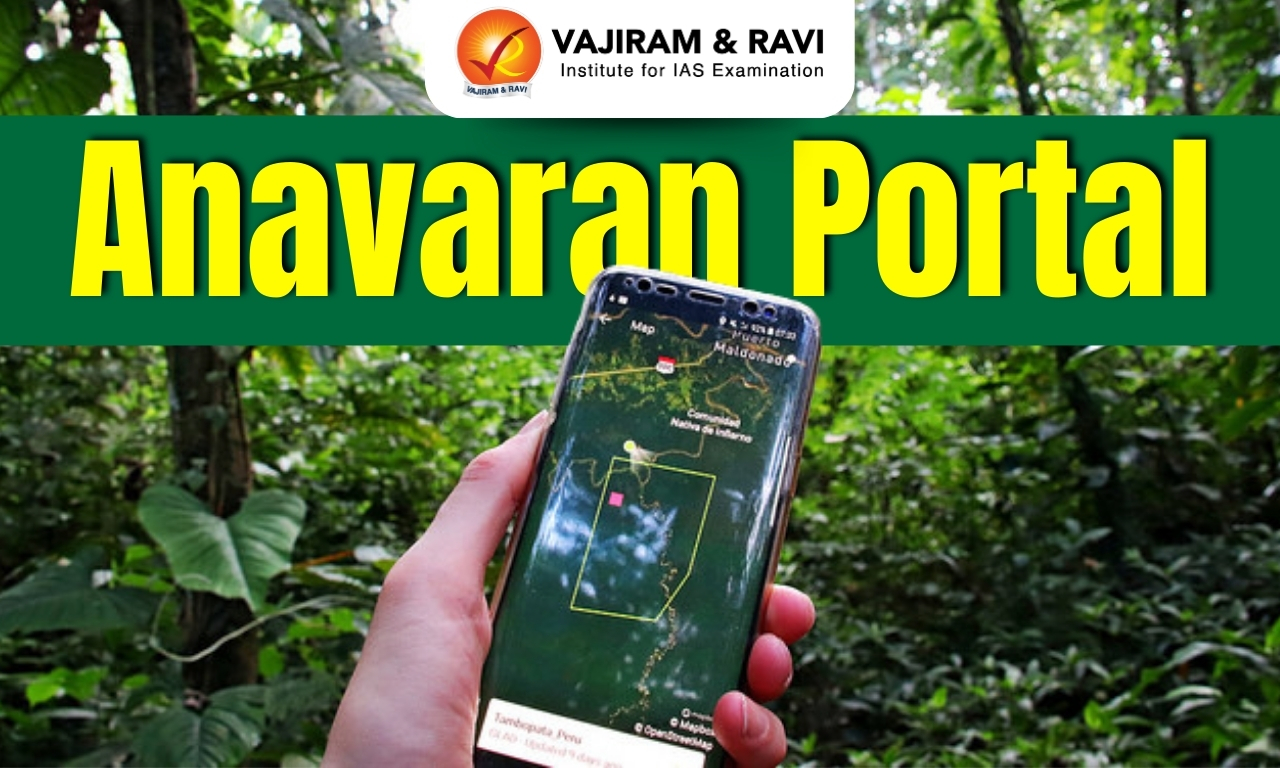
  • It has been using satellite data and machine learning to enable Forest Survey of India to issue location alerts on the loss of forest cover to states every 15 days so that targeted field inspections can be carried out.
  • Technology Used
    • The Anavaran alert system is based on the Google Earth Engine (GEE) platform.
    • It uses Sentinel-2 satellite images as input data.
    • For continuous monitoring during cloudy and monsoon seasons, this is further integrated with Sentinel-1 Synthetic Aperture Radar (SAR) data.

Key Facts about Forest Survey of India (FSI)

  • It is a premier national organization under the union Ministry of Environment, Forests and Climate Change.
  • It was established on June 1,1981 by succeeding the "Preinvestment Survey of Forest Resources" (PISFR)” 
    • Preinvestment Survey of Forest Resources" (PISFR), was a project initiated in 1965 by Government of India with the sponsorship of FAO and UNDP.
  • Mandate: It is responsible for assessment and monitoring of the forest resources of the country regularly. In addition, it is also engaged in providing the services of training, research and extension.
  • It has been publishing the State of Forest Report on a biennial basis since 1987.
    • State of Forest Report carries out an in-depth assessment of the forest and tree resources of the country based on interpretation of Remote Sensing satellite data and field based National Forest Inventory (NFI).

Source: IE

Anavaran Portal FAQs

Q1: What is the primary purpose of the Anavaran Portal?

Ans: To monitor and manage forest resources

Q2: Which technology is used by the Anavaran Portal?

Ans: Artificial Intelligence and Machine Learning

Exercise LAMITIYE

Exercise LAMITIYE

Exercise LAMITIYE Latest News

Indian Armed Forces contingent is participating in the eleventh edition of joint military Exercise “LAMITIYE-2026” with Seychelles Defence Forces (SDF) in Seychelles. 

About Exercise LAMITIYE

  • It is the joint military exercise conducted between India and Seychelles.
  • LAMITIYE’ means ‘Friendship’ in the Creole language.
  • It is a biennial training event and has been conducted in Seychelles since 2001.
  • Participating Troop: The contingent comprises personnel from the ASSAM Regiment and participation from Indian Navy and Indian Air Force including INS Trikand and a C-130 aircraft.
  • Exercise LAMITIYE 2026
    • This edition marks a significant milestone with the participation of all three services of the Indian Armed Forces.
    • The exercise will strive to enhance synergy in the domains of Sub-conventional Operations in Semi-Urban environment and cooperation and interoperability between both the sides during Peace Keeping Operations.
    • Both sides will jointly train, plan and execute a series of tactical drills for neutralisation of likely threats that may be encountered in a Semi-Urban environment, while exploiting and showcasing New Generation Equipment and technology.
    • It will include Field Training Exercises, combat discussions, case studies, lectures & demonstrations, culminating with Validation Exercise.

Source: PIB

Exercise LAMITIYE FAQs

Q1: Exercise LAMITIYE is a joint military exercise between India and which country?

Ans: Seychelles

Q2: What is the primary objective of Exercise LAMITIYE 2026?

Ans: To enhance synergy and interoperability in sub-conventional operations

National Highways Green Cover Index

National Highways Green Cover Index

National Highways Green Cover Index Latest News

Recently, the National Highways Authority of India (NHAI) released the first National Highways Green Cover Index (NH-GCI).

About National Highways Green Cover Index

  • It is an initiative of National Highways Authority of India.
  • It has been prepared in coordination with the National Remote Sensing Centre (NRSC) of the Indian Space Research Organisation (ISRO).
  • The initiative aims to provide a scientific and quantitative assessment of green cover within the Right of Way (RoW) along the National Highways network by leveraging advanced space-based technologies.
  • Methodology Used
    • The assessment is derived from chlorophyll content detected through high-resolution satellite sensors.
    • It measures the percentage of land covered with vegetation along highway corridors, including plantations on the left and right sides of the road, as well as in the median wherever feasible.
    • The analysis is conducted for every one-kilometre highway segment using the Normalized Difference Vegetation Index (NDVI) derived from satellite imagery.
  • Coverage: Approximately 30,000 km of National Highways spanning 24 States have been covered for the period July–December 2024.
  • Significance
    • It offers a robust, reliable, cost-effective, and time-efficient mechanism for macro-level estimation of the green cover along the National Highways.
    • It will enable comparison, ranking, and targeted interventions for improved plantation management.

Source: PIB

National Highways Green Cover Index FAQs

Q1: What is the primary objective of the National Highways Green Cover Index (NH-GCI)?

Ans: To assess and monitor green cover along national highways

Q2: Which state has the highest green cover along national highways, according to the NH-GCI report?

Ans: Assam

Key Facts about Malawi

Key Facts about Malawi

Malawi Latest News

Recently, India has dispatched a consignment of one thousand metric tonnes of rice to Malawi to support Malawi’s efforts towards food security following the drought caused by the El Niño effect. 

About Malawi

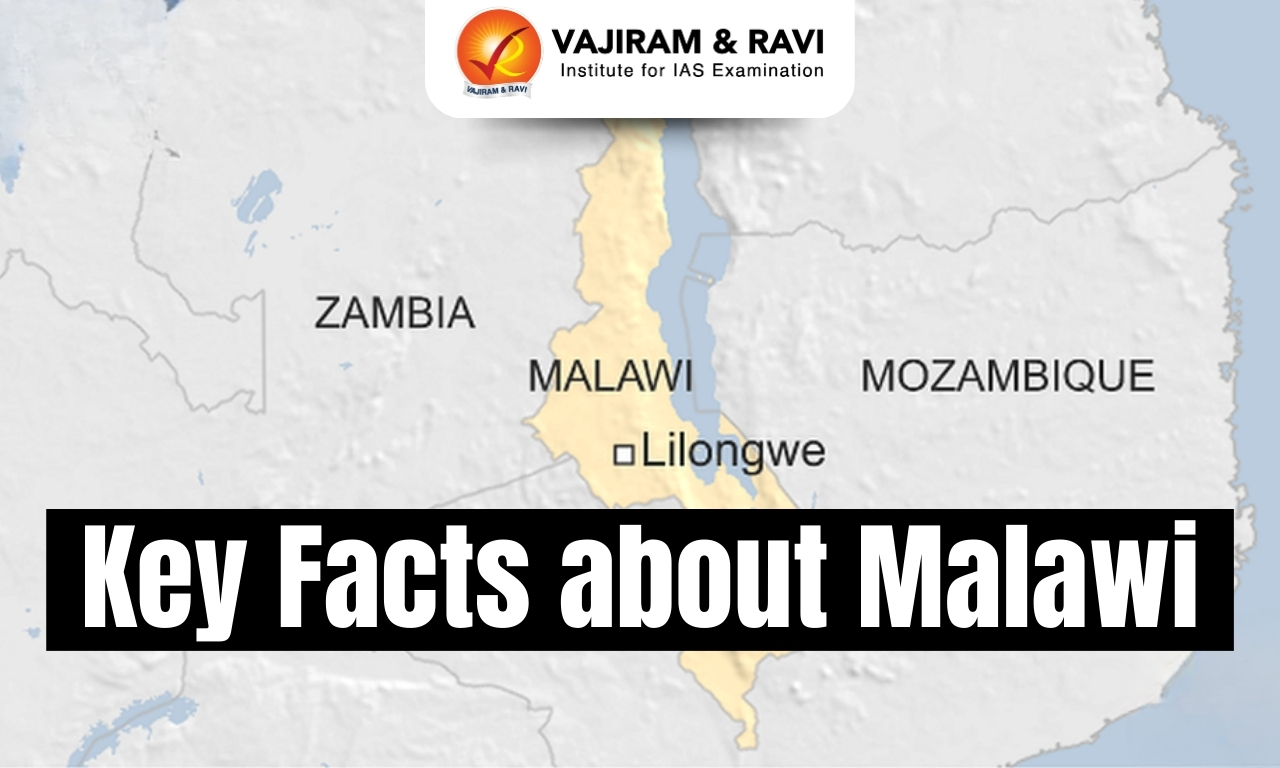
  • It is a landlocked nation in southeastern Africa.
  • Bordering Countries: It is bordered by three countries namely Mozambique on the east, south, and southwest. Tanzania to the north and northeast and Zambia is located to the west.
  • Capital City: Lilongwe

Geographical Features of Malawi

  • It occupies a narrow, curving strip of land along the East African Rift Valley.
  • Major Lakes:  Lake Nyasa, known in Malawi as Lake Malawi, accounts for more than one-fifth of the country’s total area.
  • Major Rivers: Shire,  Rukuru, Dwangwa, Lilongwe, Bua etc.
  • Plateaus: The two largest plateaus are the Nyika Plateau and the Shire Highlands. 
  • Highest Peak: Sapitwa Peak in Mt. Mulanje near the Mozambique border.
  • Waterfalls: Likhubula Falls is a stunning waterfall located in Malawi.
  • Natural Resources: Coal, lime, limestone, graphite, black granite, aquamarine, tourmaline, ruby, sapphire, bauxite, and marble are some of the minerals found in Malawi.

Source: News On Air

Malawi FAQs

Q1: Where is Malawi located?

Ans: Southern Africa

Q2: What is the capital city of Malawi?

Ans: Lilongwe

Sinhagad Fort

Sinhagad Fort

Sinhagad Fort Latest News

At least 25 people were injured after a swarm of bees attacked visitors at Sinhagad Fort recently.

About Sinhagad Fort

  • Sinhagad, earlier known as ‘Kondhana’, is a fortress located near Pune, Maharashtra. 
  • It perched on an isolated cliff of the Bhuleswar range of Sahyadri Mountains, 1,312 m above sea level. 
  • According to history, the fort was built 2,000 years ago and it is said that the name Kondana was derived from sage Kaundinya. 
  • Early inscriptions and carvings suggest it served as a spiritual retreat and strategic outpost for ancient dynasties. 
  • Mohammed bin Tughalak captured the fort from the Koli tribal chieftain, Nag Naik in 1340 CE. 
  • In 1496 CE, Malik Ahmad, the founder of the Nizam Shahi dynasty took control of the fort.
  • Nearly 200 years later, the Maratha leader Shahaji Bhonsale captured the fort. 
  • In 1647 CE, Shivaji held the stronghold.
  • In 1665 CE, as per the Treaty of Purandar, Shivaji handed over Sinhagad to the Mughals and again captured it in 1670 CE, under the direction of Tanaji Malusare who was Shivaji's favorite general. 
  • It has witnessed epic battles, including the legendary Battle of Sinhagad in 1670, where valor, sacrifice, and strategy led to an unforgettable victory for the Marathas over the Mughal Army.
  • While recouping the fort during Battle of Sinhagad, Malusare lost his life for which Shivaji Maharaj honoured the fort with the name Sinhagad Fort or Lion’s Fort.
  • Aurangzeb laid siege to Sinhagad in 1701- 03 CE, but could not hold it for long. 
  • Finally the British seized the fort from the Marathas in 1818 AD. The fort was later used as a retreat for many European residents of Pune. 

Sinhagad Fort Architecture

  • It is a marvel of Maratha architecture and engineering. 
  • The fort features two main entrances—the Pune Darwaza, facing Pune, and the Kalyan Darwaza, opening towards the Konkan region—both showcasing intricate stonework and strategic placement for enhanced security.
  • It has an advanced water storage system, which includes ancient rainwater harvesting techniques and natural reservoirs that ensure a continuous water supply.
  • The fort has several bastions, ramparts, walls, and gates that enclose its premises. 
  • The fort also houses a temple dedicated to Goddess Kali, a brewery, some military sheds and the tombs of Rajaram Chhatrapati (Shivaji’s youngest son) and Tanaji Malusare.

Source: IE

Sinhagad Fort FAQs

Q1: Where is Sinhagad Fort located?

Ans: Near Pune in Maharashtra.

Q2: What was the earlier name of Sinhagad Fort?

Ans: Kondhana.

Q3: Which famous battle was fought at Sinhagad Fort in 1670?

Ans: The Battle of Sinhagad.

Q4: Which Maratha warrior’s tomb is also located in Sinhagad Fort?

Ans: Tanaji Malusare, who was Shivaji's favorite general.

Sheshnaag-150

Sheshnaag-150

Sheshnaag-150 Latest News

India is developing the Sheshnaag-150, a long-range swarm attack drone that can fly over 1,000 km, carry powerful warheads and strike targets.

About Sheshnaag-150

  • It is a long-range collaborative attack swarm drone, with autonomous systems capable of deep strikes and saturation attacks.
  • It is being developed by NewSpace Research and Technologies (NRT), a Bengaluru-based aerospace startup focusing on AI-driven unmanned systems and swarm robotics.

Sheshnaag-150 Features

  • Weighing about 150 kg, Sheshnag can carry 25-40 kg payload which is sufficient to damage infrastructure, military vehicles or personnel.
  • What sets it apart is its AI-powered swarm techmultiple drones can team up autonomously to evade defenses and hit targets together.
  • It has an operational range of over 1,000 km.
  • It can stay airborne for over five hours, enabling it to loiter over target areas before executing an attack.
  • It is equipped with real-time surveillance, autonomous target identification, and strike capabilities.
  • It has the ability to operate in GPS-denied environments using visual navigation systems. This ensures that the drone can still reach targets even if satellite navigation signals are jammed during warfare.

Source: BS

Sheshnaag-150 FAQs

Q1: What is Sheshnaag-150?

Ans: It is a long-range collaborative attack swarm drone with autonomous strike capabilities.

Q2: Which organisation is developing the Sheshnaag-150 drone?

Ans: It is being developed by NewSpace Research and Technologies (NRT), a Bengaluru-based aerospace startup.

Q3: What is the operational range of Sheshnaag-150?

Ans: Over 1,000 km.

Q4: What is the key advantage of swarm technology used in Sheshnaag-150?

Ans: Multiple drones can coordinate autonomously to evade defenses and conduct saturation attacks.

Gurudongmar Lake

Gurudongmar Lake

Gurudongmar Lake Latest News

Tourism to the high-altitude Gurudongmar Lake in North Sikkim has begun to revive after more than two years of disruption following the devastating South Lhonak Lake GLOF, which severely damaged road infrastructure.

About Gurudongmar Lake

  • It is located on the northern-most edge of Sikkim, very close to the Chinese Tibetan border.
  • It is one of the highest lakes in the world and in India, located at an altitude of 17,800 ft (5,430 m).
  • It is spread out over 290 acres and is surrounded by snow-covered mountain ranges all around.
  • The lake is primarily fed by glaciers and is a source stream for the Tso Lahmu Lake that later forms the source of the Teesta River. 
  • It is considered sacred by Buddhists, Sikhs, and Hindus. 
  • The lake is named after Guru Padmasambhava—also known as Guru Rinpochefounder of Tibetan Buddhism. 
  • Guru Padmasambhava visited the lake in the 8th century on the way back from Tibet. 
  • Even in extreme winters, a part of this lake never freezes. 
    • The myth behind this is that Guru Padmasambhava had once touched and consecrated this lake and made it partially frozen throughout the year.

Source: EM

Gurudongmar Lake FAQs

Q1: Where is Gurudongmar Lake located?

Ans: It is located in the northernmost part of Sikkim, close to the China.

Q2: Why is Gurudongmar Lake geographically significant?

Ans: It is one of the highest lakes in the world and in India, located at an altitude of 17,800 ft (5,430 m).

Q3: What is the main source of water for Gurudongmar Lake?

Ans: It is mainly fed by glaciers.

Q4: Which lake receives water from Gurudongmar Lake and later forms the source of the Teesta River?

Ans: Tso Lhamo Lake.

Q5: After whom is Gurudongmar Lake named?

Ans: Guru Padmasambhava, also known as Guru Rinpoche.

DART Mission

DART Mission

DART Mission Latest News

A groundbreaking study has revealed that NASA’s DART Mission not only altered the motion of a small asteroid within its system but also slightly changed the orbit of the entire asteroid pair around the Sun.

About DART Mission

  • DART (Double Asteroid Redirection Test) was a NASA space probe dedicated to investigating and demonstrating one method of asteroid deflection by changing an asteroid’s motion in space through kinetic impact.
  • It was launched on November 24, 2021.
  • It was the first-ever space mission to demonstrate asteroid deflection by a kinetic impactor.
  • It was the world’s first planetary defense technology demonstration.
  • It was aimed at finding out whether or not we could redirect the trajectory of a near-Earth object simply by crashing into it. 
  • The target of DART was a binary asteroid system consisting of a smaller moonlet, Dimorphos, orbiting around a larger asteroid, Didymos.
    • Because the two were linked by gravity, the theory went, knocking little Dimorphos off-kilter would affect both objects.
  • DART spacecraft successfully collided with Dimorphos on 26 September 2022.
    • Weighing in at over 1,000 pounds, the spacecraft’s collision with Dimorphos was as energetic as an explosion of over three tons of TNT. 
    • DART’s collision shortened the orbit of the asteroid by around 33 minutes. 
    • The collision also slightly altered the orbit of the Didymos system around the Sun. 
    • Researchers found that the solar orbital period changed by about 0.15 seconds.
  • The mission was a success. For the first time, humans have successfully demonstrated the ability to change the motion of an asteroid in space.

Source: MC

DART Mission FAQs

Q1: What does DART stand for?

Ans: Double Asteroid Redirection Test.

Q2: Which organisation launched the DART mission?

Ans: NASA.

Q3: What was the main objective of the DART mission?

Ans: To test asteroid deflection by crashing a spacecraft into an asteroid (kinetic impact method).

Q4: Which asteroid system was targeted by the DART mission?

Ans: The Didymos–Dimorphos system.

Q5: What major scientific achievement did the DART mission demonstrate?

Ans: Humans can change the motion of an asteroid in space for planetary defence.

Doomsday Fish

Doomsday Fish

Doomsday Fish Latest News

Two giant oarfish, rarely seen deep-sea creatures sometimes called “doomsday fish,” were recently spotted near the shore in Cabo San Lucas, Mexico, in an extremely rare sighting.

About Doomsday Fish

  • The oarfish is commonly known as the “doomsday fish”.
  • It is a deep-sea dweller that rarely comes near the surface.
  • Scientific Name: Regalecus glesne
  • Habitat: They are deep-sea dwellers, thriving most often in the zone least explored by scientists to date: the mesopelagic zone (waters down to 1,000 meters).

Doomsday Fish Features

  • It is known for its long, ribbon-like body that enables the species to float inconspicuously throughout the water column.
  • It also boasts large eyes and foreboding red spines that stick out to form a crown-like cluster. 
  • Oarfish can reach up to 30 feet (about 9 metres) long, making them the longest bony fish known to exist in the ocean.
  • They float vertically and use their reflective bodies as a type of camouflage.
  • It is a filter feeder and primarily eats krill, plankton, and other small crustaceans. 

Folklore Related to Doomsday Fish

  • In some areas of the world, these creatures are seen as being harbingers of bad news, particularly disasters or destruction.
  • The oarfish has the nickname of “Ryugu no tsukai,” or “sea god’s palace messenger,” in Japanese folklore.
  • This myth traces back to the 17th century and says that the surfacing of the oarfish is a harbinger of future natural disasters.

Source: MC

Doomsday Fish FAQs

Q1: Which fish is commonly known as the “Doomsday Fish”?

Ans: The Oarfish.

Q2: Why is the oarfish called the “Doomsday Fish”?

Ans: Because folklore associates its appearance near the surface with natural disasters or bad events.

Q3: In which ocean zone do oarfish mainly live?

Ans: They are deep-sea dwellers, thriving most often in the zone least explored by scientists to date: the mesopelagic zone (waters down to 1,000 meters).

Q4: What is the typical body shape of an oarfish?

Ans: It has a long, ribbon-like body.

Q5: Why is the oarfish considered unique among fishes?

Ans: It is the longest bony fish in the ocean.

Silent Valley National Park

Silent Valley National Park

Silent Valley National Park Latest News

Recently, a comprehensive bird survey conducted in Silent Valley National Park documented 192 bird species.

About Silent Valley National Park

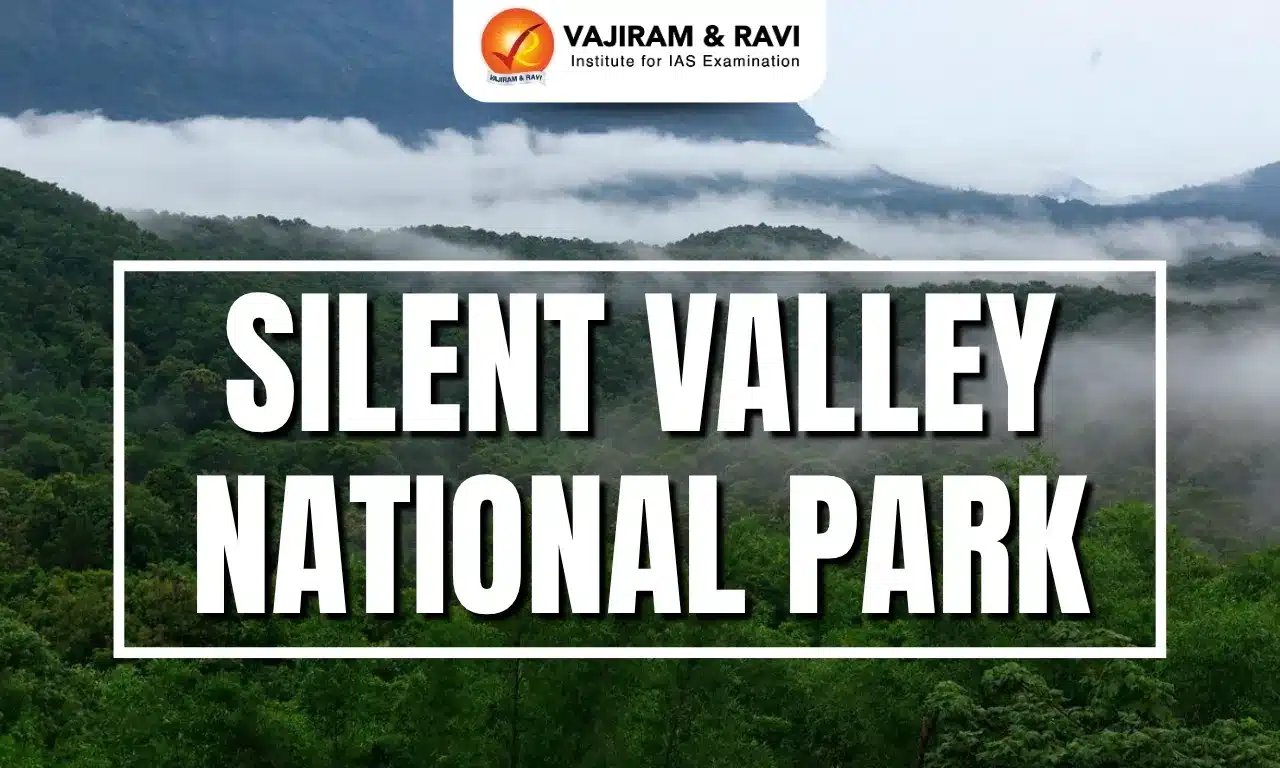
  • Location: It is located along the southwest corner of the Nilgiris in South India, in the State of Kerala.
  • It is one of the last undisturbed tracts of tropical rainforest in India. 
  • It constitutes the centerpiece of the Nilgiri Biosphere Reserve, sanctified as a World Heritage Site by UNESCO in 2012.
  • The altitude of the park varies between 658 to 2383 meters. 
  • River: It is nourished by the Kunthipuzha River.
  • Vegetation: It has four types of vegetation “West Coast tropical evergreen forest, southern sub-tropical broad-leaved hill forest, montane wet temperature forest, and grasslands.
  • Flora: The flora of the valley includes about 1000 species of flowering plants, 107 species of orchids, 100 ferns and fern allies, 200 liverworts, 75 lichens, and about 200 algae.
    • Plants of high medicinal value as well as the towering Culinea trees are also found here. 
  • Fauna:  It is famous for its population of lion-tailed macaques, Nilgiri langur, Malabar giant squirrel, Indian elephant, tiger, leopard, and gaur (Indian bison).

Source: TH

Silent Valley National Park FAQs

Q1: Where is the Silent Valley National Park located?

Ans: Kerala

Q2: Silent Valley National Park lies along which geographical region?

Ans: Southwest corner of the Nilgiris in South India.

Q3: What type of forest is mainly found in Silent Valley National Park?

Ans: Tropical wet evergreen forest.

Q4: Which river nourishes the Silent Valley National Park?

Ans: Kunthipuzha River.

Q5: Why is the valley called “Silent Valley”?

Ans: Because of the absence of cicadas that make buzzing sounds

Enquire Now