Bab el-Mandeb Strait

Bab el-Mandeb Strait

Bab el-Mandeb Strait Latest News

As the conflict between the United States, Israel and Iran deepens, attention is now shifting southwards to another narrow stretch of water, the Bab el-Mandeb Strait.

About Bab el-Mandeb Strait

  • It is also known as the “Gate of Tears” in Arabic, referring to the large number of shipwrecks that have occurred in this region. 
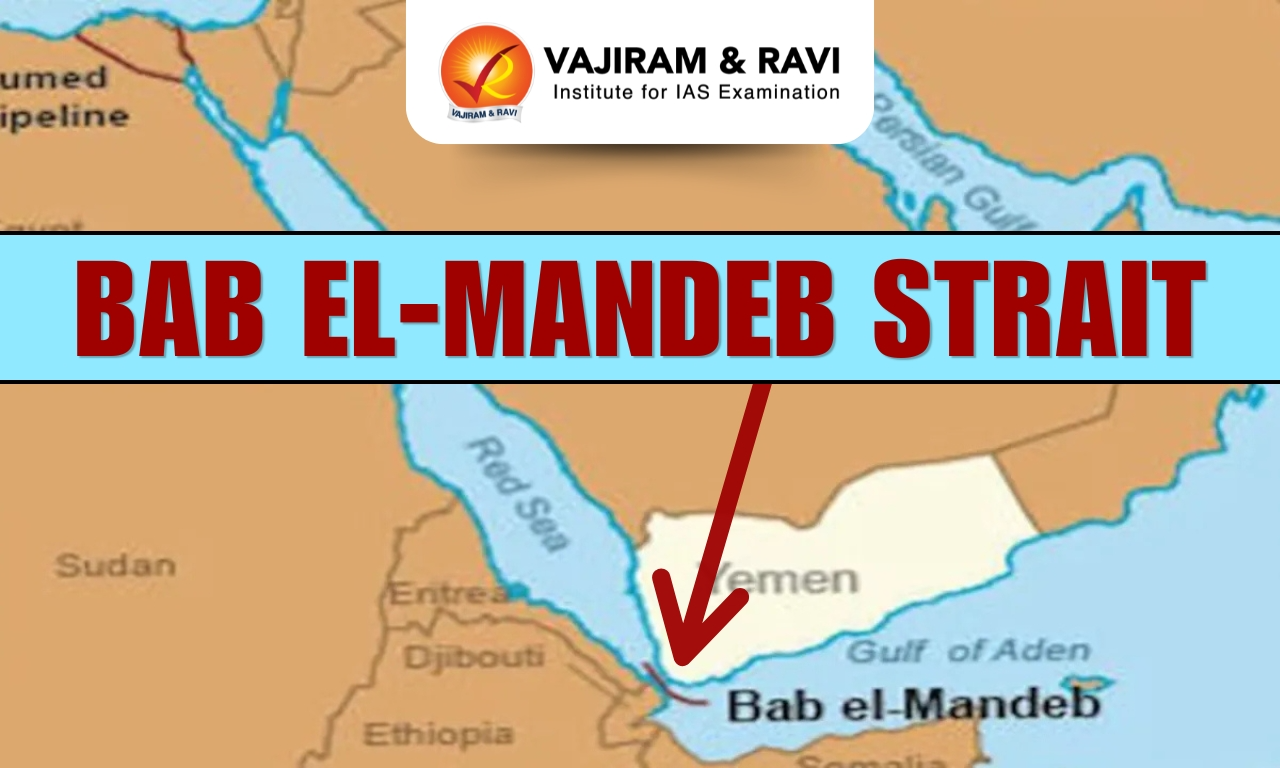
  • Location: It lies at the southern tip of the Red Sea, between Yemen and the Horn of Africa. It connects the Red Sea to the Gulf of Aden and further to the Indian Ocean.
  • It also separates Arabia, in the northeast, from the African continent, in the southwest.
  • It further acts as a link between the Indian Ocean and the Mediterranean Sea via the Red Sea and the Suez Canal.
    • The strait is 30 kilometers (KM) wide and is divided into two channels by the Yemeni island of Perim, with the eastern channel being called Alexander’s Strait, while the western-lying Dact-el-Mayun Channel.
  • Significance: It is a crucial link in the trade route connecting the Mediterranean to Asia. 
    • Ships transporting goods between Europe and Asia, as well as Middle Eastern oil bound for Europe and North America, pass through it when using Egypt’s Suez Canal.

Source: IE

Bab el-Mandeb Strait FAQ's

Q1: Which two bodies of water does the Bab el-Mandeb Strait connect?

Ans: Red Sea and Gulf of Aden

Q2: Why is the Bab el-Mandeb Strait strategically important?

Ans: It's a key shipping route for oil and goods

Solar Radio Burst

Solar Radio Burst

Solar Radio Burst Latest News

Researchers from the Indian Institute of Astrophysics (IIA) have made a significant breakthrough in understanding a long-standing solar mystery regarding solar radio burst.

About Solar Radio Burst

  • It is defined as an intense solar radio emission associated with solar flares.
  • Origin: These are observed in radio wavelengths most frequently during solar transients, such as coronal mass ejections (CMEs) and flares.
  • SRBs are direct signatures of accelerated electrons in the solar atmosphere.
  • These are observed across a wide range of wavelengths, from millimetres to kilometres, corresponding to frequencies from the GHz to the kHz range.
    • Observations at short wavelengths correspond to distances close to the solar surface, while those at long wavelengths correspond to the large distances from the Sun.
  • Types: Considering the morphological characteristics, five main categories of solar radio bursts can be distinguished: Type I, Type II, Type III, Type IV, and Type V. 
  • Impacts
    • These solar transients have a direct impact on the near-Earth atmosphere. 
    • It can interfere with Global Navigation Satellite System (GNSS) signals by reducing signal-to-noise ratio and causing loss of lock.

Source: DD News

Solar Radio Burst FAQ's

Q1: What is a solar radio burst?

Ans: A sudden release of energy from the Sun

Q2: What type of solar radio burst is associated with coronal mass ejections (CMEs)?

Ans: Type II

National Company Law Appellate Tribunal

National Company Law Appellate Tribunal

National Company Law Appellate Tribunal Latest News

Recently, the National Company Law Appellate Tribunal (NCLAT) upheld NCLT powers to direct defreezing of demat accounts in insolvency cases and dismissed Bombay Stock Exchange’s appeals. 

About National Company Law Appellate Tribunal

  • It is a quasi-judicial body constituted under the Companies Act, 2013.
  • It was established to hear appeals against the decisions of the National Company Law Tribunal (NCLT).
  • Objectives: To promote timely corporate dispute resolution, ensure transparency, and improve efficiency in insolvency and corporate governance matters.

Functions of NCLAT

  • Hearing appeals against orders of the Insolvency and Bankruptcy Board of India (IBBI). 
  • Hearing appeals against orders of the Competition Commission of India (CCI).
  • Hearing appeals related to the National Financial Reporting Authority (NFRA).
  • Giving advisory opinions when legal issues are referred by the President of India
  • Headquarters: New Delhi.
  • Composition: It includes a Chairperson, along with Judicial and Technical Members, all appointed by the Central Government based on expertise in law, finance, accountancy, and administration.

Powers and Procedure

  • NCLAT can regulate its own procedure and possess powers equivalent to a civil court under the Civil Procedure Code, 1908.
  • It can summon witnesses, receive affidavits, enforce production of documents, and issue commissions.
  • Orders passed by NCLAT are enforceable like civil court decrees.
  • Appeals against NCLAT orders can be filed in the Supreme Court of India.
  • Civil courts have no jurisdiction over matters within the purview of NCLAT.
  • No court or authority can grant injunctions against any action taken by NCLAT under its legal authority.
  • Timely disposal: NCLAT is required to dispose of appeals within six months from the date of receipt to ensure swift resolution.

Source: MC

National Company Law Appellate Tribunal FAQ's

Q1: Under which Act was NCLAT established?

Ans: Companies Act, 2013

Q2: What is the primary function of NCLAT?

Ans: To hear appeals against NCLT orders

Shyamji Krishna Varma

Shyamji Krishna Varma

Shyamji Krishna Varma Latest News

Recently, the Prime Minister of India paid homage to freedom fighter Shyamji Krishna Varma on his death anniversary.

About Shyamji Krishna Varma

  • Shyamji Krishna Varma was born on 4th October, 1857 in Mandvi town of Kachchh district of Gujarat. 
  • He was an Indian freedom fighter, lawyer and journalist.
  • He became the first President of Bombay Arya Samaj and was an admirer of Dayanand Saraswati.
  • Contributions
    • Indian Home Rule Society (IHRS)
      • It was founded by Shyamji Krishna Varma, with support from Bhikaji Cama, Dadabhai Naoroji and S.R. Rana.
      • It was an Indian organisation founded in London in 1905 that sought to promote the cause of self-rule in British India.
    • India House
      • It was founded by him in London.
      • It was a student residence that existed between 1905 and 1910 which was opened to promote nationalist views among Indian students in Britain.
    • Indian Sociologist: It was started in London. The monthly Indian Sociologist became an outlet for nationalist ideas

Source: PIB

Shyamji Krishna Varma FAQ's

Q1: What was Shyamji Krishna Varma's contribution to India's freedom struggle?

Ans: He founded the Indian Home Rule Society

Q2: What was the name of the journal published by Shyamji Krishna Varma?

Ans: The Indian Sociologist

Indonesia

Indonesia

Indonesia Latest News

Recently, Indonesia began implementing social media restrictions for children under 16

About Indonesia

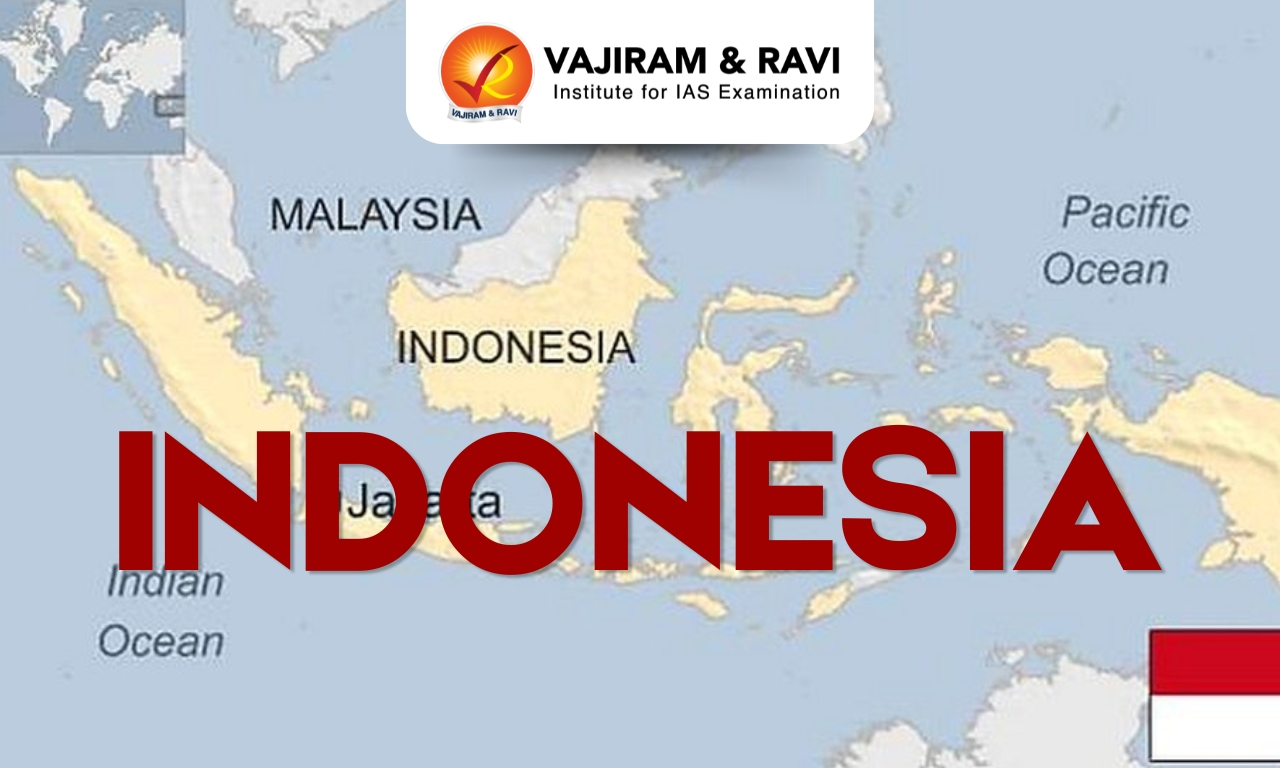
  • Location: It is an archipelagic nation located off the Southeast Asian mainland in the Pacific and Indian Oceans.
  • Bordering countries: It is bordered by Malaysia, Papua New Guinea, and Timor-Leste.
  • Maritime Border: It is surrounded by the Indian Ocean in the south; by the Pacific Ocean (South China Sea) in the north.
  • Capital City:  Jakarta

Geographical Features of Indonesia

  • Terrain:  The major Indonesian islands are characterized by densely forested volcanic mountains in the interior that slope downward to coastal plains covered by thick alluvial swamps. 
  • Climate: The climate of Indonesia is almost everywhere equatorial, ie hot, humid and rainy throughout the year
  • Rivers: Main Rivers are Kapuas, Barito, Musi, and Digul.
  • Highest Peak: Puncak Jaya 16,502 ft (5,030 m)
  • Natural Resources: It is dominated by natural gas and crude petroleum. Other major mineral exports include coal, nickel, bauxite, gold, tin, and copper.

Source: TH

Indonesia FAQs

Q1: What is the capital of Indonesia?

Ans: Jakarta

Q2: What is the official language of Indonesia? A) English

Ans: Indonesian (Bahasa Indonesia)

E-commerce Moratorium

E-commerce Moratorium

E-commerce Moratorium Latest News

More than 200 global business organisations signed a joint statement calling ‌for an extension of the World Trade Organization E-commerce Moratorium.

About E-commerce Moratorium

  • It is a global agreement among World Trade Organization members.
  • It bans customs duties being applied to electronic transmissions such as digital downloads and streaming.
  • It was first ‌adopted in 1998 at the WTO’s Second Ministerial Conference in ​Geneva as part of a declaration to encourage early digital ⁠trade growth.
  • It covers cross-border transmissions such as software downloads, e-books, music and movie streaming and video games.
  • Originally intended to be temporary, the tariff moratorium has been renewed ‌roughly every two years at each WTO ministerial conference.
  • It was most recently extended for two years at the 13th conference ‌in 2024.
  • It is set to expire this month at ‌the ⁠14th WTO ministerial conference in Yaounde, Cameroon
  • India argues that:
    • It may lead to significant revenue loss. 
    • It restricts policy space in the digital economy. 
    • Developing countries lack the technological capacity to benefit equally.

Source: TH

E-commerce Moratorium FAQs

Q1: What is the E-commerce Moratorium?

Ans: A temporary ban on customs duties on electronic transmissions

Q2: Why is India opposing the extension of the E-commerce Moratorium?

Ans: To increase revenue through customs duties

Balirajgarh site

Balirajgarh Site

Balirajgarh site Latest News

Recently, the Archaeological Survey of India (ASI) has begun excavation at Bihar’s historic Balirajgarh site.

About Balirajgarh site

  • Location: It is located in the Madhubani district of Bihar.
  • It holds great mythological and historical significance, with local folklore identifying it as the capital of the legendary King Bali.
  • It is believed that this site served as a major administrative hub of the ancient Videha Kingdom.
  • In 1938 Archeological Survey of India declared the site of national importance under the Ancient Monuments Preservation Act of 1904.
  • Previous Excavation: it has been excavated in five phases from 1962 to 2014.
  • During excavation, antiquities of five phases of cultural periods, namely Northern Black soil, Sunga, Kushan,Gupta and later Pala period were discovered. 

What is the Archaeological Survey of India?

  • It is a premier organisation for archaeological research and protection of the tangible heritage of the nation. 
  • It was established in 1861 by Sir Alexander Cunningham, with its headquarters in New Delhi. 
  • After independence, it was established as a statutory body under the Ancient Monuments and Archaeological Sites and Remains Act, 1958 (AMASR Act).
  • The prime concern of ASI is the maintenance of ancient monuments, archaeological sites, and remains of national importance. 
  • Besides, it regulates all archaeological activities in the country as per the provisions of the AMASR Act. 
  • It also regulates the Antiquities and Art Treasure Act, 1972.
  • Nodal Ministry: Ministry of Culture, Government of India

Source: IE

Balirajgarh site FAQs

Q1: Where is the Balirajgarh site located?

Ans: Madhubani, Bihar

Q2: What is the historical significance of Balirajgarh?

Ans: It is believed to be the location of the ancient city of Mithila

IONS Maritime Exercise (IMEX)

IONS Maritime Exercise (IMEX)

IONS Maritime Exercise (IMEX) Latest News

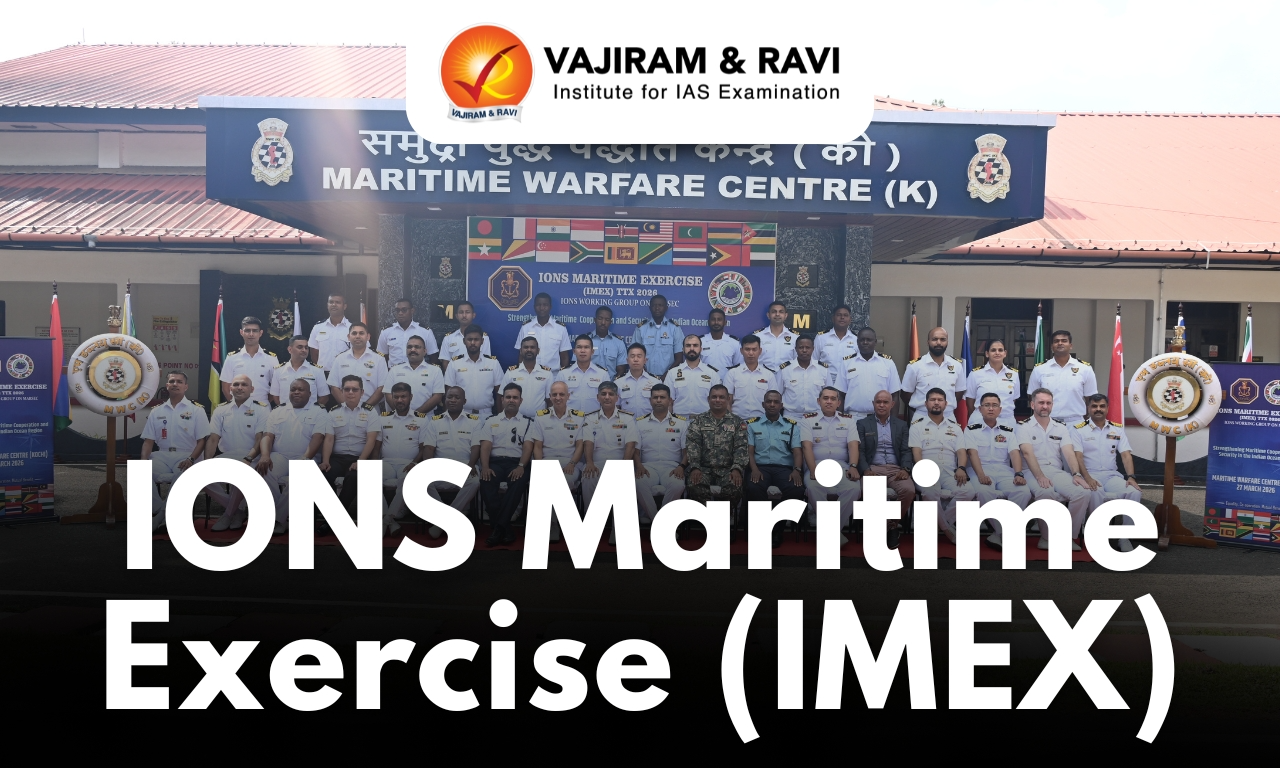
Recently, the Indian Navy hosted IONS Maritime Exercise (IMEX) TTX 2026 at the Maritime Warfare Centre, Southern Naval Command, Kochi.

About IONS Maritime Exercise (IMEX)

  • It focused on non-traditional maritime security threats and complex operational scenarios.
  • It aimed to improve coordination among participating navies through better information sharing, streamlined decision-making processes and validation of maritime security frameworks.
  • Participating Countries: Bangladesh, France, Indonesia, Kenya, Maldives, Mauritius, Myanmar, Seychelles, Singapore, Sri Lanka, Tanzania, and Timor-Leste
  • Significance: It reaffirmed the role of IONS as a key platform for regional maritime cooperation and is expected to contribute to strengthening security mechanisms and ensuring stability across the Indian Ocean Region.

What is the Indian Ocean Naval Symposium?

  • It is a voluntary initiative that seeks to increase maritime cooperation among navies of the littoral states of the Indian Ocean Region.
  • It promotes maritime cooperation, mutual understanding, and collaboration on issues such as maritime security and humanitarian assistance and disaster relief (HADR).
  • It was conceived by the Indian Navy in 2008.
  • The inaugural edition of IONS was held in Feb 2008 at New Delhi, with the Indian Navy as the Chair for two years (2008–2010). 
  • IONS is structured around a rotating chairmanship, biennial conclaves of chiefs, and working groups.

Source: PIB

IONS Maritime Exercise (IMEX) FAQs

Q1: Where was the IONS Maritime Exercise (IMEX) TTX 2026 held?

Ans: Kochi

Q2: What is the primary objective of IMEX TTX 2026?

Ans: To address non-traditional maritime security challenges in the Indian Ocean Region

Extracellular RNA

Extracellular RNA

Extracellular RNA Latest News

Recently, scientists reported that extracellular RNA (exRNA) from bacteria can persist in disinfected drinking water. 

About Extracellular RNA

  • The exRNA is RNA that exists outside cells.
  • It is found in body fluids such as blood, saliva, urine, and cerebrospinal fluid. 
  • To survive outside the cell, exRNA travels in its own molecular containers that prevent enzymes from breaking it down before it reaches its destination.
  • These are heterogeneous populations including small (e.g., miRNA) and long non-coding RNAs and coding RNAs (e.g., mRNA).
  • Functions: It has been found to be part of a sophisticated long-distance communication system, allowing cells to deliver instructions to other cells, influencing behavior and gene activation.
  • It helps coordinate responses in the immune system, tissue repair, and development.
  • Medical significance
    • It enables diagnosis of diseases like cancer and heart disease through RNA pattern testing in body fluids
    • It has potential for early detection and monitoring.

Source: TH

Extracellular RNA FAQs

Q1: What is one role of exRNA?

Ans: To deliver instructions to other cells

Q2: How does exRNA survive outside cells?

Ans: It is protected by molecular containers

Jungle cat

Jungle cat

Jungle cat Latest News

Recent studies revealed that Jungle cat’s populations are shrinking and suggested they need habitats outside protected areas.

About Jungle cat

  • The Jungle cat (Felis chaus) is a medium-sized cat.
  • Its name comes from the Caucasus Mountains, the place this cat was first discovered. 
  • Other names: Swamp Cat, Reed Cat
  • Appearance
    • It is long-legged and is the largest of the extant Felis species. Females tend to be smaller and lighter than males.
    • It has a white muzzle, yellow irises, large ears ending in black tufts, and the sometimes faint striping on its long legs.
  • Habitat: These are found across diverse habitats, from grasslands and wetlands to deserts.
  • Distribution: They’re present across Asia, with large populations in India and Nepal.
  • It is also found in Egypt, and throughout southwest Asia, southeast Asia, and Central Asia, extending its range as far as the south of China. 
  • It avoids dense forests and heavily-modified landscapes, preferring agro-pastoral and open habitats.
  • It is not nocturnal and does much of its hunting in the early mornings and late afternoons.
  • Diet: It is a carnivorous creature and mostly prey on rodents, lizards, frogs, snakes and livestock. 
  • Conservation Status

Source: TH

Jungle cat FAQs

Q1: What is the scientific name of the Jungle Cat?

Ans: Felis chaus

Q2: What is the conservation status of the Jungle Cat?

Ans: Least Concern

Enquire Now