SOLAR-1

SOLAR-1

SOLAR-1 Latest News

The United States recently activated SOLAR-1, its first dedicated space weather monitoring satellite, designed to provide faster warnings of solar storms that can affect GPS, communications, satellites and power grids.

About SOLAR-1

  • It is the first United States satellite designed exclusively for continuous operational space weather observation. 
  • It is operated by the U.S. National Oceanic and Atmospheric Administration (NOAA). 
  • Originally named Space Weather Follow On – Lagrange 1 (SWFO-L1), the satellite was renamed to Space Weather Observations at L1 to Advance Readiness – 1 (SOLAR-1).
  • Primary Mission: Continuous monitoring of solar activity and space weather. 
  • Launch Date: 24 September 2025
  • Launch Vehicle: SpaceX Falcon 9
  • Orbit
    • Positioned at the Sun-Earth Lagrange Point 1, about 1.6 million kilometres from Earth towards the Sun, SOLAR-1 enjoys a constant, unobstructed view of solar activity.  
    • From this vantage point, it continuously measures solar wind and tracks coronal mass ejections (CMEs) before they reach Earth. 
    • The location’s gravitational stability allows the spacecraft to maintain position with minimal fuel use. 
  • It uses a special telescope, called a compact coronagraph, to monitor the sun's activity in addition to a suite of instruments to make real-time measurements of the solar wind.  
  • It can transmit CME images to NOAA’s Space Weather Prediction Center within 30 minutes, compared to up to eight hours for older systems.  
  • Its enhanced capabilities are expected to improve aurora forecasts and strengthen the protection of power grids, navigation, communications, and space missions from severe space weather. 

News: MC

SOLAR-1 FAQs

Q1: What is SOLAR-1?

Ans: The first U.S. satellite designed exclusively for continuous operational space weather observation.

Q2: Which organization operates SOLAR-1?

Ans: It is operated by the U.S. National Oceanic and Atmospheric Administration (NOAA).

Q3: What is the primary mission of SOLAR-1?

Ans: Continuous monitoring of solar activity and space weather.

Q4: At which location in space is SOLAR-1 positioned?

Ans: Sun-Earth Lagrange Point 1 (L1)

Q5: What major solar events does SOLAR-1 track before they reach Earth?

Ans: Coronal Mass Ejections (CMEs)

Kinnerasani Wildlife Sanctuary

Kinnerasani Wildlife Sanctuary

Kinnerasani Wildlife Sanctuary Latest News

The Forest Department is set to launch safari tours at Kinnerasani Wildlife Sanctuary in Kothagudem district Telangana.

About Kinnerasani Wildlife Sanctuary

  • It is located in the Bhadradri Kothagudem district, Telangana, on the right bank of the Godavari River.
  • It derives its name from the perennial Kinnerasani River, which flows through the heart of the forest and eventually joins the Godavari River.  
  • It is also part of Dandakaranya Forest and lies close to the Kinnerasani Dam. 
  • It is spread over an area of 635.4 sq km with the picturesque Kinnerasani Lake and densely forested islands in the middle of the sanctuary.  
  • It is predominantly inhabited by tribal communities like Koyas and Gonds.
  • Flora: The forest comprises dry deciduous vegetation dominated by teak (Tectona grandis), bamboo, Terminalia, Anogeissus, Pterocarpus, and medicinal plants.  
  • Fauna: It is home to an impressive diversity of fauna, including Bengal Tigers, Indian Leopards (Panthers), Sloth Bears, Indian Gaurs (Bison), Dholes, Sambar, Cheetal, Chinkara, Chousingha (Four-horned antelope), Blackbucks, Wild Boars, Hyenas, and Jackals.

News: TT

Kinnerasani Wildlife Sanctuary FAQs

Q1: In which state is the Kinnerasani Wildlife Sanctuary located?

Ans: Telangana

Q2: On the bank of which river is the Kinnerasani Wildlife Sanctuary situated?

Ans: Godavari River

Q3: Which river flows through the Kinnerasani Wildlife Sanctuary?

Ans: Kinnerasani River

Q4: Kinnerasani Wildlife Sanctuary forms part of which major forest region?

Ans: Dandakaranya Forest

Q5: What is the dominant type of vegetation found in Kinnerasani Wildlife Sanctuary?

Ans: Dry deciduous forest

Masroor Rock-Cut Temples

Masroor Rock-Cut Temples

Masroor Rock-Cut Temples Latest News

Tucked away in the hills of Himachal Pradesh’s Kangra Valley lies Masroor Rock-Cut Temples, an extraordinary piece of Indian heritage that is mostly ignored.

About Masroor Rock-Cut Temples

  • Masroor Rock-Cut Temples, also referred to as Masroor Temples, is an early 8th-century complex of rock-cut Hindu temples in the Kangra Valley of the Beas River in Himachal Pradesh. 
  • They are often referred to as the Ellora of Himachal and the Himalayan pyramid. 

Masroor Rock-Cut Temples History

  • Archaeological surveys say that they have been built around the 8th century — almost 1200 years ago — due to their resemblance to the “Gupta style of architecture” from the same period.  
  • However, there is no mention of the temple in any of the scriptures or historical records. 
  • The temple complex was first reported by Henry Shuttleworth in 1913, bringing it to the attention of archaeologists.  
  • They were independently surveyed by Harold Hargreaves of the Archaeological Survey of India in 1915. 

Masroor Rock-Cut Temples Architecture

  • The 15-monument temple complex resembles the North Indian Nagara architecture style and is dedicated to Lord Shiva, Lord Ram, Goddess Sita, and Lord Lakshmana.  
  • Unlike other Hindu temples in the country that face the east, this one faces northeast towards the Dhauladhar mountains.  
  • The temples were carved out of monolithic rock with a shikhara and provided with a sacred pool of water.
  • The temple complex follows a symmetrically laid-out square grid. 
  • The main temple, with a square plan, is surrounded by smaller temples arranged in a mandala pattern. 
  • Three entrances adorn the temple, facing northeast, southeast, and northwest. Interestingly, evidence points towards a planned but unfinished fourth entrance, often overlooked in historical records. 
  • The Masrur Temples display elaborate reliefs portraying significant Vedic and Puranic deities. 
  • These reliefs are accompanied by captivating friezes that narrate ancient tales from Hindu texts. 
  • Much of the Masroor temple’s sculpture and reliefs have been lost. They were also quite damaged, most likely from earthquakes.

News: TOI

Masroor Rock-Cut Temples FAQs

Q1: Where are the Masroor Rock-Cut Temples located?

Ans: Kangra Valley of the Beas River, Himachal Pradesh.

Q2: The Masroor Rock-Cut Temples are believed to have been built around which century?

Ans: 8th century CE

Q3: Why are the Masroor Rock-Cut Temples often referred to as the “Ellora of Himachal”?

Ans: They are a complex of rock-cut temples.

Q4: Which architectural style do the Masroor Rock-Cut Temples resemble?

Ans: North Indian Nagara architecture style

Q5: What type of layout does the Masroor Temple complex follow?

Ans: Symmetrical square grid layout.

Vitamin C

Vitamin C

Vitamin C Latest News

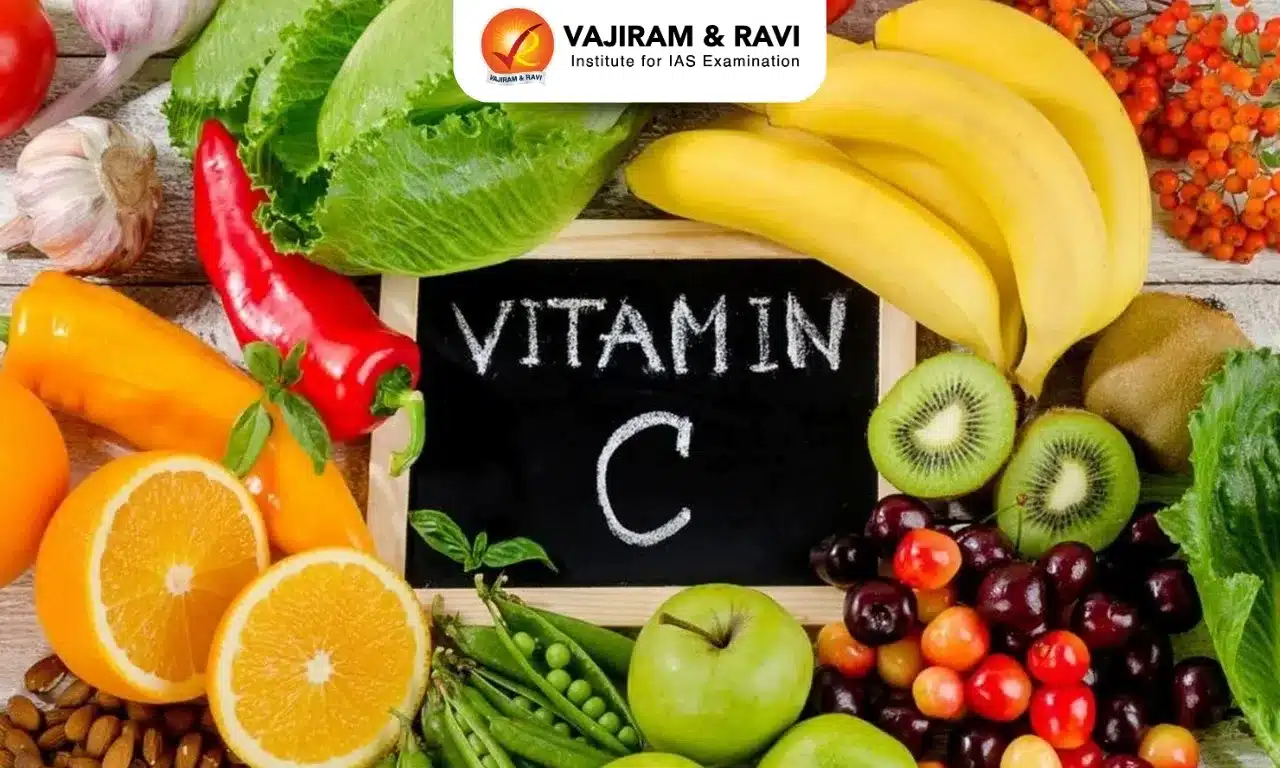
Researchers in Japan recently found that older adults with higher levels of vitamin C in their blood have a higher volume of gray matter in their brains and higher connectivity across brain regions involved in memory and attention.  

About Vitamin C

  • Vitamin C (also known as L-ascorbic acid or ascorbate) is a water-soluble vitamin.

Vitamin C Function

  • It is a powerful antioxidant that can neutralize harmful free radicals.
  • It is needed for the growth and repair of tissues in all parts of your body. 
  • It helps make several hormones and chemical messengers used in the brain and nerves.
  • It is used to:
    • Form an important protein called collagen, used to make skin, tendons, ligaments, and blood vessels.
    • Heal wounds and form scar tissue.
    • Repair and maintain cartilage, bones, and teeth.
    • Aid in the absorption of iron.

Vitamin C Sources

  • Unlike most mammals and other animals, humans do not have the ability to synthesize vitamin C and must obtain it from the diet. 
  • Vitamin C comes from fruits and vegetables.
  • Good sources include berries, cantaloupe, tomatoes, peppers, potatoes, cabbage, Brussels sprouts, broccoli, spinach, and citrus fruits, such as oranges.  
  • Some juices and cereals have added vitamin C.
  • Vitamin C is sensitive to heat, so some of its nutritional benefits can be lost during cooking. Raw foods are more beneficial as dietary sources.

Vitamin C Deficiency

  • Vitamin C is not stored in your body, so deficiency can happen quickly.
  • Vitamin C deficiency is more likely in people who:
    • Smoke or are around secondhand smoke.
    • Have certain conditions of the digestive tract or certain types of cancer.
    • Have a diet that doesn't include enough fruits and vegetables.
  • Not having enough vitamin C can lead to a condition called scurvy. 
    • Scurvy causes anemia, bleeding gums, bruising, and poor wound healing.

News: IPM

Vitamin C FAQs

Q1: What is another name for Vitamin C?

Ans: L-ascorbic acid

Q2: What type of vitamin is Vitamin C?

Ans: Water-soluble vitamin

Q3: What is one of the primary functions of Vitamin C?

Ans: Antioxidant activity.

Q4: What disease is caused by severe Vitamin C deficiency?

Ans: Scurvy

Mortonagrion santha

Mortonagrion santha

Mortonagrion santha Latest News

Scientists from the Zoological Survey of India and the University of Madras recently discovered a new species of damselfly, named Mortonagrion santha, among the tropical vegetation of the Andaman and Nicobar Islands.

About Mortonagrion santha

  • It is a new species of damselfly.
  • It was discovered around a small farm pond surrounded by a coconut plantation in Dasarathpur, Rangat tehsil, in the Andaman and Nicobar Islands.   
  • It belongs to a genus of insects known for their incredible secrecy, often blending perfectly into the shaded coastal vegetation. 
  • The Mortonagrion santha’s physical distinct features separate it from its closest known relative, Mortonagrion arthuri, a species found further east in Southeast Asia.  
    • The new damselfly has unique pale-blue, crescent-shaped postocular spots located just behind its eyes.
    • It also has a distinctive bright-blue splash of colour on its ninth abdominal segment. 
    • Under a microscope, M. santha also shows a uniquely shaped, three-lobed collar area (the prothorax) and different proportions in its tail-like mating appendages, where the upper parts are only about half the length of the lower parts.

News: RM

Mortonagrion santha FAQs

Q1: What is Mortonagrion santha?

Ans: A new species of damselfly.

Q2: Where was Mortonagrion santha discovered?

Ans: Andaman and Nicobar Islands

Q3: Which distinctive marking is found in Mortonagrion santha?

Ans: It has unique pale-blue, crescent-shaped postocular spots located just behind its eyes.

Oilseeds Kisaan Mitra

Oilseeds Kisaan Mitra

Oilseeds Kisaan Mitra Latest News

Recently, the Indian Council of Agricultural Research (ICAR) has launched ‘Oilseeds Kisaan Mitra. 

About Oilseeds Kisaan Mitra

  • It is a WhatsApp-based artificial intelligence-powered advisory service.
  • It is developed by the ICAR-Indian Institute of Oilseeds Research (ICAR-IIOR), Hyderabad.
  • It aimed at strengthening oilseed (groundnut, mustard, sesame, sunflower, soybean, niger, and other oilseed crops) cultivation and improving farmers’ access to scientific guidance.

Features of Oilseeds Kisaan Mitra

  • It provides round-the-clock, research-based support to oilseed farmers in multiple Indian languages.
  • The AI-powered chatbot responds instantly with research-based guidance on variety selection, crop management, pest and disease control, irrigation, and post-harvest practices, 24 hours a day, 7 days a week, free of cost.

Working of Oilseeds Kisaan Mitra

  • It uses advanced AI and a robust knowledge base developed from the collective scientific expertise of multiple ICAR institutes.
  • It understands questions typed or sent in regional languages and provides precise, crop-specific answers.
  • Farmers need no special app or internet browser; the familiar WhatsApp interface is all that is needed.
  • The chatbot covers the entire crop cycle including variety selection, agronomic practices, pest and disease management, irrigation scheduling, and post-harvest guidance and seed availability.
  • The knowledge base has been built collaboratively with ICAR-National Soybean Research Institute, Indore (ICAR-NSRI), ICAR-Indian Institute of Groundnut Research, Junagadh (ICAR-IIGR), ICAR-Indian Institute of Rapeseed and Mustard Research, Bharatpur (ICAR-IIRMR) and PC-Unit (Sesame & Niger).

Source: PIB

Oilseeds Kisaan Mitra FAQs

Q1: Oilseeds Kisaan Mitra is developed by which institute?

Ans: ICAR-Indian Institute of Oilseeds Research, Hyderabad

Q2: What is the primary objective of Oilseeds Kisaan Mitra?

Ans: It aimed at strengthening oilseed (groundnut, mustard, sesame, sunflower, soybean, niger, and other oilseed crops) cultivation and improving farmers’ access to scientific guidance.

Shigellosis

Shigellosis

Shigellosis Latest News

Recently, more cases of shigellosis (bacillary dysentery) are being reported across Keralam. 

About Shigellosis

  • It is a highly contagious bacterial diarrhoeal disease caused by shigella.
  • It can affect anyone, but children under five are particularly susceptible.
  • It is one of the leading bacterial causes of diarrhoea worldwide.
  • Humans are the only natural reservoir of the Shigella bacteria.
  • The disease may be more severe in young children, older adults, immune-compromised individuals or malnourished persons.
  • Transmission
    • The infection is transmitted through direct, close contact with infected individuals, through the faecal-oral route and through sexual contact.
    • It can also spread through contaminated food and water or contact with faeces of an infected person.
  • Symptoms
    • The most common symptoms is diarrhoea, which can be bloody, contain mucus and last for a prolonged period of three days or more.
    • Other symptoms include stomach cramps, vomiting, fever and feeling the need to pass stool even when the bowels are empty.
  • Treatment: Medicines, including antibiotics may be prescribed for a serious infection.

Source: TH

Shigellosis FAQs

Q1: Which international body listed Shigella as a priority pathogen for new antibiotic development?

Ans: WHO 2017 Priority Pathogens List for AMR research

Q2: Which age group is most affected by Shigellosis globally?

Ans: Highest burden in children under 5,

One Station One Product Initiative

One Station One Product Initiative

One Station One Product Initiative Latest News

The Ministry of Micro, Small and Medium Enterprises (MSME) is promoting the products of Divyangjan artisans through the One Station One Product (OSOP) initiative. 

About One Station One Product Initiative

  • It was launched on 25 March 2022.
  • It is an initiative of Indian Railways.
  • It aims to enhance livelihoods through skill development for local artisans, weavers, and craftsmen. Sale outlets are provided at stations nationwide, allotted through a tendering process.
  • It leverages the extensive reach of Indian Railways to transform stations into accessible marketplaces for regional products.
  • OSOP was scaled up through a structured rollout, with stalls allotted on a rotational basis at nominal fees to ensure wider participation.
  • The OSOP initiative is helping artisans expand their market reach by improving visibility, creating better sales opportunities, and supporting sustainable livelihoods.
  • Implementation: Railway divisions implement the scheme in coordination with state agencies, SHGs, and Micro, Small and Medium Enterprises (MSMEs).
  • Significance:   It is playing a crucial role in reviving traditional crafts that were gradually losing prominence.

Source: PIB

One Station One Product Initiative FAQs

Q1: Who are the beneficiaries eligible for allotment under OSOP?

Ans: Focus on marginalised sections: artisans, weavers, potters, tribal people, SHGs

Q2: One Station One Product scheme was launched by which ministry?

Ans: Ministry of Railways,

Jordan

Jordan

Jordan Latest News

Recently, Iran has reportedly launched missile strikes targeting a US airbase in Jordan.

About Jordan

  • Location: It is a landlocked country located in the rocky desert of the northern Arabian Peninsula.
  • Bordering Countries: It is bordered by 5 Nations: Syria in the north, Iraq in the east, Saudi Arabia in the south and southeast and Israel and West Bank in the west.
  • Water bodies: Dead Sea, the Gulf of Aqaba and the Sea of Galilee.
  • The Dead Sea is located along the western borders of the country.
  • Capital City: Amman

Geographical Features of Jordan

  • Terrain: It has arid desert plateau; a great north-south geological rift along the west of the country is the dominant topographical feature.
  • Highest Point: Jabal Umm ad Dami is the highest point of Jordan.
  • Rivers: The Jordan River which drains into the Dead Sea.
  • Ports: Al-Aqabah, the only port of Jordan is located in the south-western part of the country along the coasts of the Gulf of Aqaba.
  • Natural Resources: It mainly consists of phosphates, potash and shale oil.

Source: NDTV

Jordan FAQs

Q1: Which major river forms part of Jordan’s western border?

Ans: Jordan River

Q2: What is the capital city of Jordan ?

Ans: Amman

Network Survey Vehicle

Network Survey Vehicle

Network Survey Vehicle Latest News

Recently, the Ministry of Road Transport and Highways (MoRTH) announced that it has rolled out a nationwide deployment of advanced Network Survey Vehicles (NSVs). 

About Network Survey Vehicle

  • It is a specialized infrastructure management tool comprising vehicles equipped with advanced sensors and data acquisition systems.
  • These vehicles systematically collect data on road inventory and condition of National Highways.

Key Features of Network Survey Vehicle

  • It is equipped with laser profilers, GPS and cutting-edge imaging technology.
  • It is equipped with advanced 3D laser-based systems across all states and its network.
  • With advanced technology, NSV surveys up to 300 km daily.
  • It is usually a specialised van or SUV equipped with multiple sensors and instruments.
  • It consists of Laser, Global Positioning System (GPS), Video image processing tools, High-resolution cameras, Inertial Measurement Units (IMU), and DMI (Distance Measuring Indicator).

Working of Network Survey Vehicle

  • The survey will capture 13 types of defects, including crack measurement, ravelling, patch area, potholes, edge break, roughness, rutting, lane marking, etc.
  • It will also cover details like carriageway type, road type, pavement and shoulder width, topography, median details, right of way, utilities, land use, etc.
  • The data will be collected for all projects involving 2/4/6 and 8 lanes with NSV before the start of work and thereafter at regular intervals of six months.
  • Data collected through NSV survey will be uploaded on NHAI’s ‘AI’ based portal Data Lake, where it will be analysed to transform data into knowledge and subsequent actionable insights.
  • Raw survey data is encrypted and transmitted to the centralised NSV centre within 48 hours.
  • Expert teams, strategically deployed across five zones, monitor and report findings systematically.
  • Within 10 days, raw data is transformed into actionable insights — a process that earlier stretched to 4-6 months.

Source: PIB

Network Survey Vehicle FAQs

Q1: How many types of road defects are captured by NSV?

Ans: 13 types including cracks, potholes, rutting, ravelling, edge break

Q2: NSV can survey how many km of National Highways daily?

Ans: Up to 300 km daily with advanced tech

Enquire Now