Begonia quadricornualata

Begonia quadricornualata

Begonia quadricornualata Latest News

Botanists recently discovered a new plant species named Begonia quadricornualata in the remote forests of northeast India.

About Begonia quadricornualata

  • It is a new plant species.
  • It was discovered in the Papum Pare district of Arunachal Pradesh, a region nestled at the intersection of the Himalaya and Indo-Burma biodiversity hotspots.
  • The discovery occurred during a routine botanical documentation project in Senki View, located on the eastern fringe of the Itanagar Wildlife Sanctuary.  

Begonia quadricornualata Features

  • It is characterised by its four-horned fruit, upright stems and delicate white-to-pink flowers. 
  • Derived from the Latin words quattuor (four), cornu (horn), and alatus (winged), the name quadricornualata refers to the way four horns on the plant’s ovary transform into four fully developed wings as the fruit matures.  
    • This unique fruit structure, which is densely covered in reddish-brown wool, helps distinguish it from other hornless or ridged species in the region. 
  • What sets it apart from its closest relatives is its distinctively rugged appearance. 
  • The female plants are covered in dense, long, red-to-brown "hispid" hairs, stiff bristles that give the leaves a woolly texture. 
  • It also boasts exceptionally long leaf stalks, or petioles, which can reach up to 50 centimetres in length, nearly double the size of its nearest cousins, Begonia handelii and Begonia tessaricarpa. 
  • While its relatives often grow flowers in clusters, the female version of this new species produces only a single flower at a time. 
  • For now, the species has been categorised as "Data Deficient," .

News: RM

Begonia quadricornualata FAQs

Q1: What is Begonia quadricornualata?

Ans: It is a newly discovered species of plant.

Q2: Where was Begonia quadricornualata discovered?

Ans: It was discovered in the Papum Pare district of Arunachal Pradesh.

Q3: What is the most distinctive feature of Begonia quadricornualata?

Ans: Its four-horned fruit that develops into four wing-like structures as it matures.

Q4: What colour are the flowers of Begonia quadricornualata?

Ans: White to pink.

Pygoluciola mawsynram

Pygoluciola mawsynram

Pygoluciola mawsynram Latest News

Scientists from Assam and Meghalaya recently identified a new firefly species in Mawsynram and named it Pygoluciola mawsynram.

About Pygoluciola mawsynram

  • It is a new species of firefly.
  • It was discovered from Mawsynram in Meghalaya's East Khasi Hills district, the world's wettest place.
  • It was named Pygoluciola mawsynram in recognition of the region's unique biodiversity and the Khasi community that has long protected it through traditional conservation practices.  
  • Adults of the newly discovered firefly were observed flying close to water bodies surrounded by dense vegetation, ferns, and semi-evergreen forests.  
  • The researchers believe such habitats, along with the area's high humidity and extensive leaf litter, may be crucial for the species' life cycle and survival.
  • Pygoluciola mawsynram has distinct body characteristics and unique flashing patterns that differentiate it from other members of the genus. 
  • The discovery raises the number of known species in the rare Pygoluciola genus to 29 worldwide.  
  • It also raises the number of Pygoluciola species recorded from India to five. 
  • India is home to 92 known firefly species, nearly 60 percent of which are endemic.

News: IT

Pygoluciola mawsynram FAQs

Q1: What is Pygoluciola mawsynram?

Ans: It is a newly discovered species of firefly.

Q2: Where was Pygoluciola mawsynram discovered?

Ans: It was discovered in Mawsynram, East Khasi Hills district, Meghalaya.

Q3: Why was the new firefly named Pygoluciola mawsynram?

Ans: It was named in recognition of Mawsynram's unique biodiversity and the Khasi community's traditional conservation practices.

Q4: What type of habitat does Pygoluciola mawsynram prefer?

Ans: Humid habitats near water bodies with dense vegetation, ferns, semi-evergreen forests, and abundant leaf litter.

United Nations Population Fund

United Nations Population Fund

United Nations Population Fund Latest News

A new United Nations Population Fund survey of young adults finds that most Indians still want children, but economic pressure and gender inequality are pushing the decision further and further away.

About United Nations Population Fund

  • It is an international development agency created in 1967 to support the execution of projects and programmes in the area of population and sexual and reproductive health.
  • Background
    • It was originally called the United Nations Fund for Population Activities.
    • In 1987, it was officially renamed as the United Nations Population Fund but the original abbreviation UNFPA (United Nations Fund for Population Activities) was retained.
  • It is not directly responsible for the collection of primary statistics; it plays an important role in the technical and financial support of statistical activities in countries, such as population censuses and thematic surveys etc.
  • Funding: It is entirely supported by voluntary contributions of donor governments, intergovernmental organizations, the private sector and foundations and individuals, not by the United Nations regular budget.
  • It funds assistance, research, and advocacy programs in three major areas:
    • Reproductive health, including family planning, safe motherhood, and the prevention and treatment of sexually transmitted diseases,
    • The population problems of developed and developing countries and possible strategies for addressing them.
    • Issues related to the status of women, including the gender gap in education.
  • UNFPA receives overall policy guidance from the General Assembly and Economic and Social Council (ECOSOC).
  • Headquarters: New York.

Source: UN

United Nations Population Fund FAQs

Q1: UNFPA is the UN's lead agency for which area?

Ans: Sexual and Reproductive Health and Population

Q2: UNFPA is funded by whom?

Ans: Voluntary contributions from member states and private sources

Jodhpuri Mojari

Jodhpuri Mojari

Jodhpuri Mojari Latest News

Recently, the Centre has granted a Geographical Indication (GI) tag to Jodhpur’s nearly 200-year-old Mojari craft, giving the traditional footwear official recognition and a boost in global branding. 

About Jodhpuri Mojari

  • It is handcrafted traditional footwear from Jodhpur, Rajasthan.
  • It is crafted primarily by the members of a Jinagar community. 
  • The community adopted shoemaking some 250 years ago. They made jeen (saddle) and myaan (leather sheaths for swords and daggers) for the armies.
  • Once patronised by the royals, the Mojari gradually evolved into a distinctive craft.
  • Key Features of Jodhpuri Mojari
    • The mojaris are entirely handmade, using only leather from camel, goat, cow and buffalo. 
    • It is airy, easy to walk long distances, tough and flexible, and easy to take off at homes and temples.
    • Mojari, worn by both men and women, suited the hot climate of Rajasthan.

Key Facts about Geographical Indication Tag

  • It is a sign used on products that have a specific geographical origin and possess qualities or a reputation that are due to that origin.
  • This is typically used for agricultural products, foodstuffs, wine and spirit drinks, handicrafts and industrial products.
  • The Geographical Indications of Goods (Registration and Protection) Act, 1999 seeks to provide for the registration and better protection of geographical indications relating to goods in India.
  • This GI tag is valid for 10 years following which it can be renewed.

Source: IE

Jodhpuri Mojari FAQs

Q1: Jodhpuri Mojari is a traditional footwear from which state?

Ans: Rajasthan

Q2: Jodhpuri Mojari is primarily made of which material?

Ans: Leather

SwaYaan Initiative

SwaYaan Initiative

SwaYaan Initiative Latest News

Recently, the Ministry of Electronics and Information Technology (MeitY) and Drone Federation India launched National Innovation Challenge for Drone Research (NIDAR) under SwaYaan initiative

About SwaYaan Initiative

  • It was launched in 2022.
  • It is a National Initiative by the Ministry of Electronics and Information Technology (MeitY) to develop and strengthen the UAS/Drone ecosystem in India.
  • The vision is in line with the Government of India's initiative to make India a global Drone hub by the year 2030.
  • Aim: To empower participants from all walks of life, ranging from undergraduates to faculties and open learners across five identified technical areas, through more than 1500 academic, non-formal, research, and knowledge-sharing activities.
  • The project is implemented through a network of 30 premier Academic and R&D institutions, including IIT, IISc, IIIT, NITs, IIITDM, C-DAC, and NIELIT Centres.
    • In addition, Skill councils and Industrial bodies like FICCI, ESSCI, TSSC, DFI, HAL, etc., are integral parts of Project mentoring and supervision teams.
  • Five key work themes guide the project: Drone Electronics, GNC Algorithms Simulation, Aeromechanics, Drone Applications, and Allied UAS Technologies—ensuring specialized focus areas. 

Source: PIB

SwaYaan Initiative FAQs

Q1: SwaYaan was launched in which year?

Ans: It was launched in 2022.

Q2: SwaYaan Initiative was launched by which ministry?

Ans: Ministry of Electronics and Information Technology (MeitY)

UMANG Portal

UMANG Portal

UMANG Portal Latest News

Recently, researchers revealed significant vulnerabilities in the UMANG portal.

About UMANG Portal

  • UMANG (Unified Mobile Application for New-age Governance) is a single unified platform to access government services offered by Central, State, and Local bodies—anytime, anywhere.
  • It is part of the Digital India initiative of the Ministry of Electronics and Information Technology (MeitY).
  • UMANG aims to make it easier for the people to access important services from Government departments, Local bodies.
  • Features
    • It provides a unified approach where you can install one application to avail multiple government services on multiple channels like mobile application, web, and authorized partners centers, which can be accessed through smartphones, tablets and desktops.
    • UMANG web and app supports 23 Indian languages, including English and Hindi in 21 other regional languages.
    • Target: UMANG aims to offer over 2000+ services to more than 220 departments.

Source: TH

UMANG Portal FAQs

Q1: UMANG Portal was launched by which ministry?

Ans: Ministry of Electronics and Information Technology

Q2: UMANG is developed by?

Ans: National e-Governance Division - NeGD and Ministry of Electronics and IT

Indian Giant Flying Squirrel

Indian Giant Flying Squirrel

Indian Giant Flying Squirrel Latest News

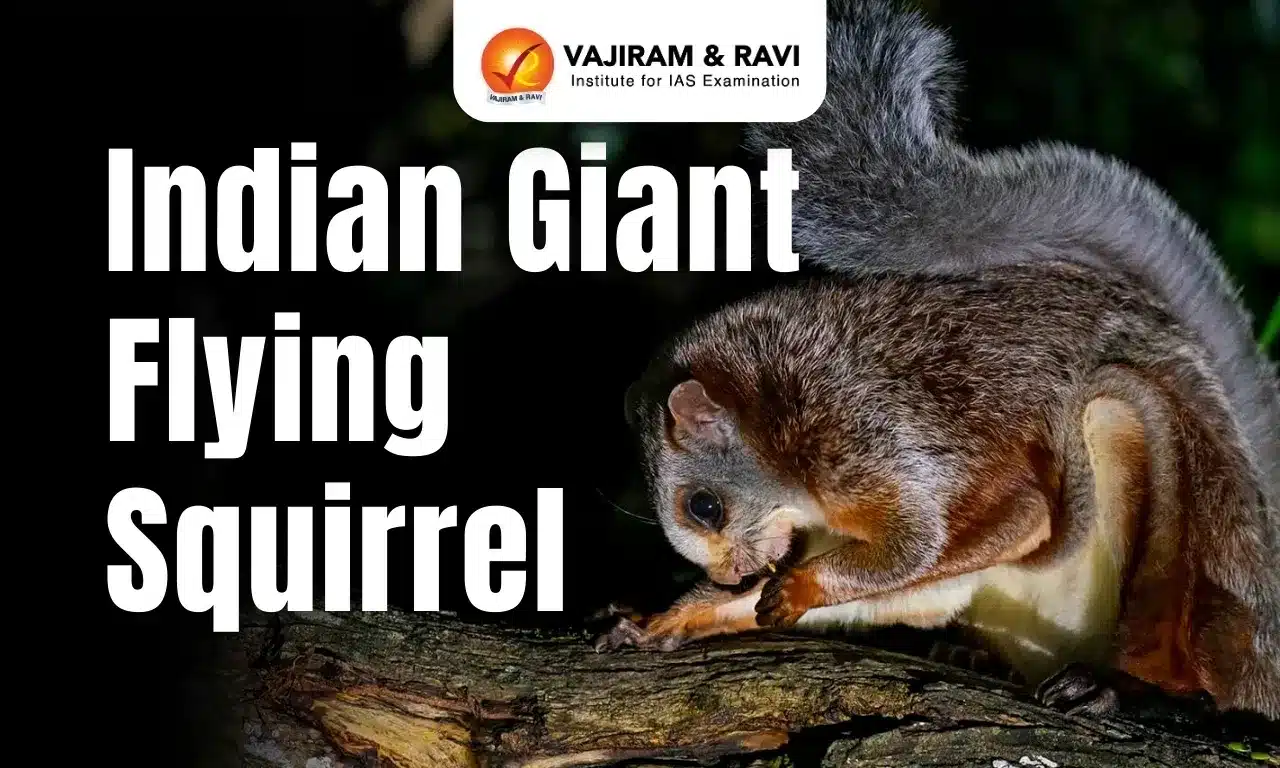
A rare Indian giant flying squirrel has been recently spotted in Uttarakhand's Ramnagar forests for the first time in nearly 12 years.

About Indian Giant Flying Squirrel

  • The Indian giant flying squirrel (Petaurista philippensis), also known as the large brown flying squirrel or the common giant flying squirrel, is a type of rodent in the Sciuridae family, which includes squirrels. 
  • It is capable of gliding flight using a skin membrane, the patagium, stretched between front and hind legs.  
  • Scientific Name: Petaurista philippensis

Indian Giant Flying Squirrel Habitat and Distribution

  • It can be found only in Southeast and South Asia and southern and central China. 
  • In South Asia they have a patchy distribution in Sri Lanka and India, primarily concentrated in the Himalayan Mountains and northeast regions north of Bombay and Rajasthan. 
  • They live in dry deciduous and evergreen forests, usually at higher elevations.
  • They can also be found in plantations. 

Indian Giant Flying Squirrel Features

  • It is one of the largest flying squirrels, with a body length of about 30 – 45 cm and a tail measuring up to 60 cm. 
  • This species has black to gray-brown fur, long and soft on the upper parts and somewhat shorter underneath the body, with a grizzled appearance.  
  • The tail is hairy and blackish to gray-brown, the feet are black, and the nose is pale pink with black vibrissae. 
  • They are nocturnal animals. 
  • They are arboreal and spend most of their life in the canopy.  

Indian Giant Flying Squirrel Conservation Status

It is classified as ' Least Concern' under the IUCN Red List.

News: IS

Indian Giant Flying Squirrel FAQs

Q1: To which family does the Indian Giant Flying Squirrel belong?

Ans: It is a type of rodent in the Sciuridae family, which includes squirrels.

Q2: How does the Indian Giant Flying Squirrel glide?

Ans: It glides using a skin membrane called the patagium stretched between its front and hind legs.

Q3: In which regions is the Indian Giant Flying Squirrel naturally found?

Ans: South Asia, Southeast Asia, and southern and central China.

Q4: What is the preferred habitat of the Indian Giant Flying Squirrel?

Ans: Dry deciduous and evergreen forests, usually at higher elevations.

Q5: What is the IUCN Red List status of the Indian Giant Flying Squirrel?

Ans: Least Concern.

Chandipura Virus (CHPV)

Chandipura Virus (CHPV)

Chandipura Virus (CHPV) Latest News

Gujarat recently reported seven confirmed cases of the Chandipura virus (CHPV) in the last few weeks, of which three patients have died.

About Chandipura Virus (CHPV)

  • It belongs to the Rhabdoviridae family, the same virus family that includes rabies, although it causes a different disease. 
  • It was first identified in 1965 in Chandipura village in Maharashtra, India, from which it gets its name.  
  • The virus is known to cause Acute Encephalitis Syndrome (AES), a serious condition that leads to inflammation of the brain.  
  • Although cases are uncommon, outbreaks have been reported in different parts of India over the years, with children being the most affected group. 
  • Most reported outbreaks have occurred in western and central India, particularly during the rainy season.
  • Transmission: 
  • It is vector-borne and primarily spread through the bite of infected sand flies, which are tiny blood-feeding insects. 
  • Some studies have also suggested that ticks may play a role in transmitting the virus, although sand flies remain the main carrier. 
  • There is currently no evidence that CHPV spreads directly from one person to another through coughing, sneezing, or physical contact. 

Chandipura Virus (CHPV) Symptoms

  • Common symptoms include:
    • High fever
    • Severe headache
    • Vomiting
    • Weakness and tiredness
    • Muscle pain
    • Irritability or unusual drowsiness
    • Convulsions or seizures
    • Confusion
    • Loss of consciousness in severe cases
  • It can progress very rapidly, especially in children. 
  • In some cases, symptoms may worsen within a short period and lead to serious complications involving the brain and nervous system. 
  • CHPV can cause high case fatality ratios, ranging from 56% to 75%, as reported during previous outbreaks in India.  

Chandipura Virus (CHPV) Treatment

  • There is currently no specific antiviral medicine or vaccine to treat the infection.
  • Treatment mainly focuses on supportive care to manage symptoms and prevent complications.

News: TP

Chandipura Virus (CHPV) FAQs

Q1: What is Chandipura Virus (CHPV)?

Ans: It is a vector-borne virus that causes Acute Encephalitis Syndrome (AES).

Q2: Where was Chandipura Virus first identified?

Ans: It was first identified in 1965 in Chandipura village in Maharashtra.

Q3: What disease is caused by Chandipura Virus?

Ans: Acute Encephalitis Syndrome (AES).

Q4: How is Chandipura Virus primarily transmitted?

Ans: Through the bite of infected sand flies.

Q5: Is there a specific antiviral medicine available for Chandipura Virus infection?

Ans: No.

Pradhan Mantri Formalisation of Micro Food Processing Enterprises Scheme

Pradhan Mantri Formalisation of Micro Food Processing Enterprises Scheme

Pradhan Mantri Formalisation of Micro Food Processing Enterprises Scheme Latest News 

The Central Government is considering extending the Pradhan Mantri Formalisation of Micro Food Processing Enterprises (PMFME) Scheme until 2029 owing to its success. 

About Pradhan Mantri Formalisation of Micro Food Processing Enterprises Scheme

  • It was launched on 29 June 2020.
  • It is a Centrally Sponsored Scheme that focuses on the growth and formalisation of micro food units across the country.
  • The scheme is part of the Atmanirbhar Bharat Abhiyaan and supports the Vocal for Local vision in the food processing sector.
  • It provides financial, technical and business assistance to entrepreneurs for setting up new units or upgrading existing ones.
  • Financial Outlay & Time Period
    • The scheme runs from 2020-21 to 2025-26 with an outlay of Rs. 10,000 crores.
    • The expenditure under the scheme is to be shared in 60:40 ratio between Central and State Governments, in 90:10 ratio with North Eastern and Himalayan States, 60:40 ratio with UTs with legislature and 100% by the Center for other UTs.

Features of PMFME Scheme

  • Support to Individual / Group Category Micro Enterprises: Credit-linked capital subsidy 35% of the eligible project cost, maximum ceiling Rs.10 lakh per unit;
  • Support to SHGs for seed capital: It provides seed capital of Rs. 40,000/- per member of SHG engaged in food processing for working capital and purchase of small tools subject to maximum of Rs. 4 lakh per SHG Federation.
  • Support for Common Infrastructure: Credit linked capital subsidy @35% subject to maximum of Rs. 3 crore to support FPOs, SHGs, Cooperatives and any Government agency for setting up of common infrastructure.
  • Branding and Marketing Support: Grant upto 50% for Branding and Marketing to groups of FPOs/ SHGs/ Cooperatives or an SPV of micro food processing enterprises.
  • Capacity Building: The scheme envisages training for Entrepreneurship Development Skilling (EDP+): program modified to meet the requirement of food processing industry and product specific skilling.

Source: NIE

Pradhan Mantri Formalisation of Micro Food Processing Enterprises Scheme FAQs

Q1: MFME is launched by which ministry?

Ans: Ministry of Food Processing Industries

Q2: What is the scheme duration of PMFME?

Ans: 2020-2021 to 2024-2025

Gulf of Mannar

Gulf of Mannar

Gulf of Mannar Latest News

The Gulf of Mannar has witnessed a steep decline in bird numbers over the last four decades, with overall shorebird abundance dropping by nearly 57%, according to a peer-reviewed study published recently.

About Gulf of Mannar

  • It is a vast shallow bay that forms part of the Laccadive Sea in the Indian Ocean. 
  • It is located between southeastern India and western Sri Lanka. 
  • The gulf is 130–275 km wide and 160 km long.  
  • It is bounded to the northeast by Rameswaram (island), Adam’s (Rama’s) Bridge (a chain of shoals), and Mannar Island.
  • It is connected to the Palk Bay in the north through the Palk Strait. 
  • It receives several rivers, including the Tambraparni (India) and the Aruvi (Sri Lanka).
  • The port of Tuticorin is on the Indian coast. 
  • The gulf is noted for its pearl banks and sacred chank (a gastropod mollusk).

Gulf of Mannar Biodiversity

  • Endowed with three distinct coastal ecosystems (coral reefs, seagrass beds, and mangroves), it is considered one of the world’s richest regions from a marine biodiversity perspective. 
  • There are known to be over 4,223 species of flora and fauna in the Gulf of Mannar.
  • Sea Turtles, sharks, dugongs, and dolphins are regular visitors to the Gulf, and 117 species of hard coral have been recorded here.
  • The Gulf became a protected national park in 1986, earning the name Gulf of Mannar National Park. 
  • It was designated as a Biosphere Reserve in 1989, the first such marine conservation area in India and the South Asian region.

News: NIE

Gulf of Mannar FAQ's

Q1: Where is the Gulf of Mannar located?

Ans: It is located between southeastern India and western Sri Lanka.

Q2: The Gulf of Mannar forms part of which sea?

Ans: It forms part of the Laccadive Sea in the Indian Ocean.

Q3: Which island forms the northeastern boundary of the Gulf of Mannar?

Ans: Rameswaram Island.

Q4: Which major Indian port is located on the coast of the Gulf of Mannar?

Ans: Tuticorin (Thoothukudi).

Q5: Why is the Gulf of Mannar Biosphere Reserve significant?

Ans: It is India's and South Asia's first marine Biosphere Reserve.

Enquire Now