About OSIRIS-REx:
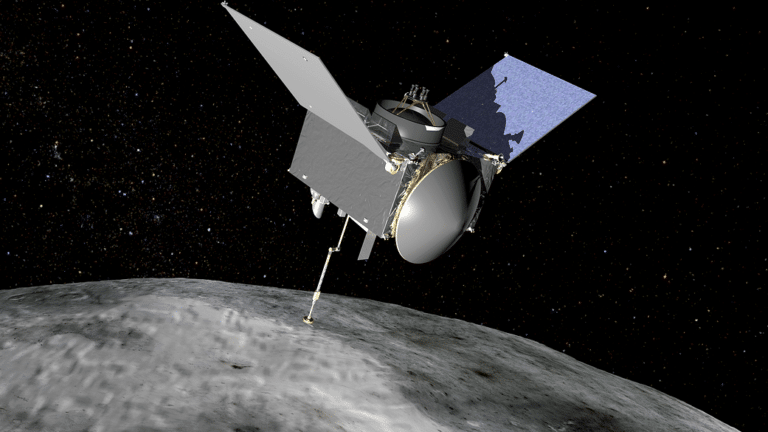
- It is a NASA spacecraft mission designed to study the near-Earth asteroid called Bennu.
- The name OSIRIS-REx stands for “Origins, Spectral Interpretation, Resource Identification, Security, Regolith Explorer.“
- Goal: To collect a sample weighing at least 2.1 ounces (59.5 grams) from asteroid 101955 Bennu (formerly known as 1999 RQ36) and then bring the sample to Earth.
- The mission will help scientists investigate how planets formed and how life began, as well as improve our understanding of asteroids that could impact Earth.
- It is the first U.S. spacecraft to collect a sample from an asteroid.
- It was launched on Sept. 8, 2016.
- It reached its asteroid target in 2018 and is bringing a small sample to Earth for study.
- The samples will arrive on Earth in 2023. An extended mission will take the spacecraft into orbit around near-Earth asteroid Apophis in 2029.
Key facts about Asteroid Bennu:
- It is located about 200 million miles away from the Earth.
- It was discovered by a team from the NASA-funded Lincoln Near-Earth Asteroid Research team in 1999.
- It is a B-type asteroid, implying that it contains significant amounts of carbon and various other minerals.
- Around 20-40 percent of Bennu’s interior is empty space, and scientists believe that it was formed in the first 10 million years of the solar system’s creation, implying that it is roughly 4.5 billion years old.
- Bennu is believed to have been born in the Main Asteroid belt between Mars and Jupiter, and because of gravitational tugs from other celestial objects and the slight push asteroids get when they release absorbed sunlight, the asteroid is coming closer to Earth.
What is an Asteroid?
- An asteroid is a small rocky object that orbits the Sun.
- These objects are remnants from the early formation of our solar system, dating back billions of years.
- Most asteroids are found in the region between the orbits of Mars and Jupiter, known as the asteroid belt, but they can also be found in other regions of the solar system.
Q) What is Regolith?
Regolith refers to the layer of loose, unconsolidated material that covers the solid bedrock on the surface of a planet, moon, or other celestial body. It is composed of a mixture of fragmented rocks, soil, dust, and other particles that have accumulated over time through various geological processes such as weathering, impact cratering, volcanic activity, and erosion. Regolith can vary greatly in thickness and composition depending on the specific geological history and environmental conditions of the celestial body.
Source: Osiris-Rex adjusts course to get closer to Earth with asteroid samples





 Last updated on March, 2026
→ UPSC Final Result 2025 is now out.
→ UPSC has released UPSC Toppers List 2025 with the Civil Services final result on its official website.
→ Anuj Agnihotri secured AIR 1 in the UPSC Civil Services Examination 2025.
→ UPSC Marksheet 2025 is now out.
→ UPSC Notification 2026 & UPSC IFoS Notification 2026 is now out on the official website at upsconline.nic.in.
→ UPSC Calendar 2026 has been released.
→ Check out the latest UPSC Syllabus 2026 here.
→ UPSC Prelims 2026 will be conducted on 24th May, 2026 & UPSC Mains 2026 will be conducted on 21st August 2026.
→ The UPSC Selection Process is of 3 stages-Prelims, Mains and Interview.
→ Prepare effectively with Vajiram & Ravi’s UPSC Prelims Test Series 2026 featuring full-length mock tests, detailed solutions, and performance analysis.
→ Enroll in Vajiram & Ravi’s UPSC Mains Test Series 2026 for structured answer writing practice, expert evaluation, and exam-oriented feedback.
→ Join Vajiram & Ravi’s Best UPSC Mentorship Program for personalized guidance, strategy planning, and one-to-one support from experienced mentors.
→ Shakti Dubey secures AIR 1 in UPSC CSE Exam 2024.
→ Also check Best UPSC Coaching in India