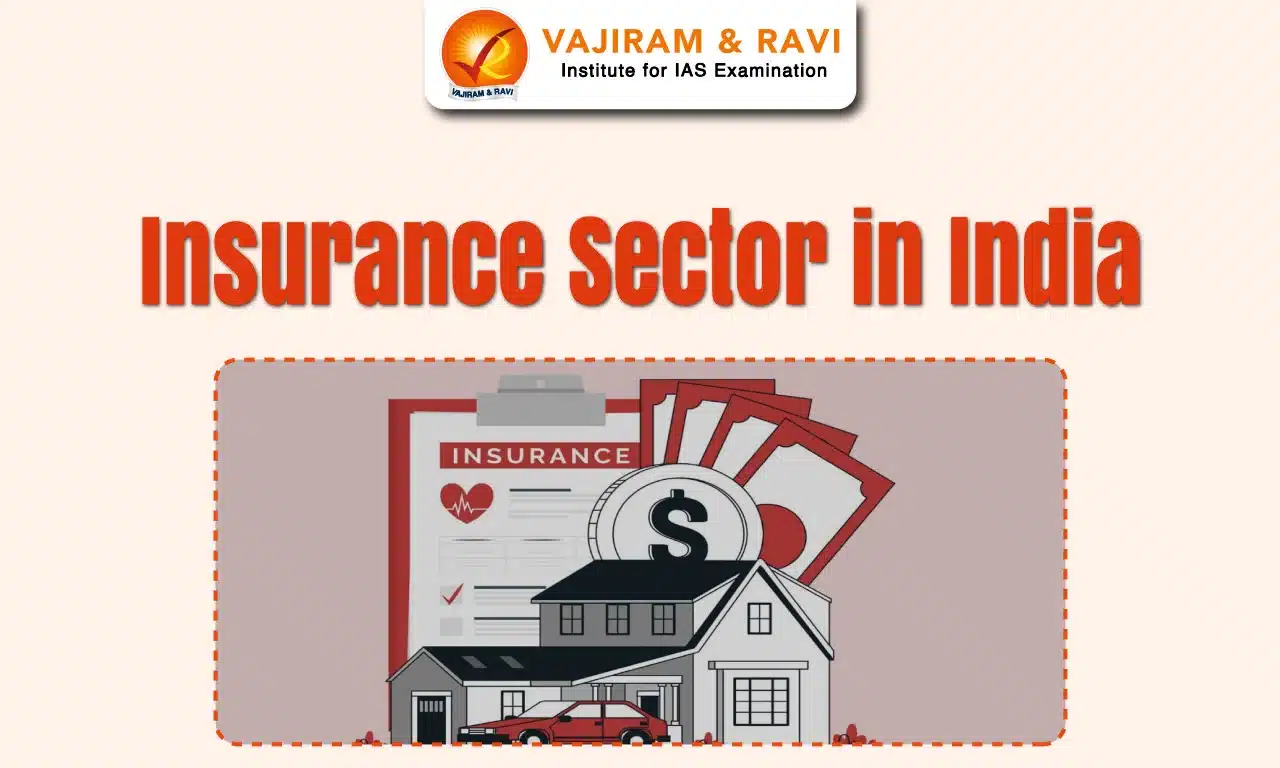
Insurance Sector in India encloses both public and private entities and falls under the Union List of the 7th Schedule of the Indian Constitution. This classification grants exclusive legislative authority to the central government. Over the years, the sector has seen significant reforms, including the entry of private players and the relaxation of foreign direct investment (FDI) norms. In 2000, India opened its insurance market to private companies, initially capping FDI at 26%. This limit was later revised to 49% in 2014 and further increased to 74% in May 2021.
Insurance Sector in India
Insurance Sector in India comprises 58 domestic insurance companies, with 24 specializing in life insurance and 34 in non-life insurance. The Life Insurance Corporation of India (LIC) is the sole public-sector entity providing life insurance, while six other public-sector insurers cover different types of coverage. The General Insurance Corporation of India (GIC Re) serves as the country's sole national reinsurer. The insurance ecosystem also includes various stakeholders such as agents (both individual and corporate), surveyors, brokers, and third-party administrators responsible for managing health insurance claims.
What is Insurance?
Insurance is a financial safeguard that helps individuals and organizations manage risks by providing protection against unforeseen losses. It functions as a contract in which an insurer offers financial compensation for specific damages, such as property loss, injuries, or health-related expenses. Essentially, insurance serves as a security measure, ensuring financial stability in the face of unexpected events like accidents, theft, fire, or other uncertainties. It is a structured financial product designed to minimize the impact of potential risks.


Indian Insurance Sector Timeline
The development ofIndian Insurance Sector begins back to the early 19th century when British colonial rulers introduced formal insurance practices. Below is an Indian Insurance Sector Timeline highlighting major milestones in the sector's history.
| Indian Insurance Sector Timeline | |
| Year | Important Milestones |
|
1818 |
Oriental Life Insurance Company, the first life insurance company in India, was established in Kolkata (then Calcutta) by Anita Bhavsar and others. It primarily catered to European customers. |
|
1850 |
Triton Insurance Company, the first general insurance company, was set up in Kolkata to provide non-life insurance services. |
|
1870 |
The Bombay Mutual Life Assurance Society, the first Indian-owned life insurance company, was founded in Mumbai (then Bombay). |
|
1907 |
The Indian Mercantile Insurance Company and the United India Insurance Company were established, marking the entry of Indian companies into the insurance market. |
|
1912 |
The Indian Life Assurance Companies Act was passed, which laid the foundation for the regulation and supervision of insurance companies in India. |
|
1928 |
The Indian Insurance Companies Act was enacted, introducing comprehensive regulations for insurance companies operating in India. |
|
1938 |
The Insurance Act was passed, leading to the nationalization of life insurance in India. The government established the Life Insurance Corporation of India (LIC) as a statutory body to take over and consolidate various life insurance companies. |
|
1956 |
The General Insurance Business (Nationalization) Act was enacted, leading to the nationalization of the general insurance sector. The government established the General Insurance Corporation (GIC) and four subsidiary companies to handle different classes of general insurance. |
|
1991 |
The government initiated economic reforms, including liberalization and opening up of the insurance sector to private players. The Insurance Regulatory and Development Authority of India (IRDAI) was established as the regulatory authority for the insurance sector. |
|
2000 |
Private insurance companies were allowed to operate in India, leading to the entry of various domestic and foreign players. This brought increased competition, product innovation, and improved customer services. |
|
2002 |
The IRDAI issued guidelines for the introduction of unit-linked insurance plans (ULIPs), a type of life insurance policy linked to the performance of investment funds. ULIPs gained popularity due to their investment and insurance benefits. |
|
2013 |
The Insurance Laws (Amendment) Act was passed, increasing the foreign direct investment (FDI) limit in the insurance sector from 26% to 49%. This allowed foreign insurance companies to have a higher stake in Indian insurance ventures. |
|
2020 |
The government increased the FDI limit in the insurance sector to 74%, further opening up the sector to foreign investors. |
Types of Insurance
- Life Insurance: This insurance ensures the financial well-being of the policyholder’s family in the event of their passing, providing monetary support to dependents.
- Property Insurance: Designed to safeguard an individual’s or organization’s real estate and assets, this insurance offers compensation for damages caused to insured properties.
- Marine Insurance: This coverage protects against the loss of goods transported via ships, as well as damages to vessels, cargo, or port terminals.
- Fire Insurance: Provides financial protection for property or goods damaged due to fire incidents, ensuring compensation for the insured.
- Liability Insurance: Shields businesses from financial losses arising from legal claims, including those related to negligence, injuries, or misconduct.
- Guarantee Insurance: Ensures advance payments or financial commitments outlined in a contractual agreement, offering security to both parties.
- Health Insurance: Covers medical expenses incurred due to illness or injury, reducing the financial burden of healthcare costs.
Insurance Sector in India Regulatory Body
The Insurance Regulatory and Development Authority of India (IRDAI) is the apex body responsible for regulating and supervising the Insurance Sector in India. It was established to ensure the orderly growth of the insurance industry while protecting the interests of policyholders.
Formation and Reason for Formation
The Insurance Regulatory and Development Authority of India (IRDAI) was established in 1999 based on the recommendations of the Malhotra Committee, which was formed in 1993 to assess and suggest reforms for India's insurance sector. The committee highlighted the necessity of an independent and autonomous regulatory body to oversee the Insurance Sector in India, safeguard policyholder’s interests, ensure transparency, encourage fair competition, and facilitate sustainable growth.
Insurance Sector in India Reforms
SInce the establishment of the autonomous body, the Insurance Sector of India has seen various reforms. Below in the table we have included the Insurance Sector in India Reforms:
| Insurance Sector in India Reforms | ||
| Year | Reform/Formation | Details |
|
1999 |
Formation of the Insurance Regulatory and Development Authority of India (IRDAI) |
The IRDAI was established as an autonomous regulatory body in 1999 to oversee and regulate the insurance sector in India. Its primary role is to protect the interests of policyholders and ensure the orderly growth of the insurance industry. |
|
2000 |
Introduction of Unit-Linked Insurance Plans (ULIPs) |
In 2000, the IRDAI issued guidelines for ULIPs, which combined investment and insurance benefits. ULIPs allowed policyholders to invest in various funds and participate in the market’s ups and downs while providing life insurance coverage. |
|
2002 |
Bancassurance Guidelines |
The IRDAI introduced guidelines for bancassurance, which enabled banks to sell insurance products. This partnership between banks and insurance companies expanded the distribution network, making insurance products more accessible to customers. |
|
2005 |
Compulsory Listing of Insurance Companies |
In 2005, the IRDAI made it mandatory for insurance companies to be listed on the stock exchanges. This move aimed to increase transparency, improve corporate governance, and enhance market discipline within the insurance sector. |
|
2007 |
Introduction of Health Insurance Portability |
Health insurance portability was introduced, allowing policyholders to switch between insurance companies without losing the benefits earned under their existing policies. This reform increased competition among insurers and provided greater choice and flexibility to policyholders. |
|
2010 |
Introduction of Point of Sales (POS) Products |
The IRDAI introduced POS products in 2010, allowing insurance policies to be sold through authorized intermediaries at designated points of sale. POS products simplified the sales process and made insurance more accessible to customers. |
|
2013 |
Increase in Foreign Direct Investment (FDI) Limit |
The Insurance Laws (Amendment) Act was passed in 2013, increasing the FDI limit in the insurance sector from 26% to 49%. This reform aimed to attract foreign investment, bring in expertise, and promote the growth of the insurance industry. |
|
2016 |
Introduction of E-insurance Policies |
The IRDAI mandated the issuance of electronic insurance policies in 2016. E-insurance policies eliminated the need for physical documents, reduced paperwork, and provided convenience to policyholders. |
|
2017 |
Standardization of Health Insurance Products |
The IRDAI introduced guidelines for standardization of health insurance products in 2017. This reform aimed to simplify policy comparisons, increase transparency, and facilitate informed decision-making for customers. |
|
2020 |
Increase in FDI Limit to 74% |
In 2020, the government raised the FDI limit in the insurance sector from 49% to 74%. This move was intended to attract more foreign investment, enhance capital inflow, and foster growth in the insurance industry. |
Top 10 Insurance Companies in India
Below we haves shared the Top 10 Insurance Companies in India and a brief description about each company:
HDFC Life Insurance
Established in 2000, HDFC Life Insurance is a joint venture between Housing Development Finance Corporation Limited (HDFC) and Standard Life Aberdeen PLC. The company provides a wide range of insurance solutions, including security plans, pension plans, health policies, and specialized plans for women and children. It also allows policyholders to enhance coverage with additional riders and is known for its efficient claims settlement process.
Max Life Insurance
Founded in 2000, Max Life Insurance is among India's top life insurance providers. It focuses on ensuring long-term financial security for its policyholders. The company offers various insurance products, including child insurance, investment plans, protection schemes, and group solutions, all tailored to individual needs.
Life Insurance Corporation of India (LIC)
LIC is India's largest and only government-owned life insurance company, dominating the life insurance sector. Established with the mission to provide financial security to citizens, LIC channels its funds into government securities and global financial markets. Despite competition from around 25 private insurers, LIC remains the most trusted life insurance provider, particularly among rural and underprivileged communities.
Reliance Nippon Life Insurance
A joint venture between Reliance Capital and Nippon Life, Reliance Nippon Life Insurance commenced operations in 2001. With over 10 million customers, it is one of the largest private life insurers. The company offers a diverse range of insurance plans across five segments: pension, protection, child, health, and savings, catering to both individuals and corporate entities.
AEGON Life Insurance
Launched in 2008, AEGON Life Insurance is recognized for its customer-centric approach and innovative solutions. The company employs a multi-channel marketing strategy to educate individuals on financial planning. Its offerings include term insurance, ULIP plans, endowment policies, group plans, and savings schemes, making it a comprehensive service provider.
Bajaj Allianz Life Insurance
A collaboration between Bajaj Finserv Limited and Allianz SE, Bajaj Allianz Life Insurance is a leading private insurer in India. It provides a broad portfolio of life insurance solutions, designed to meet the evolving financial requirements of customers.
Kotak Mahindra Life Insurance
Kotak Mahindra Life Insurance, a joint venture between Kotak Mahindra Bank Limited and Old Mutual Limited, is one of the fastest-growing insurance providers in India. The company offers diverse financial products, catering to both businesses and individual investors. Its policies focus on future security, wealth creation, and investment growth through affordable life insurance plans.
Bharti AXA Life Insurance
A joint venture between Bharti Enterprises and AXA Group, Bharti AXA Life Insurance provides an array of insurance policies, including savings plans, term life insurance, ULIP plans, and child education policies. The company integrates financial services with its expertise in agriculture and telecommunications to offer long-term value to policyholders.
Pramerica Life Insurance
Established in 2013 as a partnership between Prudential International Insurance Holdings Limited and Dewan Housing Finance Corporation Limited (DHFL), Pramerica Life Insurance has expanded to 138 branches across India. It provides life insurance solutions for individuals and groups, specializing in retirement planning, child education security, wealth accumulation, and savings plans.
Exide Life Insurance
Previously known as ING Vysya Life Insurance, Exide Life Insurance is a well-established private insurer headquartered in Bengaluru. A subsidiary of Exide Industries Limited, the company serves over 15 million customers. It has a strong traditional product portfolio, offering consistent bonus payouts and reliable long-term protection and savings plans.

 Last updated on Sep, 2026
→ UPSC 2027 Notification will be released on 13 January 2027 at upsconline.nic.in.
→ Asian Games 2026 are being held in Aichi-Nagoya, Japan, from 19 September to 4 October.
→ Check out the latest UPSC Syllabus here.
→ Download UPSC Model Answers for Mains 2026
→ UPSC Mains Question Paper 2026 is out now for Essay & GS Paper 1, 2, 3 & 4.
→ UPSC Calendar 2027 has been released.
→ Enroll in Vajiram & Ravi’s UPSC Mains Test Series 2027 for structured answer writing practice, expert evaluation, and exam-oriented feedback.
→ Join Vajiram & Ravi’s UPSC Mentorship Program 2027 for personalized guidance, strategy planning, and one-to-one support from experienced mentors.
→ Go through the UPSC Mains Previous Year Papers to enhance your preparation.
→ UPSC has released UPSC Toppers List 2025 with the Civil Services final result on its official website.
→ Also check Best UPSC Coaching in India
Insurance Sector in India FAQs
Q1. What is insurance as a sector in India?+
Q2. What is the status of insurance sector in India?+
Q3. How many insurance sectors are there in India?+
Q4. Who are top 3 insurance companies in India?+
Q5. What is the future of insurance in India?+
Tags: insurance sector in india