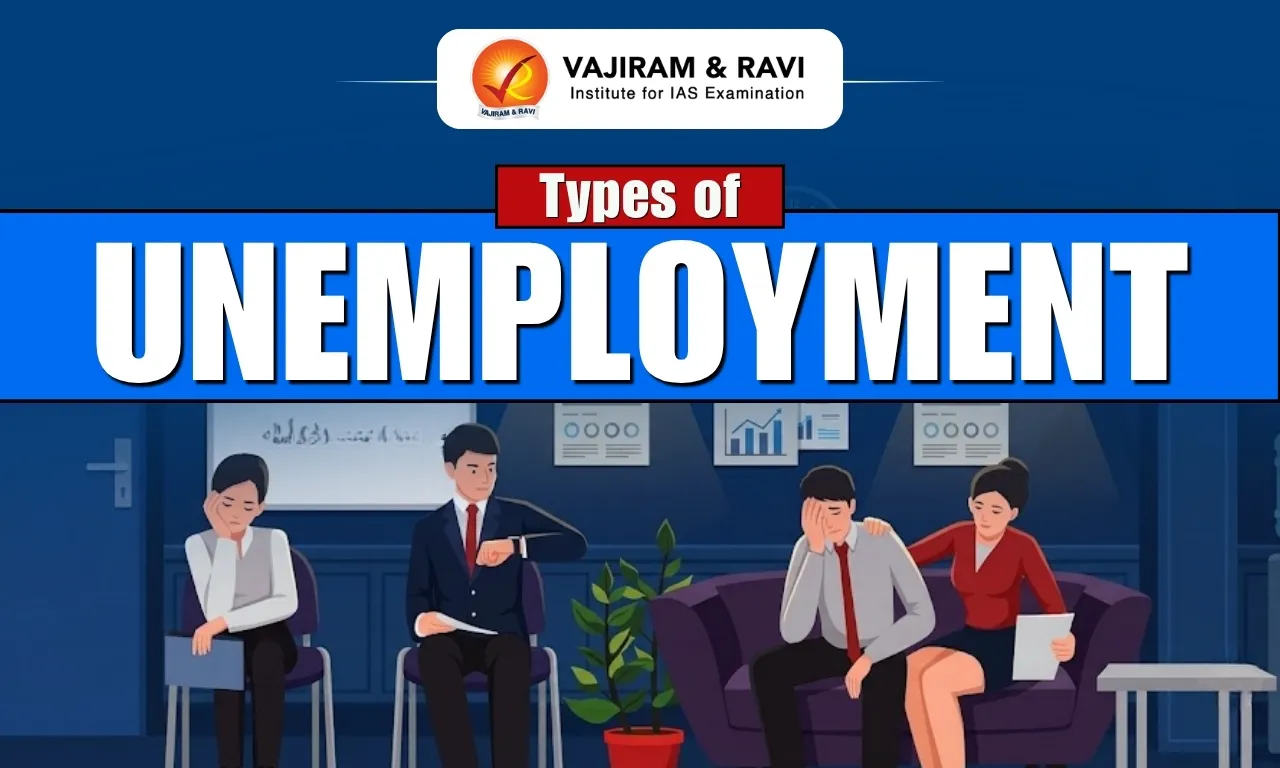
Types of unemployment in India reflect the diverse challenges faced by the Indian labour market due to structural, seasonal, economic, technological and demographic factors. Unemployment occurs when individuals willing and able to work are unable to find suitable employment opportunities. Major forms include open unemployment, disguised unemployment, seasonal unemployment, structural unemployment, frictional unemployment, cyclical unemployment and educated unemployment.
These types highlight issues such as skill mismatches, rural underemployment, sectoral imbalances, technological changes and fluctuations in economic activity. The Periodic Labour Force Survey (PLFS) provides official estimates of unemployment and employment trends in India. Understanding different types of unemployment is crucial for analysing labour-market dynamics and developing targeted employment policies, skill-development programmes and inclusive growth strategies to promote productive and sustainable employment.
Types of Unemployment Overview
Types of unemployment are classified according to the reasons why individuals remain unemployed despite being willing to work.
- Structural Unemployment: It arises due to a mismatch between workers' skills and industry requirements.
- Only 4.2% of persons aged 15–59 received formal vocational training as per the Periodic Labour Force Survey 2025, highlighting persistent skill gaps.
- Disguised Unemployment: This type of unemployment occurs when more workers are employed than required, particularly in agriculture, resulting in near-zero marginal productivity.
- Seasonal Unemployment: It results from seasonal fluctuations in sectors such as agriculture, construction, and tourism.
- Frictional Unemployment: It refers to temporary unemployment during job transitions or while searching for new employment. This type is not measured separately in official labour market surveys such as the PLFS.
- Cyclical Unemployment: This type of unemployment arises during economic slowdowns due to reduced demand for labour.
- Although not separately estimated, changes in the overall Unemployment Rate (UR) reflect labour market conditions over the business cycle.
- Educated/Youth Unemployment: It refers to unemployment among educated and young individuals. Youth unemployment (among persons aged 15–29 years) stood at 9.9% in 2025, compared to an overall UR of 3.1%, while the NEET rate was 25%, indicating persistent school-to-work transition challenges.
- Chronic Unemployment: It occurs when individuals remain unemployed for a prolonged period due to persistent skill gaps, limited job opportunities, structural changes, or regional disparities.
Types of Unemployment Causes
Unemployment in an economy arises due to multiple structural, cyclical, technological, and institutional factors. Understanding the causes of different types of unemployment helps in designing targeted labour markets and employment policies.
Structural Unemployment Causes
Skill mismatch between the workforce and evolving industry requirements reduces employability.
- Automation and technological advancement displace workers possessing obsolete skills.
- Decline of traditional industries without adequate reskilling programmes leads to job losses.
- Structural transformation from agriculture to industry and services outpaces labour mobility and skill development.
- Inadequate vocational education and technical training limit workforce adaptability.
- Regional disparities and occupational immobility prevent workers from accessing available employment opportunities.
Disguised (Concealed) Unemployment Causes
Excess labour in agriculture results in more workers being employed than required.
- Joint family farming systems absorb surplus family members despite negligible additional productivity.
- Fragmented and small landholdings reduce productive employment opportunities.
- Slow industrialisation and urbanisation fail to absorb surplus agricultural labour.
Seasonal Unemployment Causes
Agriculture's dependence on sowing and harvesting seasons leaves workers unemployed during the lean season.
- Seasonal fluctuations in construction, tourism, and agro-processing industries create temporary unemployment.
- Lack of non-farm rural employment opportunities limits year-round livelihood options.
Frictional Unemployment Causes
Imperfect information and weak job matching between employers and job seekers delay employment.
- The time lag between leaving one job and joining another results in temporary unemployment.
- Voluntary job switching in search of better wages, career growth, or working conditions contributes to unemployment.
- Fresh graduates and new entrants to the labour force require time to secure their first job.
- Geographic immobility and relocation constraints prolong the job search process.
Cyclical (Demand-Deficient) Unemployment Causes
Economic recessions and business cycle downturns reduce employment opportunities.
- Declining aggregate demand compels firms to reduce production and workforce.
- Lower private investment and weak consumer spending slow job creation.
- Global economic shocks and a contraction in external demand adversely affect domestic employment.
- High interest rates and tight monetary policy discourage investment and employment generation.
Educated Unemployment Causes
Higher education curricula often fail to match industry skill requirements.
- Oversupply of general degree holders exceeds demand in the organised sector.
- Preference for government and white-collar jobs leads many educated youth to remain unemployed.
- Weak industry-academia collaboration and poor vocational training reduce employability.
- Limited organised sector employment cannot absorb the growing number of graduates entering the labour market.
Chronic Unemployment Causes
- Skill and Education Mismatch: Inadequate vocational training and mismatch between workers’ skills and industry requirements reduce employability.
- Structural and Technological Changes: Economic restructuring, automation and shifts in production can make existing skills obsolete.
- Limited and Unequal Job Creation: Insufficient employment opportunities, low industrialisation and regional disparities can lead to prolonged unemployment.
- Labour Market Barriers: Poor job information, limited mobility, social constraints and weak access to formal employment can prolong joblessness.


Types of Unemployment Challenges
Unemployment remains a persistent challenge due to structural, institutional, and policy constraints that hinder effective job creation and labour market adjustment. The following challenges limit the success of employment generation initiatives and labour market reforms in India.
- Weak Labour Market Information Systems: Inadequate job matching, limited labour market data, and underutilisation of platforms such as the National Career Service (NCS) delay employment and increase frictional unemployment.
- Persistent Skill Mismatch: Rapid technological and industrial transformation has widened the gap between workforce skills and industry requirements, while vocational education and skilling programmes continue to face quality and placement challenges.
- Limited Labour Mobility: Regional disparities, language barriers, high migration costs, and inadequate affordable housing restrict workers from moving to regions with better employment opportunities.
- Slow Pace of Quality Job Creation: Employment generation in manufacturing and modern services has not kept pace with labour force growth, limiting the absorption of surplus agricultural labour and educated youth.
- Large Informal Sector: The predominance of informal employment with limited social security, low productivity, and weak enforcement of labour standards makes unemployment and underemployment difficult to address sustainably.
- Challenges in Rural Employment Diversification: Dependence on agriculture, limited non-farm rural industries, and implementation gaps in schemes such as the VB-G RAM G Act, 2025 (erstwhile MGNREGA) restrict year-round employment opportunities and perpetuate seasonal unemployment.
- Inadequate Reskilling for Technological Change: The rapid adoption of automation, artificial intelligence, and digital technologies is outpacing the country's reskilling and upskilling ecosystem, increasing the risk of technological unemployment.
- Poor Measurement of Hidden Unemployment: Disguised unemployment and underemployment are not adequately reflected in conventional unemployment statistics, making policy design and targeted interventions more challenging.
- Weak Industry–Academia Linkages: Higher education institutions often fail to align curricula with industry needs, resulting in low employability, educated unemployment, and limited apprenticeship opportunities.
- Fiscal and Institutional Constraints: Limited fiscal space, slow policy implementation, weak Centre–State coordination, and external economic uncertainties constrain the government's ability to implement effective employment-generation strategies.
Types of Unemployment Remedies
The Government of India has launched several initiatives to improve employability, generate quality jobs, strengthen labour market institutions, and promote inclusive employment across sectors.
- National Career Service (NCS): A digital employment platform that connects job seekers with employers, career counsellors, and skill providers to reduce job-search and matching gaps.
- Skill India Programme (SIP): An umbrella skilling initiative aimed at enhancing workforce employability by integrating flagship programmes such as PMKVY 4.0, PM-NAPS, and Jan Shikshan Sansthan (JSS).
- Pradhan Mantri Kaushal Vikas Yojana (PMKVY) 4.0: Provides industry-aligned, free short-term skill training, Recognition of Prior Learning (RPL), and emerging technology courses to improve youth employability.
- Pradhan Mantri National Apprenticeship Promotion Scheme (PM-NAPS): Encourages apprenticeship-based learning by providing financial support to employers for apprentice stipends, thereby facilitating school-to-work transition.
- Jan Shikshan Sansthan (JSS): Delivers vocational training to non-literates, neo-literates, school dropouts, women, and disadvantaged groups to enhance livelihood opportunities.
- Viksit Bharat - Guarantee for Rozgar and Ajeevika Mission (Gramin) [VB-G RAM G]: Replaces MGNREGA from 1 July 2026 and provides a statutory guarantee of at least 125 days of wage employment per rural household annually, while linking employment generation with durable rural assets, livelihood infrastructure, water security and climate-resilience works.
- e-Shram Portal: Develops a national database of unorganised workers to facilitate access to social security, skilling programmes, and employment opportunities.
- Pradhan Mantri Viksit Bharat Rozgar Yojana (Employment Linked Incentive Scheme): Incentivises formal employment generation, particularly in the manufacturing sector, through employer- and employee-linked benefits.
- Four Labour Codes: Simplify labour regulations, improve ease of doing business, expand social security coverage, and encourage formal employment generation.
- Production Linked Incentive (PLI) Scheme: Promotes large-scale manufacturing investment across key sectors to generate employment, strengthen industrial competitiveness, and support labour-intensive production.
- Gig and Platform Worker Welfare Measures: Budget 2025–26 initiatives extend e-Shram registration, digital identity, and Ayushman Bharat-PMJAY health coverage to gig and platform workers, improving social protection.
- Union Budget 2026-27 Key Initiatives: A new ₹10,000 crore SME Growth Fund to create champion enterprises, mega textile parks, and AVGC (Animation, Visual Effects, Gaming, Comics) Creator Labs in 15,000 schools.
- State-Level Skill Development Initiatives: Programmes such as Tamil Nadu's Naan Mudhalvan, Uttar Pradesh Skill Development Mission, and other state initiatives complement central schemes by aligning skilling with regional industry requirements.
Types of Unemployment UPSC PYQs
Q1. Most of the unemployment in India is structural in nature. Examine the methodology adopted to compute unemployment in the country and suggest improvements. (UPSC Mains 2023)
Q2. Disguised unemployment generally means________. (UPSC Prelims 2013)
(a) Large number of people remain unemployed
(b) Alternative employment is NOT available
(c) Marginal productivity of labour is zero
(d) Productivity of workers is low
Ans: (c)

 Last updated on Oct, 2026
→ UPSC 2027 Notification will be released on 13 January 2027 at upsconline.nic.in.
→ Check Nobel Prize 2026 Winners List here.
→ Download PIB PRiSM Monthly Magazine 2026 here.
→ Check UPSC Monthly Current Affairs Magazine The Recitals here.
→ Check out the latest UPSC Syllabus here.
→ Download UPSC Model Answers for Mains 2026
→ UPSC Mains Question Paper 2026 is out now for Essay & GS Paper 1, 2, 3 & 4.
→ UPSC Calendar 2027 has been released.
→ Enroll in Vajiram & Ravi’s UPSC Mains Test Series 2027 for structured answer writing practice, expert evaluation, and exam-oriented feedback.
→ Join Vajiram & Ravi’s UPSC Mentorship Program 2027 for personalized guidance, strategy planning, and one-to-one support from experienced mentors.
→ Go through the UPSC Mains Previous Year Papers to enhance your preparation.
→ UPSC has released UPSC Toppers List 2025 with the Civil Services final result on its official website.
→ Also check Best UPSC Coaching in India
Types of Unemployment FAQs
Q1. What is frictional unemployment?+
Q2. What is cyclical unemployment?+
Q3. What is structural unemployment?+
Q4. What is hidden unemployment?+
Q5. What is disguised unemployment?+
Tags: quest types of unemployment upsc economy notes