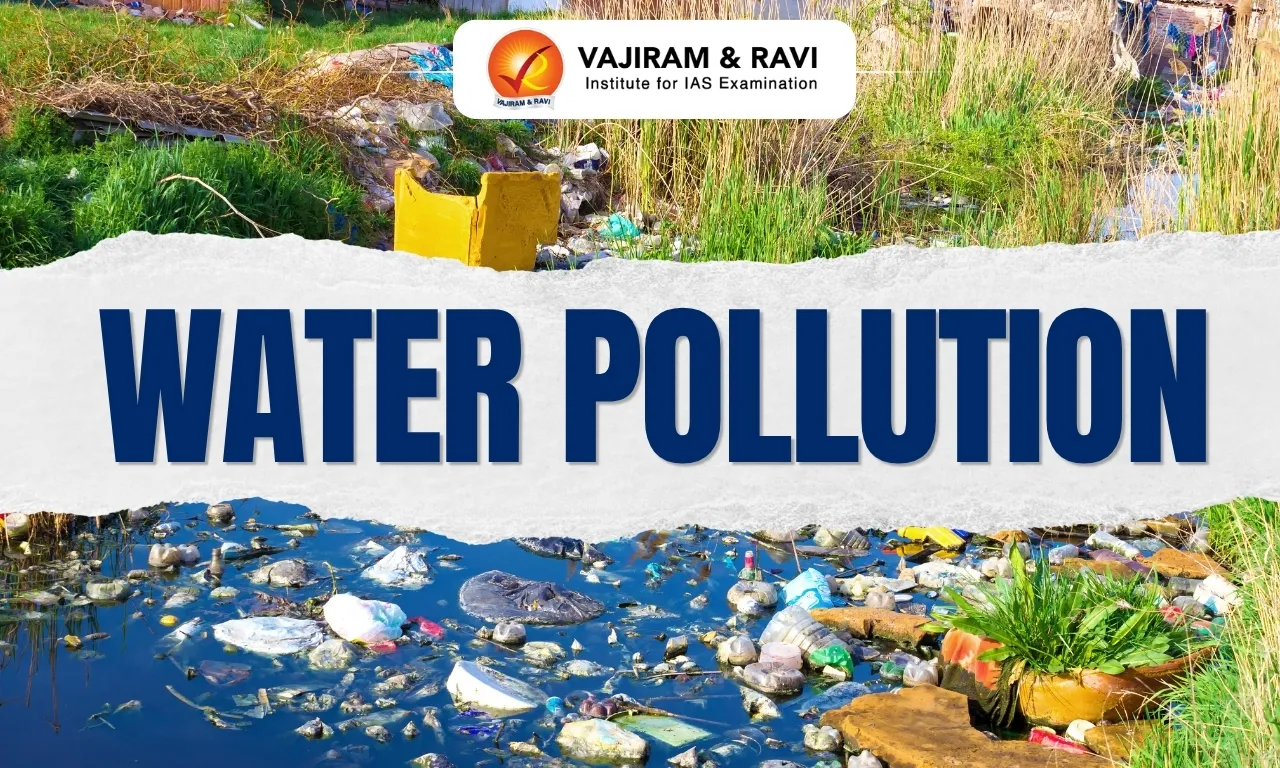
Water pollution is the contamination of water bodies with harmful substances, making them unsafe for humans and aquatic life. In India, major contributors include industrial waste, sewage, and agricultural runoff, with rivers and groundwater heavily polluted. This has serious health, environmental, and economic impacts.
Efforts to control water pollution include government initiatives like the Namami Gange Programme and the Zero Liquid Discharge Policy, alongside global actions. Key measures involve promoting green technologies and wastewater treatment and raising public awareness to reduce pollution and conserve water resources.
Water Pollution Definition
Water pollution is defined as the contamination of water bodies such as streams, lakes, seas, groundwater, or oceans by substances harmful to living organisms. It can also be defined as any alteration to the natural properties of water caused by human-made pollutants, making it unsuitable for drinking or incapable of supporting aquatic life, such as fish and other biological communities.
Water Pollution Status in India
Water pollution in India is a growing environmental and public-health concern, with the CPCB reporting widespread polluted river stretches and groundwater quality challenges. The CPCB identifies 296 polluted river stretches across 271 rivers, indicating widespread deterioration in river water quality.
- Heavy-Metal Contamination: A Central Water Commission (CWC) study found 81 rivers and tributaries affected by toxic metals such as arsenic, lead, mercury, iron and copper.
- Ganga Basin: 47% of 161 monitoring stations exceeded prescribed metal limits.
- West-flowing rivers south of Tapi: 64% exceeded limits.
- Krishna Basin: 83% exceeded limits.
- Sewage Generation: Urban areas produce around 72,000 million liters per day (MLD) of sewage, however more than 60% of this effluent is released untreated into aquatic bodies due to a serious infrastructure deficiency.
- Groundwater Contamination: Around 70% of groundwater resources are contaminated, with nearly 20% of examined samples exceeding acceptable levels of nitrates, fluoride, arsenic, and heavy metals.
- Public Health: Waterborne and water-related illnesses account for approximately 21% of all communicable diseases in India.


Water Pollution Types
The types of water pollution can be classified based on the source of contamination, nature of pollutants, and their effects on aquatic ecosystems. Major types include:
- Groundwater Pollution: Occurs when pollutants such as fertilisers, pesticides, landfill waste and septic-system contaminants seep into aquifers, compromising groundwater quality and making it unsafe for human use.
- Surface Water Pollution: Occurs when harmful substances contaminate rivers, lakes, oceans and other surface-water bodies through natural events, accidental releases, agricultural runoff or direct industrial discharge.
- Suspended Matter Pollution: Results from plastics, rubber and other persistent materials suspended or floating in water. They can block sunlight and oxygen penetration, settle on the bottom and release toxic substances.
- Oil Pollution: Caused by oil spills, transportation, runoff and deliberate dumping. Oil spreads across the water surface, reducing oxygen and sunlight penetration and harming aquatic organisms and seabirds.
- Microbiological Pollution: Caused by microorganisms such as bacteria, viruses and protozoa, often due to untreated or inadequately treated water. It can cause waterborne diseases such as cholera and harm aquatic organisms.
- Chemical Pollution: Results from industrial chemicals, heavy metals, solvents, fertilisers and pesticides entering water systems. These pollutants can impair aquatic growth and reproduction and may cause mortality.
- Thermal Pollution: Occurs when heated water, particularly cooling water from power plants, is discharged into water bodies. Increased temperature reduces dissolved oxygen and can damage fish, eggs and larvae.
- Oxygen-Depletion Pollution: Occurs when dissolved oxygen levels fall excessively, often following nutrient pollution and decomposition. Oxygen depletion can kill aquatic organisms and favour anaerobic organisms that may produce harmful substances.
Water Pollution Sources
Water pollution originates from natural processes and human activities. Its sources are broadly classified into point and non-point sources, as well as natural and anthropogenic sources.
- Natural sources arise from natural processes that increase the concentration of naturally occurring substances in water.
- Anthropogenic sources result from human activities and include domestic, agricultural, industrial, mining, petroleum, urban, and waste-related activities.
Point Sources
These are specific, identifiable sources that discharge pollutants or effluents directly into water bodies.
- Domestic Sewage and Wastewater: Untreated sewage from households, institutions and municipal systems introduces pathogens, nutrients and organic pollutants into water bodies.
- Industrial Effluents: Industries discharge heavy metals, chemicals, dyes, oil, grease and other toxic substances into rivers and lakes.
- Mining and Petroleum Activities: Mining operations, mine tailings and petroleum activities can release sediments, heavy metals, chemicals and hydrocarbons into water resources.
- Radioactive Waste: Nuclear facilities, medical activities and radioactive mining waste can contaminate surface and groundwater when improperly managed.
Non-Point Sources
These sources are diffuse spread over large areas, with pollutants reaching water bodies mainly through runoff and leaching.
- Agricultural Runoff: Fertilisers, pesticides, animal waste and eroded soil enter rivers, lakes and groundwater through runoff and leaching.
- Urban Stormwater: Rainwater carries oil, chemicals, sediments and other pollutants from roads and urban surfaces into water bodies.
- Construction Activities: Construction sites contribute sediments, debris, and other pollutants through surface runoff.
- Abandoned Mines and Landfills: Pollutants can leach from abandoned mines and landfills into surrounding surface and groundwater.
Water Pollution Causes
Water pollution occurs when harmful substances such as industrial waste, sewage, oil spills, and agricultural runoff contaminate water bodies. These pollutants degrade water quality, harm aquatic life, and pose risks to human health. The detailed explanation is given below:
- Industrial Waste: Industrial effluents containing toxic chemicals and heavy metals contaminate water and threaten aquatic ecosystems and human health.
- Example: A Central Water Commission study found 81 rivers and tributaries with high concentrations of one or more toxic heavy metals.
- Sewage and Wastewater: Untreated or inadequately treated domestic and municipal wastewater introduces pathogens, nutrients, organic matter and chemicals into water bodies.
- Example: CPCB data cited in the earlier source indicated significant untreated urban sewage discharge; improving wastewater treatment remains a key pollution-control priority.
- Agricultural Runoff: Fertilisers, pesticides, animal waste and soil runoff enter surface and groundwater through runoff and leaching, causing nutrient and chemical contamination.
- Example: The Annual Ground Water Quality Report 2025 recorded localised nitrate and fluoride contamination; in Bihar, nitrate exceeded the permissible limit in 78 of 584 samples.
- Oil Leaks and Spills: Oil released through offshore activities, transportation, industrial operations and runoff contaminates water, reduces oxygen availability and damages aquatic ecosystems.
- Example: The Indian Coast Guard conducts pollution-response seminars and mock drills to strengthen preparedness for marine oil spills.
- Plastic and Marine Dumping: Plastic and other persistent waste entering rivers and oceans accumulates in aquatic ecosystems, harms wildlife and contributes to microplastic pollution.
- Mining, Landfills and Leaching: Mining activities, mine tailings and landfill leachate can introduce sediments, heavy metals, chemicals and other contaminants into surface and groundwater.
- Radioactive Contamination: Improperly managed radioactive substances from nuclear, medical and mining activities can contaminate groundwater and create long-term environmental risks.
- Urban Runoff and Construction: Stormwater carries oil, sediments, chemicals and construction debris from roads and built-up areas into nearby water bodies..
Water Pollution Effects
Water pollution has significant adverse effects on human health, aquatic life, and ecosystems. It also contributes to climate change, has severe economic impacts, and reduces the aesthetic value of water bodies, affecting both the environment and society. These are explained below in detail:
Health Impacts
Exposure to contaminated water can lead to diseases like gastroenteritis, skin rashes, and respiratory problems from harmful bacteria, viruses, and chemicals.
- According to the World Health Organization 2022, at least 1.7 billion people globally use a drinking water source contaminated with faeces, leading to 1 million annual deaths from diarrhoea.
- According to UNICEF and WHO, 1 in 4 people worldwide lack access to safe drinking water.
- Example: The Yamuna shows severe sewage-related contamination, with faecal coliform reported above 1,00,000 MPN/100 ml in the cited Delhi stretch, against the stated standard of 500 MPN/100 ml.
Environmental Impacts
Oxygen depletion from water pollution causes fish kills and disrupts reproduction, leading to species decline or extinction. Nutrient runoff triggers algal blooms and increases BOD, worsening oxygen loss.
- In Ennore estuary & Kosasthalaiyar river, Chennai (August 2026) mass fish kill was linked to sewage-driven organic loading, with tests showing low dissolved oxygen (<4 mg/L)
- Water pollution can contribute to climate change by releasing greenhouse gasses such as methane and carbon dioxide from decomposing organic matter in water bodies.
Economic Impacts
Loss of income from fishing and tourism due to polluted waters, with increased costs for water treatment, cleanup, and healthcare for affected individuals. According to World Bank, the health costs attributed to water pollution in India constitute around 3 per cent of the nation’s GDP, totalling nearly $6.7-8.7 billion on an annual basis.
Treatment of Polluted Water
Polluted water treatment is a multi-step process that removes physical, chemical, and biological impurities before reusing or discharging the water. Main stages of treatment include As follows:
- Preliminary Treatment: Uses bar screens and grit chambers to catch and remove big particles such as plastic, rags, and sand.
- Primary Treatment: Heavy suspended particles and floating oils are separated and removed using gravity settling tanks and clarifiers.
- Secondary Treatment: Uses microorganisms and air in aeration tanks to break down and consume dissolved organic materials via biological digestion.
- Tertiary Treatment: It involves the removal of fine contaminants, heavy metals, and nutrients using enhanced filtering, membrane separation, and chemical precipitation.
- Disinfection: Uses chlorine, ozone, or ultraviolet (UV) light to kill any leftover bacteria, viruses, or pathogens.
Water Pollution Government Initiatives
Water pollution in India is addressed through regulatory, river-conservation and sustainable water-management initiatives aimed at improving water quality and protecting public health.
- Water (Prevention and Control of Pollution) Act 1974: Provides for the prevention and control of water pollution and maintaining or restoring the wholesomeness of water in the country. This Act was amended twice in 1988 and 2003.
- National River Conservation Plan (NRCP): Aims to reduce pollution loads in major rivers and improve river water quality through pollution-abatement measures.
- Namami Gange Programme(2014): Focuses on cleaning and conserving the Ganga through sewage-treatment infrastructure, river-surface cleaning, afforestation and public awareness.
- Zero Liquid Discharge (ZLD) Policy: Promotes industrial wastewater treatment and reuse to minimise or eliminate the discharge of liquid effluents into water bodies.
- National Water Policy: Provides a framework for water conservation, efficient utilisation of water resources and pollution control to promote sustainable water management.
Global Efforts Against Water Pollution
Global efforts to control water pollution focus on sustainable water management, improved water quality, ecosystem protection, and equitable access to safe water and sanitation. Key initiatives include:
- SDG6 (Clean Water and Sanitation): Aims to ensure the availability and sustainable management of water and sanitation for all by 2030.
- UN-Water Work Programme 2024–2026 & GLAAS 2025: Coordinates global action on water and sanitation through improved data, financing, innovation, capacity-building, and advocacy. GLAAS 2025 reports that fewer than 13% of countries have adequate resources to implement WASH plans, funding falls short by 46% of estimated needs, and fewer than half of countries publish accessible drinking-water quality reports.
- Urban Water Agenda 2030: Promotes sustainable, inclusive, and resilient urban water management while advancing the Sustainable Development Goals (SDGs).
- Freshwater System tracker (2026): Developed by Systems Change Lab with UNEP-WCMC support, the tracker finds that global efforts are failing to keep pace with freshwater threats. Of 37 outcome indicators assessed, five—including surface water quality, groundwater quality, and heavy metal contamination—are improving but lack measurable global targets.
- World Water Quality Alliance (WWQA): Launched in 2019 as a UNEP-convened multi-stakeholder network to address freshwater-quality challenges through monitoring, analysis and collaborative solutions.
- Innovative Technologies: Countries such as Singapore demonstrate technology-based approaches through NEWater, which treats and recycles wastewater for potable-water use.
Water Pollution Way Forward
Water pollution requires an integrated approach focusing on prevention, wastewater treatment, sustainable resource use, industrial compliance, and scientific groundwater management.
- Strengthen Wastewater Treatment: Expand sewage and industrial effluent treatment capacity and promote wastewater recycling and reuse to reduce untreated discharge into water bodies.
- Promote Sustainable Agriculture: Reduce excessive use of fertilisers and pesticides and adopt precision farming, organic practices and vegetative buffer zones to minimise agricultural runoff.
- Strengthen Industrial Compliance: Enforce effluent discharge standards through effective monitoring and penalties while promoting Zero Liquid Discharge (ZLD) and wastewater reuse in water-intensive industries.
- Control Plastic and Solid Waste: Strengthen segregation, recycling and scientific waste management while reducing plastic leakage into rivers, lakes and marine ecosystems.
- Adopt Nature-Based Solutions: Restore wetlands, riparian buffers and water bodies to naturally filter pollutants, reduce runoff and improve aquatic ecosystem health.
- Strengthen Groundwater Governance: Promote aquifer-based management, groundwater-quality monitoring, recharge and scientific planning, particularly in contaminated and water-stressed areas.
- Promote Water Conservation and Recharge: Expand rainwater harvesting, artificial groundwater recharge and rejuvenation of traditional water bodies to improve water security and reduce dependence on groundwater.
Water Pollution UPSC PYQs
Q1: Enumerate the National Water Policy of India. Taking the river Ganges as an example, discuss the strategies which may be adopted for river water pollution control and management. What are the legal provisions for the management and handling of hazardous wastes in India? (UPSC Prelims 2013)
Q2: Which of the following is/are the possible consequence/s of heavy sand mining in riverbeds? (UPSC Prelims 2018)
- Decreased salinity in the river
- Pollution of groundwater
- Lowering of the water table
Select the correct answer using the code given below.
(a) 1 only
(b) 2 and 3 only
(c) 1 and 3 only
(d) 1, 2 and 3
Ans: (b)
Q3: Which of the following can be found as pollutants in the drinking water in some parts of India? (UPSC Prelims 2013)
- Arsenic
- Sorbitol
- Fluoride
- Formaldehyde
- Uranium
Select the correct answer using the codes given below.
(a) 1 and 3 only
(b) 2, 4 and 5 only
(c) 1, 3 and 5 only
(d) 1, 2, 3, 4 and 5
Ans: (c)

 Last updated on Oct, 2026
→ UPSC 2027 Notification will be released on 13 January 2027 at upsconline.nic.in.
→ Check Nobel Prize 2026 Winners List here.
→ Download PIB PRiSM Monthly Magazine 2026 here.
→ Check UPSC Monthly Current Affairs Magazine The Recitals here.
→ Check out the latest UPSC Syllabus here.
→ Download UPSC Model Answers for Mains 2026
→ UPSC Mains Question Paper 2026 is out now for Essay & GS Paper 1, 2, 3 & 4.
→ UPSC Calendar 2027 has been released.
→ Enroll in Vajiram & Ravi’s UPSC Mains Test Series 2027 for structured answer writing practice, expert evaluation, and exam-oriented feedback.
→ Join Vajiram & Ravi’s UPSC Mentorship Program 2027 for personalized guidance, strategy planning, and one-to-one support from experienced mentors.
→ Go through the UPSC Mains Previous Year Papers to enhance your preparation.
→ UPSC has released UPSC Toppers List 2025 with the Civil Services final result on its official website.
→ Also check Best UPSC Coaching in India
Water Pollution FAQs
Q1. What is water pollution?+
Q2. What are 10 causes of water pollution?+
Q3. What is water pollution in 5 lines?+
Q4. What are 5 examples of water pollution?+
Q5. What are the 7 types of water pollution?+
Tags: quest UPSC Environment and Ecology Notes water pollution