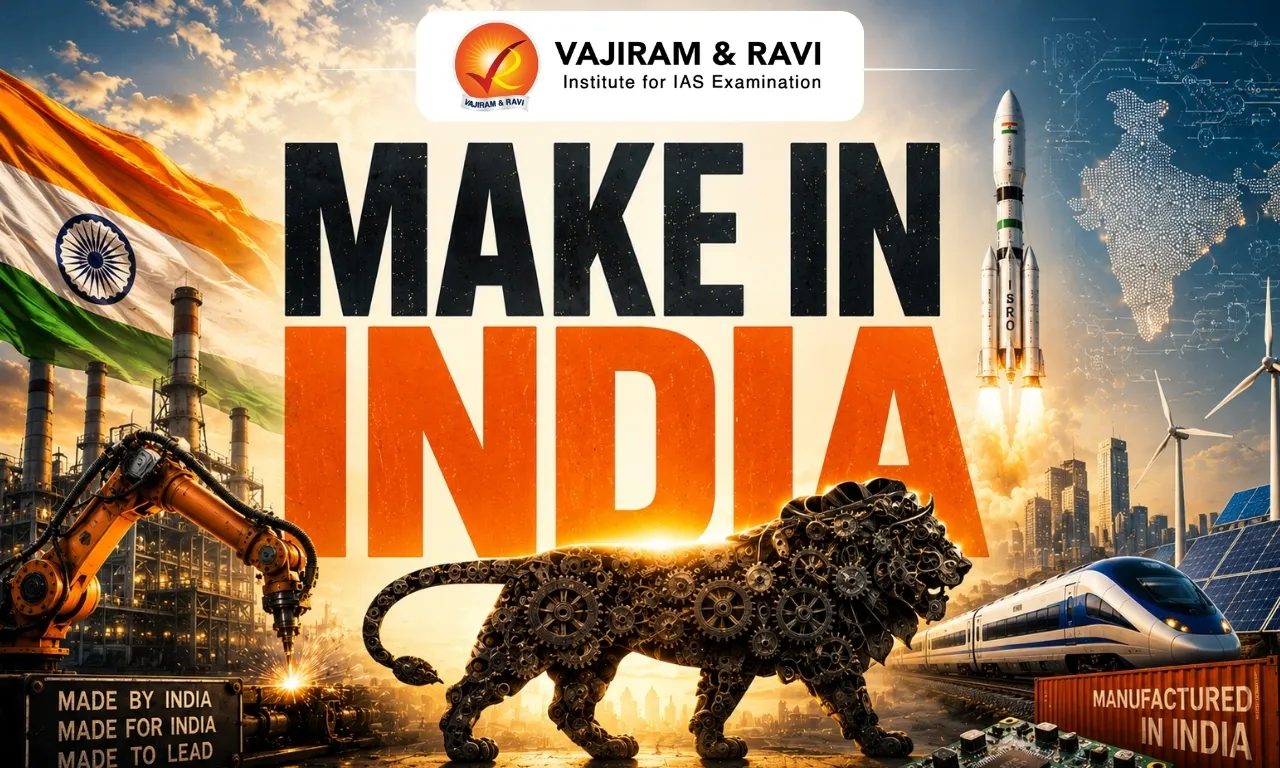
Make in India is a landmark government initiative launched on September 25, 2014, to transform India into a global hub for manufacturing, design, and innovation. Make in India 2.0 expanded the initiative to 27 priority sectors, covering electronics, defence, automobiles, pharmaceuticals, textiles, and renewable energy. It seeks to create a competitive business environment by simplifying regulations, improving infrastructure, attracting Foreign Direct Investment (FDI), and promoting ease of doing business.
By strengthening domestic manufacturing, the initiative aims to generate employment, enhance technological capabilities, integrate Indian firms into Global Value Chains (GVCs), and strengthen domestic supply chains. Thus, Make in India promotes industrial competitiveness, reduces critical import dependence, and supports the broader vision of Atmanirbhar Bharat and Viksit Bharat.
Make in India Objectives
In order to boost industrial growth and position India as a top global manufacturing location, the Make in India project was started. Objectives of Make in India are:
- Make India a global centre for investment and industry.
- Boost the manufacturing sector's GDP contribution.
- Create a lot of job opportunities.
- Draw in both foreign and domestic direct investment.
- Encourage entrepreneurship, creativity, and technology development.
- Bolster India's ability to compete in exports.
- Build top-notch industrial infrastructure.
- Lessen reliance on imports and promote Atmanirbhar Bharat.
Make in India Features and Pillars
With an emphasis on developing a competitive manufacturing ecosystem, the programme is based on four fundamental elements.
- New Processes: The government implemented several measures to make conducting business easier, including streamlining rules, digitising approvals, lowering the burden of compliance, and improving the efficiency and transparency of corporate processes.
- New Infrastructure: Modern industrial corridors, smart cities, logistical infrastructure, and innovation ecosystems are the initiative's main goals. Additionally, it enhances digital connectivity, talent development, and intellectual property rights (IPR) to assist the expansion of manufacturing.
- New Sectors: Foreign Direct Investment (FDI) regulations have been loosened in a number of industries, including construction, railroads, defence, insurance, and medical devices, promoting increased private and international involvement.
- New Mindset: By collaborating with businesses and promoting innovation, investment, and entrepreneurship, the government changed from being a regulator to a facilitator.
Make in India and the National Manufacturing Mission
The National Manufacturing Mission (NMM) acts as a strategic framework to accelerate the goals of the Make in India (MII) programme. While MII serves as the broader vision to attract global capital and drive industrialisation, the National Manufacturing Mission focuses on solving ground-level operational bottlenecks to ensure long-term execution.
- Synergy with Make in India: The mission complements MII by targeting critical pillars: reducing the cost of doing business, empowering MSMEs, encouraging Industry 4.0 adoption, and upskilling the Indian workforce for future-ready jobs.
- Focus on Clean-Tech & Sunrise Sectors: It reinforces MII 2.0 by providing targeted policy support to high-tech and sustainable sectors, including solar cell production, EV battery ecosystems, semiconductors, and specialised manufacturing clusters like footwear and toys.


Make in India Logo
The Make in India logo is the primary visual identifier of the Government of India's flagship initiative
- The logo features a stylised, forward-moving silhouette of a lion on the prowl.
- Inspired by the Lion Capital of Ashoka (India’s national emblem), it represents strength, courage, tenacity, and national pride.
Make in India Governmental Initiatives
The Make in India campaign has played a vital role in establishing India as a global centre for manufacturing. The plan seeks to establish India as a major participant in the world economy with a heavy emphasis on developing industrial capacities, encouraging innovation, and building top-notch infrastructure.
The Production Linked Incentive (PLI) Scheme
The PLI Scheme, which was introduced to boost exports and local manufacturing, offers cash incentives based on increased production. Its features are
- It has an approved financial outlay of ₹1.91 lakh crore
- Includes 14 key industries like solar modules, textiles, food processing, electronics, cars, medicines, telecom, and drones.
- As of 31.03.2026, the PLI Schemes resulted in an actual investment of over ₹2.40 lakh crore and employment generation of over 14.15 lakh (direct and indirect).
- It promotes spending on cutting-edge technology.
- It encourages export competitiveness and economies of scale.
- Benefits: Large-scale private industrial investment.
- Growth in domestic production.
- Creation of jobs in all priority sectors.
PM Gati Shakti National Master Plan
PM Gati Shakti was introduced in 2021 for a broader infrastructure and connectivity framework that supports Make in India by improving logistics and industrial connectivity.
- Seven Engines: Roads, railroads, ports, airports, waterways, mass transit, and logistics infrastructure.
- Benefits: Implementing projects more quickly.
- Enhanced effectiveness of the supply chain.
- Decreased expenses for logistics.
- Improved industry connectivity.
National Logistics Policy (NLP)
By increasing logistics efficiency through digital integration, standardisation, and infrastructure development, the National Logistics Policy enhances PM GatiShakti. Its goals include cutting logistics expenses and raising India's position in the Logistics Performance Index to one of the top 25 nations by 2030 and creating a data-driven decision support system. Its benefits are
- Lower the cost of logistics.
- Boost India's standing in the Logistics Performance Index.
- Create a technologically advanced and effective logistics ecosystem.
- Boost the competitiveness of exports.
Semiconductor Mission (Semicon India Program)
To create a complete ecosystem for semiconductor manufacturing, the government started the Semicon India Program. One particularly encouraging development is Tata's joint venture with Taiwan's Powerchip in Dholera. Features of the semiconductor mission are
- Funding for semiconductor manufacturing facilities.
- Encouragement of display production.
- Assistance with semiconductor packaging, testing, and assembly.
- Chip design incentives via the Design Linked Incentive (DLI) Programme.
- The initiative seeks to improve India's electronics manufacturing ecosystem and lessen reliance on imports.
Startup India
By encouraging entrepreneurship, innovation, and technology-driven manufacturing, Startup India enhances Make in India. With 2.23 lakh DPIIT-recognised startups, India has the third-largest startup ecosystem globally. Its benefits are.
- Encourage startups by making compliance simpler.
- Boost funding availability.
- Promote manufacturing driven by innovation.
- Create job opportunities.
Infrastructure Initiatives Driving Make in India
A robust, world-class physical foundation is essential for seamless manufacturing and trade. India’s mega-infrastructure programmes are directly lowering logistics costs, upgrading supply chains, and driving the success of Make in India:
- National Infrastructure Pipeline (NIP)
- Role in MII: The NIP provides a forward-looking roadmap to channel massive investments into energy, transport, water, and urban infrastructure.
- Impact: Reliable power, high-speed connectivity, and modernised industrial parks under NIP ensure that manufacturing hubs operate without resource bottlenecks, giving foreign and domestic investors confidence to set up production units.
- Bharatmala Pariyojana
- Role in MII: Bharatmala focuses on optimising road freight efficiency through the construction of expressways, economic corridors, feeder routes, and border roads.
- Impact: By linking remote production centres directly to major markets and border entry points, it drastically cuts transit times, reduces freight costs, and enhances supply chain reliability for domestic manufacturers.
- Sagarmala Programme
- Role in MII: Sagarmala focuses on port-led development, modernising coastal shipping, upgrading port capacity, and creating Coastal Economic Zones (CEZs).
- Impact: Since manufacturing heavily relies on trade competitiveness, Sagarmala drastically reduces turnaround times at ports. It seamlessly connects inland factories to sea routes, making Indian-made goods cheaper and faster to export globally.
Make in India Achievements
The Make in India initiative has significantly strengthened India's manufacturing ecosystem through policy reforms, infrastructure development and increased investment. The programme has improved India's global competitiveness, enhanced domestic production and encouraged technological advancement across key sectors.
- Growing Investment from Overseas: India is now one of the top investment destinations in the world thanks to significant FDI brought in by policy reforms and ease of doing business. FDI increased from $36.05 billion in FY 2013-14 to $94.53 billion in FY 2025-26.
- Growth in Electronics Manufacturing: The majority of smartphones are currently produced in India, which has become the second-largest mobile phone manufacturer in the world, manufacturing 99% domestically.
- Manufacturing for Defence: With projects like the building of INS Vikrant, defence exports have increased. Defence exports surged from ₹686 crore in 2013–14 to a record ₹38,424 crore in 2025–26, with exports reaching over 80 countries.
- Modernisation of Railroads: Vande Bharat Express's development is a reflection of India's expanding capacity for cutting-edge railway engineering and production. Indian Railways has introduced 164 Vande Bharat trains as of Dec. 2025 and electrified 46,900 km of railway lines since 2014.
- Export Growth: Indian manufacturing exports have increased in a number of industries, including electronics, food products, textiles, medicines, and engineering equipment. PLI Schemes Drive Over ₹15.2 Lakh Crore in Exports across Various Sectors.
- Expansion of Startup Ecosystems: India has created one of the biggest startup ecosystems in the world, encouraging creativity and creating jobs in the industrial and technology industries.
Make In India Challenges
The Make in India initiative continues to face several structural, regulatory and global challenges that affect its ability to fully realise India's manufacturing potential. Issues such as infrastructure bottlenecks, skill shortages, regulatory complexities and external economic uncertainties continue to influence investment decisions and industrial competitiveness.
- Infrastructure Deficits: Production costs are raised by poor industrial infrastructure, transportation connectivity, and logistics.
- Low Manufacturing Value Addition: India has expanded manufacturing capacity in several sectors, but domestic value addition remains relatively low in areas such as electronics.
- Under the revised national accounts series, manufacturing accounted for 14.8% of total GVA in 2025–26.
- Exorbitant Logistics Expenses: Compared to many rival manufacturing economies, logistics costs are still comparatively higher.
- The latest DPIIT-NCAER assessment estimates India’s logistics costs at 7.97% of GDP in 2023–24. However, localised inefficiencies and structural bottlenecks continue to raise operational costs for manufacturers compared with major manufacturing economies.
- Skill Gaps: Workers with the necessary skills are still in limited supply in modern industrial industries.
- Limited R&D and Technology Depth: India's manufacturing sector faces gaps in research and development, advanced technologies and indigenous innovation.
- R&D expenditure as a percentage of the country’s GDP (gross domestic product) is just 0.64%.
- Complicated Labour and Land Regulations: Regulatory obstacles and drawn-out approval procedures hinder industrial growth.
- Reliance on Imported Parts: Many industries still rely significantly on foreign inputs, especially semiconductors and electronics.
- MSME Limitations: Small manufacturers' ability to compete is impacted by their limited access to global markets, technology, and financing.
- Uncertainty in the World Economy: Manufacturing investment decisions are still influenced by supply chain disruptions and geopolitical concerns.
Make in India Way Forward
The Make in India project must continue to expand through policy changes, technology advancements, and infrastructure development if it is to realise its goal of turning India into a worldwide manufacturing hub. The initiative can be strengthened by the following actions:
- Boost Competitiveness in Manufacturing: To compete with the top industrial economies in the world, concentrate on increasing productivity through automation, digitalisation, Industry 4.0 techniques, and modern manufacturing technology.
- Boost Infrastructure and Logistics: To lower transportation costs and increase supply chain efficiency, expedite the implementation of PM GatiShakti, industrial corridors, dedicated freight corridors, multimodal transport networks, and logistics parks.
- Deepening Domestic Value Addition: India should move beyond assembly-led manufacturing by strengthening domestic production of components, intermediate goods, machinery and critical inputs.
- Strengthen Global Value Chain (GVC) Integration: Encourage Indian companies to join international production networks through trade facilitation, quality standards, and foreign collaborations in order to advance export-oriented manufacturing.
- Strengthen Technology, Innovation, and Research: To transition from labour-intensive manufacturing to technology-driven production, increase expenditures in R&D, semiconductor manufacturing, robots, artificial intelligence, and advanced electronics.
- Make MSMEs stronger: To increase the competitiveness of Micro, Small, and Medium-Sized Enterprises (MSMEs), which are the foundation of manufacturing, expand access to global markets, digital technology, modern machinery, affordable loans, and skill development.
- Create a Skilled Labour Force: Increase the scope of industry-focused skill development programmes under programmes like the Skill India Mission to give workers knowledge of cutting-edge manufacturing, digital production systems, and emerging technology.
- Assure Investor-Friendly and Stable Policies: To boost investor confidence and draw in long-term domestic and global investments, provide consistent taxation, clear rules, and quicker approvals.
Make In India UPSC PYQs
Q1. “Success of ‘Make in India’ programme depends on the success of ‘Skill India’ programme and radical labour reforms.” Discuss with logical arguments. (UPSC Mains 2015)

 Last updated on Oct, 2026
→ UPSC 2027 Notification will be released on 13 January 2027 at upsconline.nic.in.
→ Check Nobel Prize 2026 Winners List here.
→ Download PIB PRiSM Monthly Magazine 2026 here.
→ Check UPSC Monthly Current Affairs Magazine The Recitals here.
→ Check out the latest UPSC Syllabus here.
→ Download UPSC Model Answers for Mains 2026
→ UPSC Mains Question Paper 2026 is out now for Essay & GS Paper 1, 2, 3 & 4.
→ UPSC Calendar 2027 has been released.
→ Enroll in Vajiram & Ravi’s UPSC Mains Test Series 2027 for structured answer writing practice, expert evaluation, and exam-oriented feedback.
→ Join Vajiram & Ravi’s UPSC Mentorship Program 2027 for personalized guidance, strategy planning, and one-to-one support from experienced mentors.
→ Go through the UPSC Mains Previous Year Papers to enhance your preparation.
→ UPSC has released UPSC Toppers List 2025 with the Civil Services final result on its official website.
→ Also check Best UPSC Coaching in India
Make in India FAQs
Q1. What is the Make in India concept?+
Q2. What is the motto of Make in India?+
Q3. When was Make in India launched?+
Q4. What are the 4 pillars of Make in India?+
Q5. What are the Make in India products?+
Tags: make in india quest upsc economy notes