The industrial sector in India is undergoing a significant transformation, evolving from traditional industries towards advanced manufacturing, innovation, and high-technology production. Supported by infrastructure development, policy reforms, rising investment, and growing domestic demand, the industrial sector in India has emerged as a key pillar of economic growth.
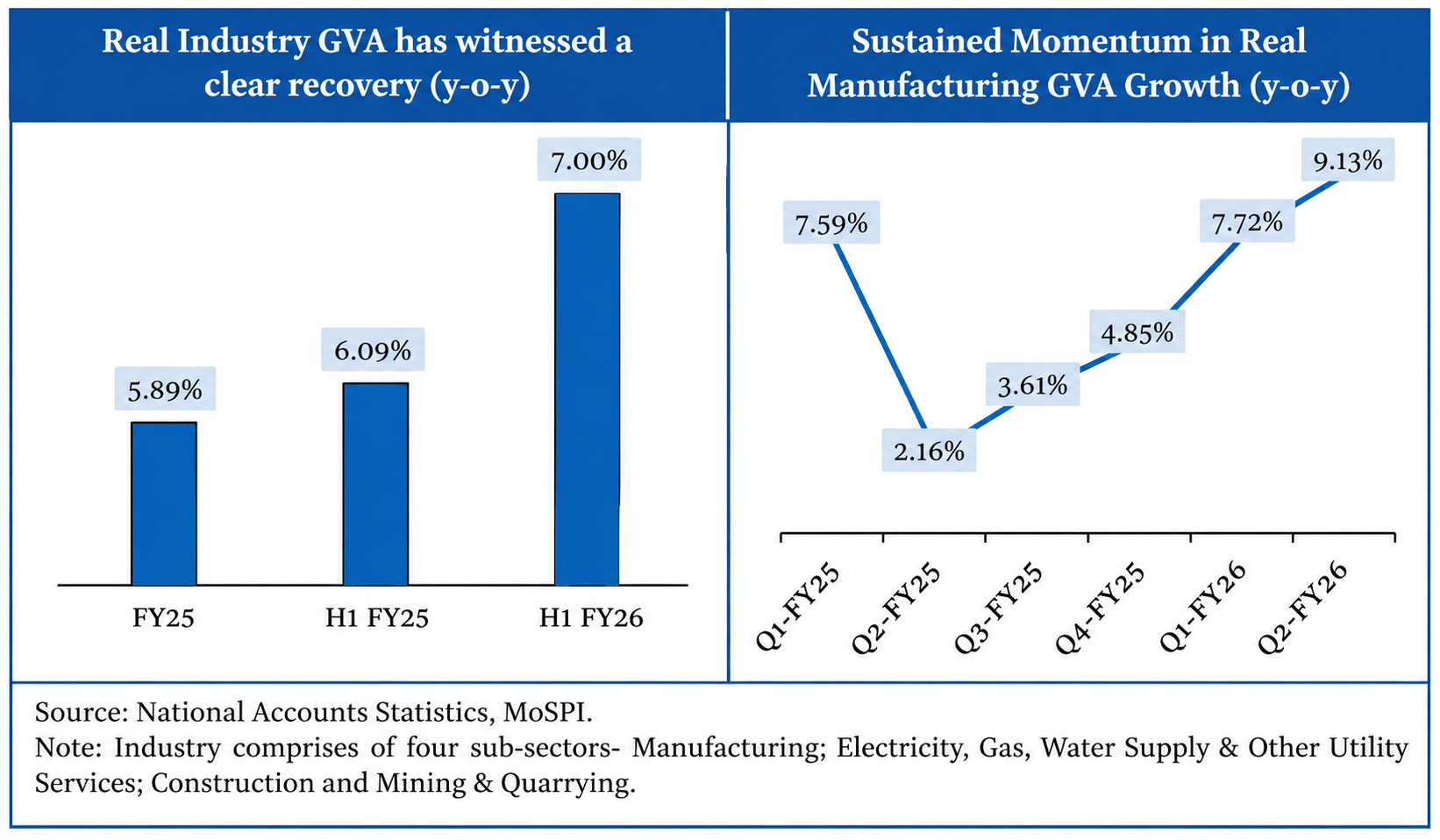
During the first half of FY 2025–26, industrial GVA grew by 7.0% in real terms, demonstrating resilience despite global supply-chain disruptions, inflationary pressures, and geopolitical uncertainties. India is also seeking deeper integration into Global Value Chains (GVCs) by shifting from cost-based manufacturing towards technology-driven and value-added production. Strengthening manufacturing, research and development, infrastructure, logistics, and MSMEs will remain crucial for enhancing industrial competitiveness and achieving the vision of Viksit Bharat @2047.
Industrial Sector Types
The industrial sector in India is highly diversified, encompassing a wide range of industries that contribute to economic growth, employment generation, infrastructure development, and exports. Each category of industrial sector plays a distinct role in the economy, from extracting natural resources and manufacturing finished goods to building infrastructure and providing essential utility services.
- Manufacturing Sector: This sector makes up the majority of industrial output and transforms raw resources into completed items.
- Examples include steel, cement, cars, electronics, pharmaceuticals, textiles, chemicals, and food processing.
- Automation, digitalisation, robotics, and cutting-edge technologies like artificial intelligence are becoming more and more prevalent in manufacturing.
- The Mining Sector: Natural resources such as iron ore and coal, limestone, bauxite, copper, and manganese are extracted by mining businesses.
- The raw materials needed for infrastructure development and production come from mining.
- The Construction Sector: It comprises roads, railroads, airports, housing, smart cities, and industrial parks.
- It increases demand for steel, cement, and machinery and is one of India's biggest employers.
- Gas, Electricity, and Utility Services: Industrial output is supported by a stable energy infrastructure. Industrial productivity has increased dramatically as a result of investments in power distribution, transmission networks, and renewable energy.
Industrial Sector Overview
The industrial sector includes mining and quarrying, manufacturing, electricity, gas, water supply and construction.
- It links agriculture and services by processing raw materials, generating employment and boosting exports.
- India's growing domestic market, skilled workforce, improving infrastructure, policy reforms and digital ecosystem make it an attractive manufacturing destination.
Industrial Sector Performance for Fiscal Year 2025–2026
India's industrial sector saw continued growth during FY 2025–2026, despite poor global manufacturing circumstances. As stated by the Economic Survey:
- In the first half of FY 2025–2026, industry Gross Value Added (GVA) increased by 7.0%, compared with 5.9% in FY 2024–2025.
- In Q1 and Q2, manufacturing GVA grew by 7.72% and 9.13%, respectively, indicating a resurgence of industrial vigour.
- Despite the standstill in several advanced countries, India continued to rank among the world's fastest-growing industrial economies, as per the World Bank.
India's Transition to High-Tech Manufacturing
The growing proportion of high-value manufacturing is one of the largest structural shifts in India's industrial sector.
- Currently, 46.3% of India's manufacturing value addition comes from medium- and high-technology businesses, indicating a steady shift toward more advanced production techniques.
- This change has been expedited by government support for semiconductors, electronics, pharmaceuticals, transportation equipment, and speciality chemicals.
- This change is crucial because, in addition to low manufacturing costs, future global competitiveness will rely on innovation, technological leadership, and integration into Global Value Chains (GVCs).
- India's increasing industrial strength was highlighted by its Competitive Industrial Performance (CIP) ranking, which rose from 40th in 2022 to 37th in 2023.


Industrial Sector Importance
The industrial sector is a key driver of India's growth, employment, exports and infrastructure, while creating strong linkages with agriculture and services across the economy.
- Boosts Economic Growth: Industry GVA grew 7.0% in real terms in H1 FY2025–26, with manufacturing GVA growing 7.72% in Q1 and 9.13% in Q2.
- Generates Employment: The organised manufacturing sector employed about 1.96 crore persons in 2023–24, with employment rising 5.92% during the year. It added around 57 lakh jobs over 2014–15 to 2023–24.
- Promotes Exports: India accounted for about 1.8% of global merchandise exports and 2.9% of global manufacturing GVA in 2024, highlighting substantial scope for expanding its global manufacturing presence.
- Drives Technological Innovation: Medium- and high-technology industries accounted for 46.3% of India's manufacturing value added, reflecting increasing movement towards technology-intensive production.
- Supports Infrastructure Development: Industrial growth creates demand for roads, railways, ports, power and industrial corridors. India's high-speed road corridors increased from 550 km in FY2014 to 5,364 km by December 2025.
- Strengthens Supply Chains: Initiatives such as PLI have expanded domestic production and supplier networks. Across 14 sectors, PLI has attracted over ₹2 lakh crore investment, generating more than ₹18.7 lakh crore incremental production/sales by September 2025.
- Enhances Global Competitiveness: Integration with global value chains enables Indian firms to access international markets, technology and production networks.
- However, India's manufacturing share remains only 2.9% of global manufacturing GVA, indicating considerable room for expansion.
- Promotes Regional Development: Industrial clusters and corridors help spread investment beyond traditional centres.
- However, industrial activity remains largely concentrated in Gujarat, Maharashtra, Karnataka, and Tamil Nadu; together, they accounted for about 43% of industrial GSVA in FY2022–23.
- Creates a Multiplier Effect: Industrial expansion generates demand for transport, logistics, finance, construction, energy and business services, creating linkages across the economy.
- The Economic Survey notes that dynamic industrial and service sectors can also absorb surplus agricultural labour and generate additional demand for farm output.
Industrial Sector Government Initiatives
India’s industrial sector is driving economic growth through policy reforms, rising investment, infrastructure expansion and manufacturing initiatives aimed at generating jobs, boosting exports and enhancing global competitiveness.
The Production Linked Incentive (PLI) Programme
- India's main industrial strategy, the Production Linked Incentive (PLI) Scheme, aims to increase domestic manufacturing and draw in foreign investment.
- 14 strategic sectors are covered under the programme, including pharmaceuticals, electronics and medical devices, telecom, food processing, cars, textiles, solar PV modules, speciality steel and white goods.
- Major Achievements: Investments of ₹2.40 lakh crore.
- About ₹15.2 lakh crore in exports.
- Around 14.15 lakh jobs, including direct and indirect.
National Manufacturing Mission (NMM)
- The National Manufacturing Mission, which was included in the Union Budget 2025–2026, offers a long-term industrial restructuring strategy.
- Its main goals for 2035 are as follows: Raising the GDP share of manufacturing from 12.9% to 25%, generating 143 million jobs, and increasing exports of goods to USD 1.2 trillion.
- Three strategic categories are identified by the mission
- Scale: Pharmaceuticals and automobiles.
- Fix and Transform: Capital goods and electronics.
- Seed: Electric cars and semiconductors.
PM Gati Shakti National Master Plan
- In order to lower logistical costs and boost industrial efficiency, PM Gati Shakti unifies transportation, logistics, and infrastructure planning across ministries.
- Major achievements
-
- 58 ministries are integrated into a digital platform.
- Over 1,800 data layers are available for planning.
- Indian goods are more competitive in global markets due to lower logistics costs.
India Semiconductor Mission
- The government started the India Semiconductor Mission to lessen reliance on imported chips.
- The programme features:
- A sum of ₹76,000 crore.
- Twelve semiconductor manufacturing and packaging projects in six states have been approved as of August 2026.
- Attracted investments totalling over ₹1.6 lakh crore.
Increasing Research and Innovation
- India is putting more emphasis on industrial growth fuelled by research.
- Significant initiatives include the Anusandhan National Research Foundation (ANRF) to improve cooperation in research.
- The Research, Development & Innovation (RDI) Fund will invest ₹1 lakh crore over six years to encourage private sector R&D and deep-tech innovation.
Industrial Sector Sector-wise Progress
India's industrial sector revolution is due to the robust performance of a number of key manufacturing sectors. These industries have been bolstered by government policy backing, growing domestic demand, technical innovation, and infrastructure investments, making India a more competitive manufacturing destination.
Steel Industry
- The foundation of India's manufacturing and infrastructure ecosystem is the steel sector.
- India is currently the second-largest producer of crude steel in the world because of robust demand from the engineering, building, infrastructure, railway, and automotive sectors.
- Important Highlights: Production of crude steel rose from 103.54 million tonnes in FY21 to 152.18 million tonnes in FY25.
- 146.69 million tonnes of finished steel were produced.
- Due to strong domestic demand, steel consumption rose to 152.13 million tonnes.
- Crude steel output increased by 11.7% and finished steel production by 10.8% between April and October of FY26.
The Cement Sector
- With an established production capacity of about 690 million tonnes, India is the world's second-largest manufacturer of cement as of early 2026.
- Infrastructure development, housing, roads, railroads, industrial corridors, and urbanisation are all supported by the industry.
- Present Situation: In FY25, cement production was over 453 million tonnes.
- India consumes only 290 kg of cement per person as per the Economic Survey 2025-26, which is far less than the global average and suggests substantial room for future expansion.
MSMEs
- MSMEs, or micro, small, and medium-sized enterprises, continue to be essential to India's economic ecosystem.
- MSMEs' contribution as per the Economic Survey 2025-26: 35.4% of manufacturing output, 48.58% of exports, and roughly 31.1% of GDP.
- Employment of more than 32 crore individuals.
- Over 7.4 crore registered businesses.
Electronics Sector
- India's fastest-growing manufacturing sector and a significant contributor to exports is the electronics industry.
- India used to be a net importer of electronics, but it is now a major hub for global production.
- Major Achievements: In FY25, electronics became India's third-largest export sector.
-
- In the first half of FY26, exports of electronics totalled USD 22.2 billion.
- India's electronics production reached ₹11.3 lakh crore in FY2024–25, while electronics exports reached ₹3.27 lakh crore.
- Production of mobile phones rose from ₹18,000 crore in FY15 to ₹5.45 lakh crore in FY25, a roughly 30-fold rise.
- India is currently the world's second-largest producer of mobile phones, with more than 300 production facilities.
Automobile Sector
- India is now recognised as the biggest market for two- and three-wheelers worldwide and the third-biggest car market in the world.
- Major Achievements
-
- Over 30 million people are employed, both directly and indirectly.
- The automotive industry accounts for around 15% of GST collections.
- In FY25, more than 5.3 million vehicles were exported.
- Over the last ten years, production has grown by almost 33%.
Pharmaceutical Sector
- India is considered the “Pharmacy of the World". The nation sells pharmaceutical goods to 191 nations and provides about 20% of the world's generic medications.
- Major achievements: In FY25, industry turnover was ₹4.72 lakh crore.
-
- Over half of exports are sent to controlled markets, such as the US and Europe.
- Between FY21 and FY25, medical equipment exports rose from USD 2.5 billion to USD 4.1 billion.
The Textile Sector
- India's textile industry continues to be one of the biggest employers in the nation.
- Major achievements: The industry is estimated to be worth USD 179 billion.
- It makes up about 2% of the GDP.
- Makes up over 11% of the GVA of manufacturing.
- In FY25, textile exports totalled USD 37.75 billion.
Coal Industry
- India's principal commercial energy source is still coal.
- Major achievements: In FY25, coal production surpassed 1,047 million tonnes.
-
- The supply of coal domestically rose dramatically.
- Over 74% of India's electricity is produced by coal, which makes up around 55% of the country's energy mix.
Petrochemicals and Chemicals
- Pharmaceuticals, agriculture, textiles, plastics, and manufacturing all depend heavily on the chemicals sector.
- Major achievements: 8.1% of manufacturing GVA was contributed.
- Total production of major chemicals and petrochemicals rose from 45,638 thousand metric tonnes (MT) in FY16 to 58,617 thousand MT in FY25.
Industrial Sector Challenges
India's industrial sector continues to face several structural and external challenges despite significant progress in manufacturing, infrastructure development, and policy reforms. Global economic uncertainties, technological disruptions, supply chain vulnerabilities, and domestic constraints have slowed the pace of industrial transformation.
- Land Acquisition Challenges: Acquiring suitable industrial land can involve fragmented ownership, high costs, rehabilitation concerns and lengthy legal procedures, delaying large manufacturing and infrastructure projects.
- Uncertainty in the World Economy: Exports and investment are nevertheless impacted by supply chain interruptions, inflation, and geopolitical tensions.
- Complex Environmental Approvals: Multiple environmental, forest, wildlife and pollution-control clearances can increase project timelines and compliance costs. Balancing faster approvals with environmental safeguards remains a key challenge.
- Inadequate Global Value Chain (GVC) Integration: India remains less involved in international manufacturing networks than several East Asian economies.
- Excessive Reliance on Imports: Import-dependent industries include semiconductors, electronics components, and coking coal.
- Low Private Research and Development Investment: In comparison to top manufacturing economies, India's gross expenditure on research and development is still quite low.
- Skill Gap: A workforce skilled in automation, artificial intelligence, robotics, sophisticated manufacturing, and digital technologies is necessary for industry.
- Competitiveness of MSMEs: Many MSMEs still struggle with issues like productivity, market access, financing, and technology adoption.
- Climate Change and Environmental Pressures: Extreme weather events, water stress, rising temperatures and the transition towards low-carbon production can disrupt industrial operations and increase adaptation and compliance costs.
Industrial Sector Way Forward
The industrial sector in India is at a turning point. The nation must build on recent reforms while tackling structural issues to realise the vision of Viksit Bharat @2047 and become a global leader in manufacturing. The following actions can guarantee long-term, sustainable growth and boost industrial competitiveness.
- Quicken Digital Transformation and Advanced Manufacturing: To boost production, optimise supply chains, and improve product quality, industries should embrace cutting-edge technology.
- By creating intelligent manufacturing ecosystems, companies will be able to enhance operational efficiency and react swiftly to shifting market demands.
- Boost Research and Innovation Ecosystem: India needs to become a technology creator rather than just an adopter.
- India's capacity for innovation will be strengthened, and globally competitive goods will be developed with increased public and private investment in R&D.
- Strengthen Global Value Chain (GVC) Integration: India should link MSMEs with large manufacturers through supplier-development programmes, standards & technology support and promote export-oriented manufacturing in order to establish itself as a dependable manufacturing partner as global supply chains evolve.
- Promote Cluster-Based Industrialisation: Strengthening industrial clusters, economic corridors and sector-specific manufacturing ecosystems can create economies of scale, shared infrastructure, specialised suppliers and skilled labour pools.
- Streamline Land Acquisition: Establishing transparent land banks, improving land records, enabling time-bound acquisition and ensuring fair compensation and effective rehabilitation and resettlement can reduce delays in industrial projects.
- Enhance ease of doing business: Both domestic and foreign investments will be encouraged by streamlining regulatory processes, lowering compliance requirements, expediting approvals through digital governance, and guaranteeing transparent policy execution.
- Build Climate-Resilient Industry: Industrial planning should incorporate climate-risk assessments, water efficiency, disaster-resilient infrastructure, heat management and diversified supply chains.
- Create a Skilled Labour Force: For sophisticated manufacturing, closing the skill gap is essential. Emerging technologies, including artificial intelligence (AI), semiconductor manufacturing, automation, electric mobility, and precision engineering, should be the main focus of industry-oriented training programmes.
Industrial Sector PYQs
Q1. India aims to become a semiconductor manufacturing hub. What are the challenges faced by the semiconductor industry in India? Mention the salient features of the India Semiconductor Mission. (UPSC Mains 2025)
Q2. Account for the failure of the manufacturing sector in achieving the goal of labour-intensive exports rather than capital-intensive exports. Suggest measures for more labour-intensive rather than capital-intensive exports. (UPSC Mains 2017)
Q3. With reference to coal-based thermal power plants in India, consider the following statements: (UPSC Prelims 2023)
- None of them uses seawater.
- None of them is set up in water-stressed district.
- None of them is privately owned.
How many of the above statements are correct?
a) Only one
b) Only two
c) All three
d) None
Ans: (d)
Q4. In India the steel production industry requires the import of: (UPSC Prelims 2015)
a) Saltpeter
b) Rock phosphate
c) Coking coal
d) All of the above
Ans: (c)
Q5. In the Index of Eight Core Industries, which one of the following is given the highest weight? (UPSC Prelims 2015)
a) Coal Production
b) Electricity generation
c) Fertiliser Production
d) Steel Production
Ans: (b)

 Last updated on Oct, 2026
→ UPSC 2027 Notification will be released on 13 January 2027 at upsconline.nic.in.
→ Check Nobel Prize 2026 Winners List here.
→ Download PIB PRiSM Monthly Magazine 2026 here.
→ Check UPSC Monthly Current Affairs Magazine The Recitals here.
→ Check out the latest UPSC Syllabus here.
→ Download UPSC Model Answers for Mains 2026
→ UPSC Mains Question Paper 2026 is out now for Essay & GS Paper 1, 2, 3 & 4.
→ UPSC Calendar 2027 has been released.
→ Enroll in Vajiram & Ravi’s UPSC Mains Test Series 2027 for structured answer writing practice, expert evaluation, and exam-oriented feedback.
→ Join Vajiram & Ravi’s UPSC Mentorship Program 2027 for personalized guidance, strategy planning, and one-to-one support from experienced mentors.
→ Go through the UPSC Mains Previous Year Papers to enhance your preparation.
→ UPSC has released UPSC Toppers List 2025 with the Civil Services final result on its official website.
→ Also check Best UPSC Coaching in India
Industrial Sector FAQs
Q1. What are the 5 industrial sectors?+
Q2. Which is the fastest-growing sector in India?+
Q3. What is the National Manufacturing Mission?+
Q4. How much does the industrial sector contribute to India’s GDP?+
Q5. What is the contribution of the manufacturing sector to India's GDP?+
Tags: industrial sector quest upsc economy notes