The EU, or the European Union, is a political and economic union of 27 European countries that have developed common institutions and policies to promote peace, prosperity, economic cooperation and shared European values. The EU has evolved from post-Second World War economic cooperation into a major global economic and political actor. Its foundations include human dignity, freedom, democracy, equality, the rule of law and human rights.
The EU operates through a unique institutional system in which Member States pool sovereignty in certain areas while retaining national governments and institutions. Its major areas of activity include the single market, trade, economic policy, environment, security, research and social development.
EU Evolution
The development of the European Union was a gradual process that began after World War 2 to establish lasting peace and closer economic cooperation among European countries.
- European Coal and Steel Community: In 1951, Belgium, France, Germany, Italy, Luxembourg and the Netherlands established the European Coal and Steel Community (ECSC). Cooperation in strategically important industrial sectors was intended to strengthen economic integration and make future conflict between European countries less likely.
- Treaties of Rome: The process of integration expanded during the 1950s with the Treaties of Rome, which established the European Economic Community and strengthened cooperation among the participating countries.
- First enlargement: During the 1970s, Denmark, Ireland and the United Kingdom joined the European Community. The 1980s saw further developments in European integration, including the Erasmus programme and progress towards the single market.
- Maastricht Treaty and European Union: The Maastricht Treaty of 1992 marked a major turning point by establishing the European Union in its modern form. The 1990s also witnessed the development of the single market and border-free travel.
- Introduction of the euro: The euro was launched in 1999, becoming an important symbol of European economic integration. It subsequently became the official currency of an increasing number of EU Member States.
- Further enlargement: Between 2000 and 2009, the EU expanded significantly, with 12 countries joining the Union. The Lisbon Treaty was also signed during this period and subsequently became an important foundation of the EU's institutional functioning.
- Recent developments: The EU has subsequently dealt with major challenges including the financial crisis, migration, the UK's decision to leave the EU, the COVID-19 pandemic, Russia's war against Ukraine and climate change.
EU Members
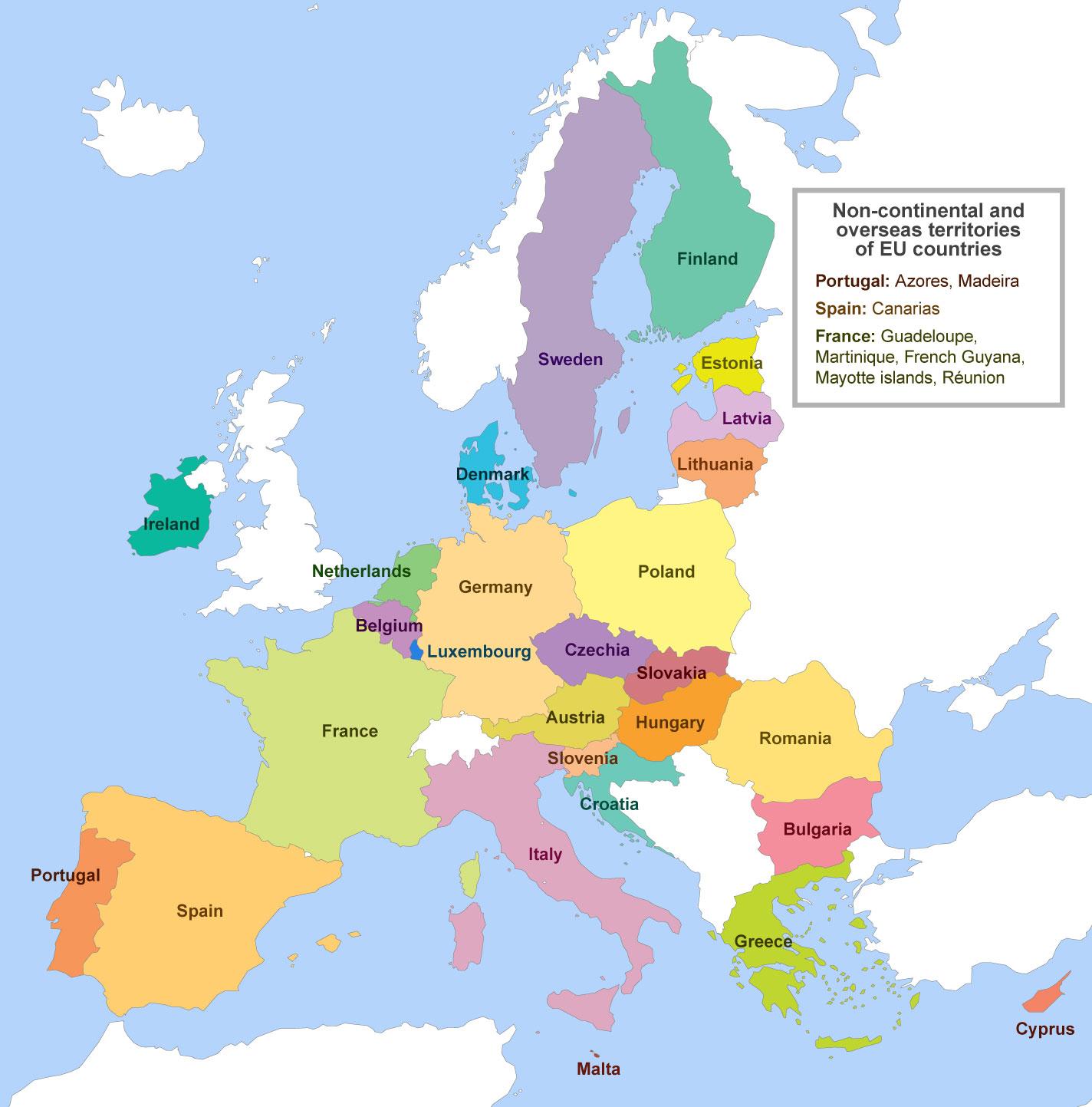
The European Union has expanded considerably from its six founding members and currently consists of 27 Member States, representing almost 450 million people.
- The six founding countries were Belgium, France, Germany, Italy, Luxembourg and the Netherlands.
- It is important to note that not every European Union member state uses the euro or belongs to the Schengen area. Membership of these arrangements differs among EU countries.
- The United Kingdom, which had been an EU member state since 1973, left the European Union on 31 January 2020 following Brexit. It was the first country to withdraw from the European Union.


EU Objectives
The EU's objectives extend beyond economic integration and cover peace, social development, environmental protection, fundamental rights and international cooperation.
- Promote peace and well-being: The European Union seeks to promote peace, its values and the well-being of its citizens.
- Establish an area of freedom, security and justice: It aims to provide freedom, security and justice without internal borders while maintaining appropriate controls at external borders.
- Create an internal market: The European Union seeks to establish and maintain an internal market that facilitates economic activity throughout the Union.
- Promote sustainable economic development: The European Union aims for balanced economic growth, price stability, a competitive social market economy, employment and social progress.
- Protect the environment: Environmental protection and action against climate change are important objectives of the Union.
- Promote scientific and technological progress: The European Union encourages research, innovation and technological advancement.
- Promote equality and social justice: The European Union seeks to combat social exclusion and discrimination and promote equality between women and men.
- Strengthen economic and social cohesion: The Union aims to reduce economic, social and territorial disparities and strengthen solidarity among Member States.
- Preserve cultural diversity: The European Union seeks to respect Europe's cultural and linguistic diversity.
- Promote international peace and cooperation: The European Union aims to contribute to international peace and security, sustainable development, human rights, free and fair trade and respect for international law.
European Union Headquarters
The European Union does not operate from a single headquarters because its major institutions are located in different European cities. The principal locations include:
- European Parliament: Brussels, Strasbourg and Luxembourg
- European Council: Brussels
- Council of the European Union: Brussels and Luxembourg
- European Commission: Brussels and Luxembourg
- Court of Justice of the European Union: Luxembourg
- European Central Bank: Frankfurt
- European Court of Auditors: Luxembourg
- Brussels is the principal institutional centre of the EU, particularly because the European Commission, the European Council and the Council of the European Union have their main locations there.
European Union Structure
The institutional structure of the European Union is designed to distribute responsibilities among different institutions rather than concentrating all authority in one body. The European Union has seven major institutions, supported by European Union bodies and decentralised agencies.
- European Parliament: The European Parliament directly represents European Union citizens. It adopts legislation jointly with the Council of the European Union and approves the EU budget.
- European Council: The European Council brings together the heads of state or government of European Union Member States. It sets the EU's broad political direction and priorities but generally does not adopt legislation.
- Council of the European Union: The Council represents the governments of European Union Member States. National ministers participate depending on the policy being discussed. It adopts EU legislation jointly with the European Parliament.
- European Commission: The European Commission represents the common interests of the EU. It proposes legislation, manages European Union policies and the budget, and monitors the correct application of EU law.
- Court of Justice of the European Union: The Court of Justice ensures that European Union law is interpreted and applied consistently across the Union.
- European Central Bank: The European Central Bank is responsible for maintaining price stability in the euro area and conducts monetary policy for the countries using the euro.
- European Court of Auditors: The European Court of Auditors examines European Union finances and checks whether European Union money is properly accounted for and spent according to the applicable rules.
European Union Powers and Functions
The European Union exercises powers in economic, legislative, judicial, monetary, trade and other policy areas, depending on the competencies granted to it.
- Economic functions: The European Union operates a large single market that facilitates the free movement of goods, services, capital and people.
- Legislative functions: The European Commission proposes legislation, while the European Parliament and Council adopt legislation in areas covered by European Union competence.
- Trade functions: The European Union has significant powers in international trade and negotiates trade agreements on matters falling under EU trade competence.
- Budgetary functions: The European Union manages a common budget that finances programmes and projects linked to common European priorities.
- Judicial functions: The Court of Justice ensures that European Union law is interpreted and applied consistently across Member States.
- Monetary functions: The European Central Bank conducts monetary policy for the euro area and seeks to maintain price stability.
- Foreign policy and security functions: The European Union also coordinates a Common Foreign and Security Policy. However, Member States retain their individual foreign policies, which can sometimes make common European Union positions difficult to achieve.
European Union and India
India-European Union relations have an important economic dimension, particularly because of the scale of bilateral trade, investment and business ties.
- According to the European Commission, India is one of the world's fastest-growing large economies and represents an important market with significant potential for trade and investment.
- India-European Union Trade: In 2025, EU-India trade in goods reached €118 billion.
- EU-India goods trade represented 11.1% of India's total trade.
- The European Union was India's third-largest trading partner.
- India was the EU's ninth-largest trading partner in goods.
- Goods trade increased by 83.7% over the preceding decade.
- Trade in services amounted to €67 billion in 2024.
- European Union foreign direct investment stock in India reached €132.8 billion in 2024.
- Around 6,000 European companies were present in India
- EU-India institutional cooperation: The EU-India High-Level Dialogue on Trade and Investment was established in 2021.
- The EU-India Trade Sub-Commission operates under the 1994 Cooperation and Partnership Agreement.
- These mechanisms provide platforms for discussing trade, investment and market-access issues.
INDIA EU TRADE DEAL
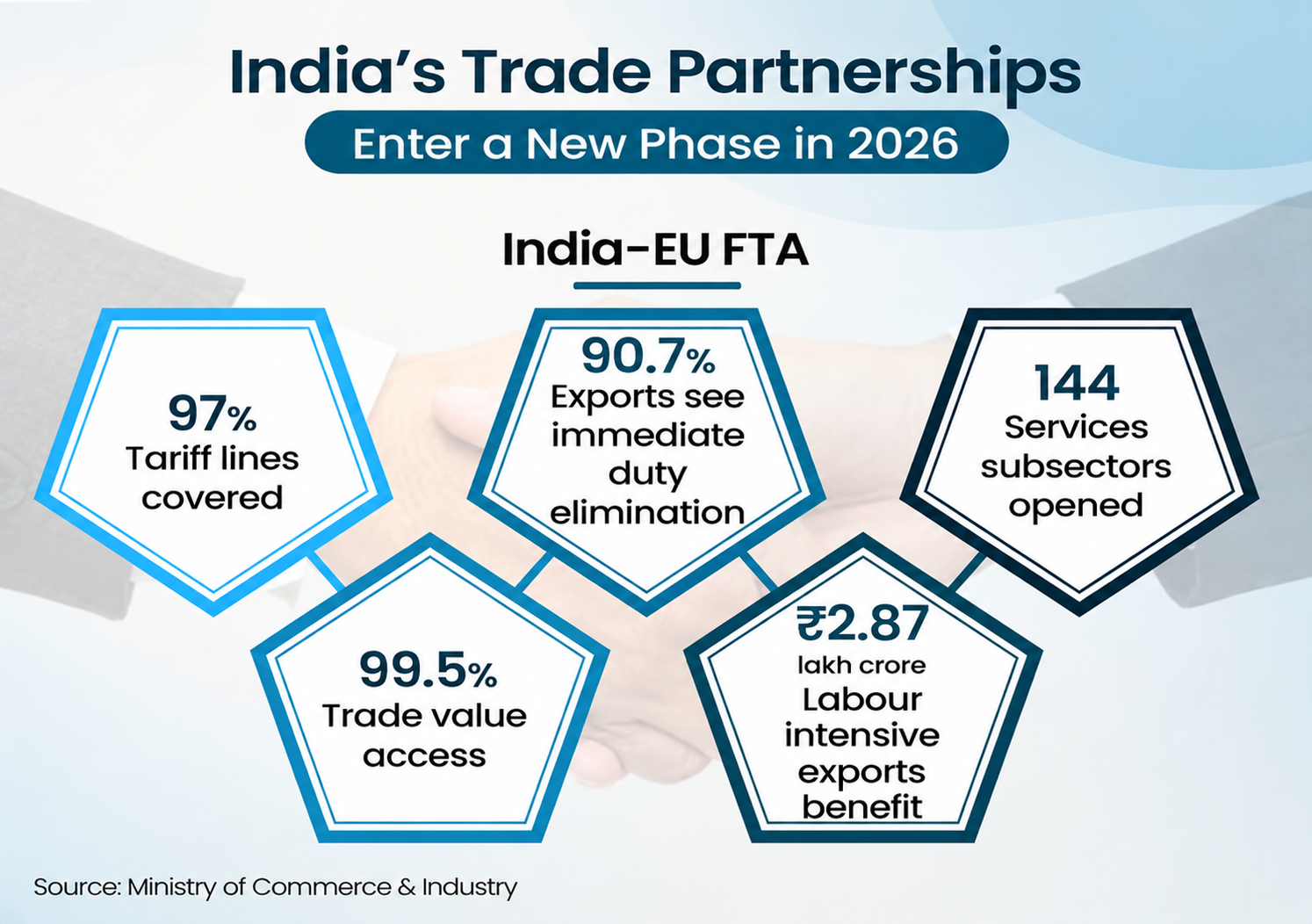
India and the European Union concluded negotiations for a landmark Free Trade Agreement (FTA) on 27 January 2026. It grants India preferential access across 97% of tariff lines, covering 99.5% of trade value.
| India–European Union FTA 2026 | ||
|
Tariff Liberalisation |
|
|
|
Key Indian Gainers |
|
|
|
Automobile Quota |
|
|
|
Agriculture |
|
|
|
RRM Three-Tier Resolution Structure: |
|
|
EU Initiatives to Tackle Climate Change
The European Union (EU) has adopted a wide range of climate initiatives to reduce greenhouse-gas emissions, promote clean energy, protect carbon sinks and move towards a climate-neutral economy by 2050.
- These measures form part of the EU's broader European Green Deal and include legally binding climate targets, the Fit for 55 package, renewable-energy measures, energy-efficiency policies, carbon-removal initiatives and measures to make transport greener.
- European Climate Law: Provides the legal framework for EU climate action and makes climate neutrality by 2050 legally binding.
- 2030 Target: At least 55% reduction in net GHG emissions from 1990 levels.
- 2040 Target: 90% reduction in net GHG emissions, comprising at least 85% domestic reductions and up to 5% through international carbon credits.
- 2050 Target: Achieve net-zero GHG emissions and climate neutrality.
- 2026 Amendment: Introduced the legally binding 2040 target, establishing an intermediate milestone between 2030 and 2050.
- European Green Deal: The European Green Deal is the overarching framework through which the EU is transforming its economy to address climate change and achieve climate neutrality.
- It covers measures across different economic sectors rather than treating climate change as a stand-alone environmental issue.
- Fit for 55 Package: The Fit for 55 package is a major set of EU climate laws and measures designed to help achieve the target of reducing net greenhouse gas emissions by at least 55% by 2030. It includes measures relating to:
- Renewable energy
- Energy efficiency
- Carbon removal
- Emissions trading
- Transport
- The transition towards a greener economy
- The package therefore connects the EU's climate targets with concrete policy measures across the economy.
- EU Deforestation Regulation (EUDR): Aims to prevent products linked to deforestation from entering or leaving the EU market.
- Covers: Timber and six commodities—cattle, cocoa, coffee, oil palm, rubber and soy—and products derived from them.
- Compliance: Products must be deforestation-free, with businesses required to demonstrate their origin and comply with due-diligence requirements.
- Objective: Reduce deforestation and promote sustainable, traceable supply chains.
European Union Challenges
The challenges facing the European Union (EU) include security pressures, migration, climate-policy disagreements, external contestation, human-rights dilemmas and questions about the EU's role in the international order.
- Changing EU Security and Foreign Policy: The EU's security policy faces the challenge of balancing protection from external threats with its traditional emphasis on cooperation, openness and the liberal international order.
- Growing Contestation from Turkey: Turkey's increasingly assertive engagement with the EU creates a challenge to the Union's legitimacy and influence in its surrounding region.
- Challenges in the EU's Climate Policy: The EU's climate policy faces the challenge of combining ambitious climate action with the interests, circumstances and concerns of other countries and affected communities.
- Migration and the EU's Liberal Values: Migration presents a major challenge for the EU because the need to manage irregular migration can come into tension with the Union's commitment to liberal values and internal solidarity.
- Balancing Human Rights and Member-State Sovereignty: The EU faces a challenge in promoting human rights internationally while balancing supranational decision-making with the sovereignty of its Member States.
- Questions Over the EU's Role in the Global Order: The EU faces the challenge of maintaining its global legitimacy while responding to concerns that the existing international order does not adequately represent all countries and communities.
- The Russia-Ukraine Challenge: Russia's war against Ukraine poses a complex challenge for the EU, which must strengthen European security while preserving political pluralism and democratic values within the Union.
European Union Way Forward
- Strategic Resilience: Strengthen energy security, critical infrastructure and supply-chain resilience to reduce external vulnerabilities.
- Constructive Turkey Engagement: Use sustained dialogue and economic cooperation to manage differences and preserve regional stability.
- Inclusive Climate Transition: Align climate ambition with industrial competitiveness through green investment, innovation and climate finance.
- Balanced Migration Framework: Improve border management while expanding legal migration pathways and ensuring equitable responsibility-sharing.
- Value-Based Diplomacy: Promote human rights through consistent engagement while respecting national sovereignty and international law.
- Multilateral Reform: Support greater representation of developing countries and strengthen the EU's role in a more inclusive global order.
- India–EU Strategic Convergence: Deepen cooperation in maritime security, critical technologies, defence, connectivity and resilient supply chains.
- FTA Implementation: Convert the India–EU FTA into greater market access, investment and technology flows, while addressing non-tariff barriers.
- Global South Cooperation: Leverage the India–EU partnership for joint projects in digital infrastructure, clean energy, healthcare and sustainable development.
European Union UPSC PYQs
Q1. Which of the following countries are members of the European Union? (UPSC Prelims 2026)
- Belarus
- Poland
- Germany
- Switzerland
Select the answer using the code given below
a) 1, 2 and 4
b) 1 and 4 only
c) 2 and 3
d) 2 and 4 only
Ans: (c)
Q2. Which organization has enacted the Nature Restoration Law (NRL) to tackle climate change and biodiversity loss? (UPSC Prelims 2025)
a) The European Union
b) The World Bank
c) The Organization for Economic Cooperation and Development
d) The Food and Agriculture Organization
Ans: (a)
Q3. Consider the following statements: (UPSC Prelims 2024)
Statement I: The European Parliament approved the Net-Zero Industry Act recently
Statement-II: The European Union intends to achieve carbon neutrality by 2040 and therefore aims to develop all of its own clean technology by that time.
Which one of the following is correct in respect of the above statements?
a) Statement-I and Statement-II are correct and Statement-II explains Statement-I
b) Both Statement-I and Statement-II are correct, but Statement-II does not explain Statement-I
c) Statement-I is correct, but Statement-II is incorrect
d) Statement-I is incorrect, but Statement-II is correct
Ans: (c)
Q4. Consider the following statements (UPSC Prelims 2023)
The ‘Stability and Growth Pact’ of the European Union is a treaty that
- Limits the levels of budgetary deficit of the countries of the European Union.
- Makes the countries of the European Union to share their infrastructure facilities.
- Enables the countries of the European Union to share their technologies.
How many of the above statements are correct?
a) Only one
b) Only two
c) All three
d) None
Ans: (a)
Q5. The term ‘Digital Single Market Strategy’ seen in the news refers to: (UPSC Prelims 2017)
a) ASEAN
b) BRICS
c) EU
d) G20
Ans: (c)

 Last updated on Oct, 2026
→ UPSC 2027 Notification will be released on 13 January 2027 at upsconline.nic.in.
→ Check Nobel Prize 2026 Winners List here.
→ Download PIB PRiSM Monthly Magazine 2026 here.
→ Check UPSC Monthly Current Affairs Magazine The Recitals here.
→ Check out the latest UPSC Syllabus here.
→ Download UPSC Model Answers for Mains 2026
→ UPSC Mains Question Paper 2026 is out now for Essay & GS Paper 1, 2, 3 & 4.
→ UPSC Calendar 2027 has been released.
→ Enroll in Vajiram & Ravi’s UPSC Mains Test Series 2027 for structured answer writing practice, expert evaluation, and exam-oriented feedback.
→ Join Vajiram & Ravi’s UPSC Mentorship Program 2027 for personalized guidance, strategy planning, and one-to-one support from experienced mentors.
→ Go through the UPSC Mains Previous Year Papers to enhance your preparation.
→ UPSC has released UPSC Toppers List 2025 with the Civil Services final result on its official website.
→ Also check Best UPSC Coaching in India
EU FAQs
Q1. What is EU?+
Q2. When was the European Union established?+
Q3. What is the European Parliament?+
Q4. What is the European Green Deal?+
Q5. What is the Fit for 55 package?+
Tags: eu quest UPSC International Relations and Institutions Notes