Wildlife sanctuaries in India play a vital role in preserving ecological diversity, safeguarding vulnerable flora and fauna, and restoring threatened habitats across the country. Established under the Wildlife Protection Act 1972, these legally protected zones allow for monitored human activities while maintaining strict legal safeguards to prevent habitat destruction.
According to official data from the Wildlife Institute of India (WII), the national network includes 574 wildlife sanctuaries in India spanning over 1,27,241 sq.km. Ranging from vast landscapes like the Kutch Desert Wildlife Sanctuary to urban wetland refuges like Mangalavanam Bird Sanctuary, these zones act as critical ecological corridors. They reduce habitat fragmentation, support endangered species recovery, and sustain essential ecosystem functions across diverse Indian landscapes.
Wildlife Sanctuary Definition
A wildlife sanctuary is a legally protected area notified by a state or central government because of its ecological, faunal, floral, geomorphological, natural or zoological importance for conserving wildlife and its environment.
- Under the Wildlife Protection Act 1972, wildlife sanctuaries in India are intended for the protection, propagation and development of wildlife and its habitat.
- Unlike national parks, certain regulated human activities may be permitted within a sanctuary under the applicable legal provisions by the Chief Wildlife Warden.
Wildlife Sanctuaries in India Need
The need for wildlife sanctuaries in India arises from increasing pressure on natural habitats and the necessity of providing legally protected spaces where wildlife populations and ecosystems can survive.
- Protection of threatened species: Sanctuaries provide relatively secure habitats for vulnerable and endangered wildlife.
- Habitat conservation: They protect forests, grasslands, wetlands, mountains, mangroves and other important ecosystems.
- Prevention of habitat degradation: Legal restrictions help control activities that may adversely affect wildlife.
- Maintenance of ecological balance: Protected ecosystems sustain food chains, natural regeneration, and ecological processes.
- Conservation of wildlife sanctuaries in India: Sanctuaries preserve diverse species of plants, animals, birds, reptiles and aquatic organisms.
- Species recovery: Protected habitats can support breeding, population recovery and long-term conservation.
- Scientific research: They provide natural settings for ecological studies, wildlife monitoring, and conservation research.
- Environmental education: Sanctuaries create opportunities to increase public understanding of biodiversity.
- Regulated nature tourism: Responsible tourism can generate awareness and contribute to local economic opportunities.


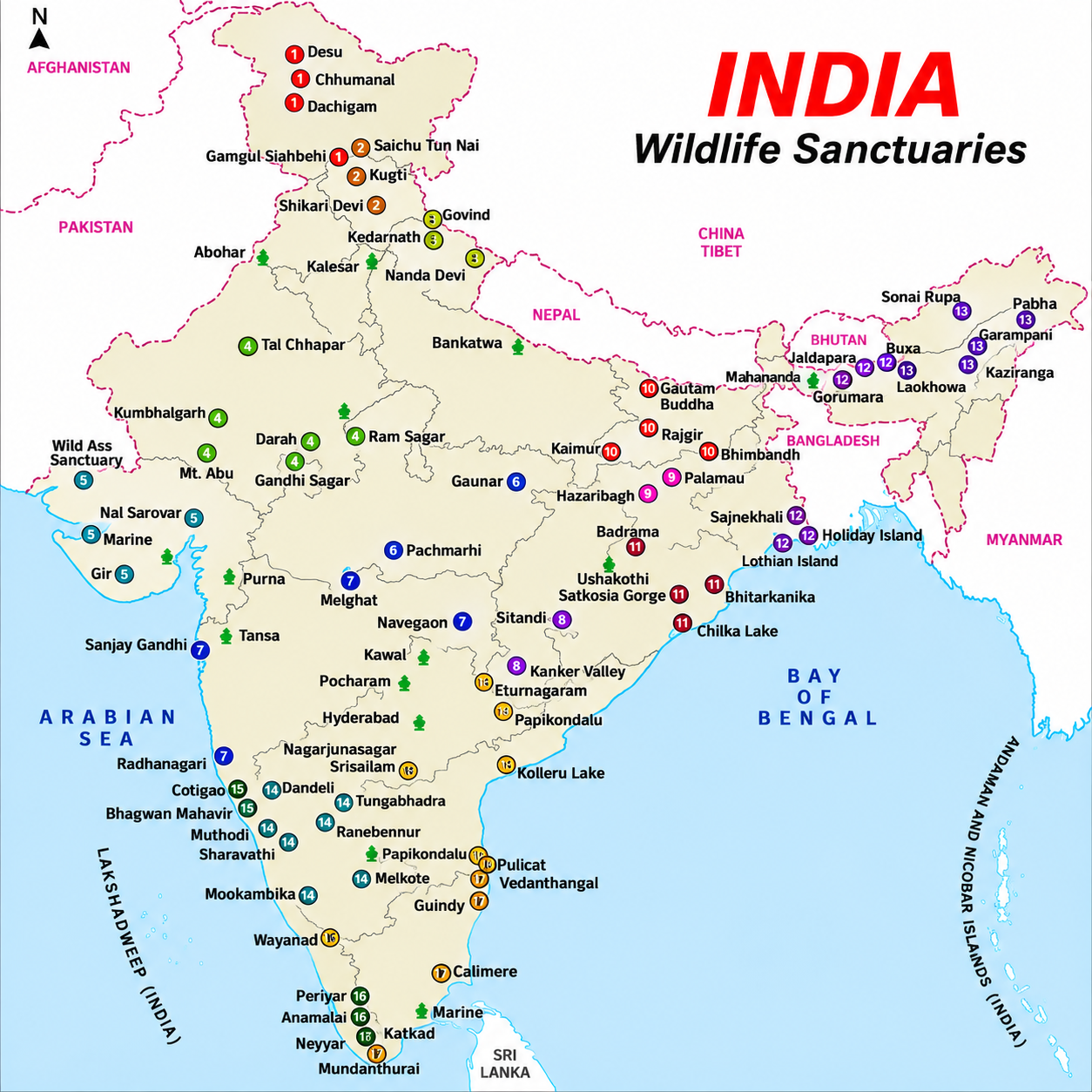
Wildlife Sanctuaries in India Map
Wildlife Sanctuaries in India List
Wildlife Sanctuaries in India has a network that spans almost every major ecological region, and a state-wise listing helps illustrate the geographical spread and diversity of protected wildlife habitats.
Wildlife Sanctuaries in India State-wise
| State | Important Wildlife Sanctuaries |
|
Andhra Pradesh |
• Coringa Wildlife Sanctuary • Kolleru Wildlife Sanctuary • Krishna Wildlife Sanctuary • Rollapadu Wildlife Sanctuary • Sri Lankamalleswara Wildlife Sanctuary |
|
Arunachal Pradesh |
• D'Ering Memorial Wildlife Sanctuary • Dibang Wildlife Sanctuary • Eagle Nest Wildlife Sanctuary • Kamlang Wildlife Sanctuary • Pakke Wildlife Sanctuary • Sessa Orchid Wildlife Sanctuary |
|
Assam |
• Amchang Wildlife Sanctuary • Bornadi Wildlife Sanctuary • Deepor Beel Wildlife Sanctuary • Hoollongapar Gibbon Wildlife Sanctuary • Pobitora Wildlife Sanctuary |
|
Bihar |
• Kaimur Wildlife Sanctuary • Kanwar Lake Wildlife Sanctuary • Nagi Bird Sanctuary • Nakti Bird Sanctuary • Rajgir Wildlife Sanctuary |
|
Chhattisgarh |
• Barnawapara Wildlife Sanctuary • Bhoramdeo Wildlife Sanctuary • Tamor Pingla Wildlife Sanctuary |
|
Goa |
• Bondla Wildlife Sanctuary • Cotigao Wildlife Sanctuary • Mhadei Wildlife Sanctuary • Netravali Wildlife Sanctuary |
|
Gujarat |
• Gir Wildlife Sanctuary • Indian Wild Ass Wildlife Sanctuary • Nal Sarovar Bird Sanctuary • Balaram-Ambaji Wildlife Sanctuary • Jessore Sloth Bear Sanctuary |
|
Haryana |
• Abubshahar Wildlife Sanctuary • Bhindawas Wildlife Sanctuary • Chhilchhila Wildlife Sanctuary • Kalesar Wildlife Sanctuary • Khaparwas Wildlife Sanctuary |
|
Himachal Pradesh |
• Chail Wildlife Sanctuary • Dhauladhar Wildlife Sanctuary • Kalatop-Khajjiar Wildlife Sanctuary • Kibber Wildlife Sanctuary • Renuka Wildlife Sanctuary |
|
Jharkhand |
• Dalma Wildlife Sanctuary • Hazaribagh Wildlife Sanctuary • Lawalong Wildlife Sanctuary • Palamau Wildlife Sanctuary • Palkot Wildlife Sanctuary • Udhwa Lake Bird Sanctuary |
|
Karnataka |
• Bhadra Wildlife Sanctuary • Biligiriranga Swamy Temple Wildlife Sanctuary • Cauvery Wildlife Sanctuary • Dandeli Wildlife Sanctuary • Brahmagiri Wildlife Sanctuary • Ranganathittu Bird Sanctuary |
|
Kerala |
• Periyar Wildlife Sanctuary • Wayanad Wildlife Sanctuary • Chinnar Wildlife Sanctuary • Neyyar Wildlife Sanctuary • Peppara Wildlife Sanctuary • Thattekad Bird Sanctuary |
|
Madhya Pradesh |
• Bori Wildlife Sanctuary • Gandhi Sagar Wildlife Sanctuary • Ken Gharial Wildlife Sanctuary • Nauradehi Wildlife Sanctuary • Ratapani Wildlife Sanctuary |
|
Maharashtra |
• Bhimashankar Wildlife Sanctuary • Koyna Wildlife Sanctuary • Radhanagari Wildlife Sanctuary • Karnala Bird Sanctuary • Tansa Wildlife Sanctuary • Thane Creek Flamingo Sanctuary |
|
Manipur |
• Jiri-Makru Wildlife Sanctuary • Kailam Wildlife Sanctuary • Yangoupokpi- Lokchao Wildlife Sanctuary |
|
Meghalaya |
• Nongkhyllem Wildlife Sanctuary • Siju Wildlife Sanctuary • Narpuh Wildlife Sanctuary • Baghmara Pitcher Plant Wildlife Sanctuary |
|
Mizoram |
• Khawnglung Wildlife Sanctuary • Lengteng Wildlife Sanctuary • Ngengpui Wildlife Sanctuary • Pualreng Wildlife Sanctuary • Thorangtlang Wildlife Sanctuary |
|
Nagaland |
• Fakim Wildlife Sanctuary • Puliebadze Wildlife Sanctuary • Singphan Wildlife Sanctuary |
|
Odisha |
• Bhitarkanika Wildlife Sanctuary • Baisipalli Wildlife Sanctuary • Badrama Wildlife Sanctuary • Chandaka-Dampara Wildlife Sanctuary • Gahirmatha Marine Wildlife Sanctuary |
|
Punjab |
• Abohar Wildlife Sanctuary • Harike Wildlife Sanctuary • Nangal Wildlife Sanctuary • Kathlaur-Kaushal Wildlife Sanctuary |
|
Rajasthan |
• Mount Abu Wildlife Sanctuary • Tal Chhapar Wildlife Sanctuary • Kumbhalgarh Wildlife Sanctuary • Ramsagar Wildlife Sanctuary • Kailadevi Wildlife Sanctuary |
|
Sikkim |
• Fambong Lho Wildlife Sanctuary • Kyongnosla Alpine Wildlife Sanctuary • Maenam Wildlife Sanctuary • Shingba Rhododendron Wildlife Sanctuary |
|
Tamil Nadu |
• Point Calimere Wildlife Sanctuary • Mudumalai Wildlife Sanctuary • Sathyamangalam Wildlife Sanctuary • Vedanthangal Bird Sanctuary • Vallanadu Blackbuck Sanctuary |
|
Telangana |
• Eturnagaram Wildlife Sanctuary • Kinnerasani Wildlife Sanctuary • Manjeera Wildlife Sanctuary • Pakhal Wildlife Sanctuary • Pocharam Wildlife Sanctuary |
|
Tripura |
• Sepahijala Wildlife Sanctuary • Trishna Wildlife Sanctuary • Gumti Wildlife Sanctuary • Rowa Wildlife Sanctuary |
|
Uttar Pradesh |
• Katarniaghat Wildlife Sanctuary • Kishanpur Wildlife Sanctuary • Hastinapur Wildlife Sanctuary • National Chambal Wildlife Sanctuary |
|
Uttarakhand |
• Askot Wildlife Sanctuary • Binsar Wildlife Sanctuary • Kedarnath Wildlife Sanctuary • Nandhaur Wildlife Sanctuary • Sonanadi Wildlife Sanctuary |
|
West Bengal |
• Buxa Wildlife Sanctuary • Chapramari Wildlife Sanctuary • Haliday Island Wildlife Sanctuary • Mahananda Wildlife Sanctuary • Sajnakhali Wildlife Sanctuary • Senchal Wildlife Sanctuary |
Wildlife Sanctuaries in India Union Territories-wise
| Union Territory | Important Wildlife Sanctuaries |
|
Andaman and Nicobar Islands |
• Interview Island Wildlife Sanctuary • North Reef Wildlife Sanctuary • Narcondam Wildlife Sanctuary • South Sentinel Island Wildlife Sanctuary |
|
Chandigarh |
• Sukhna Lake Wildlife Sanctuary |
|
Delhi |
• Asola Bhatti Wildlife Sanctuary |
|
Jammu and Kashmir |
• Hirpora Wildlife Sanctuary • Gulmarg Wildlife Sanctuary • Overa-Aru Wildlife Sanctuary • Surinsar-Mansar Wildlife Sanctuary |
|
Ladakh |
• Changthang Wildlife Sanctuary |
|
Dadra and Nagar Haveli and Daman and Diu |
• Dadra and Nagar Haveli Wildlife Sanctuary |
Important Facts of Wildlife Sanctuaries in India
- Largest Wildlife Sanctuary in India: The Kutch Desert Wildlife Sanctuary in Gujarat is generally recognised among the largest wildlife sanctuaries in India by area, covering roughly 7,500 sq. km and protecting the distinctive desert and salt-marsh landscape of the Rann of Kutch.
- Smallest Wildlife Sanctuary in India: The Kutch Bustard Sanctuary in Gujarat is the smallest wildlife sanctuary in India, covering an area of just 2 square kilometres.
Important Wildlife Sanctuaries in India in News
- Kumbhalgarh Wildlife Sanctuary (Rajasthan): The Ministry of Environment, Forest and Climate Change issued a notification declaring the sanctuary in the Aravalli range as an Eco-Sensitive Zone to protect local flora, fauna, and indigenous communities.
- Debrigarh Wildlife Sanctuary (Odisha): The National Tiger Conservation Authority recently approved plans to transition the sanctuary into Odisha's third tiger reserve, involving the relocation of Royal Bengal Tigers.
- Karimpuzha Wildlife Sanctuary (Kerala): A recent faunal survey documented new biodiversity records, including multiple species of birds, butterflies, and odonates recorded in the young sanctuary for the first time.
- Thanthai Periyar Wildlife Sanctuary (Tamil Nadu): Established as Tamil Nadu's 18th wildlife sanctuary in the Erode district, this protected region secures a critical elephant migration corridor bridging the Western and Eastern Ghats.
- Ratapani Wildlife Sanctuary (Madhya Pradesh): Notified as a full-fledged 57th Tiger Reserve, addressing the expanding big cat population near Bhopal.
- Hollongapar Gibbon Sanctuary (Assam): In a landmark achievement for wildlife conservation, a Western Hoolock Gibbon recently successfully used a specially constructed canopy bridge over a railway line in Assam's Hollongapar Gibbon Sanctuary, marking the first documented instance anywhere in the world of a gibbon crossing such a structure above a railway track.
- Vallanadu Blackbuck Sanctuary (Tamil Nadu): The National Green Tribunal (NGT) ordered a review of nearby quarrying activities to protect native Blackbuck populations from habitat fragmentation and noise pollution.
- Aralam Wildlife Sanctuary (Kerala): Officially renamed as the "Butterfly Sanctuary" under the Wildlife Protection Act 1972. The area hosts around 266 butterfly species (over 80% of Kerala's total butterfly diversity), out of which 27 are endemic to the Western Ghats.
- Bhoramdev Wildlife Sanctuary (Chhattisgarh): This key corridor connecting Kanha and Achanakmar is introducing new "bird hearing" technology. The acoustic monitoring system will track and map bird and wildlife vocalisations to counter poaching and study biodiversity changes.
Wildlife Sanctuaries in India Significance
Wildlife sanctuaries in India are significant because they combine legal protection with habitat conservation, helping maintain biodiversity and ecological functions across India's varied landscapes.
- Biodiversity conservation: They protect multiple species within their natural habitats.
- Endangered species protection: Special habitats provide refuge for threatened wildlife.
- Habitat preservation: Sanctuaries protect forests, wetlands, grasslands, mountains and coastal ecosystems.
- Ecological stability: Healthy ecosystems maintain food webs and natural ecological processes.
- Wildlife corridors: Some sanctuaries contribute to connectivity between larger protected landscapes.
- Research and monitoring: They facilitate long-term studies of species and ecosystems.
- Environmental awareness: Wildlife tourism and education can increase public support for conservation.
- Local economic opportunities: Carefully managed tourism can generate income for communities around protected areas.
- Climate resilience: Intact ecosystems can help landscapes withstand environmental changes.
Wildlife Sanctuaries in India Challenges
Despite statutory protection, wildlife sanctuaries in India continue to experience pressures from habitat fragmentation, human activities, wildlife crime, tourism and environmental changes.
- Habitat Fragmentation: Roads, railways, mining, settlements and other infrastructure can divide habitats and restrict animal movement in the wildlife sanctuaries in India.
- Human-Wildlife Conflict: Expansion of agriculture and settlements around protected areas can increase encounters between people and wild animals.
- Poaching and Illegal Wildlife Trade: Illegal hunting and trafficking can reduce populations of threatened species and undermine conservation efforts.
- Tourism Pressure: Unregulated tourism can disturb wildlife, generate waste and place additional pressure on fragile habitats.
- Invasive Species: Invasive plants and animals can alter native ecosystems and compete with indigenous species.
- Climate Change: Changes in temperature, rainfall, extreme weather and water availability can affect habitats and species distribution.
- Limited Management Capacity: Some sanctuaries require stronger staffing, scientific monitoring, equipment, infrastructure, and financial resources.
Wildlife Sanctuaries in India Way Forward
To better protect wildlife sanctuaries in India, stronger landscape-level planning, scientific management, community participation, and responsible tourism are needed alongside effective enforcement of wildlife laws.
- Protect wildlife corridors: Maintain ecological connectivity between isolated habitats.
- Strengthen anti-poaching mechanisms: Improve patrolling, intelligence gathering and wildlife-crime investigation.
- Use modern technology: Expand camera traps, GIS, remote sensing and digital wildlife monitoring.
- Reduce human-wildlife conflict: Improve early-warning systems, compensation and community-based mitigation.
- Promote community participation: Involve local residents in conservation planning and livelihood programmes.
- Regulate tourism: Apply carrying-capacity principles and minimise disturbance to wildlife.
- Restore degraded ecosystems: Rehabilitate forests, wetlands, grasslands and other damaged habitats.
- Control invasive species: Develop systematic programmes to identify and manage invasive organisms.
- Climate-resilient management: Incorporate climate risks into sanctuary management plans.
- Strengthen institutional capacity: Provide adequate personnel, funding, training and scientific expertise.
Wildlife Sanctuaries in India UPSC PYQs
Q1. Which of the following Protected Areas are located in Cauvery basin? (UPSC Prelims 2020)
- Nagarhole National Park
- Papikonda National Park
- Sathyamangalam Tiger Reserve
- Wayanad Wildlife Sanctuary
Select the correct answer using the code given below:
a) 1 and 2 only
b) 3 and 4 only
c) 1, 3 and 4 only
d) 1, 2, 3 and 4
Ans: (c)
Q2. Which of the following are in Agasthyamala Biosphere Reserve? (UPSC Prelims 2019)
a) Neyyar, Peppara, and Shendurney Wildlife Sanctuaries; and Kalakad Mundanthurai Tiger Reserve
b) Mudumalai, Sathyamangalam and Wayanad Wildlife Sanctuaries; and Silent Valley National Park
c) Kaundinya, Gundla Brahmeswaram and Papikonda Wildlife Sanctuaries; and Mukurthi National Park
d) Kawal and Sri Venkateswara Wildlife Sanctuaries; and Nagarjunasagar-Srisailam Tiger Reserve
Ans: (a)
Q3. In which of the following States is Pakhui Wildlife Sanctuary located? (UPSC Prelims 2018)
a) Arunachal Pradesh
b) Manipur
c) Meghalaya
d) Nagaland
Ans: (a)

 Last updated on Sep, 2026
→ UPSC 2027 Notification will be released on 13 January 2027 at upsconline.nic.in.
→ Check out the latest UPSC Syllabus here.
→ Download UPSC Model Answers for Mains 2026
→ UPSC Mains Question Paper 2026 is out now for Essay & GS Paper 1, 2, 3 & 4.
→ UPSC Calendar 2027 has been released.
→ Enroll in Vajiram & Ravi’s UPSC Mains Test Series 2027 for structured answer writing practice, expert evaluation, and exam-oriented feedback.
→ Join Vajiram & Ravi’s UPSC Mentorship Program 2027 for personalized guidance, strategy planning, and one-to-one support from experienced mentors.
→ Go through the UPSC Mains Previous Year Papers to enhance your preparation.
→ UPSC has released UPSC Toppers List 2025 with the Civil Services final result on its official website.
→ Also check Best UPSC Coaching in India
Wildlife Sanctuaries in India FAQs
Q1. How many wildlife sanctuaries are in India?+
Q2. Which is India's largest wildlife sanctuary?+
Q3. Which is the oldest wildlife sanctuary in India?+
Q4. Which UT has the highest number of Wildlife Sanctuaries in India?+
Q5. Who has the authority to declare a Wildlife Sanctuary in India?+
Tags: quest upsc enviornment and ecology notes wildlife sanctuaries in india