
The Chera Dynasty was one of the three major Tamil dynasties of ancient South India, alongside the Cholas and Pandyas. It ruled mainly present-day Kerala and parts of western Tamil Nadu and is known from Sangam literature, inscriptions, and foreign accounts.
The Cheras contributed to the development of trade, agriculture, literature, and South Indian culture. Their decline resulted from succession conflicts, the rise of the Cholas and Pandyas, and growing regional powers, leading to political fragmentation in Kerala by the 12th century.
Chera Dynasty History
Cheras were an ancient Dravidian royal dynasty of Tamil origin that ruled mainly over present-day Kerala and parts of western Tamil Nadu.
- The Cheras developed through agriculture, spice production, and maritime trade, particularly with the Roman world and West Asia.
- Important rulers included Senguttuvan Chera, while the later Chera Perumals (c. 9th–12th centuries CE) played a major role in Kerala's political and cultural development, and they were also called Keralaputras according to Ashoka's edicts .
Chera Dynasty Founder
There is no securely established historical founder of Chera dynasty. Uthiyan Cheralathan is generally regarded as the earliest known Chera ruler mentioned in surviving Sangam-era Tamil literature. He is therefore sometimes described as the earliest recorded Chera king. Mentioned in Pattitrupattu and connected to the early Chera dynasty, Uthiyan Cheralathan is thought to be among the first historically recorded Chera monarchs.
Chera Dynasty Time Period
The two main stages of the Chera polity's development were separated by a time of political change. Sangam texts are the primary source of information on the early Cheras, although later Cheras created a more structured kingdom in Kerala.
- Early Cheras (Approx. 3rd century BCE–4th century CE): Based mostly in Kerala and western Tamil Nadu, they were well-known in Sangam literature and marine trade. Senguttuvan Chera and Nedum Cheralathan were significant leaders.
- Later Cheras/Kulasekharas (Approx. 9th–12th century CE): Under the Kulasekhara emperors, the dynasty flourished again, with Mahodayapuram (Kodungallur) serving as a key hub. Before their fall in the twelfth century, they bolstered Kerala's administrative, commercial, and cultural institutions.
Chera Dynasty Capital
Vanji (Vanchi), which is commonly associated with Karur in modern-day Tamil Nadu, served as the main capital of Chera Dynasty. Muziris (Muchiri) on the Malabar Coast was a significant port and commercial hub. Mahodayapuram (Kodungallur) became the capital during the later Chera period.
Chera Dynasty Rulers
The Chera dynasty rulers belonged to different phases, with the early rulers known mainly from Sangam literature and the later rulers from inscriptions and other records. Some important rulers were:
- Perumchottu Uthiyan Cheralathan (c. 1st century CE): One of the earliest known Chera rulers in Sangam literature; he is associated with the epithet Vanavaramban and the famous “Perum Choru” tradition.
- Imayavaramban Nedum Cheralathan (c. 1st century CE): During his roughly 58-year reign, he strengthened Chera power and extended its borders.
- Senguttuvan Chera (c. 1st century CE): A prominent early Chera ruler and an important figure in Tamil literary tradition.
- Kulasekhara Alvar (c. 800–820 CE): Associated with the Second Chera Empire, which was based on Mahodayapuram, and the resurgence of Chera supremacy.
- Rajasekhara Varman (c. 820–844 CE): He was a significant Later Chera ruler connected to the Vazhappalli inscription and the Kollam Era (825 CE).
- Rama Varma Kulasekhara (1090–1102 CE): He was considered the last Perumal Chera ruler; his reign witnessed Chola attacks and the weakening of Chera authority.


Chera Dynasty Geographical Extent
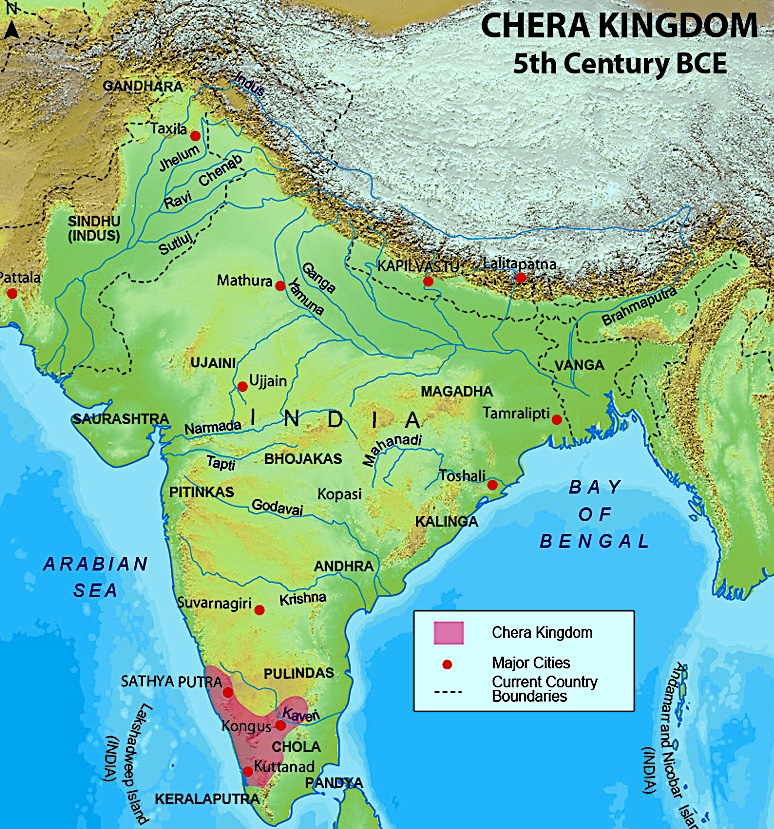
The Chera Dynasty ruled mainly over present-day Kerala and parts of western Tamil Nadu in southern India. Its territory was situated west and north of the Pandya kingdom. The Arabian Sea formed its western boundary, providing access to important maritime trade routes, while the Western Ghats separated the Chera heartland from the interior regions of Tamil Nadu.
- The Cheras also extended their influence eastward into the Kongu region, with Karur emerging as an important inland centre. Their territory broadly stretched from northern Kerala towards the southern regions near Kanyakumari.
- Major ports such as Muziris (Muchiri) connected the Chera kingdom with Roman and West Asian markets, making it an important centre of ancient international maritime trade.
Chera Dynasty Map
The Chera Dynasty map illustrates the geographical layout of one of the most powerful ancient empires of southern India, which flourished alongside the Cholas and Pandyas during the Sangam period. Their territory primarily spanned across the western coast, heavily influencing maritime trade networks across the Arabian Sea.
Chera Dynasty Administration
The Chera polity was mainly monarchical, with the ruler wielding considerable power. However, it was not a strictly centralised system. Instead, it had a decentralised system in which local chiefs exercised significant autonomy.
- King and Chiefs: The king held supreme executive, legislative, and judicial power, overseeing law, foreign relations, and military campaigns
- Under the leadership of local chiefs, the kingdom was divided into a number of nadus, which served as significant regional political entities.
- Local authority: At the grassroots level, small judicial and administrative assemblies known as Manrams resolved daily disputes, oversaw community projects, and controlled local resources such as irrigation.
- Temple-Centred Administration: Temples served as administrative, religious, and commercial hubs. Local allegiance and royal power were further strengthened by temple festivals and endowments.
- Later Chera Centralisation: Compared to its predecessors, the Later Cheras/Perumals developed a more centralised government, especially through better land-revenue management and economic organisation.
Chera Dynasty Society
Chera society was shaped by agriculture, maritime trade and cultural interaction. It was relatively diverse, particularly in port towns, where different communities, occupations and religious traditions interacted.
- Social Structure: Local groups maintained a high degree of autonomy in their particular regions, while rulers, regional chieftains, village leaders, cultivators, and trading communities made up society.
- Religious Pluralism: Buddhism, Jainism, and Hinduism all coexisted, and their temples, monasteries, and shrines promoted intercultural understanding and social harmony.
- Position of Women: Women held a respected place in society, had the right to inherit property, and actively joined religious and cultural rites. Lower-income women engaged in agricultural labour, giving them a degree of financial independence
Chera Dynasty Economy
Agriculture, forest resources, and sea trade were the main pillars of the Chera economy. Long-distance trade was a major source of prosperity because the Malabar Coast's advantageous location linked the Cheras to the Roman world and the Middle East.
- Commerce Administration: While big centres like Muziris operated within the larger administrative framework supporting commercial activity, local authorities assisted in regulating commerce.
- Merchant organisations with a great deal of autonomy, like Manigramam and Anjuvannam, operated in significant commercial hubs in the medieval period.
- Agriculture: The Western Ghats provided important forest resources, and fertile areas and copious amounts of rainfall supported agriculture. Turmeric, cardamom, and black pepper were significant commercial crops.
- Maritime Trade: Kerala was connected to the Roman Empire, the Middle East, and Southeast Asia by the Cheras' significant participation in Indian Ocean trade.
- The Cheras exported black pepper, fine spices, ivory, pearls, gems, and teak wood. In return, they imported Roman gold coins, lead, tin, and glass
- Ports: Tondi linked coastal and inland trade routes, while Muziris (Muchiri) served as the main international port. These ports functioned as hubs for the distribution, storage, and gathering of commodities.
Chera Dynasty Art and Architecture
Chera art and architecture developed through temple building, stone and wood sculpture, murals and inscriptions, reflecting the cultural traditions of Kerala and the wider Tamil region.
- Temple Architecture: Kerala created unique temple designs during the Chera period, such as circular sanctums, conical roofs, and wooden architectural components. One significant example is the 12th-century Perumthrikkovil at Piravom.
- Wooden Craftsmanship: In temple buildings like the Namaskaramandapa and Valiyambalam, wood carving was a significant artistic legacy.
- Stone Sculpture: Chera and other South Indian creative traditions are reflected in the stone sculptures of deities that are kept in Kerala temples.
- Murals: With their intricate visual compositions and religious themes, temple murals and painted decorations constituted a significant portion of Kerala's creative legacy.
- Inscriptions: Copper-plate documents and stone inscriptions offer crucial proof of Chera religious establishments, land grants, and temple operations.
- For example, inscriptions from the 12th and 13th centuries are preserved in the Perumthrikkovil shrine.
- Mahodayapuram: Traditionally associated with the Chera Perumals' royal residence, Cheraman Parambu in Kodungallur has produced laterite foundations, wall remnants, ceramics, beads, and other archaeological artefacts that demonstrate the material culture of the time.
- Religious Architecture: Thiruvanchikulam and Kizhthali, which are close to Cheraman Parambu, are connected to the Chera Perumal period's historical environment and highlight the significance of Mahodayapuram's religious hubs.
Chera Dynasty Decline
Chera Dynasty declined gradually, particularly during the 11th–12th centuries CE, as prolonged conflicts with the Cholas weakened Chera authority and central control. By the 12th century, the Chera Perumal kingdom had fragmented into several regional powers.
- Chola and Pandya Conflicts: The Chola dynasty launched major invasions during the "Hundred Years War", seizing core territories like southern Travancore and regions of Kongunadu.
- Weakening Chera Central Authority: The weakening of the Chera Perumal central authority increased the autonomy of regional chiefs and contributed to political fragmentation.
- Rise of Local Chiefs: The Chera polity became more divided as regional chieftains and nadus gained more autonomy.
- Economic and Land Changes: The Chera state's function as the main economic regulator was progressively diminished by changes in land relations and control over land transactions.

 Last updated on Sep, 2026
→ UPSC 2027 Notification will be released on 13 January 2027 at upsconline.nic.in.
→ Check out the latest UPSC Syllabus here.
→ Download UPSC Model Answers for Mains 2026
→ UPSC Mains Question Paper 2026 is out now for Essay & GS Paper 1, 2, 3 & 4.
→ UPSC Calendar 2027 has been released.
→ Enroll in Vajiram & Ravi’s UPSC Mains Test Series 2027 for structured answer writing practice, expert evaluation, and exam-oriented feedback.
→ Join Vajiram & Ravi’s UPSC Mentorship Program 2027 for personalized guidance, strategy planning, and one-to-one support from experienced mentors.
→ Go through the UPSC Mains Previous Year Papers to enhance your preparation.
→ UPSC has released UPSC Toppers List 2025 with the Civil Services final result on its official website.
→ Also check Best UPSC Coaching in India
Chera Dynasty FAQs
Q1. Was Chera a Tamil dynasty?+
Q2. Who is the founder of the Chera dynasty?+
Q3. Was Kerala ruled by Cheras?+
Q4. Who is powerful, Chera or Chola or Pandya?+
Q5. Are Cheras Tamil or Malayalam?+
Tags: chera dynasty quest UPSC Medieval History Notes