The advent of the Portuguese in India marked the beginning of European colonial expansion in the subcontinent. Vasco da Gama’s arrival at Calicut in 1498 opened a direct maritime route, followed by Portuguese naval dominance, fortified settlements, and territorial expansion under leaders such as Almeida and Albuquerque.
Their legacy included changes in maritime trade, warfare, administration, agriculture, printing, architecture, medicine, and culture, alongside missionary activity and religious conflicts. Portuguese power declined due to internal weaknesses, Indian resistance, and Dutch-English competition, finally ending with Operation Vijay in 1961.
Portuguese in India History
Portuguese in India began with the capture of Goa in 1510, which became the centre of Portuguese power in Asia. They established territories including Daman, Diu, Dadra and Nagar Haveli. Portuguese influence declined over time due to European and regional challenges, finally ending with India’s liberation of Goa, Daman and Diu in 1961.
Arrival of Portuguese in India
Portuguese expansion in India marked the beginning of European colonial expansion, driven by maritime exploration, commercial ambitions, and the search for direct access to the lucrative trade of the East.
- Age of Exploration: The Renaissance encouraged geographical exploration, while advances in shipbuilding and navigation enabled long-distance voyages.
- Search for Eastern Markets: Portugal sought direct access to the wealthy markets of Asia, particularly the profitable spice trade.
- Vasco da Gama’s Arrival: Vasco da Gama reached Calicut (Kozhikode) in May 1498, marking the Portuguese entry into the Indian Ocean trading system.
- Commercial and Religious Motives: Portuguese expansion was primarily driven by the desire to monopolise the spice trade, alongside the objective of spreading Christianity.
- Role of the Crown: Portugal lacked a powerful merchant class; therefore, the Portuguese Crown provided financial and political support to overseas commercial enterprises.
- From Trade to Power: The Portuguese increasingly used naval and military force, establishing forts and strategic settlements to secure their commercial interests.
- Portuguese India: Their Asian possessions formed the Estado da Índia (Portuguese State of India), a maritime network of territories, forts, ships, and administrative establishments under the Portuguese Crown.
- First and Last Europeans: The Portuguese were the first European colonial power to establish a lasting presence in India and the last to relinquish their Indian possessions, with their rule ending in 1961.


Portuguese in India map
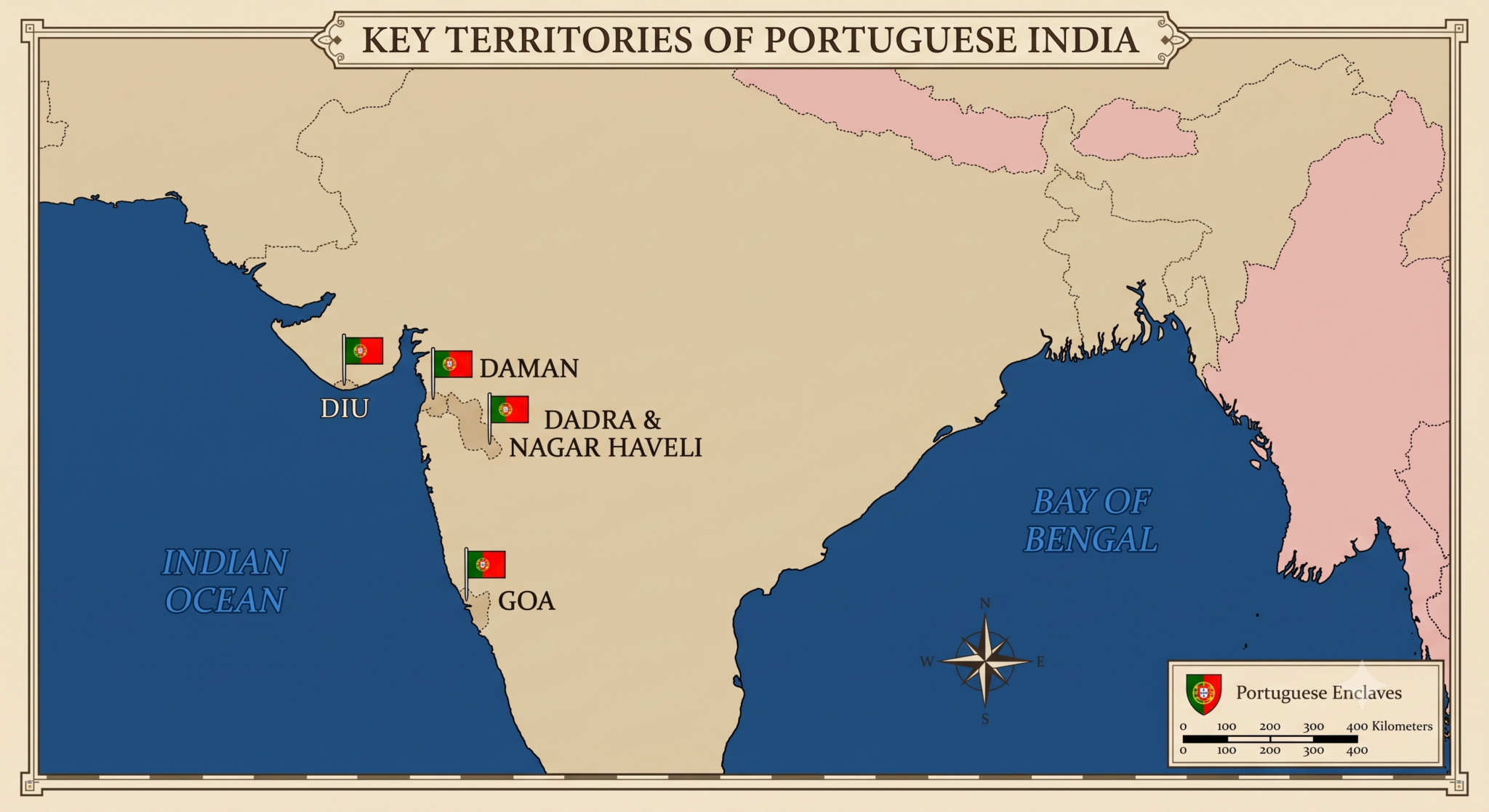
The map of Portuguese in India highlights the major Portuguese territories in India such as Goa, Daman, Diu, Dadra and Nagar Haveli, which formed the core of Portuguese India.
Portuguese in India Key Territories
List of Portuguese Colonies in India consisted of Goa, Daman, Diu, Dadra and Nagar Haveli, which formed the principal Portuguese possessions in western India.
- Goa: Goa was the principal Portuguese possession in India. Alfonso de Albuquerque captured Goa in 1510, and it remained under Portuguese rule for about 450 years. Goa became the administrative and political centre of Portuguese India. It was liberated on 19 December 1961 and became the 25th State of India on 30 May 1987.
- Diu: Diu was strategically important due to its location on the western coast. In 1535, the Portuguese obtained permission from Bahadur Shah, Sultan of Gujarat, to build the Diu Fort and maintain a garrison. Diu remained under Portuguese control until its liberation along with Goa and Daman on 19 December 1961.
- Daman: The Portuguese captured Daman in 1559, subsequently constructing a fort and establishing a military presence. It remained under Portuguese rule for more than 450 years and was liberated on 19 December 1961 along with Goa and Diu.
- Dadra and Nagar Haveli: Dadra and Nagar Haveli came under Portuguese control after the Marathas ceded the territory in the late 18th century. The Portuguese left the territory in 1954, and it became part of India as a Union Territory on 11 August 1961.
Discovery of the Sea Route
The search for a direct maritime route to India was driven by European commercial ambitions, disruptions in existing trade routes and changing political conditions in the Middle East. Its discovery transformed Euro-Asian maritime trade.
- Need for a New Route: Disruptions in established trade routes and political changes in the Middle East encouraged Europeans to seek an alternative route to India.
- Prince Henry the Navigator: Encouraged Portuguese exploration along the African coast in search of an eastern sea route.
- Treaty of Tordesillas (1494): Portugal and Spain divided their overseas spheres of expansion, with Portugal receiving the eastern sphere and Spain the western sphere.
- Bartolomeu Dias (1487): Rounded the Cape of Good Hope, proving the possibility of reaching the Indian Ocean from the Atlantic and paving the way for the India route.
- Vasco da Gama’s Expedition (1497): Sailed from Portugal via the Cape of Good Hope towards India.
- Arrival at Calicut (1498): Vasco da Gama reached Calicut in May 1498, establishing a direct maritime link between Europe and India.
- Commercial Impact: The route enabled Portugal to challenge and initially control maritime trade between India and Europe, opening a new phase in Euro-Asian trade.
Portuguese in India Rise
Portuguese expansion in India combined commercial ambitions, the search for the spice trade route, religious objectives, and royal patronage. By combining trade with naval power, forts, and strategic alliances. Portuguese in India challenged the established Arab-Indian maritime network and emerged as a major naval and territorial power in the Indian Ocean.
- Maritime Breakthrough (1488-1498): Bartolomeu Dias rounded the Cape of Good Hope in 1488, while Vasco da Gama reached Calicut in 1498, establishing a direct Europe-India sea link.
- Initial Foothold: Facing resistance from the Zamorin of Calicut and established merchants, the Portuguese allied with Cochin and Cannanore, rivals of Calicut. Fort Manuel at Cochin (1503) became an important base.
- Trade Backed by Naval Power: Superior ships, cannon, shipbuilding, and seamanship enabled the Portuguese to combine commerce with military coercion and challenge existing maritime networks.
- Blue Water Policy and Battle of Diu: Francisco de Almeida prioritised naval supremacy over territorial expansion. The Battle of Diu (1509) established Portuguese dominance in the Arabian Sea.
- Territorial Expansion: Under Afonso de Albuquerque (1509–1515), the Portuguese focused on strategic ports and chokepoints. Goa (1510) became a key base, while Malacca (1511) secured a crucial Asian spice-trade route.
- Consolidation: Goa became the principal Portuguese base in Asia; under Nuno da Cunha, the headquarters shifted from Cochin to Goa in 1530. Portuguese influence also extended to Diu and Daman, supported by forts and armed fleets.
- Control of Maritime Trade: The Cartaz system required ships to carry Portuguese passes, enabling regulation of Indian Ocean commerce and reinforcing their commercial monopoly.
Portuguese in India Administration
Portuguese in India established the Estado da Índia as a network of coastal territories, forts and commercial settlements rather than a large contiguous empire. Its administration focused on maritime trade, naval supremacy and control of strategic ports and sea routes, with Goa emerging as its administrative centre.
- Viceroy/Governor: Administration was headed by a Viceroy/Governor, generally appointed for a limited term. Francisco de Almeida (1505) was the first governor, followed by leaders such as Albuquerque and Nuno da Cunha.
- Goa as Headquarters: Captured by Albuquerque in 1510, Goa became the principal Portuguese base in Asia. Under Nuno da Cunha, the headquarters shifted from Cochin to Goa in 1530, owing to its strategic location and natural harbour.
- Vedor da Fazenda: An important financial official responsible for revenue, cargo and dispatch of fleets, reflecting the close link between administration, commerce and naval operations.
- Fort-based Administration: Portuguese authority rested on forts and coastal settlements, administered by captains. Their distance from the central administration sometimes led to autonomy and administrative misuse.
- Maritime Control: The Cartaz system required ships to obtain Portuguese passes, allowing the Portuguese to regulate maritime commerce and strengthen their commercial monopoly.
- Strategic Network: Major centres included Goa, Cochin, Cannanore, Diu, Daman, Bassein and Hooghly, while Malacca supported Portuguese control over wider Indian Ocean trade.
Vasco da Gama
Vasco da Gama pioneered the direct maritime route to India, reaching Calicut in 1498. His voyage proved the commercial viability of the Europe–India sea route and laid the foundation for Portuguese in India.
- Calicut: His diplomatic encounter with the Zamorin failed, partly because Portuguese goods were unsuitable for the established luxury trade and Arab merchants opposed the new competitors.
- Cannanore: Reached an understanding with the Kolathiri Raja, rival of the Zamorin, gaining access to spices and strengthening the Portuguese foothold.
- Significance: His first voyage demonstrated the profitability of the direct sea route and transformed Portugal into a major maritime power.
First Governor of Portuguese India: Francisco de Almeida
Francisco de Almeida, the first Viceroy of Portuguese India, laid the foundation of Portuguese naval supremacy, prioritising control of maritime trade over extensive territorial expansion.
- Blue Water Policy: Focused on establishing Portuguese naval dominance and securing maritime trade routes.
- Strategic Objective: Sought control of strategic maritime points near the Red Sea and Persian Gulf to weaken rival trading networks.
- Battle of Diu (1509): Defeated the combined fleet of the Gujarat Sultanate, Mamluks and Zamorin of Calicut, strengthening Portuguese naval supremacy in the Arabian Sea.
- Significance: Established the naval foundation of the Estado da Índia, demonstrating the importance of naval power, ship-borne artillery and seamanship.
Alfonso de Albuquerque
Afonso de Albuquerque was the principal architect of Portuguese power in the East, shifting the focus from naval supremacy to strategic ports, territories and trade chokepoints.
- Goa (1510): Captured Goa, which became the principal Portuguese base in India.
- Malacca (1511): Captured Malacca, controlling a crucial trade route linking India with Southeast Asia and China.
- Strategic Network: Established Portuguese bases at key points controlling Indian Ocean routes.
- Significance: Transformed Portuguese power from a mainly commercial-naval enterprise into a strategic territorial empire.
Nuno da Cunha
Nuno da Cunha consolidated Portuguese territorial power along the western coast and expanded its influence towards Bengal.
- Goa: Strengthened Goa as the administrative headquarters, replacing Cochin as the principal centre.
- Bassein (1534): Bahadur Shah of Gujarat ceded Bassein and its dependencies to the Portuguese during his conflict with Humayun.
- Diu & Bengal: Secured Portuguese rights to establish a fort at Diu and expanded influence towards Hooghly.
Dom João de Castro
Dom João de Castro was a major successor of Albuquerque, known for defending Portuguese positions and attempting to curb administrative corruption.
- Defence of Diu (1546): Successfully relieved and defended the Portuguese fortress at Diu against the Sultan of Gujarat, marking the last major Portuguese military victory in Asia.
- Conflict with Bijapur: Defeated the forces of Ibrahim Adil Shah, strengthening Portuguese control around Goa.
- Administrative Reforms: Attempted to curb corruption by fixing officials’ salaries and restricting their private trade.
- Significance: His military success and reforms briefly restored Portuguese military prestige and administrative discipline.
Portuguese in India Religious Policy
Portuguese in India combined commercial and strategic expansion with the spread of Roman Catholic Christianity. Missionary activity was especially prominent in Goa, while Portuguese religious policies also led to conflict with existing religious and Christian communities.
- Missionary Expansion: Jesuits and other missionaries accompanied Portuguese expansion and established churches and missionary institutions.
- Religious Intolerance in Goa: Portuguese authorities imposed restrictions on Hinduism and Islam, including religious persecution and coercive conversions.
- Goa Inquisition (1560): Established to enforce Catholic orthodoxy, it acted against practices considered incompatible with Catholicism and targeted converts suspected of retaining earlier religious practices.
- Syrian Christian Community: Attempts to bring Kerala’s Saint Thomas/Syrian Christians under Roman Catholic authority generated resistance and contributed to the Coonan Cross Oath (1653).
- Jesuit Missions to Mughal Court: Akbar invited Jesuits to his court; the first mission reached Fatehpur Sikri in 1580, led by Rodolfo Aquaviva and Antonio Monserrate. Later missions under Akbar and Jahangir facilitated religious and cultural exchange.
- Cultural Assimilation: Despite coercive policies, Christianity in Goa developed through interaction with local society, creating a distinctive Portuguese Catholic–Konkani cultural synthesis.
Portuguese in India Influence
Portuguese in India marked the beginning of European maritime and colonial expansion, transforming trade, warfare, agriculture, religion, education, architecture, and culture, while also leaving a coercive colonial legacy.
- Maritime Trade: Vasco da Gama’s arrival at Calicut in 1498 opened the direct maritime route between Europe and India. Portuguese trading centres along the western coast strengthened their commercial and strategic influence.
- 1st factory of Portuguese in India: The first Portuguese factory in India was established at Calicut (1500), while Fort Manuel at Cochin (1503) became an important early fortified base.
- Warfare and Naval Power: The Portuguese use of ship-borne artillery, firearms, fortified bases and armed fleets strengthened their control over maritime trade and demonstrated the importance of naval power and gunpowder warfare in the Indian Ocean.
- Fruits Introduced by Portuguese in India: Papaya and cashew were among the important fruits introduced by the Portuguese to India, later becoming widely cultivated and integrated into Indian food culture.
- Crops Introduced by Portuguese in India: The Portuguese introduced chilli, potato, tomato and maize to India, which subsequently became important to Indian agriculture and cuisine.
- Printing, Knowledge and Culture: The first printing press in India was established at Goa in 1556, promoting printed literature and education. Portuguese influence also shaped Indo-Portuguese architecture, cuisine, music, customs and language. Garcia de Orta contributed to botanical and medical knowledge through his writings on Indian plants and tropical diseases.
- Religion and Colonial Legacy: Christian missionary activity, particularly in Goa, expanded Catholic influence, while coercive conversion and restrictions on other faiths generated social tensions. Portuguese rule also involved violence, slavery, piracy, coercive trade and exploitation, reflecting an important early phase of European colonialism in India.
Portuguese in India Decline
Portuguese in India declined from the late 16th century due to internal weaknesses, Indian resistance and growing Dutch and English competition. Their naval and commercial monopoly gradually eroded, though they retained Goa, Daman and Diu until 1961.
- Weak Leadership: After Albuquerque, ineffective governors and administrative corruption weakened Portuguese governance and local support.
- Religious Policies: Coercive conversions and restrictions on Hindus and Muslims generated resentment and anti-Portuguese sentiment.
- Indian Resistance: The growing power of the Mughals and Marathas weakened Portuguese influence. The Mughals expelled them from Hooghly in the early 1630s.
- European Rivalry: The rise of the Dutch and English challenged Portuguese maritime dominance through stronger fleets, resources and overseas networks.
- Losses: The English victory at Swally (1612) and Dutch capture of Malabar forts (1663) further weakened Portuguese power.
- Iberian Union & Brazil: The Iberian Union (1580) diverted Portuguese resources towards Spanish priorities, while the growing importance of Brazil drew attention away from Asia.
- End of Monopoly: Dutch and English acquisition of navigational knowledge and alternative maritime networks ended Portugal’s earlier Europe-India maritime monopoly.
Portuguese in India After Independence
Portuguese in India remained a colonial presence after 1947 as Portugal refused to relinquish its territories. India ultimately liberated the Portuguese territories in 1961, while bilateral relations were restored after Portugal’s democratic transition.
- 1947-1955: India sought integration of Goa, Daman, Diu, Dadra and Nagar Haveli, but Portugal refused; diplomatic relations were severed in 1955.
- Dadra & Nagar Haveli (1954): Came under Indian control following local nationalist action.
- Operation Vijay (1961): India launched Operation Vijay on 18 December 1961; Portuguese forces surrendered the next day, ending colonial rule.
- Integration: Goa, Daman and Diu were incorporated into India, ending more than four centuries of Portuguese territorial rule.
- 1974–75: Following Portugal’s Carnation Revolution, it recognised India’s sovereignty over the former Portuguese territories, and diplomatic relations were restored.
Portuguese in India UPSC PYQs
Q1: Analyse the impact of Portuguese rule on Indian society and economy. (UPSC Mains 2017)
Q2: The first European power to establish a permanent settlement in India was: (UPSC Prelims 2018)
(a) Dutch
(b) French
(c) Portuguese
(d) British
Ans: (c)

 Last updated on Sep, 2026
→ UPSC 2027 Notification will be released on 13 January 2027 at upsconline.nic.in.
→ Check out the latest UPSC Syllabus here.
→ Download UPSC Model Answers for Mains 2026
→ UPSC Mains Question Paper 2026 is out now for Essay & GS Paper 1, 2, 3 & 4.
→ UPSC Calendar 2027 has been released.
→ Enroll in Vajiram & Ravi’s UPSC Mains Test Series 2027 for structured answer writing practice, expert evaluation, and exam-oriented feedback.
→ Join Vajiram & Ravi’s UPSC Mentorship Program 2027 for personalized guidance, strategy planning, and one-to-one support from experienced mentors.
→ Go through the UPSC Mains Previous Year Papers to enhance your preparation.
→ UPSC has released UPSC Toppers List 2025 with the Civil Services final result on its official website.
→ Also check Best UPSC Coaching in India
Portuguese in India FAQs
Q1. Is there a Portuguese colony in India?+
Q2. Which Portuguese came first in India?+
Q3. Why did Portuguese leave Goa?+
Q4. Do Portuguese still live in India?+
Q5. Was Goa originally Portuguese?+
Tags: portuguese in india quest upsc modern history notes