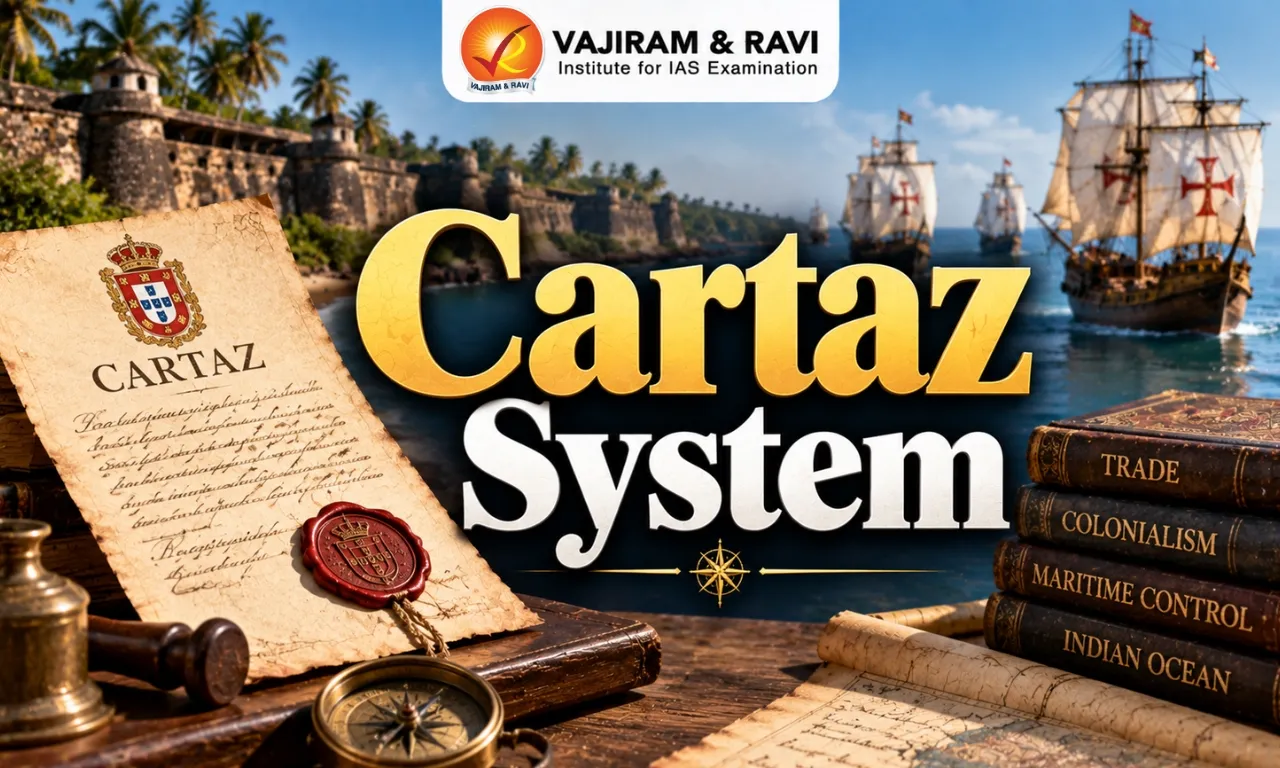
Cartaz System was a Portuguese maritime pass system used to regulate shipping, collect customs duties, and strengthen control over Indian Ocean trade. Francisco de Almeida, the first Governor and Viceroy, pursued the Blue Water Policy, emphasising naval supremacy and control of sea routes rather than extensive territorial conquest.
This system required merchant ships to obtain permits and was enforced by Portuguese armadas, with penalties for non-compliance. It linked naval power with commercial imperialism, strengthened Portuguese control over strategic ports and the spice trade, and contributed to the development of Portugal’s sea-borne empire, though Asian merchants continued to resist and evade it.
Cartaz System Meaning
The word 'cartaz' referred to a maritime pass or licence issued by the Portuguese. Cartaz System was introduced by Portuguese authorities and pursued as an instrument of Portuguese maritime and commercial control by Portuguese governors like Francisco de Almeida and Afonso de Albuquerque. It was a maritime pass system used to regulate and control shipping in the Indian Ocean.
- Trade Control: Sought to control Indian Ocean trade and strengthen Portuguese maritime dominance.
- Spice Trade: Aimed to secure a dominant position in the spice trade and regulate competing maritime commerce.
- Revenue: Generated revenue through customs duties and controlled trading ports.
- Naval Enforcement: Supported Portuguese control of sea routes through naval power and armed fleets.
Cartaz System Key Features
The cartaz system worked through mandatory permits, customs controls, and Portuguese naval enforcement, allowing Portugal to regulate and tax maritime trade.
- Mandatory Pass: Ships engaged in maritime trade had to obtain a Cartaz (pass) from Portuguese authorities.
- Information Recorded: The pass specified the captain, ship size and crew, and also regulated the arms and ammunition carried.
- Customs Control: Licensed ships were subject to Portuguese regulations and could be directed towards Portuguese-controlled ports where duties were collected.
- Naval Enforcement: Portuguese armadas (naval fleets) enforced the system and controlled sea-borne traffic.
- Penalties: Ships sailing without a Cartaz could be confiscated, while their crews faced severe punishment.
- Purpose: By controlling shipping and collecting customs duties, the system helped Portugal dominate and tax Indian Ocean trade.


Cartaz System Impacts
Cartaz System changed the functioning of Indian Ocean trade by bringing merchant shipping under Portuguese regulation, taxation, and naval enforcement.
- Restriction on Merchant Freedom: Asian merchants could not freely sail and trade without Portuguese permission.
- Portuguese Taxation: Ships were required to pay customs duties at Portuguese-controlled forts, increasing Portuguese revenue.
- Militarisation of Trade: Portuguese armadas backed the system, linking commercial regulation with naval force.
- Punishment of Non-compliance: Ships without a Cartaz could be confiscated, while their crews faced severe punishment.
- Resistance and Evasion: Asian merchants and regional powers resisted or bypassed Portuguese restrictions, limiting Portugal’s ability to establish a complete maritime monopoly.
Cartaz System Significance
Cartaz System became an important instrument of Portuguese maritime and commercial imperialism, linking naval power with the regulation of Indian Ocean commerce.
- Maritime Control: Enabled the Portuguese to regulate merchant shipping and important sea routes through compulsory naval passes and enforcement.
- Commercial Monopoly: Helped secure Portuguese interests in the spice trade, while directing merchants towards Portuguese-controlled ports and trading centres.
- Naval Power: Demonstrated how naval force could be used to enforce commercial authority, making maritime power central to Portuguese expansion.
- European Imperialism: Marked an important stage in European intervention in the established Asian maritime trading system, combining trade regulation with political and military power.
- Limits: Portuguese control was never absolute; Asian merchants and regional powers continued to resist and evade Portuguese restrictions, limiting their maritime monopoly.
Cartaz System and Blue Water Policy
Cartaz System and Blue Water Policy were complementary instruments of Portuguese maritime expansion. While the Blue Water Policy focused on establishing naval supremacy and controlling sea routes, the Cartaz System regulated and taxed maritime commerce through compulsory passes.
- Blue Water Policy: Pursued by Francisco de Almeida, it emphasised naval supremacy and control of maritime routes rather than extensive inland territorial conquest.
- Cartaz System: Required merchant ships to obtain Portuguese passes (cartazes), enabling Portugal to regulate shipping and collect customs duties.
- Commercial Control: Both strengthened Portuguese control over Indian Ocean trade, particularly the lucrative spice trade.
- Naval Enforcement: Portuguese armed fleets and fortified ports provided the military foundation for enforcing maritime regulations.
- Maritime Empire: Together, they enabled Portugal to build a sea-based commercial empire through control of ships, ports, forts and strategic sea routes.
Cartaz System UPSC PYQs
Q 1: “The Battle of Diu (1509) was a turning point in the establishment of Portuguese dominance in the Indian Ocean.” Discuss. (UPSC Mains 2020)
Q 2: The Blue Water Policy was associated with which Portuguese figure? (UPSC Prelims 2021)
(a) Vasco da Gama
(b) Alfonso de Albuquerque
(c) Francisco de Almeida
(d) Pedro Álvares Cabral
Ans. (c)

 Last updated on Sep, 2026
→ UPSC 2027 Notification will be released on 13 January 2027 at upsconline.nic.in.
→ Check out the latest UPSC Syllabus here.
→ Download UPSC Model Answers for Mains 2026
→ UPSC Mains Question Paper 2026 is out now for Essay & GS Paper 1, 2, 3 & 4.
→ UPSC Calendar 2027 has been released.
→ Enroll in Vajiram & Ravi’s UPSC Mains Test Series 2027 for structured answer writing practice, expert evaluation, and exam-oriented feedback.
→ Join Vajiram & Ravi’s UPSC Mentorship Program 2027 for personalized guidance, strategy planning, and one-to-one support from experienced mentors.
→ Go through the UPSC Mains Previous Year Papers to enhance your preparation.
→ UPSC has released UPSC Toppers List 2025 with the Civil Services final result on its official website.
→ Also check Best UPSC Coaching in India
Cartaz System FAQs
Q1. Who introduced Cartaz system in India?+
Q2. What is the Cartez System?+
Q3. Did Vasco da Gama introduce the Cartaz system?+
Q4. Are Cartaz system and blue water policy the same?+
Q5. Who is the father of the blue water policy?+
Tags: cartaz system quest upsc modern history notes