Marine heatwaves are prolonged periods of unusually high ocean temperatures that can significantly affect marine ecosystems, fisheries, coastal communities and global climate systems. Unlike ordinary seasonal warming, these events involve temperatures that remain exceptionally high compared with the normal conditions of a particular region and time of year. They can develop due to ocean currents, atmospheric circulation, weak winds, reduced ocean mixing, El Niño, and rising global temperatures.
Marine heatwaves can trigger coral bleaching, disrupt fish distribution, damage kelp and seagrass ecosystems, affect fisheries and aquaculture, and influence extreme weather. Their increasing frequency, intensity and duration have made them an important climate-change concern.
Marine Heatwaves Meaning
A marine heatwave is a prolonged period of unusually warm ocean temperatures that exceed a location-specific climatological threshold, commonly the 90th percentile, for at least five consecutive days.
- Marine heatwaves can occur near coastlines or across vast oceanic regions and may extend from the surface into deeper waters.
- There is no single temperature value that defines a marine heatwave globally because the threshold varies according to the region and its normal climate.
Marine Heatwaves Overview
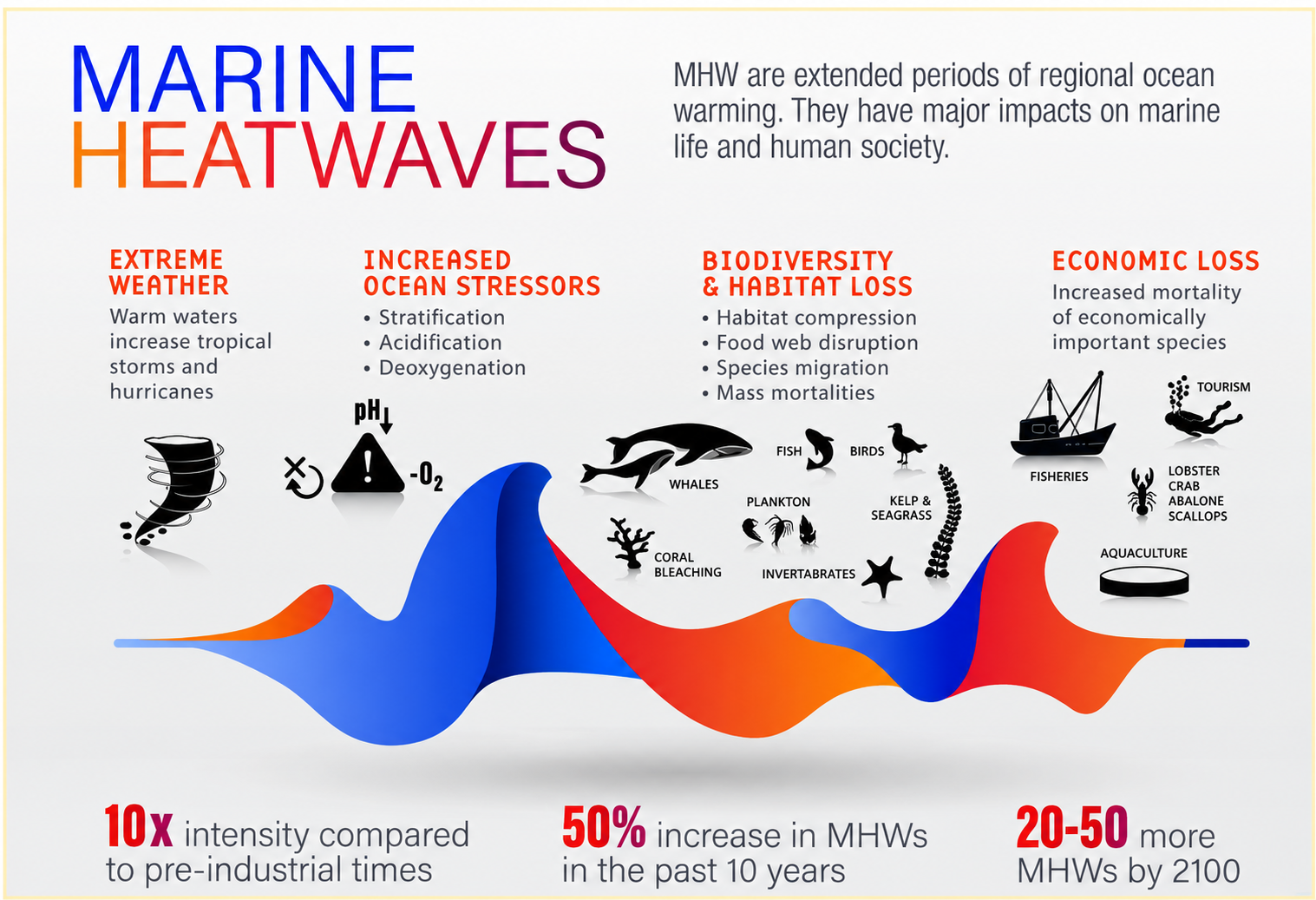
The overview of marine heatwaves shows that these events are becoming more frequent, intense and persistent, with consequences extending from ocean ecosystems to fisheries, tourism, communities and extreme weather.
- Marine heatwaves are different from the gradual rise in average ocean temperatures because they represent temporary episodes of exceptionally high regional temperatures superimposed on long-term ocean warming. They can occur in surface waters as well as deeper parts of the ocean.
- According to the National Oceanography Centre, the global number of marine heatwaves has doubled since 1982.
- IUCN separately reports that the frequency of marine heatwaves has increased by 50% over the previous decade, while also becoming longer and more severe.
- The ocean is particularly important for human societies because it supports the livelihoods of more than three billion people and provides the main source of protein for approximately one billion people, making marine heatwaves a significant environmental and socioeconomic concern.


Marine Heatwaves Causes
The causes of marine heatwaves involve interactions between atmospheric conditions, ocean currents, heat exchange and vertical mixing, while human-induced climate change raises the background temperature on which these events occur.
- Surface Heat Flux: Surface heat flux occurs when heat is transferred from the atmosphere into the ocean. Persistent high-pressure systems, clear skies and reduced winds can increase heating of the upper ocean and favour the development of marine heatwaves.
- Ocean Currents and Heat Advection: Warm ocean currents can transport heat horizontally into a particular region. This process, known as heat advection, can increase ocean temperatures over a large area and contribute to marine heatwave development and persistence.
- Weak Winds and Reduced Ocean Mixing: Strong winds normally promote mixing between warmer surface water and cooler deeper water. When winds weaken, the upper layer becomes thinner and can heat more rapidly because it is less effectively mixed with cooler water below.
- El Niño and Large-Scale Climate Variability: Marine heatwaves can be associated with large-scale climate patterns such as El Niño. The Australian Marine Conservation Society notes that they are more likely during El Niño years when extreme heat and dry conditions persist.
- Climate Change: Climate change is increasing the background temperature of the ocean, making extreme marine temperature events more likely. IUCN states that human-driven climate change is causing global ocean warming, while regional weather patterns, ocean currents and mixing influence individual marine heatwaves.
Marine Heatwaves Occurrence
Marine heatwaves can occur throughout the year, although their timing and intensity vary by region, and particular atmospheric or oceanic conditions can make their development more likely.
- They are particularly favoured by hot, dry and relatively windless conditions, because weak winds reduce mixing between warm surface water and cooler water below. In some regions, El Niño conditions can further increase their likelihood.
- The California example shows that marine heatwaves can occur year-round and may extend across 500–2,000 km of the Pacific Ocean.
Marine Heatwaves Duration and Intensity
- The duration and intensity of these heatwaves vary considerably, with events lasting from several days to weeks, months or, in some cases, much longer periods.
- Marine heatwaves are generally identified when unusually high temperatures persist for at least five consecutive days.
- IUCN notes that some marine heatwave events can persist for several days to weeks or months, while exceptionally persistent events may last much longer.
- The European Union's (EU) Copernicus Climate Change Service (C3S) and the Copernicus Marine Service classify these heatwaves ranging from Category I, moderate, to Category IV, extreme, according to intensity.
- The depth of marine heatwaves can also vary. Copernicus reported that the 2022 Mediterranean heatwaves reached depths of up to 1,500 metres, demonstrating that their effects are not necessarily confined to surface waters.
Marine Heatwaves Impacts
The impacts of marine heatwaves extend across marine biodiversity, fisheries, coral reefs, coastal economies, weather systems and communities dependent on ocean resources.
- Impact on Coral Reefs: Marine heatwaves can cause severe thermal stress and coral bleaching. If elevated temperatures persist, bleached corals can experience starvation, disease and mortality.
- The Australian Marine Conservation Society reports that marine heatwaves have contributed to bleaching events on the Great Barrier Reef and Ningaloo Reef, with the Great Barrier Reef experiencing six mass bleaching events since 2016.
- Impact on Kelp and Seagrass: Kelp forests and seagrass meadows are particularly sensitive to marine heatwaves. Excessive warming can cause their decline or collapse, damaging habitats and reducing their capacity to store carbon.
- Australia's giant kelp forests have declined by more than 90% due to ocean heating, according to the Australian Marine Conservation Society.
- Impact on Fish and Marine Species: Marine heatwaves can alter fish reproduction, migration, geographic distribution and access to food. Species may move towards cooler waters, changing the composition of marine communities and creating winners and losers among different species.
- During California's 2014–2016 marine heatwave, hammerhead sharks, bluefin tuna and pelagic red crabs were observed moving farther north. Northern anchovy populations increased sharply, while Pacific sardine populations remained low.
- Impact on Fisheries and Aquaculture: Marine heatwaves can reduce fish stocks, alter the distribution of commercially important species and create economic losses for fisheries and aquaculture.
- IUCN notes impacts on species such as lobster and snow crab in the northwest Atlantic and scallops off Western Australia.
- Impact on Harmful Algal Blooms: Warmer upper-ocean conditions can favour some algal species. While marine heatwaves do not automatically cause harmful algal blooms, suitable warm conditions can encourage certain algae to grow rapidly. Some species produce toxins such as domoic acid, which can accumulate through the food web.
- During California's 2014–2016 marine heatwave, an unprecedented harmful algal bloom contributed to the closure of the Dungeness crab fishery for an entire season.
- Impact on Marine Biodiversity: Marine heatwaves can cause mass mortality among marine invertebrates and disrupt species interactions. IUCN also notes that changing environmental conditions can facilitate the spread of invasive alien species, potentially disturbing marine food webs.
- Kelp forests, seagrass meadows and coral reefs are among the ecosystems particularly sensitive to these heatwaves. A severe event affecting Western Australia in 2011 caused extensive ecosystem loss, with some species disappearing across hundreds of kilometres.
- Impact on Weather and Climate: Marine heatwaves can influence atmospheric conditions because warmer ocean water supplies additional heat and moisture to the atmosphere.
- They can contribute to stronger tropical storms and hurricanes and may increase the likelihood of heavy rainfall, floods, droughts and wildfires in some circumstances.
- Impact on Coastal Communities and Tourism: Marine heatwaves can affect tourism, seafood industries and coastal livelihoods. Fishery closures, declining marine resources and damage to coral reefs can reduce income and employment in communities dependent on the ocean.
- The Great Barrier Reef, for example, supports around 64,000 jobs, highlighting the economic significance of healthy marine ecosystems.
- Impact on Carbon Storage: The loss of blue-carbon ecosystems such as kelp and seagrass can weaken natural carbon-storage capacity. When these ecosystems deteriorate, stored carbon can potentially be released, reducing the climate-regulating services provided by marine ecosystems.
Marine Heatwaves and Major Examples
Major examples of marine heatwaves demonstrate how extreme ocean warming can affect ecosystems and economies across different geographical regions.
- 2014–2016 North Pacific Marine Heatwave — “The Blob”: The 2014–2016 North Pacific marine heatwave, commonly known as “The Blob", combined with the 2015–2016 El Niño event, became the largest marine heatwave recorded for the North Pacific, according to the UC San Diego source.
- It produced major changes in fish populations, food availability and marine wildlife.
- 2018 Southern California Marine Heatwave: A significant marine heatwave occurred in 2018 around the Southern California Bight and extended southward towards Baja California, Mexico.
- 2019 “Blob 2.0”: Another summer marine heatwave, referred to as “Blob 2.0,” occurred off California in 2019, demonstrating the recurrence of extreme warm-water conditions in the region.
- UK Marine Heatwave of 2023: In summer 2023, sea temperatures around the UK were as much as 5°C above average according to reports from the Copernicus Climate Change Service.
- NOC researchers associated the event with conditions including sunny skies, calm seas and weak winds and examined its links with changes in land temperature and rainfall.
- Mediterranean Marine Heatwaves of 2022: The Mediterranean experienced an exceptionally intense marine heatwave in 2022. Copernicus reported temperatures exceeding 32°C in the Mallorca Channel, while coastal waters around the Balearic Islands reached a record 29.2°C in August 2022, the warmest regional sea-surface temperature recorded in 40 years.
- Temperatures were more than 3°C above the average of previous decades in parts of the Mediterranean.
- Baltic Sea Marine Heatwaves of 2022: In 2022, nearly two-thirds of the Baltic Sea experienced marine heatwaves. Temperatures in the Gulf of Bothnia reached as much as 9.6°C above normal, while summer and autumn sea-surface temperatures were the third-highest recorded since 1997.
- Iberian Peninsula Marine Heatwaves of 2022: In the Iberian region, marine heatwaves in 2022 lasted an average of 145 days, with temperatures reaching approximately 6°C above normal.
- Many events were more intense than the longest previous event recorded there in 1997.
- Australian Marine Heat Conditions: Around Australia, sea-surface temperature during 2022–23 was the third-highest on record, reaching 0.64°C above the 1961–1990 average.
- The Australian Marine Conservation Society also reports that Australia's south-eastern ocean region is warming at around 3–4 times the global average.
Marine Heatwaves in India
India is vulnerable to marine heatwaves (MHWs) due to its extensive coastline along the Arabian Sea, Bay of Bengal and Indian Ocean. Increasing MHW activity poses risks to marine ecosystems, fisheries, coastal livelihoods and the monsoon.
- Rising frequency: During 1982–2018, the western Indian Ocean experienced a four-fold rise in MHW events, while the northern Bay of Bengal recorded a two- to three-fold rise.
- Arabian Sea: Coastal waters along India's west coast have witnessed a rapid multifold increase in MHW days since the early 1980s, with warming in the Arabian Sea contributing to more frequent and longer-lasting events.
- Fisheries: MHWs can alter fish distribution, migration, recruitment and productivity, affecting fish catches, aquaculture and coastal livelihoods. These impacts vary across species and regions.
- Marine ecosystems: Prolonged warming causes thermal stress to coral reefs, seagrass and other sensitive ecosystems, increasing the risk of coral bleaching, biodiversity loss and changes in ecosystem productivity.
- Monsoon impacts: Changes in ocean temperatures can influence atmospheric circulation and Indian monsoon rainfall, resulting in regionally varying changes in rainfall patterns.
- Early warning: The Indian National Centre for Ocean Information Services (INCOIS) provides Marine Heatwave Advisory Services (MAHAS), including daily monitoring and advisories on MHW intensity and severity across the Indian Ocean and Indian coastal sectors.
Marine Heatwaves and Climate Change
Marine heatwaves are natural climate phenomena, but human-induced warming is increasing their frequency and severity and reducing the margin of safety for temperature-sensitive marine ecosystems.
- IUCN reports project that marine heatwaves by 2100 could occur up to 50 times as often as in pre-industrial times, with frequency increasing by 20–50 times and intensity by up to 10 times under projected climate conditions. The Arctic and tropical regions are expected to be particularly affected.
- The Australian Marine Conservation Society reports that global marine heatwave frequency has doubled since 1982 and warns that continued high fossil-fuel emissions could push many ocean regions towards a near-permanent marine heatwave state later this century.
Marine Heatwaves Mitigation and Adaptation
Adaptation and mitigation of marine heatwaves require reducing the underlying causes of ocean warming while strengthening the ability of marine ecosystems and coastal communities to withstand unavoidable extreme events.
- Reduce Greenhouse Gas Emissions: The most important long-term measure is to reduce greenhouse gas emissions from fossil fuels. Lower emissions can slow the accumulation of heat in the climate system and reduce the background warming that increases the likelihood of extreme marine temperatures.
- Protect and Restore Marine Ecosystems: Marine protected areas can provide refuges for vulnerable coral, kelp and seagrass ecosystems. Protecting ecosystems from additional pressures such as overfishing & habitat degradation can improve their resilience to marine heatwaves.
- Promote Sustainable Fisheries: Sustainable fisheries management can reduce additional stress on marine ecosystems. Catch restrictions and other fisheries-management measures can help limit economic and ecological damage during periods of extreme ocean warming.
- Strengthen Monitoring and Early-Warning Systems: Improved monitoring and forecasting can provide early information about the development of marine heatwaves.
- IUCN recommends establishing temperature baselines, incorporating species' thermal limits and combining physical and biological information to identify ecosystems and species at greatest risk.
- Use Advanced Ocean Observation Systems: Satellites, deep-sea observatories, ships, fixed monitoring stations, and autonomous instruments such as Argo floats can help track ocean temperatures and other conditions.
- NOC uses these observations alongside numerical models to understand and forecast marine heatwaves.
- Build Regional Ocean Resilience: National and sub-national governments can develop region-specific measures based on local ecological and socioeconomic risks.
- IUCN recommends coordinated action involving governments, researchers, fisheries, aquaculture, ecotourism, conservation organisations and civil society.
- Invest in Nature-Based Solutions: Nature-based solutions can strengthen ecosystem resilience while addressing broader climate risks.
- IUCN recommends investment in nature-based approaches alongside ambitious reductions in fossil-fuel emissions and improved research and monitoring capacity.
Marine Heatwaves and Land Heatwaves Difference
| Basis | Marine Heatwaves | Land Heatwaves |
|
Occurence |
Oceans and coastal waters |
Land areas |
|
Temperature measured |
Unusually high sea/ocean temperature |
Unusually high air or land-surface temperature |
|
Common definition |
Ocean temperature above the 90th percentile of the historical baseline for at least 5 days |
Usually several consecutive days of unusually high temperature compared with the local climatic baseline |
|
Major impacts |
Coral bleaching, fish migration, biodiversity loss, fisheries and marine ecosystem damage |
Heat stress, mortality, crop losses, drought, wildfires and infrastructure stress |
|
Main drivers |
Ocean currents, atmospheric conditions, reduced mixing and climate change |
Persistent high-pressure systems, solar heating, dry soils and atmospheric circulation |
|
Duration |
Can persist for weeks, months or even years |
Usually lasts days to weeks, although persistent events can occur |
|
Example |
2014–16 North Pacific “The Blob” |
Major European heatwaves such as those experienced in 2022 |

 Last updated on Sep, 2026
→ UPSC 2027 Notification will be released on 13 January 2027 at upsconline.nic.in.
→ Asian Games 2026 are being held in Aichi-Nagoya, Japan, from 19 September to 4 October.
→ Check out the latest UPSC Syllabus here.
→ Download UPSC Model Answers for Mains 2026
→ UPSC Mains Question Paper 2026 is out now for Essay & GS Paper 1, 2, 3 & 4.
→ UPSC Calendar 2027 has been released.
→ Enroll in Vajiram & Ravi’s UPSC Mains Test Series 2027 for structured answer writing practice, expert evaluation, and exam-oriented feedback.
→ Join Vajiram & Ravi’s UPSC Mentorship Program 2027 for personalized guidance, strategy planning, and one-to-one support from experienced mentors.
→ Go through the UPSC Mains Previous Year Papers to enhance your preparation.
→ UPSC has released UPSC Toppers List 2025 with the Civil Services final result on its official website.
→ Also check Best UPSC Coaching in India
Marine Heatwaves FAQs
Q1. What are marine heatwaves?+
Q2. What is causing marine heatwaves?+
Q3. Where do marine heatwaves occur? +
Q4. What are the major impacts of marine heatwaves?+
Q5. How long can marine heatwaves last?+
Tags: marine heatwaves quest UPSC Environment & Ecology Notes