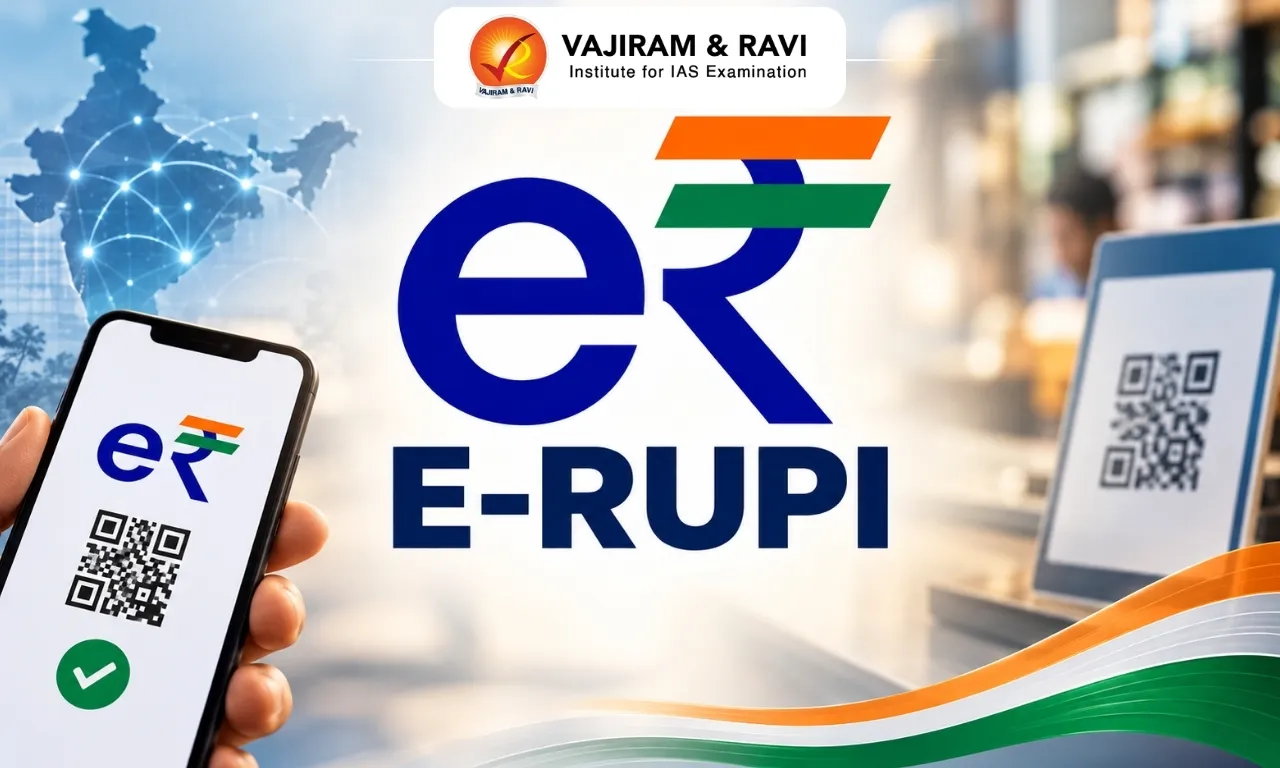
E-RUPI is a person-specific and purpose-specific digital voucher system launched by the Government of India in 2021 to enable targeted and cashless delivery of benefits and services. Developed by the National Payments Corporation of India (NPCI), it allows beneficiaries to receive prepaid vouchers through SMS or QR codes and redeem them at designated service providers without requiring a bank account, payment app or smartphone. e-RUPI can strengthen welfare delivery by reducing leakages, improving transparency and ensuring that benefits are used for their intended purpose.
E-RUPI applications extend beyond government schemes to healthcare, education, employee benefits and CSR initiatives. However, wider adoption requires addressing challenges related to awareness, digital accessibility, service-provider participation, cybersecurity, interoperability and scalability.
E-RUPI Overview
e-RUPI is a digital voucher-based payment system developed by the NPCI (National Payments Corporation of India), through which beneficiaries receive prepaid vouchers on their mobile phones in the form of an SMS or QR code.
- These vouchers can be redeemed at authorised service centres without the need for physical cards or cash transactions.
- For instance, if a government department wants to provide financial support for a specific medical treatment, it can issue an e-RUPI voucher of a fixed amount through a partner bank. The beneficiary can then use the voucher at the designated hospital to avail of the service.
- Thus, e-RUPI functions as a one-time, cashless, and contactless payment mechanism that enables secure and targeted delivery of benefits without requiring internet banking, digital payment applications, or even a smartphone.
E-RUPI v/s CBDC (Digital Rupee / e₹) v/s UPI
| Dimension | UPI | e-RUPI | Digital Rupee / e₹ |
|
Nature |
Real-time digital payment system |
Purpose-specific prepaid voucher; not legal tender |
RBI-issued digital legal tender |
|
Usage |
Transfers money between bank accounts for any transaction |
Only for designated services; non-transferable |
General-purpose digital money for all transactions |
|
Form |
Bank account-linked payment through UPI apps |
SMS/QR voucher; no card or internet banking required |
Digital currency held in an e₹ wallet offered by authorised banks/non-banks. |
|
Source of Funds |
Linked bank account |
Prepaid voucher funded by issuer |
Digital currency issued by the Reserve Bank of India |
|
Convertibility / Transfer |
Freely transferable between bank accounts |
Cannot be transferred or converted into cash |
Fully convertible into cash or bank deposits |
|
Objective |
Instant, interoperable digital payments |
Targeted, leak-proof DBT and welfare delivery |
Sovereign digital alternative to physical cash |


E-RUPI Benefits
E-RUPI has been designed to ensure leak-proof, targeted, and efficient delivery of benefits through a secure digital voucher system. It promotes financial inclusion while simplifying the transfer of welfare benefits and services.
- Cashless and Contactless Transactions: e-RUPI enables beneficiaries to access services without using cash, debit or credit cards, internet banking, or mobile payment applications.
- Targeted and Leak-Proof Benefit Delivery: e-RUPI issues person-specific and purpose-specific digital vouchers, ensuring that benefits reach only the intended beneficiary and are used only for the designated purpose.
- Enhanced Security and Privacy: e-RUPI uses OTP-based authentication and does not require beneficiaries to disclose their bank account details, thereby ensuring secure transactions.
- Promotes Financial Inclusion: e-RUPI can be redeemed without a bank account or smartphone, making digital welfare delivery accessible to rural populations and financially vulnerable groups.
- Strengthens Direct Benefit Transfer (DBT): e-RUPI improves the efficiency, transparency, and accountability of government welfare schemes by enabling direct and purpose-specific delivery of benefits.
- Supports Private Sector and CSR Initiatives: e-RUPI can be used by private organisations to deliver employee benefits, healthcare support, scholarships, and Corporate Social Responsibility (CSR) programmes.
- Strengthens Digital Governance: e-RUPI promotes transparent, efficient, and technology-driven public service delivery, supporting India's vision of a digitally empowered and cash-lite economy.
E-RUPI Challenges
E-Rupi is still a relatively new and complex technology, and there may be regulatory challenges that need to be addressed in order for e-Rupi to be successful.
- Limited adoption: Competition from UPI and other digital payment systems may limit widespread use of e-RUPI.
- Limited use cases: Its purpose-specific and non-transferable nature, while useful for targeted benefits, restricts its applicability compared with general-purpose digital payments.
- Digital divide: Limited digital literacy, mobile access and connectivity can hinder adoption among vulnerable beneficiaries.
- Merchant/service-provider acceptance: Wider use requires adequate participation of hospitals, retailers and other authorised service providers.
- Interoperability and ecosystem integration: Seamless coordination among issuers, beneficiaries and service providers is essential for efficient voucher redemption.
- Fraud and cybersecurity: Voucher theft, phishing, unauthorised redemption and other digital frauds require strong authentication and monitoring.
- Awareness and usability: Beneficiaries and service providers need greater awareness of voucher issuance, redemption and grievance mechanisms.
- Scalability: Expanding e-RUPI across multiple government schemes and private-sector use cases requires robust infrastructure and efficient voucher-management systems.
E-RUPI Way Forward
Integration of e-RUPI with the present digital payment systems is necessary to improve its scalability, accessibility and adoption.
- Expand use cases: Extend e-RUPI beyond welfare schemes to healthcare, education, nutrition, agriculture, employee benefits and CSR.
- Increase service-provider coverage: Onboard more hospitals, pharmacies, educational institutions, retailers and other eligible providers.
- Strengthen awareness: Conduct targeted digital-literacy and beneficiary-awareness campaigns, particularly in rural and vulnerable communities.
- Improve interoperability: Strengthen integration among banks, NPCI, government departments and service providers for seamless voucher issuance and redemption.
- Enhance cybersecurity: Strengthen authentication, fraud detection, transaction monitoring and grievance-redressal mechanisms.
- Improve accessibility: Expand support for basic phones, multiple languages and low-connectivity environments to make e-RUPI more inclusive.
- Ensure scalability: Develop robust voucher-management infrastructure capable of supporting large-scale government and private-sector programmes.
- Promote private-sector adoption: Encourage wider use of e-RUPI for CSR, employee benefits, healthcare and targeted assistance.
- Strengthen monitoring: Use transaction data and outcome-based monitoring to assess whether vouchers reach intended beneficiaries and achieve their intended purpose.

 Last updated on Sep, 2026
→ UPSC 2027 Notification will be released on 13 January 2027 at upsconline.nic.in.
→ Asian Games 2026 are being held in Aichi-Nagoya, Japan, from 19 September to 4 October.
→ Check out the latest UPSC Syllabus here.
→ Download UPSC Model Answers for Mains 2026
→ UPSC Mains Question Paper 2026 is out now for Essay & GS Paper 1, 2, 3 & 4.
→ UPSC Calendar 2027 has been released.
→ Enroll in Vajiram & Ravi’s UPSC Mains Test Series 2027 for structured answer writing practice, expert evaluation, and exam-oriented feedback.
→ Join Vajiram & Ravi’s UPSC Mentorship Program 2027 for personalized guidance, strategy planning, and one-to-one support from experienced mentors.
→ Go through the UPSC Mains Previous Year Papers to enhance your preparation.
→ UPSC has released UPSC Toppers List 2025 with the Civil Services final result on its official website.
→ Also check Best UPSC Coaching in India
E-RUPI FAQs
Q1. What is an e-RUPI?+
Q2. How is e-RUPI different from UPI?+
Q3. Is e-RUPI a crypto?+
Q4. Can I withdraw an e-RUPI?+
Q5. What is the limit of e-RUPI?+
Tags: e-rupi quest upsc economy notes