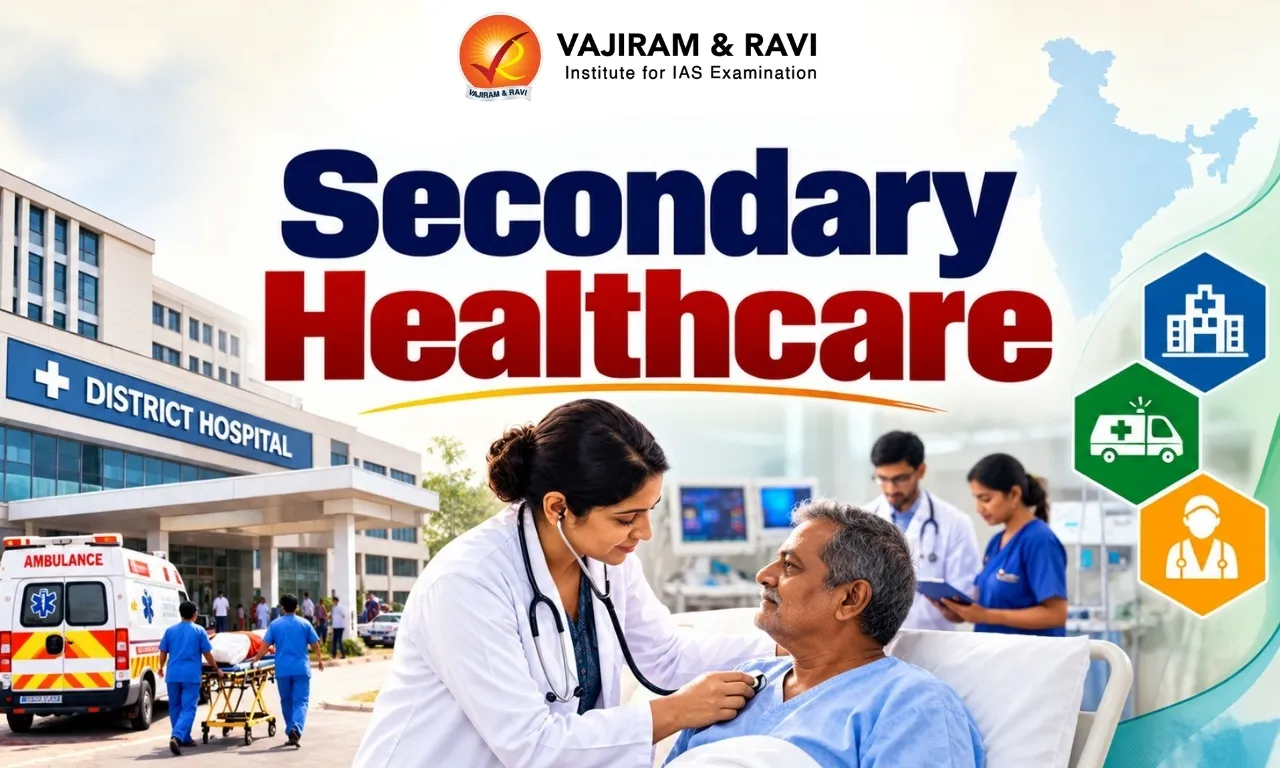
Secondary healthcare constitutes the second tier of India’s healthcare delivery system, providing specialist, emergency and inpatient services that are beyond the capacity of primary healthcare but do not require super-specialised tertiary care. It serves as the crucial bridge between primary-level facilities and medical colleges/super-speciality institutions, ensuring timely referral and management of more complex conditions.
In the public system, secondary care is mainly delivered through Community Health Centres (CHCs), Sub-Divisional Hospitals (SDHs) and District Hospitals (DHs). Its effectiveness depends on adequate beds, diagnostics, emergency services and a functional referral mechanism. However, India faces significant gaps in infrastructure and human resources, particularly in rural areas. Strengthening secondary healthcare is therefore essential for universal health coverage, reducing tertiary-hospital overcrowding, lowering out-of-pocket expenditure and achieving equitable healthcare access.
Secondary Healthcare Meaning
Secondary healthcare represents the second level of healthcare delivery, providing specialist-level curative, diagnostic and inpatient services mainly through referral from primary care. It is essential for universal health coverage.
- Definition: The second tier of healthcare delivery provides specialist-level curative and diagnostic care beyond primary-care capacity.
- Referral-based care: Primarily accessed through referrals from Primary Health Centres (PHCs)/Ayushman Arogya Mandirs (AAMs), although direct walk-ins are also common.
- Major facilities: Community Health Centres (CHCs), Sub-Divisional Hospitals (SDHs) and District Hospitals (DHs) in the public sector.
- Specialists: Mainly surgeons, physicians, gynaecologists, paediatricians and anaesthetists, while super-specialised services are generally associated with tertiary facilities.
- Nature of care: Includes hospitalisation, specialist consultation, minor-to-moderate surgery, emergency care and advanced diagnostics.
- First Referral Unit (FRU): Selected CHCs and other secondary healthcare facilities function as FRUs for emergency obstetric care, blood storage and surgical intervention.
Secondary Healthcare in India
India’s secondary healthcare system is centred on CHCs, SDHs and DHs, but its effectiveness is constrained by uneven infrastructure, inadequate bed availability and specialist shortages.
- Community Health Centre (CHC): It serves a population of 80,000–1,20,000 in rural areas and generally has 30 beds.
- It provides First Referral Unit (FRU), OT, labour room and laboratory services
- Traditionally, the core specialist team comprises a surgeon, physician, obstetrician-gynaecologist and paediatrician.
- Sub-Divisional Hospital (SDH): An SDH generally has 31–100 beds and serves a population of approximately 1–5 lakh, depending on local requirements. It functions as an intermediate referral facility between CHC and District Hospital.
- District Hospital (DH): District Hospitals generally have 101–500 beds under IPHS norms, depending on the population served, and provide comprehensive district-level secondary healthcare. It acts as the principal public health facility at the district level, providing broader specialist services, diagnostics and blood-bank facilities.
- CHCs: India had 6,359 CHCs as of 31.03.2023, including 5,491 rural CHCs across 757 districts.
- SDHs and DHs: India had 1,340 SDHs and 714 DHs as of 31 March 2023.
- Hospital Beds: There were 8,18,661 beds across PHCs, CHCs, SDHs, DHs and medical colleges as of 31.03.2023.
- Inter-State Variation: Government bed density varies considerably across states, with Kerala (1.19 beds/1,000 population) and Tamil Nadu (1.07 beds/1,000 population) performing better than several large states.


Secondary Healthcare Schemes in India
Government interventions strengthen secondary healthcare through financial protection, referral infrastructure, emergency transport, diagnostics, dialysis, hospital capacity and quality improvement.
- Ayushman Bharat–PM-JAY (2018): The National Health Authority (NHA), MoHFW, implements PM-JAY, which provides ₹5 lakh per family per year of cashless hospitalisation cover for secondary and tertiary care.
- By mid-2026, it had issued 44.14 crore Ayushman cards and supported 12+ crore hospitalisations worth approximately ₹1.8 lakh crore.
- PM-Ayushman Bharat Health Infrastructure Mission—PM-ABHIM (2021): Implemented by MoHFW/NHM with an outlay of approximately ₹64,180 crore for 2021–22 to 2025–26.
- PM-ABHIM strengthens health infrastructure across primary, secondary and tertiary levels, including Critical Care Hospital Blocks, Block Public Health Units and Integrated Public Health Laboratories.
- Against a target of 602 CCBs for districts with populations above 5 lakh, 621 CCBs have been approved.
- Its CSS component has approved ₹32,928.82 crore for health infrastructure including CCBs, Block Public Health Units and diagnostic facilities.
- Pradhan Mantri Swasthya Suraksha Yojana-PMSSY (2003; approved 2006): Implemented by MoHFW, PMSSY aims to correct regional imbalances in advanced healthcare by establishing new AIIMS and upgrading Government Medical Colleges/District Hospitals.
- So far, 22 new AIIMS and 75 Government Medical College/Institution upgradation projects have been approved.
- Although primarily focused on tertiary care and medical education, PMSSY strengthens the referral ecosystem and indirectly relieves pressure on secondary healthcare facilities.
- Pradhan Mantri National Dialysis Programme-PMNDP (2016–17): Implemented under NHM, the programme provides free haemodialysis and peritoneal dialysis, primarily through district hospitals.
- As of 30 June 2025, it was operational in all 36 States/UTs, 751 districts and 1,704 dialysis centres, with ABHA-based portability supporting the “One Nation–One Dialysis” approach.
- Free Diagnostics Service Initiative (NHM): The initiative expands access to free diagnostic services at public health facilities, providing up to 63 tests at PHC level and broader diagnostic panels and referral-linked investigations at CHC/DH levels.
- Rashtriya Arogya Nidhi (RAN) / Health Minister’s Discretionary Grant (1997): Implemented by MoHFW, these mechanisms provide financial assistance to eligible economically vulnerable patients for specified serious illnesses requiring treatment in government hospitals, including support for secondary and tertiary care.
- National Ambulance Services-108/102 (under NHM): State-implemented and NHM-supported emergency transport services connect community-level facilities with CHCs and District Hospitals, with particular importance for obstetric emergencies and rural populations.
- NQAS / Kayakalp / LaQshya (2013 / 2015 / 2017): These MoHFW initiatives strengthen quality at public facilities through NQAS for quality benchmarking and certification, Kayakalp for cleanliness, hygiene and infection control, and LaQshya for improving labour rooms and maternity OTs, particularly at CHC/DH levels.
- 15th Finance Commission Health Grants (2021–26): Implemented through local bodies, these grants primarily strengthen primary care while also supporting Block Public Health Units and diagnostic infrastructure, thereby strengthening the referral chain towards secondary healthcare.
- Ayushman Bharat Digital Mission-ABDM (2021): Led by the NHA, ABDM provides the Health Facility Registry and digital health linkages, supporting e-referrals and digital health records.
- The National Health Claims Exchange (NHCX) facilitates digital and cashless claim processing across secondary and tertiary hospitals, while more than 97 crore ABHA IDs were operational by September 2026.
Secondary Healthcare Challenges
Despite major schemes and infrastructure expansion, secondary healthcare remains constrained by inadequate capacity, specialist shortages, weak referral systems, financing gaps and uneven quality across regions.
- Bed Shortage: Government bed density is approximately 0.79/1,000 population, far below the NHP-2017 norm of 2/1,000. Overall public and private bed density is around 1.3/1,000, resulting in an estimated 2.4 million-bed national shortfall.
- Specialist Human-Resource Crisis: Rural CHCs face an approximately 80% specialist shortfall (only 4,413 of the required 21,964 specialists in position as of March 2023), particularly among surgeons, physicians, gynaecologists and paediatricians.
- Poor rural incentives, limited career opportunities and inadequate infrastructure further affect specialist retention.
- Inadequate CHC Capacity: PHCs may be upgraded to CHCs without corresponding deployment of specialists, equipment and infrastructure, creating a gap between administrative upgradation and actual service capacity.
- Weak Referral System: Two-way referral and follow-back mechanisms between PHC → CHC → DH remain weak. Patients therefore frequently bypass secondary healthcare facilities and directly approach tertiary or private hospitals.
- Urban-Rural and Inter-State Disparities: Secondary healthcare capacity varies considerably across states, with Kerala and Tamil Nadu having better government bed availability, while several high-focus states continue to face major shortages.
- Rapid urban population growth also places additional pressure on urban districts and municipal hospitals.
- Curative-Care and Financing Skew: Secondary and tertiary curative care accounts for more than 56% of Current Health Expenditure, compared with less than 9% for prevention, reinforcing a reactive and hospital-centric model of healthcare.
- High Out-of-Pocket Expenditure: Despite PM-JAY, private hospitals continue to account for the largest share of Current Health Expenditure.
- PM-JAY package rates may not always match actual treatment costs, which can affect private-sector participation in complex procedures.
- Quality and Accreditation Gaps: NQAS/NABH coverage remains uneven, with variations in infection control, biomedical-waste management, clinical protocols and quality-assurance mechanisms across facilities.
- Diagnostics and Equipment Gaps: Secondary healthcare facilities may face non-functional CT scanners and X-ray machines, along with shortages or supply-chain disruptions of reagents and other consumables, reducing effective diagnostic capacity.
- PM-ABHIM and CCB Implementation Lag: Several Critical Care Hospital Blocks (CCBs) remain under construction, while delays in implementation and utilisation can limit the intended expansion of district-level critical-care capacity.
- Federal and Governance Challenges: Since health is primarily a state subject, the effectiveness of centrally sponsored schemes depends on state-level fund absorption, counterpart funding and administrative capacity, resulting in considerable inter-state variation.
- Emergency and Trauma-Care Gaps: District-level trauma-care capacity remains uneven, while ambulance response and emergency connectivity continue to be challenging in remote, tribal and highway-linked areas.
Secondary Healthcare Way Forward
The way forward should focus on converting secondary healthcare facilities from nominal referral centres into adequately staffed, equipped, quality-assured and digitally connected centres of comprehensive specialist care.
- Close the Specialist Gap: Expand PG medical seats and link postgraduate training with mandatory rural/CHC service. Provide housing, hardship allowances and career progression while expanding tele-specialist support through eSanjeevani.
- Enforce Bed-Density Norms: Accelerate bed creation towards the NHP-2017 norm of 2 beds per 1,000 population, prioritising underserved and high-focus states. Fast-track PM-ABHIM Critical Care Hospital blocks in districts with populations above 5 lakh.
- Strengthen the Referral Chain: Institutionalise structured, digitally tracked e-referrals using ABDM’s Health Facility Registry, with effective PHC → CHC → DH → tertiary referral and feedback mechanisms.
- Upgrade CHCs Based on Actual Capacity: Avoid merely administrative upgradation of CHCs and ensure that expansion is matched with specialists, beds, equipment, diagnostics and medicines.
- Rebalance Financing Towards Prevention: Increase preventive-care spending and strengthen NCD screening and early intervention at AAMs to reduce avoidable secondary-level hospitalisation.
- Deepen PM-JAY–Provider Alignment: Periodically revise PM-JAY package rates based on actual treatment costs and improve incentives for private-sector participation while maintaining affordability and quality.
- Universalise Quality Accreditation: Expand NQAS, Kayakalp and LaQshya certification across CHCs and DHs and link quality certification with performance-based incentives.
- Complete PM-ABHIM Rollout: Sustain implementation momentum and address backlogs in CCBs, Block Public Health Units and District Integrated Public Health Laboratories, with stronger state-level execution.
- Expand Dialysis and Secondary NCD Care: Continue PMNDP expansion towards wider CHC-level coverage and strengthen chronic-disease management closer to patients’ homes.
- Strengthen Digital Integration: Leverage ABDM and the Health Facility Registry to progressively develop interoperable systems for hospital-bed availability, referrals, claims and patient navigation.
- Strengthen Emergency and Trauma Care: Develop district-level trauma-care networks, improve ambulance response and strengthen referral coordination, particularly in remote and highway regions.
- Promote Cooperative Federalism: Strengthen state-level Programme Management Units (PMUs), improve fund flow and administrative capacity, and increasingly link Centrally Sponsored Scheme releases with measurable outcomes and implementation performance.

 Last updated on Oct, 2026
→ UPSC 2027 Notification will be released on 13 January 2027 at upsconline.nic.in.
→ Asian Games 2026 are being held in Aichi-Nagoya, Japan, from 19 September to 4 October.
→ Check Nobel Prize 2026 Winners List here.
→ Download PIB PRiSM Monthly Magazine 2026 here.
→ Check UPSC Monthly Current Affairs Magazine The Recitals here.
→ Check out the latest UPSC Syllabus here.
→ Download UPSC Model Answers for Mains 2026
→ UPSC Mains Question Paper 2026 is out now for Essay & GS Paper 1, 2, 3 & 4.
→ UPSC Calendar 2027 has been released.
→ Enroll in Vajiram & Ravi’s UPSC Mains Test Series 2027 for structured answer writing practice, expert evaluation, and exam-oriented feedback.
→ Join Vajiram & Ravi’s UPSC Mentorship Program 2027 for personalized guidance, strategy planning, and one-to-one support from experienced mentors.
→ Go through the UPSC Mains Previous Year Papers to enhance your preparation.
→ UPSC has released UPSC Toppers List 2025 with the Civil Services final result on its official website.
→ Also check Best UPSC Coaching in India
Secondary Healthcare FAQs
Q1. What does "secondary healthcare" mean?+
Q2. What are primary, secondary, and tertiary care?+
Q3. What is a secondary hospital?+
Q4. What are the differences between secondary and tertiary care hospitalisations?+
Q5. What is an example of a tertiary care facility?+
Tags: quest secondary healthcare UPSC Social Justice Notes