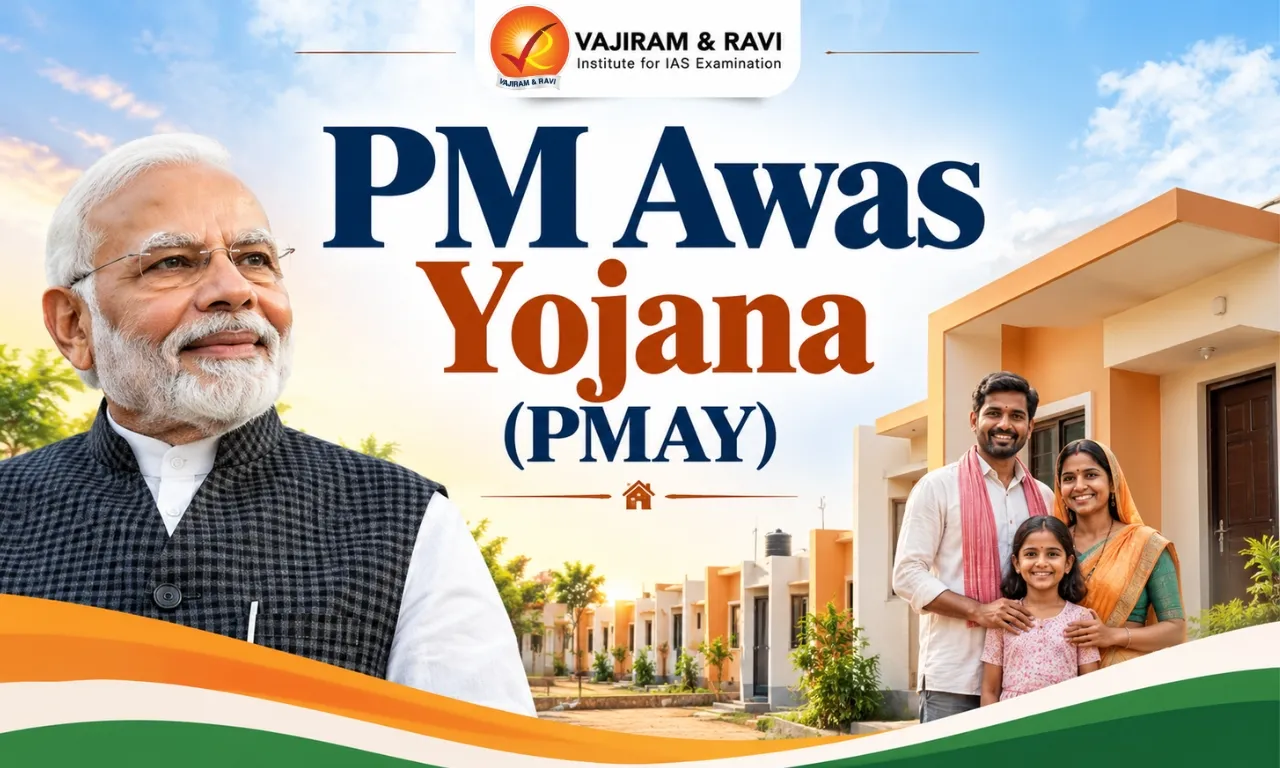
PM Awas Yojana (PMAY) is a flagship housing scheme launched by the Government of India in 2015 under the 'Housing for All' mission to provide all-weather pucca houses with basic civic amenities to eligible rural and urban households. Addressing severe housing shortages across the country, the mission focuses on Economically Weaker Sections (EWS), Low Income Groups (LIG), Middle Income Groups (MIG), slum dwellers, and rural houseless families.
PM Awas Yojana operates through two distinct tracks: PMAY-Urban under the Ministry of Housing and Urban Affairs (MoHUA) and PMAY-Gramin under the Ministry of Rural Development. Recently revamped as PM Awas Yojana 2.0 for 2024-2029, the scheme aims to build three crore additional affordable homes across India.
PM Awas Yojana Background
India’s public housing initiatives evolved from post-Independence rehabilitation and rural housing programmes to a more integrated, beneficiary-oriented approach.
- The Indira Awaas Yojana (IAY) was launched in 1985, was made an independent programme in 1996 and was restructured as PM Awas Yojana - Gramin from 1 April 2016 to improve beneficiary selection, housing quality and implementation.
- PMAY-Urban was launched on 25 June 2015, building on earlier urban housing initiatives such as JNNURM and Rajiv Awas Yojana (RAY).
PM Awas Yojana Objectives
Objectives of PM Awas Yojana focus on improving property affordability amidst rising land prices, rehabilitating urban slums, and ensuring dignified, disaster-resilient shelter equipped with basic civic infrastructure for all.
- Eliminating Housing Shortage: The primary objective of the PM Awas Yojana is to replace dilapidated ‘kutcha houses’ with all-weather ‘pucca houses’ across all statutory towns and rural Gram Panchayats for families without a pucca home anywhere in India.
- It is supported by beneficiary identification, Direct Benefit Transfer (DBT), geo-tagged monitoring and convergence with other welfare schemes.
- In-Situ Slum Rehabilitation: The mission seeks to increase the value of urban land by helping eligible slum residents improve their living conditions on the same land they currently occupy. This is done through collaboration with private developers, using land as a key resource.
- Credit-Linked Affordability: By offering interest subsidies on institutional home loans, the scheme lowers Equated Monthly Instalments (EMIs) and expands formal housing credit access for EWS, LIG, and MIG households.
- The original Credit Linked Subsidy Scheme (CLSS) under PMAY 1.0 and the Interest Subsidy Scheme (ISS) under PMAY-U 2.0 differ significantly in their subsidy disbursement, income coverage, loan limits, and property parameters.
- Empowering Women: A key social goal of the PM Awas Yojana is to enhance women's control over household assets by requiring that houses be registered in the name of the female head of the household or jointly with her husband.
- Sustainable Habitat Development: Beyond four walls, the PM Awas Yojana ensures access to water, sanitation, electricity, and clean cooking fuel while promoting green, climate-resilient construction technologies across varied geo-climatic zones.


PM Awas Yojana Features
PM Awas Yojana combines demand-driven planning, mandatory female asset ownership, geo-tagged Direct Benefit Transfers, innovative building technologies, and multi-ministerial convergence to deliver holistic, transparent housing welfare.
- Hybrid Funding Mechanism: While the Credit Linked Subsidy / Interest Subsidy vertical operates as a 100% centrally funded Central Sector Scheme, other verticals function as Centrally Sponsored Schemes with Centre-State cost sharing.
- Clear Beneficiary Definition: A beneficiary family comprises a husband, wife, and unmarried children who do not own a pucca house in any part of India.
- For PMAY Urban, an adult earning member (regardless of marital status) can be treated as a separate household provided they do not own a pucca house in their name.
- Priority to Vulnerable Groups: The guidelines mandate preference for Scheduled Castes (SCs), Scheduled Tribes (STs), OBCs, minorities, Persons with Disabilities (PwDs), senior citizens, single women, widows, and transgender individuals.
- Benefits remain subject to the applicable scheme criteria.
- Technology & Safety Standards: Houses must comply with the National Building Code (NBC) and Bureau of Indian Standards (BIS), supported by the Global Housing Technology Challenge – India (GHTC-India) and Light House Projects.
- Digital Monitoring & Transparency: CLAP is associated with processing and tracking subsidy applications in real time under the CLSS framework; Bhuvan and AwaasSoft are particularly relevant to monitoring rural housing construction to prevent leakages before releasing Direct Benefit Transfer (DBT) instalments.
- Inter-Scheme Convergence: PMAY converges with Swachh Bharat Mission (toilets), Jal Jeevan Mission and AMRUT (tap water), PM Ujjwala Yojana (LPG connections), PM Surya Ghar: Muft Bijli Yojana (rooftop solar), PM-JANMAN (pucca homes for Particularly Vulnerable Tribal Groups) and rural wage schemes for 90-95 days of unskilled labour support.
- Convergence depends on the relevant programme's eligibility and implementation arrangements.
PM Awas Yojana 2.0
PM Awas Yojana 2.0 is the revamped five-year phase (FY 2024-25 to FY 2028-29) approved by the Union Cabinet to construct three crore additional rural and urban houses.
PMAY-Urban 2.0 Verticals
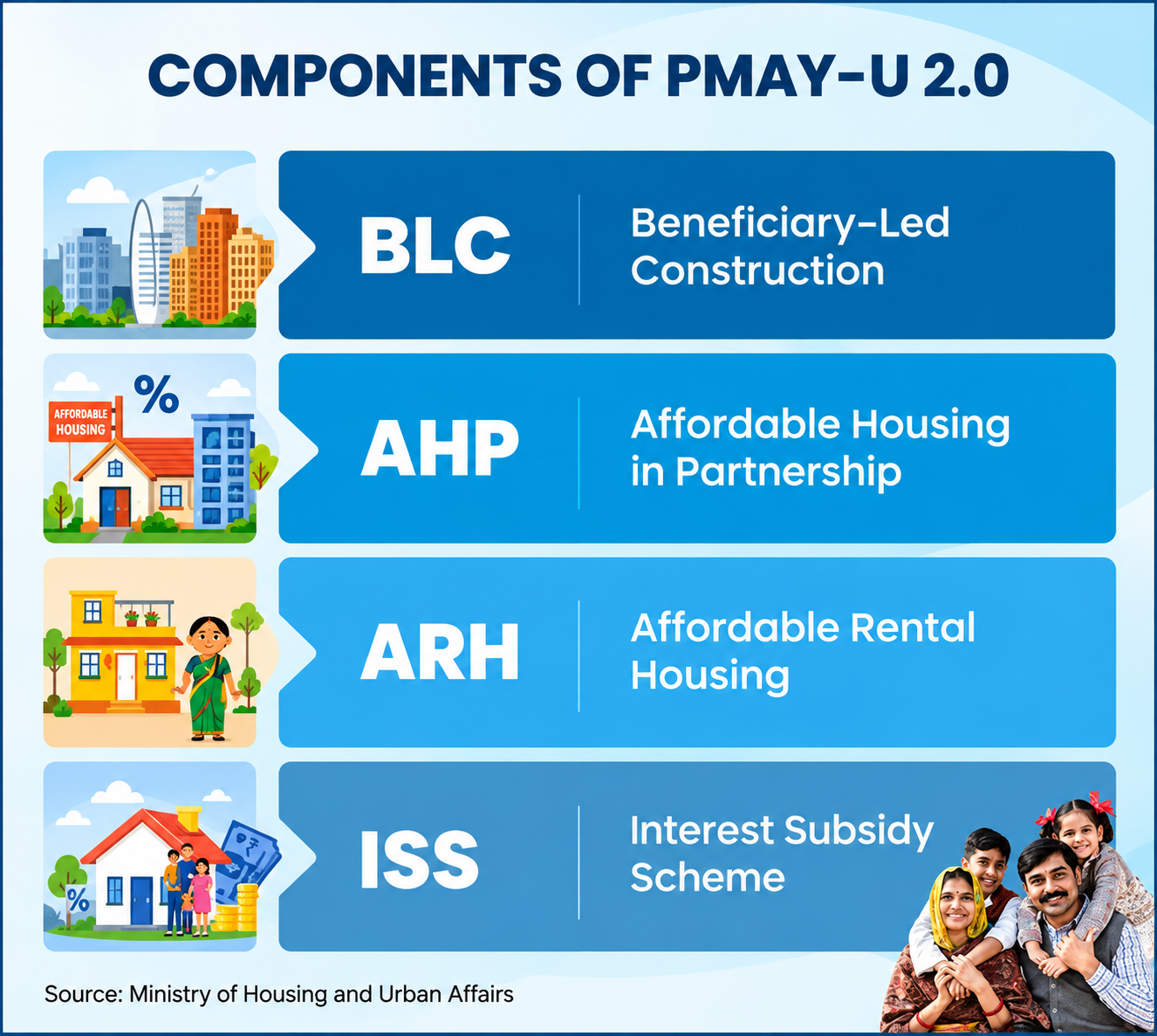
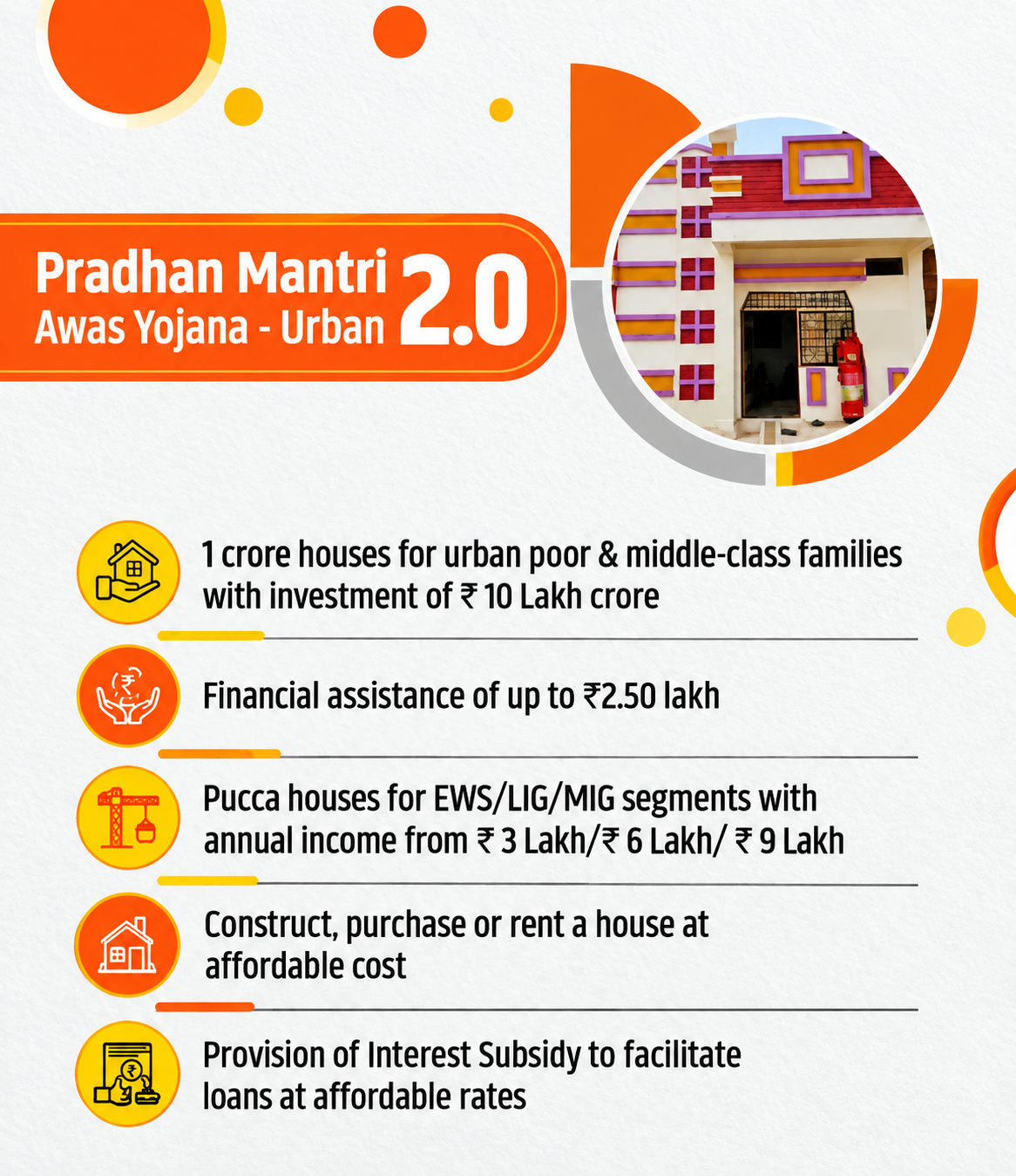
The PMAY-Urban 2.0 initiative entails a total investment of ₹10 lakh crore, with government assistance of ₹2.30-2.50 lakh crore, to support one crore urban poor and middle-class families. This includes specific support for Safai Karmacharis and street vendors through the PM SVANidhi Scheme, artisans under the PM Vishwakarma Scheme, Anganwadi workers, and construction workers across four components:
- Beneficiary-Led Construction (BLC): EWS families (annual income up to ₹3 lakh) receive up to ₹2.5 lakh in financial assistance to construct new all-weather pucca houses of up to 45 sq. m carpet area on their own land.
- Affordable Housing in Partnership (AHP): Public and private agencies construct EWS flats (30-45 sq. m carpet area), with Central and State governments jointly providing up to ₹2.5 lakh assistance per flat.
- BLC and AHP funding is shared: ₹1.50 lakh from the Centre and a minimum of ₹1 lakh from the State in general states; ₹2.25 lakh from the Centre and ₹0.25 lakh from the State in NE/Hill states and the UTs of Delhi, J&K, and Puducherry; and ₹2.50 lakh from the Centre in other UTs.
- Affordable Rental Housing (ARH): Targets EWS (income ≤ ₹3 lakh) and LIG (income up to ₹6 lakh) urban migrants, working women, and industrial workers requiring short-term rental homes equipped with creches and health centres.
- Interest Subsidy Scheme (ISS): Offers a 4% interest subsidy on the first ₹8 lakh of home loans (up to a ₹25 lakh loan for properties worth up to ₹35 lakh and a 120 sq. m area), providing a maximum benefit of ₹1.80 lakh across EWS (up to ₹3L), LIG (up to ₹6L), and MIG (up to ₹9L) segments.
PM Awas Yojana Gramin Phase II
The PM Awas Yojana Gramin Phase II continues rural housing support from FY 2024-25 to FY 2028-29 with a target of 2 crore additional pucca houses with a minimum of 25 sq. m carpet area with hygienic cooking space, providing unit assistance of ₹1.20 lakh in plain areas (60:40 Centre-State funding share) and ₹1.30 lakh in North-Eastern and Himalayan states and the UTs of Jammu & Kashmir and Ladakh (90:10 Centre-State funding share).
PM Awas Yojana Rural vs PM Awas Yojana Urban
| Aspect | PMAY Gramin (Rural) | PMAY Urban |
|
Launch & Origin |
Launched on 1 April 2016 by revamping the earlier Indira Awaas Yojana |
Launched on 25 June 2015, replacing the Rajiv Awas Yojana |
|
Nodal Ministry |
Ministry of Rural Development |
Ministry of Housing and Urban Affairs |
|
Where It Applies |
All rural Gram Panchayat areas across India, except Delhi and Chandigarh |
Statutory towns, notified planning areas, and zones under development authorities |
|
Funding Pattern |
Centrally Sponsored Scheme: Cost is shared 60:40 between Centre and States in plains, 90:10 in North-Eastern states, Himalayan states, and J&K, and 100% by the Centre in UTs without a legislature |
Hybrid Model: Most components are Centrally Sponsored, except the Interest Subsidy Scheme (ISS), which is a 100% centrally funded central sector component. |
|
How Assistance Works |
Money is sent directly to the beneficiary's bank or post-office account (DBT) in geo-tagged stages as they build their house |
Works through four routes under PMAY-U 2.0: Beneficiary-Led Construction (BLC), Affordable Housing in Partnership (AHP), Affordable Rental Housing (ARH), and Interest Subsidy on Home Loans (ISS). |
|
Who Is Eligible |
Houseless rural families and those living in zero, one, or two-room kutcha houses, provided monthly household income does not exceed ₹15,000 |
Families without a pucca house anywhere in India from the EWS (income up to ₹3 lakh), LIG (₹3-6 lakh), and MIG (₹6-9 lakh, for loan subsidy) groups, including slum dwellers, street vendors, and artisans |
|
How Beneficiaries Are Chosen |
Identified using SECC 2011 and the Awaas+ 2024 survey (with Aadhaar face authentication and 10 exclusion criteria), then verified by the Gram Sabha |
Demand-driven: eligible families apply online through the Unified PMAY-U 2.0 Portal, followed by municipal verification and geo-tagging on the Bhuvan app. |
|
Financial Support per House |
₹1.20 lakh in plains and ₹1.30 lakh in hilly/NE states, J&K, and Ladakh. Families also get ₹12,000 for a toilet, 90-95 days of rural wage support, and an optional loan up to ₹70,000 at 3% lower interest. |
Up to ₹2.50 lakh per unit for construction (BLC/AHP), or a 4% interest subsidy on the first ₹8 lakh of a home loan (up to ₹1.80 lakh maximum benefit) under ISS |
|
House Size (Carpet Area) |
At least 25 sq. metres, including a clean cooking space |
30-45 sq. metres for EWS houses under BLC/AHP, and up to 120 sq. metres for homes bought under the loan subsidy scheme |
|
Women's Ownership |
Mandatory in both: the house must be allotted in the name of the female head or jointly with her husband, unless there is no adult woman in the family. |
Mandatory on the same terms – in practice, 97% of houses sanctioned under PMAY-U 2.0 are in women's names or jointly owned. |
|
Phase 2.0 Goal (2024-29) |
Build 2 crore more rural houses (towards a total target of 4.95 crore) with an outlay of ₹3,06,137 crore |
Build or support 1 crore more urban houses with ₹2.30-2.50 lakh crore in government assistance. |
|
Progress So Far (2026) |
3.91 crore houses sanctioned and 3.12 crore completed across Phases I and II as of August 2026 |
Over 1.27 crore houses were sanctioned (including 20.80 lakh under Phase 2.0), and 1.01 crore were completed as of October 2026 |
PM Awas Yojana Achievements
PM Awas Yojana reflects massive physical and financial progress over the last decade, sanctioning over 1.25 crore urban houses and delivering more than 1 crore completed urban homes.
- Milestone Urban Completions: Across PMAY-U and PMAY-U 2.0, over 1.27 crore houses have been sanctioned, and 1.01 crore urban houses have been completed and delivered, backed by ₹1,80,582 crore in released central assistance.
- Strong PMAY-U 2.0 Rollout: On the PMAY-U 2.0 portal, 34 states/UTs have signed Memorandums of Agreement (MoAs), recording a demand of 71.55 lakh houses across 5,206 towns and sanctioning 20.8 lakh new houses as of October 2026.
- Rural Housing Transformation: Under PMAY-G (Phases I & II), against an allocated target of 4.18 crore houses (out of the cumulative 4.95 crore target by 2029), 3.91 crore houses have been sanctioned and 3.12 crore all-weather houses completed as of August 2026, supported by over ₹4.03 lakh crore in fund transfers.
- Gender Empowerment in Practice: Over 1 crore urban homes overall and 97% (20.16 lakh of 20.80 lakh) of houses sanctioned under PMAY-U 2.0 are allotted in the name of women or under joint ownership.
- Migrant Welfare via ARHCs: The operationalisation of Affordable Rental Housing Complexes (ARHCs) converted vacant government-funded housing into dignified rental spaces for informal workers and urban migrants near industrial hubs.
PM Awas Yojana Challenges
Challenges of PM Awas Yojana include urban land scarcity, exclusion of slums on private land, high beneficiary cost contributions, banking reluctance toward informal workers, and delayed state matching grants.
- Exclusion of Private Land Slums: Official PMAY-U guidelines explicitly restrict slums situated on private land from receiving central assistance for rehabilitation, leaving millions of vulnerable slum dwellers uncovered.
- Land Title Bottlenecks in BLC: Since Beneficiary Led Construction (BLC) accounts for over 80% of urban demand, families living in unregularised settlements without clear legal land titles (pattas) cannot avail construction subsidies.
- High Beneficiary Contribution Burden: In urban areas, while government assistance caps at ₹2.5 lakh, total construction costs reach ₹6-8 lakh or more due to material inflation, forcing poor households into informal debt.
- Formal Credit Exclusion: Primary Lending Institutions (PLIs) and commercial banks remain hesitant to extend home loans to EWS and informal workers lacking salary slips, Income Tax Returns (ITRs), or formal credit scores.
- Peripheral Location of AHP Projects: High inner-city land costs push public and private agencies to build Affordable Housing in Partnership (AHP) units on distant urban peripheries lacking public transit and livelihood links, resulting in unallotted or vacant flats.
PM Awas Yojana Way Forward
The PM Awas Yojana demands transitioning from a standalone construction scheme to a sustainable housing ecosystem through land titling reforms, transit-oriented zoning, and inclusive micro-mortgage frameworks.
- Unlocking Urban Land and Tenurial Rights: States must replicate models like Odisha's JAGA Mission and converge rural housing with the SVAMITVA Scheme to grant clear land titles, enabling landless EWS families to access BLC benefits.
- Operationalising the Expanded Credit Risk Guarantee: Effectively utilising the Credit Risk Guarantee Fund Trust (CRGFT) for low-income housing will incentivise banks and Housing Finance Companies (HFCs) to lend to informal workers without rigid collateral.
- Transit-Oriented Inclusionary Zoning: Urban Local Bodies (ULBs) must mandate reservation of land for EWS/LIG housing near metro corridors and commercial zones in Master Plans to prevent livelihood disruption.
- Scaling Up Rental Housing Ecosystems: Considering the growing movement of people from rural to urban areas, states should provide viability gap funding and property tax incentives to private companies to expand the Affordable Rental Housing sector.
- Mainstreaming Green Building Codes: Expanding GHTC-India technologies and passive cooling designs will ensure new housing stock protects low-income families from intensifying urban heat island effects and climate disasters.
PM Awas Yojana UPSC PYQs
Q1. Development and welfare schemes for the vulnerable, by its nature, are discriminatory in approach.” Do you agree? Give reasons for your answer. (Mains 2023)
Q2. Performance of welfare schemes that are implemented for vulnerable sections is not so effective due to the absence of their awareness and active involvement at all stages of policy process. Discuss. (Mains 2019)

 Last updated on Oct, 2026
→ UPSC 2027 Notification will be released on 13 January 2027 at upsconline.nic.in.
→ Check Nobel Prize 2026 Winners List here.
→ Download PIB PRiSM Monthly Magazine 2026 here.
→ Check UPSC Monthly Current Affairs Magazine The Recitals here.
→ Check out the latest UPSC Syllabus here.
→ Download UPSC Model Answers for Mains 2026
→ UPSC Mains Question Paper 2026 is out now for Essay & GS Paper 1, 2, 3 & 4.
→ UPSC Calendar 2027 has been released.
→ Enroll in Vajiram & Ravi’s UPSC Mains Test Series 2027 for structured answer writing practice, expert evaluation, and exam-oriented feedback.
→ Join Vajiram & Ravi’s UPSC Mentorship Program 2027 for personalized guidance, strategy planning, and one-to-one support from experienced mentors.
→ Go through the UPSC Mains Previous Year Papers to enhance your preparation.
→ UPSC has released UPSC Toppers List 2025 with the Civil Services final result on its official website.
→ Also check Best UPSC Coaching in India
PM Awas Yojana FAQs
Q1. What is the full form of PMAY?+
Q2. When was PMAY launched?+
Q3. Which ministries implement PMAY?+
Q4. What is PMAY-U 2.0?+
Q5. Can I apply for PM Awas Yojana online?+
Tags: pm awas yojana quest UPSC Social Justice Notes