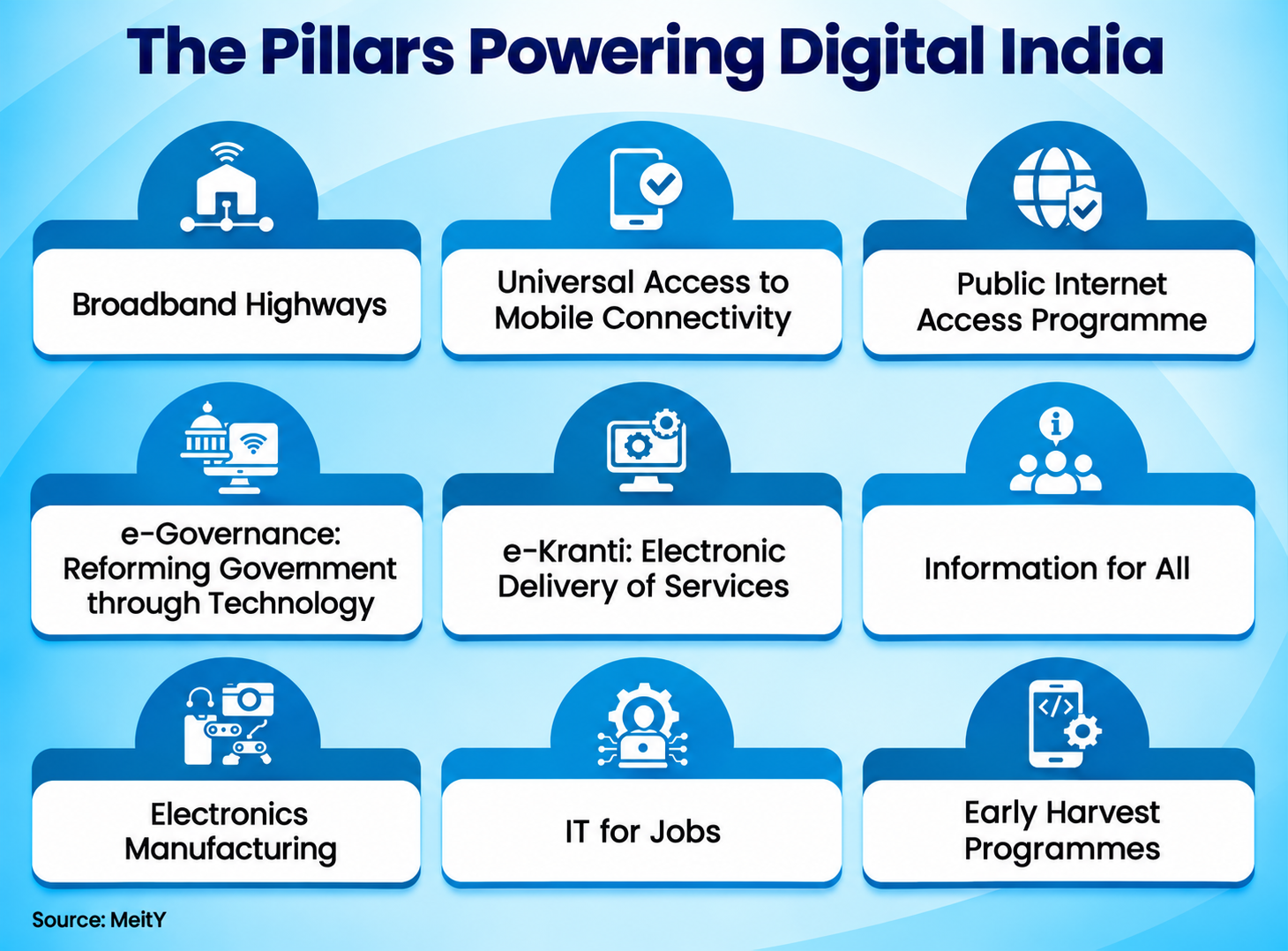
e-Kranti, officially designated as the National e-Governance Plan (NeGP) 2.0, is a key initiative under the Ministry of Electronics and Information Technology (MeitY), forming its fifth pillar of the Digital India Programme ('e-Kranti – Electronic Delivery of Services'). Approved by the Union Cabinet on 25 March 2015 with the vision of 'Transforming e-Governance for Transforming Governance', it expanded the portfolio of Mission Mode Projects (MMPs) from 31 to 44 MMPs. Unlike an approach limited to computerising existing procedures, e-Kranti emphasises Government Process Re-engineering, common standards, mobile-first services, cloud adoption and secure electronic information.
The broad aim of e-Kranti is to make public services more accessible, efficient, transparent, reliable and affordable. The framework covers sectors such as education, healthcare, agriculture, financial inclusion, justice, planning and cybersecurity, helping bring services closer to citizens while improving coordination across government departments.
e-Kranti History
The background of e-Kranti shows India's move from individual computerisation projects to a more integrated and result-focused approach in e-governance. The initiative builds on the earlier National e-Governance Plan (NeGP) and forms the service-delivery pillar of Digital India.
- NeGP: The National e-Governance Plan (NeGP) was approved by the Government on 18 May 2006 with 27 Mission Mode Projects (MMPs), expanded to 31 MMPs in 2011, and scaled to 44 MMPs (15 Central, 17 State, and 12 Integrated MMPs) under e-Kranti.
- NeGP has the goal of making all government services available to common citizens in their local areas through common service centres.
- NeGP aims to ensure that these services are efficient, transparent, and reliable, while also being affordable. The foundational digital infrastructure developed under NeGP includes:
- State Data Centres (SDCs),
- Statewide Area Networks (SWANs),
- State Service Delivery Gateways (SSDGs), and
- Common Services Centres (CSCs).
- NeGP also resulted in the launch of Mission Mode Projects such as Passport Services, Land Record Management, e-Office, and the Computerisation of the Public Distribution System, among others.
e-Kranti Rationale
The rationale for e-Kranti emerged from the limitations of the earlier National e-Governance Plan (NeGP), particularly gaps in technology adoption, process transformation, integration and implementation. The 2015 government review identified the following needs for reform:
- Transformational governance: Move beyond computerisation towards measurable improvements in the quality and accessibility of public services.
- Citizen-centric services: Expand the range of government services delivered electronically.
- Better integration: Enable rapid replication and integration of e-governance applications across departments.
- Optimum ICT utilisation: Improve the use of existing digital infrastructure and avoid fragmented investments.
- Emerging technologies: Adopt cloud computing, mobile platforms and other relevant technologies to modernise service delivery.
- Administrative reforms: Make Government Process Re-engineering (GPR) central to new Mission Mode Projects (MMPs).
- Agile implementation: Introduce flexible implementation models to improve project execution and outcomes.
e-Kranti Overview
e-Kranti is the National e-Governance Plan (NeGP) 2.0, approved by the Union Cabinet on 25 March 2015. As Pillar 5 of Digital India, it focuses on transforming government service delivery through integrated and interoperable digital systems.
- Vision: “Transforming e-Governance for Transforming Governance.”
- Mission: Deliver government services electronically through integrated and interoperable systems across multiple modes, ensuring efficiency, transparency, reliability and affordability.
- Nodal department at the time of approval: Department of Electronics and Information Technology (DeitY), subsequently reorganised as the Ministry of Electronics and Information Technology (MeitY).
- Approach: Combine technology adoption with process re-engineering, workflow automation, electronic databases and IT-based public grievance redressal.
- Thrust areas: e-Education, e-Healthcare, agriculture, financial inclusion, planning, justice, security and cybersecurity.
- Core Infrastructure:
- State Data Centres (SDCs): Central repositories to host applications and secure data at the state level.
- State Wide Area Networks (SWANs): Secure, dedicated communication networks connecting state headquarters down to the block/village level.
- Common Services Centres (CSCs): Physical front-end delivery kiosks providing e-services to rural and remote citizens.
- State Service Delivery Gateways (SSDGs): Interoperable routing systems that allow seamless data exchange between different government departments.


e-Kranti Objectives
e-Kranti's objectives focus on redesigning public service delivery around measurable outcomes rather than simply putting existing procedures online. The approved framework combines citizen-centric services, integration and technology adoption. The six objectives of e-Kranti are the following:
- Transform NeGP: Redefine the National e-Governance Plan through transformational and outcome-oriented initiatives.
- Expand citizen-centric services: Increase the range of government services available electronically to citizens using initiatives like Bhashini.
- Optimise ICT infrastructure: Ensure effective utilisation of core Information and Communication Technology (ICT) infrastructure.
- Promote integration and replication: Enable rapid replication and integration of e-governance applications across departments and jurisdictions.
- Leverage emerging technologies: Harness cloud computing (MeghRaj), mobile platforms, Artificial Intelligence, and GIS to modernise service delivery.
- Adopt agile implementation models: Replace rigid, prolonged procurement cycles with agile, outcome-linked implementation and federated architecture.
e-Kranti Key Principles
The key principles of e-Kranti establish how digital government projects should be designed and implemented. They emphasise administrative transformation, service integration, accessible technology and secure digital service delivery.
- Transformation and not Translation: Project proposals must deliver substantial changes in the quality, quantity, and manner of service delivery rather than merely digitising manual forms.
- Integrated Services and Not Individual Services: Use a common middleware and integrate back-end processes and systems to offer seamless, one-stop service delivery to citizens.
- Government Process Reengineering (GPR) to be mandatory in every MMP: Makes GPR an essential, mandatory first step in all new Mission Mode Projects (MMPs) before they can be sanctioned.
- ICT Infrastructure on Demand: Ensures government departments are provisioned with required information and communication technology (ICT) infrastructure, such as cloud and connectivity, on demand.
- Cloud by Default: It calls for leveraging cloud technologies (such as Meghraj) for flexibility, agility and cost-effectiveness in all government departments to store sensitive data, with private clouds allowed only under specific authorisation.
- Mobile First: Requires all new and revamped e-governance applications to be designed or re-engineered primarily for mobile platform delivery.
- Fast Tracking Approvals: Establishes streamlined mechanisms to remove bureaucratic delays and expedite project sanctions and implementation.
- Mandating Standards and Protocols: Enforces uniform technical standards, metadata, and interoperability frameworks across all national e-governance systems.
- Language Localisation: Guarantees that applications, digital interfaces, and services are accessible in regional Indian languages.
- National GIS (Geospatial Information System): Leverages geospatial technology such as GIS as a platform and service (NGIS) for spatial data integration, planning, and decision-making in governance.
- Security and Electronic Data Preservation: Mandates strict adherence to cybersecurity policies, data integrity, confidentiality, and long-term electronic record preservation.
e-Kranti Services Provided and Projects Covered
e-Kranti covers multiple sectors where electronic service delivery can improve access, administrative efficiency and accountability. Its original thrust areas span education, healthcare, agriculture, financial inclusion, planning, justice, security and cybersecurity.
Major Focus Areas of e-Kranti
- e-Education: Digital literacy, broadband-enabled schools and technology-based learning, including Massive Open Online Courses (MOOCs).
- e-Healthcare: Online medical consultation, electronic medical records and digital exchange of patient information. Current examples under Digital India's electronic service-delivery framework include e-Hospital and e-Sanjeevani.
- Technology for Farmers: Access to real-time market-price information, online agricultural inputs and mobile-based financial services.
- Financial Inclusion: Mobile banking, micro-ATMs and digital services through Common Service Centres (CSCs) and post offices.
- Technology for Planning: GIS-based decision-making and geospatial information systems.
- Technology for Justice: Electronic court services and digital justice processes. e-Courts is a prominent current example.
- Technology for Security: Mobile-based emergency and related citizen services.
- Cybersecurity: Security-oriented digital infrastructure and coordination to support safer electronic service delivery.
Mission Mode Projects (MMPs) of e-Kranti
Mission Mode Projects are organised around defined government functions and service-delivery objectives. The original project framework categorised them into three groups.
- Central MMPs: Like Income Tax, Passport, MCA21, Pensions and e-Office.
- State MMPs: Like Land Records, Road Transport, Agriculture, Treasuries and the Public Distribution System.
- Integrated MMPs: Like Common Services Centres, e-Courts, e-Procurement and National Service Delivery Gateway.
e-Kranti Implementation
e-Kranti's implementation model combines central coordination, departmental responsibility and state-level execution. It relies on shared digital infrastructure, integrated systems, process re-engineering and monitoring under the broader Digital India programme. The approved implementation framework includes the following arrangements:
- Programme-level monitoring: The Digital India programme management structure was designated to monitor e-Kranti, facilitate stakeholder consultation and resolve inter-ministerial issues.
- Apex Committee: Chaired by the Cabinet Secretary in the approved framework, it was assigned a role in coordinating projects, addressing inter-ministerial issues and making decisions on the MMP portfolio.
- Central Ministries and Departments: These agencies are responsible for implementing the MMPs assigned to them.
- State Governments: States are responsible for implementing relevant state-sector projects, in coordination with the concerned ministries.
- Core ICT infrastructure: State Data Centres (SDCs), State Wide Area Networks (SWANs), Common Services Centres (CSCs), State Portals, State Service Delivery Gateways (SSDGs), e-District and capacity-building arrangements support electronic delivery.
- Process reform and integration: Departments are expected to improve workflows, integrate systems and comply with notified standards rather than merely computerise existing procedures.
e-Kranti Achievements
e-Kranti's achievements are reflected in the expansion of electronic public services across healthcare, justice and other sectors. The following official figures illustrate progress within the wider Digital India service-delivery ecosystem; they should not be attributed exclusively to e-Kranti.
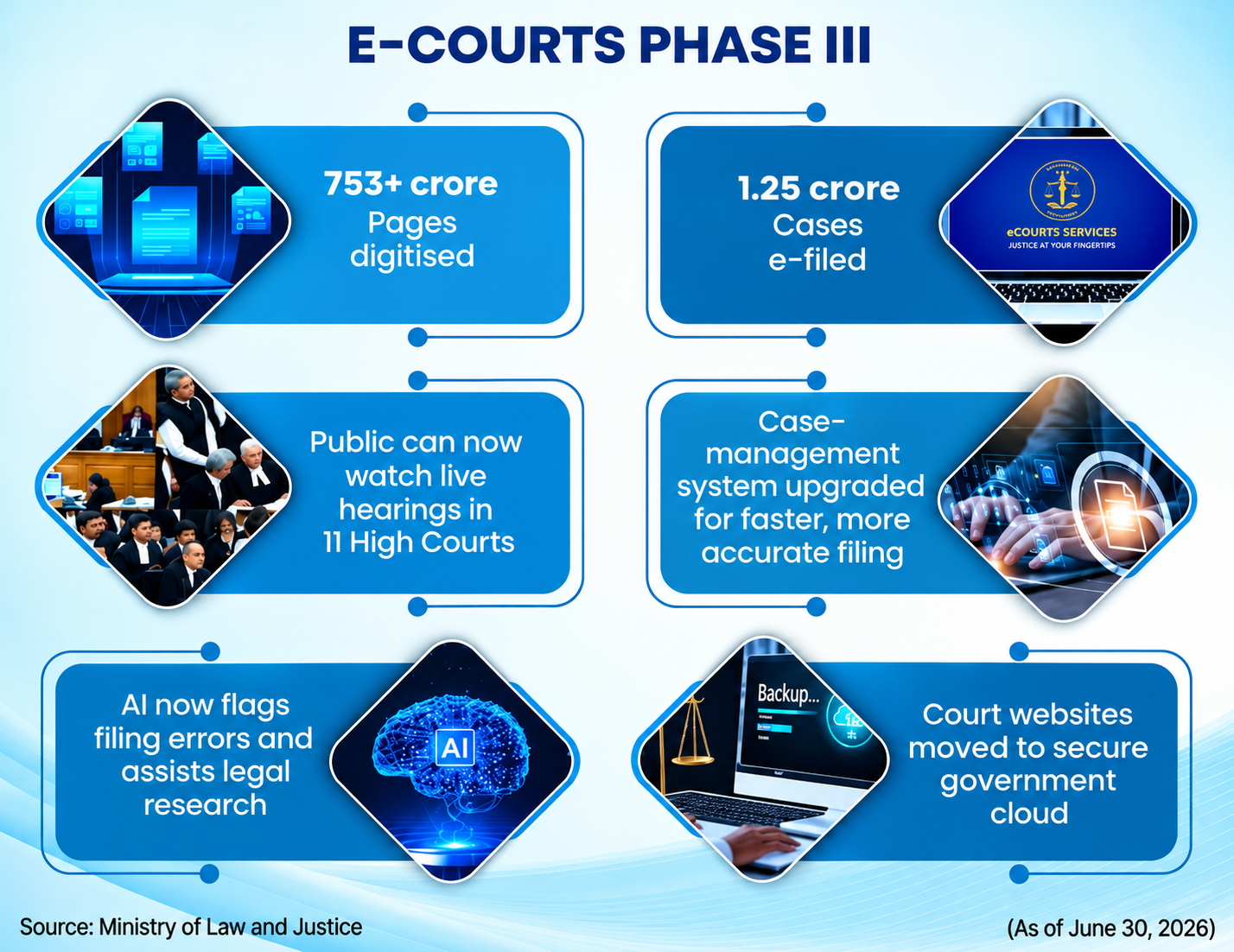
- Digital justice: By August 2026, more than 753 crore pages of court records had been digitised under the e-Courts Mission Mode Project, strengthening digital record management and access to judicial services.
- Online healthcare: e-Sanjeevani crossed 50 crore teleconsultations on 15 September 2026, expanding remote access to healthcare across States and Union Territories.
- Integrated citizen services: By October 2026, UMANG had expanded to 2,588 services and recorded approximately 805.56 crore transactions, providing a common digital gateway to government services.
- Improved access and convenience: Initiatives such as e-Hospital, e-Courts and e-Sanjeevani have reduced dependence on physical visits for selected services, supporting more accessible and citizen-centric governance.
- CSCs reached 5.01 lakh centres with 48.54 crore transactions in FY 2025-26.
- Digitisation of citizen services: Projects such as e-District, e-Posts, Passport, Visa and National ID addressed different citizen-facing services, helping establish a broader framework for electronic delivery of government services.
- Improving business and financial services: The framework included e-Biz, e-Procurement, banking, insurance, Income Tax and MCA21, extending e-governance beyond citizen services to business transactions, financial services and regulatory processes.
- Modernisation of government administration: Projects such as e-Office, e-Courts, e-Sansad and e-Vidhaan covered government functioning, judicial services and legislative processes, highlighting the administrative dimension of digital governance.
- Broad sectoral coverage: The 41 Mission Mode Projects (MMPs) covered sectors such as health, education, employment exchanges, police, pensions, agriculture, land records, public distribution, rural development and Women and Child Development.
- Support for rural and local governance: MMPs covering Gram Panchayats, rural development, agriculture, land records and municipalities extended the programme's scope to rural institutions and local-level administration.
- Digital delivery through common platforms: The framework included enabling projects such as the India Portal, National GIS (NGIS), Common Services Centres (CSC), Social Benefit Gateway and Electronic Data Interchange (EDI). These broadened the programme's coverage beyond individual departmental applications.
e-Kranti Challenges
e-Kranti's challenges stem from the gap between deploying technology and transforming service delivery. The original NeGP review identified difficulties in adopting new technologies, changing processes and implementing projects effectively, resulting in sub-optimal outcomes.
- Technology-led implementation: Digital projects may prioritise technical deployment and back-end integration without adequately addressing citizens' actual needs.
- Limited interoperability: Disconnected applications and databases can prevent seamless service delivery across departments.
- Resistance to process reform: Digitising an inefficient procedure without re-engineering it may preserve delays and unnecessary administrative steps.
- Digital divide: Unequal access to connectivity, devices and digital skills can exclude rural, remote and vulnerable populations.
- Language and accessibility barriers: Services that are difficult to use or unavailable in citizens' preferred languages limit inclusion.
- Cybersecurity and privacy risks: Electronic records and interconnected systems require reliable security, data protection and preservation arrangements.
- Implementation capacity: Departments need appropriate technical skills, coordination and institutional capacity to maintain integrated systems and deliver services reliably.
e-Kranti Way Forward
To make e-Kranti more beneficial, there is a need to prioritise outcomes, inclusive access and accountable service delivery. Its original principles provide a framework for strengthening integration, security, process reform and citizen-centric administration.
- Make GPR substantive: Simplify rules, eliminate unnecessary procedures and redesign workflows before digitising services.
- Strengthen interoperability: Integrate databases and departmental platforms through common standards and secure systems.
- Adopt user-centric design: Test services against actual citizen needs, ease of use and successful completion of applications, not just technical deployment.
- Close the digital divide: Combine mobile-first services with accessible assisted delivery through CSCs and other appropriate service outlets.
- Expand language accessibility: Provide interfaces and essential information in Indian languages, with attention to persons with disabilities.
- Strengthen cybersecurity: Apply security standards, protect personal information and maintain reliable electronic records.
- Improve accountability: Monitor service quality, processing time, grievance resolution and citizen experience alongside project implementation.
- Build institutional capacity: Invest in staff training, coordination and maintenance so digital services remain reliable over time.
- Measure service-delivery outcomes: Establish measurable service standards and monitor completion rates, delays, costs and citizen feedback.
- Strengthen grievance redressal: Provide accessible complaint channels, clearly assigned responsibility and time-bound resolution.
e-Kranti UPSC PYQs
Q1. E-governance projects have a built-in bias towards technology and back-end integration than user-centric designs. Examine. (UPSC Mains 2025)
Q2. e-governance is not just about the routine application of digital technology in service delivery process. It is as much about multifarious interactions for ensuring transparency and accountability. In this context evaluate the role of the 'Interactive Service Model' of e-governance.” (UPSC Mains 2024)
Q3. e-governance, as a critical tool of governance, has ushered in effectiveness, transparency and accountability in governments. What inadequacies hamper the enhancement of these features? (UPSC Mains 2023)
Q4. Has digital illiteracy, particularly in rural areas, coupled with lack of Information and Communication Technology (ICT) accessibility hindered socio-economic development? Examine with justification. (UPSC Mains 2021)

 Last updated on Oct, 2026
→ UPSC 2027 Notification will be released on 13 January 2027 at upsconline.nic.in.
→ Check Nobel Prize 2026 Winners List here.
→ Download PIB PRiSM Monthly Magazine 2026 here.
→ Check UPSC Monthly Current Affairs Magazine The Recitals here.
→ Check out the latest UPSC Syllabus here.
→ Download UPSC Model Answers for Mains 2026
→ UPSC Mains Question Paper 2026 is out now for Essay & GS Paper 1, 2, 3 & 4.
→ UPSC Calendar 2027 has been released.
→ Enroll in Vajiram & Ravi’s UPSC Mains Test Series 2027 for structured answer writing practice, expert evaluation, and exam-oriented feedback.
→ Join Vajiram & Ravi’s UPSC Mentorship Program 2027 for personalized guidance, strategy planning, and one-to-one support from experienced mentors.
→ Go through the UPSC Mains Previous Year Papers to enhance your preparation.
→ UPSC has released UPSC Toppers List 2025 with the Civil Services final result on its official website.
→ Also check Best UPSC Coaching in India
e-Kranti FAQs
Q1. What is e-Kranti?+
Q2. What are the 11 principles of e-Kranti?+
Q3. What are the thrust areas of e-Kranti?+
Q4. How is e-Kranti implemented?+
Q5. What is the difference between NeGP and e-Kranti?+
Tags: e-kranti quest UPSC Governance Notes