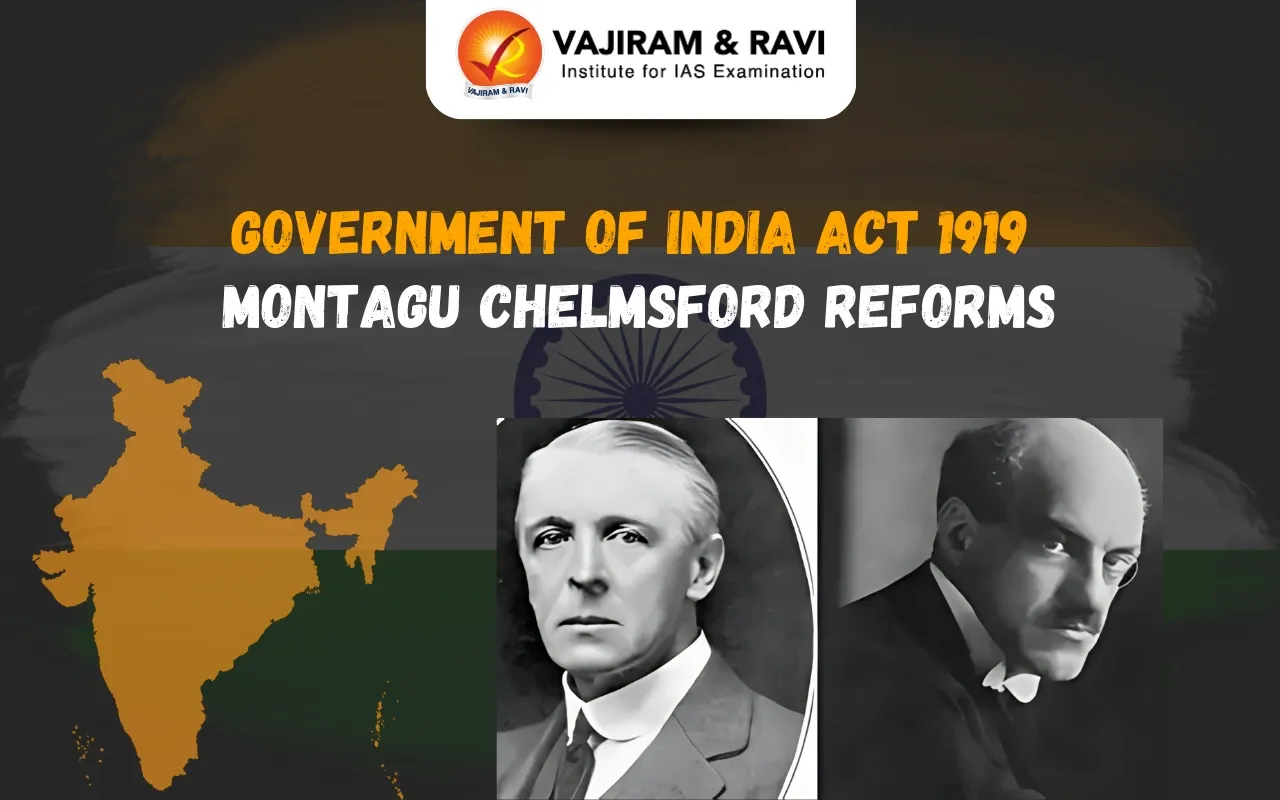
The Government of India Act 1919 is also known as the Montagu-Chelmsford Reforms. It was a key law passed by the British Parliament to meet rising demands for self-rule in India. It represented an important move toward constitutional reforms and a gradual shift of power from the British to the Indians.
The Act was a response to the rise of Indian nationalism and the evolving political environment after World War I. It sought to establish a more inclusive and representative government in British India, while still maintaining ultimate British control.
Government of India Act 1919 or Montagu Chelmsford Reform
The Montagu Chelmsford Reform, also known as Government of India Act 1919, was a legislative framework designed to reform British India's governance. It was based on the Montagu-Chelmsford Report, which was drafted by Edwin Montagu, Secretary of State for India, and Lord Chelmsford, Viceroy of India at the time.
Government of India Act 1919 Objectives
The primary goal of the Act was to introduce a more responsible form of government in India by increasing Indian participation in the administrative machinery while retaining ultimate authority with the British Crown. The Act established a dual governance structure (dyarchy) at the provincial level and a more inclusive legislative framework, but with some limitations..
Montagu-Chelmsford Reforms 1919 Background
In the early 20th century, India faced significant political unrest, with the Indian National Congress (INC) and the All India Muslim League demanding self-governance. The First World War (1914–1918) intensified these demands, as Indians sought political concessions for their support in the war.
- Economic hardships, high casualties among Indian soldiers, and repressive measures like the Rowlatt Act of 1919, also known as the Anarchical and Revolutionary Crimes Act, further fueled nationalist sentiments.
- Amid this growing unrest, Edwin Montagu's declaration of August 20, 1917, marked a crucial turning point for the Government of India Act 1919.
- The Montagu Declaration, also known as the August Declaration, of 1917, marked a shift in British policy, aiming for the "gradual development of self-governing institutions" in India to reduce unrest and outline future constitutional progress.
- This led to the Montagu-Chelmsford Report in 1918, recommending reforms that culminated in the Government of India Act 1919, which came into force in 1921.


Government of India Act 1919 Provisions
The Government of India Act 1919 introduced important provisions such as dyarchy, allowing Indian ministers control over some provincial subjects, while the British retained power over finance and law. The Viceroy held significant authority at the central level, with limited Indian involvement in key areas like defence and foreign policy.
Provincial Government
Under the provisions of Government of India Act 1919, the provinces were given more autonomy and introduced a dyarchy system.
- Executive: The Act established the concept of dyarchy at the provincial level, dividing powers between British and Indian ministers as Reserved and Transferred subjects respectively.
- Transferred subjects: Education, public health, agriculture, and local self-government had a direct impact on people's daily lives and were supposed to be handled by elected Indian representatives.
- Reserved subjects: Finance, law enforcement, and land revenue remained under the control of British governors. The governors retained considerable power, including the ability to veto decisions and issue ordinances.
- The Secretary of State for India and the Governor-General can intervene in reserved subjects, but not in transferred subjects.
- Legislature: The Government of India Act 1919 expanded the provincial legislative councils, with 70% of members elected, but key limitations persisted. The dyarchical system restricted Indian control to less critical areas, while essential sectors like finance and law remained under British authority.
- The dyarchy was implemented in eight provinces, including Assam, Bengal, Bihar and Orissa, Central Provinces, United Provinces, Bombay, Madras, and Punjab.
- The Act enabled provincial legislatures to grant franchise to women if they chose to do so (Madras was the first in 1921).
- Legislative councils could propose legislation, but the governor's approval was required. The governor could veto bills and issue ordinances.
- The legislative councils may reject the budget, but the governor has the authority to restore it if necessary.
Central Government
Under the Government of India Act 1919, the British maintained central control, with the Viceroy and a largely British executive council holding significant power.
- Executive: There were two lists for administration known as central and provincial lists.
- Governor-General's Authority: The governor-general controlled reserved subjects, could restore budget cuts, approve rejected bills, and issue ordinances.
- Viceroy's Central Power: The Viceroy held central executive authority with an eight-member council, where only three Indians had largely ceremonial roles. Key areas like defence, foreign policy, and communications were under his control.
- Government of India Act 1919 Bicameral Legislature: The Council of State (Upper House) had 60 members, 26 nominated by the British government and 34 elected by the provincial legislatures.
- The Legislative Assembly had 145 members—104 elected and 41 nominated. The electorate was limited to property owners and taxpayers.
- Legislators had the authority to ask questions, pass adjournment motions, and vote on parts of the budget, but 75% of it remained unvoted.
- The Council of State consisted of only male members and served for 5 years, while the Central Legislative Assembly lasted 3 years.
- Secretary of State's Salary: In 1919, the Government of India Act mandated that the Secretary of State for India be paid by the British exchequer.
- High Commissioner for India: The 1919 Government of India Act created the High Commissioner for India in London to represent Indian interests and manage relations with Britain.
Montagu Chelmsford Reforms Separate Electorates
The Government of India Act 1919 (Montagu-Chelmsford Reforms) continued and expanded the system of separate electorates introduced in 1909. Muslims, Sikhs, Indian Christians, Anglo-Indians, Europeans, and certain special interest groups elected their own representatives. This increased community-based political representation but also strengthened communal divisions in Indian politics.
Government of India Act 1919 Review
The Montagu-Chelmsford Report of 1919 called for a 10-year review, which led to the formation of the Simon Commission in 1927, chaired by Sir John Simon, to assess the Government of India Act of 1919. The commission was boycotted and criticised by the general public, Congress, and other groups due to the exclusion of Indians from the commission.
The Simon Commission's recommendations resulted in the Government of India Act of 1935, which advanced self-government by establishing a more federal system and increasing Indian participation in governance.
Government of India Act 1919 Outcomes
In 1918, Congress leaders like Tilak and Annie Besant condemned the proposed self-government reform, and the Rowlatt Act of 1919 then escalated unrest by restricting civil liberties and nationalist activities.
- Public Reaction: In August 1918, Congress held a special session calling for better self-government. Bal Gangadhar Tilak called the reforms "a sunless dawn," while Annie Besant deemed them unworthy. Some, like Surendranath Banerjea, saw them as progress.
- Repressive Measures: The 1919 Rowlatt Act granted powers to imprison without trial and suspend habeas corpus, severely restricting civil liberties and intensifying repression of nationalist activities.
- Mass Movements: The failure to grant genuine self-government catalyzed Mahatma Gandhi to launch the Non-Cooperation Movement.
Government of India Act 1919 Limitations
Despite its progressive aspects, the Government of India Act 1919 maintained British control over key governance areas, restricted the electorate, and created a flawed electoral system that fostered communalism and centralized administrative power, and had several significant limitations.
- Limited Electorate: The electorate was limited to a small, privileged group of people.
- Flawed Electoral System: The Government of India Act 1919 introduced a flawed electoral system with limited voting rights, which failed to gain widespread acceptance and fostered communalism through separate electorates.
- Unequal Seat Allocation: The allocation of seats in the central legislature was based on the 'importance' of each province, such as Punjab's military importance and Bombay's commercial importance.
- British Dominance Over Key Areas: British control remained over defence, foreign policy, and major financial matters. The Viceroy could veto legislation and issue ordinances, ensuring British supremacy.
- Limited Legislative Authority: The central legislature had no control over the Viceroy and his council, while provincial ministers lacked power over finances and bureaucrats, often leading to conflicts and decisions being overruled by governors.
Government of India Act 1919 Significance
The Government of India Act 1919 marked a significant constitutional shift, introducing limited self-governance while strategically serving to protect British Imperial interests and deflect growing Indian nationalist pressure.
- Responsible Government: The Act signaled the British administration’s desire to gradually introduce responsible government in India for the first time.
- Provincial Self-Government: The Act introduced the concept of provincial self-government.
- Power Transfer: More administrative power was transferred to Indians, though it did not weaken the realities of British control.
- Legitimizing Nationalism: Making self-government official policy meant Home Rule and nationalist demands could no longer be deemed seditious.
- Democratic Awareness: Citizens gained awareness regarding elections and voting, including women voting for the first time.
- Imperial Protection: Scholars agree the Act aimed to protect British interests rather than genuinely promote full self-government.
Government of India Act 1919 and 1935
The Government of India Act 1919 and the Government of India Act 1935 were important milestones in India’s constitutional development.
- The 1919 Act, based on the Montagu-Chelmsford Reforms, introduced dyarchy in provinces, expanded legislative councils, and established bicameralism at the Centre. However, real executive authority remained largely with British officials.
- The Government of India Act 1935 introduced provincial autonomy by ending dyarchy in provinces and proposed an all-India federation, although the federation was never implemented. It also expanded provincial legislatures and extended the franchise.
- Thus, the 1919 Act represented a limited move towards responsible government, while the 1935 Act provided a broader framework for provincial self-government and significantly influenced the Indian Constitution.
Government of India Act 1919 UPSC PYQs
Q1: In the Government of India Act 1919, the functions of Provincial Government were divided into "Reserved" and "Transferred" subjects. Which of the following were treated as "Reserved" subjects? (UPSC Prelims 2022)
- Administration of Justice
- Local Self-Government
- Land Revenue
- Police
Select the correct answer using the code given below:
(a) 1, 2 and 3
(b) 2, 3 and 4
(c) 1, 3 and 4
(d) 1, 2 and 4
Ans: (c)
Q2: Consider the following statements: (UPSC Prelims 2021)
- The Montagu-Chelmsford Reforms of 1919 recommended granting voting rights to all women above the age of 21.
- The Government of India Act of 1935 gave women reserved seats in the legislature.
Which of the statements given above is/are correct?
(a) 1 only
(b) 2 only
(c) Both 1 and 2
(d) Neither 1 nor 2
Ans: (b)
Q3: Which of the following is/are the principal feature(s) of the Government of India Act, 1919? (UPSC Prelims 2012)
- Introduction of dyarchy in the executive government of the provinces
- Introduction of separate communal electorates for Muslims
- Devolution of legislative authority by the centre to the provinces
Select the correct answer using the codes given below:
(a) 1 only
(b) 2 and 3 only
(c) 1 and 3 only
(d) 1, 2 and 3
Ans: (c)

 Last updated on Sep, 2026
→ UPSC 2027 Notification will be released on 13 January 2027 at upsconline.nic.in.
→ Check out the latest UPSC Syllabus here.
→ Download UPSC Model Answers for Mains 2026
→ UPSC Mains Question Paper 2026 is out now for Essay & GS Paper 1, 2, 3 & 4.
→ UPSC Calendar 2027 has been released.
→ Enroll in Vajiram & Ravi’s UPSC Mains Test Series 2027 for structured answer writing practice, expert evaluation, and exam-oriented feedback.
→ Join Vajiram & Ravi’s UPSC Mentorship Program 2027 for personalized guidance, strategy planning, and one-to-one support from experienced mentors.
→ Go through the UPSC Mains Previous Year Papers to enhance your preparation.
→ UPSC has released UPSC Toppers List 2025 with the Civil Services final result on its official website.
→ Also check Best UPSC Coaching in India
Government of India Act 1919 FAQs
Q1. What was the Government of India Act 1919 also known as?+
Q2. What were the key differences between the Government of India Acts of 1919 and 1935?+
Q3. What was the purpose of the 1919 Act?+
Q4. Who was the Viceroy of India at the time of the Government of India Act 1919?+
Q5. What is the Government of India Act 1919?+
Tags: government of india act 1919 quest upsc modern history notes