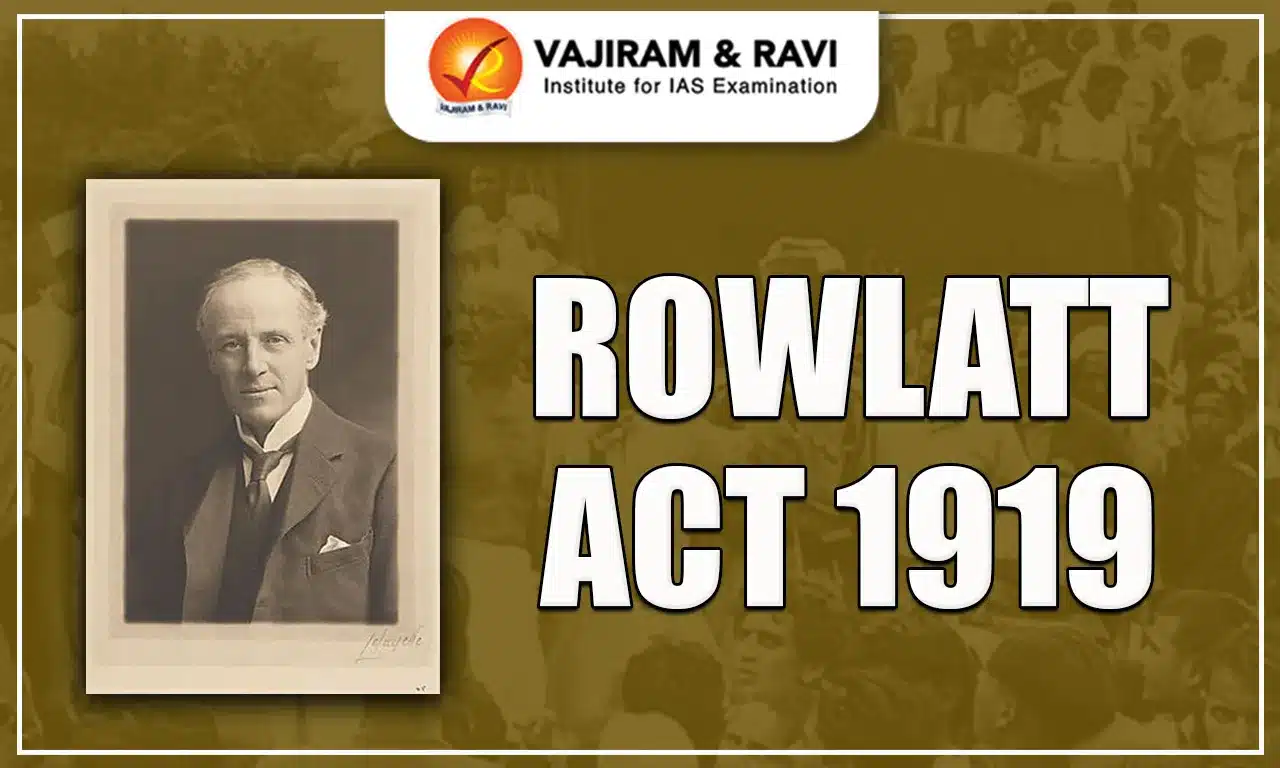
The Rowlatt Act 1919 was one of the most controversial laws introduced by the British colonial government in India after the First World War. Officially known as the Anarchical and Revolutionary Crimes Act, 1919, it gave the government extensive powers to suppress political dissent, including detention without trial and restrictions on judicial safeguards.
The Act triggered the Rowlatt Satyagraha, led by Mahatma Gandhi, and became an important turning point in the transformation of the Indian national movement into a mass movement. The agitation also formed the immediate political background to the Jallianwala Bagh Massacre of 13 April 1919.
Rowlatt Act Background
The background of the Rowlatt Act lies in the First World War and the British fear of revolutionary nationalism in India. During the war, the British government had used the Defence of India Act, 1915 to suppress revolutionary activities, restrict the press, and detain suspects.
- Sedition Committee: While the Defence of India Act was meant to be a temporary wartime measure, a committee (called the Sedition Committee) headed by British judge Sydney Rowlatt recommended the continuation of such suppressive powers.
- It can be considered an instrument of the British Carrot (GOI Act, 1919) and Stick (Rowlatt Act) policy.
- Based on the Rowlatt Committee's report, the Rowlatt Act was passed hurriedly in March 1919 amid vehement protests by Indian members of the Imperial Legislative Council.
- Betrayal of the Promise: This curtailment of civil liberties was seen as a betrayal by the British, who had promised political reforms after the War in exchange for India's support and resources. Instead, they chose further to tighten their grip with the repressive new law. Indians from all walks of life were outraged, setting the stage for widespread agitations across the country.
Rowlatt Act 1919
The Rowlatt Act was a law that empowered the British colonial government to arrest and detain people suspected of revolutionary or seditious activities without following normal legal procedures. It curtailed civil liberties and weakened judicial safeguards. The Rowlatt Act is also known as the Anarchical and Revolutionary Crimes Act, 1919. Gandhi called it the “Black Act” or “Black Law” because of its harsh and unjust provisions.


Rowlatt Act 1919 Features
The Rowlatt Act 1919 significantly expanded the colonial government’s powers against political dissent. Its provisions undermined legal rights and due process. The Act allowed the British administration in India to treat political opposition and suspected revolutionary activity as threats to public order.
- Detention without trial: The government could detain a person suspected of revolutionary activity for up to two years without a regular trial.
- Arrest without warrant: Police could arrest and search persons suspected of seditious activities without a warrant.
- Special tribunals: Political cases could be tried by special courts consisting of judges without a jury.
- Secret trials: Proceedings could be held in camera, meaning away from public view.
- No appeal: The accused had no right to appeal against the tribunal’s decision.
- Restrictions on civil liberties: The government could restrict movement, impose surveillance, and require suspected persons to furnish bonds for good behaviour.
Rowlatt Satyagraha
The Rowlatt Satyagraha was a nationwide movement led by Mahatma Gandhi in 1919 against the Rowlatt Act. It was one of Gandhi's first major attempts to apply the principle of Satyagraha to a nationwide political issue in India.
- Supported by: Rajendra Prasad, J.B. Kripalani, Vallabhbhai Patel, Rajagopalachari, Jawaharlal Nehru, Hakim Ajmal Khan, Dr. M. A. Ansari, Dr. Saifuddin Kitchlu, Dr. Satyapal, Swami Shraddhananda, Hasan Imam, etc.
Formation of Satyagraha Sabha
Mahatma Gandhi founded the Satyagraha Sabha in Bombay in February 1919 to organise resistance against the Rowlatt legislation.
- Members of the Sabha took a pledge to oppose the Act through non-violent means. They promised to disobey the law peacefully if it was enacted, while avoiding violence and maintaining discipline.
- The Sabha distributed pamphlets, mobilised public opinion, and called for a countrywide hartal. This organisation helped Gandhi transform opposition to the Act into a broader national movement.
- Gandhi set up the first Satyagraha Sabha in Bombay, which was followed by the formation of Satyagraha committees in Delhi, Allahabad, Gujarat and other places.
- Gandhi did not yet have full organisational support (Indian National Congress or any political organisation), but the Home Rule Leagues and his own Satyagraha Sabhas and Committees provided the base.
Start of the Rowlatt Satyagraha
The Rowlatt Act Satyagraha formally began with the nationwide hartal on 6 April 1919. Mahatma Gandhi had initially called for the hartal on 30 March 1919, but the date was later changed to 6 April. Gandhi urged Indians to come together in a disciplined and non-violent protest against the unjust law. People expressed their opposition through hartals, fasting, prayers, peaceful demonstrations, and non-cooperation with the colonial authorities.
Course of the Rowlatt Satyagraha
The Rowlatt Satyagraha began as a peaceful movement, but violence broke out in some areas after police repression and arrests. For the first time, Gandhi brought techniques of mass protest to build nationwide pressure against unjust British actions.
- Nationwide Hartal: On 6 April 1919, Indians in several cities observed a nationwide hartal against the Rowlatt Act. The response included shop closures, fasting, prayers, public meetings and demonstrations.
- Work came to a standstill, shops closed down, transport was affected, and massive yet peaceful rallies were held in cities across India. Students boycotted schools and colleges.
- The protest strike saw unprecedented unity, with people across faiths participating in disciplined civil disobedience.
- Together, these nationwide strikes demonstrated the collective antipathy towards repressive policies, forcing the administration to take note.
- Arrest of Local Leaders: In Amritsar, prominent local leaders Dr. Saifuddin Kitchlew and Dr. Satyapal were arrested and removed from the city. Their arrest intensified public anger in Punjab.
- Escalation of Violence: Although Gandhi had called for non-violent resistance, protests in some places turned violent. There were attacks on government buildings and clashes between protesters and the authorities in several areas.
- Jallianwala Bagh: The situation in Punjab culminated in the Jallianwala Bagh Massacre on 13 April 1919, when troops under Brigadier-General Reginald Dyer opened fire on a large gathering at Jallianwala Bagh in Amritsar.
- Withdrawal of the Satyagraha: The spread of violence deeply disturbed Gandhi. He recognised that the movement had not remained sufficiently disciplined and that many participants had not fully understood the principles of non-violence. Consequently, Gandhi called off the Rowlatt Satyagraha in April 1919.
- Gandhi believed that the people were not yet adequately trained in non-violent discipline. He later described the premature launch of mass civil disobedience as a “Himalayan miscalculation".
Jallianwala Bagh Massacre
The Jallianwala Bagh Massacre took place on 13 April 1919 at Amritsar in Punjab. A large gathering had assembled at Jallianwala Bagh on the day of Baisakhi. Some people had gathered to protest against the arrest of local leaders, while others were present for the festival.
- On April 9, 1919, the Lieutenant Governor of Punjab, Sir Michael O'Dwyer, ordered the arrest of local leaders Dr. Saifuddin Kitchlew and Dr. Satyapal in Amritsar. This sparked protests.
- On April 10, demonstrations were held in Amritsar, demanding the release of the two leaders. Troops fired on the peaceful protesters, killing many and inflaming public outrage.
- On April 13 (Baisakhi festival), over 15,000 people gathered at Jallianwala Bagh in Amritsar for a public meeting. Most were local residents and pilgrims visiting the Golden Temple.
- Brigadier General Reginald Dyer arrived with troops, blocked exit points and ordered indiscriminate firing on the gathering without any warning. The firing continued for 10 minutes, resulting in over 1,000 deaths and 1,500 wounded.
- Two days after the massacre, Martial Law was clamped down on five districts - Lahore, Amritsar, Gujranwala, Gujarat and Lyallpore.
- The declaration of Martial Law was to empower the Viceroy to direct immediate trial by court-martial of any person involved in the revolutionary activities. As the news of the massacre spread across the nation, Tagore renounced his Knighthood.
Hunter Commission
The British government appointed the Disorders Inquiry Committee, popularly known as the Hunter Commission, on 14 October 1919 to investigate the disturbances in Punjab, Delhi, and Bombay and the actions taken by the authorities.
- Dyer defended his excessive actions, claiming that it was necessary to punish defiance and violence.
- The Hunter Report criticised Brig. General Dyer's actions as unjustified. He was forced to resign, but no serious penalties were imposed on him and other perpetrators.
This tragedy became a turning point in India's freedom struggle, revealing the brutal and oppressive nature of British rule. It energised the resolve for independence across communities. On March 13 1940, at Caxton Hall in London, Udham Singh, an Indian freedom fighter, killed Michael O'Dwyer, who had approved Dyer's action and was believed to have been the main planner.
Rowlatt Satyagraha Impact and Significance
The Rowlatt Satyagraha had a major impact on the Indian national movement despite its limitations. Some key impacts of the nationwide agitation against the Rowlatt Act were:
- First Nationwide Gandhian Movement: It was Gandhi’s first major all-India agitation. Earlier, Gandhi had led local struggles in Champaran, Kheda, and Ahmedabad. The Rowlatt Satyagraha took his method of non-violent resistance to a national level.
- Repeal of the Rowlatt Act: By 1920, in the face of unrelenting protests, the British were compelled to repeal the Rowlatt Act.
- While considered belated by many, this partial capitulation to people's demands was seen as a victory for civil liberties. It also emboldened Indians to continue the freedom struggle.
- Elevation of Gandhi as a Mass Leader: The Rowlatt Satyagraha established Gandhi's leadership. His ability to cut across barriers of religion, class, caste and region and unite millions of Indians in a common cause was unparalleled. Gandhi showed the power of nonviolent civil disobedience in challenging unjust laws.
- Foundation for Non-Cooperation Movement: The events of 1919 convinced Gandhi that stronger mass mobilisation was necessary. The experience helped prepare the ground for the Non-Cooperation Movement, launched in 1920.
- Exposed British Repression: The brutal suppression of peaceful protests, especially the Jallianwala Bagh massacre, completely exposed the authoritarian nature of British rule in India.
- It united Indians in their opposition to such excessive use of force and became a turning point in changing perceptions about British rule.
- International Attention: The foreign press widely reported the repressive British response and the disciplined nationwide strike by Indians. It evoked sympathy and support from liberal groups abroad while also damaging Britain's international credibility.
The nationwide upsurge against the draconian Rowlatt Act marked a political watershed. Despite violent suppression, it succeeded in consolidating Indian public opinion and boosting the struggle for self-rule under Gandhi's leadership. The event highlighted the moral courage of satyagraha as well as the urgency of dismantling unjust colonial governance and empowering Indian voices. The Rowlatt Satyagraha's reverberations laid the foundations for gaining swaraj.
Rowlatt Act 1919 UPSC PYQs
Q1. With reference to Rowlatt Satyagraha, which of the following statements is/are correct? (UPSC Prelims 2015)
- The Rowlatt Act was based on the recommendations of the 'Sedition Committee'.
- In Rowlatt Satyagraha, Gandhiji tried to utilize the Home Rule League.
- Demonstrations against the arrival of Simon Commission coincided with Rowlatt Satyagraha.
Select the correct answer using the codes given below.
- 1 only
- 1 and 2 only
- 2 and 3 only
- 1, 2 and 3
Ans: (b)

 Last updated on Oct, 2026
→ UPSC 2027 Notification will be released on 13 January 2027 at upsconline.nic.in.
→ Check Nobel Prize 2026 Winners List here.
→ Download PIB PRiSM Monthly Magazine 2026 here.
→ Check UPSC Monthly Current Affairs Magazine The Recitals here.
→ Check out the latest UPSC Syllabus here.
→ Download UPSC Model Answers for Mains 2026
→ UPSC Mains Question Paper 2026 is out now for Essay & GS Paper 1, 2, 3 & 4.
→ UPSC Calendar 2027 has been released.
→ Enroll in Vajiram & Ravi’s UPSC Mains Test Series 2027 for structured answer writing practice, expert evaluation, and exam-oriented feedback.
→ Join Vajiram & Ravi’s UPSC Mentorship Program 2027 for personalized guidance, strategy planning, and one-to-one support from experienced mentors.
→ Go through the UPSC Mains Previous Year Papers to enhance your preparation.
→ UPSC has released UPSC Toppers List 2025 with the Civil Services final result on its official website.
→ Also check Best UPSC Coaching in India
Rowlatt Act 1919 FAQs
Q1. What is Rowlatt Act?+
Q2. Why were Indians outraged by the Rowlatt Act?+
Q3. Who called the Rowlatt Act as the Black Act?+
Q4. When did Rowlatt Satyagraha start?+
Q5. What were the limitations of Rowlatt Satyagraha?+
Tags: quest rowlatt act 1919 rowlatt satyagraha upsc modern indian history notes