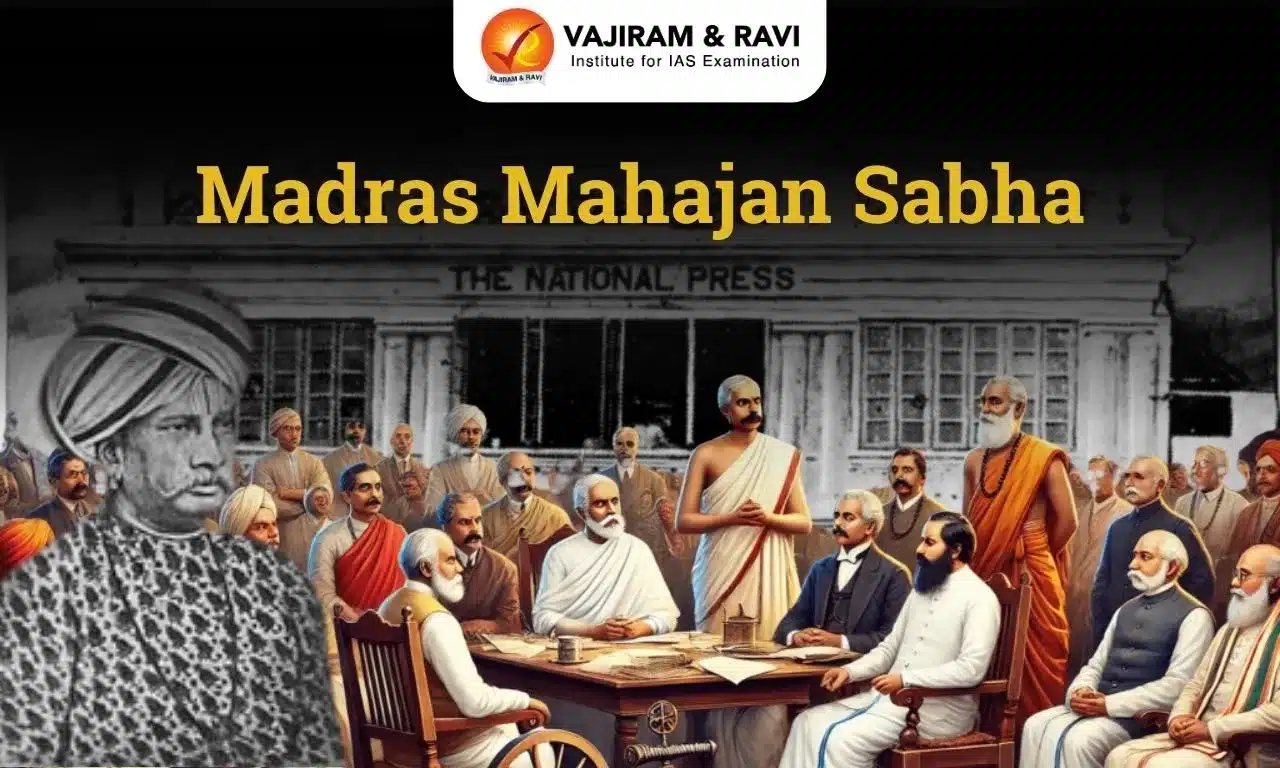
The Madras Mahajana Sabha, established in May 1884, was one of colonial India's first political organisations and the precursor of the Indian National Congress. It was founded at Ellis Road Junction on Mount Road in Madras (modern-day Chennai) and was instrumental in shaping the Indian nationalist movement in the South.
With its moderate yet firm stance on self-governance, civil rights, and economic reforms, the Sabha emerged as a powerful advocate for India's independence from British rule. The Madras Mahajana Sabha played an important role in India's freedom struggle, contributing to its independence in 1947.
Madras Mahajana Sabha Background
The Madras Mahajana Sabhawas established in 1884 by M. Veeraraghavachariar, G. Subramania Iyer, and P. Ananda Charlu after discussions at the Adyar Theosophical Society conference.
- Under the leadership of its first president, P. Rangaiah Naidu, the Sabha addressed national issues and advocated for India's independence from British rule.
- Initially regional, it soon symbolized South India's growing political consciousness and promoted moderate reforms.
- Drawing inspiration from the earlier Madras Native Association (1852) by Gajula Lakshminarasu Chetty, the Sabha carried forward the legacy of advocating for Indian rights and governance reforms.
- Its contributions were pivotal in establishing the Indian National Congress, which was crucial in the struggle for Indian independence.
- Sub-committees: The Sabha operated efficiently through five sub-committees focused on education, local self-government, public finance, economics, and public health, along with other miscellaneous matters.
Madras Mahajana Sabha Objectives
The objectives of Madras Mahajana Sabha were to represent public views and needs to the British government, suggest remedies, and devise measures to improve the condition of the people. These were aligned with the pursuit of national freedom, advocating for political and economic reforms, and promoting equality, justice, and social reforms.
- National Freedom: The primary goal of the Madras Mahajana Sabha was to work for India's independence from British rule. Its leaders believed in the importance of self-government and consistently advocated for the Indian people's right to freedom.
- Political Reforms: The Sabha advocated for legislative reforms, including the expansion of the Legislative Council and the Separation of powers between the executive and the judiciary.
- Economic Reforms: The Madras Mahajana Sabha campaigned for tax cuts as well as reductions in government and military spending, recognising the need to alleviate the Indian people's economic burden.
- It also called for the abolition of the Council of India in London, which represented British interests in Indian governance.
- Civil Service Reforms: The Madras Mahajana Sabha advocated for Civil Service examinations to be held simultaneously in England and India, allowing more Indians to compete for administrative positions in the colonial government.
- Social Reforms and Public Rights: The Sabha sought to promote fundamental rights, including equality, justice, and freedom, while opposing discriminatory policies and advocating for social reforms.


Madras Mahajana Sabha Features
The Madras Mahajana Sabha plays an important role in India's freedom movement by actively participating in political campaigns, patriotic exhibitions, and collaborations with other reformist groups, carrying on the legacy of early political activism.
- Political and social activities: The Madras Mahajana Sabha actively participated in the Salt Satyagraha of 1930 in Madras and played a key role in the Quit India Movement of 1942, during which many members faced brutal repression and imprisonment.
- Despite British crackdowns, the Sabha continued supporting the freedom struggle alongside the banned Indian National Congress.
- The Sabha had elected delegates to represent the annual sessions of the Congress, making it synonymous with those of the provincial Congress.
- It also played a significant role in establishing the Provincial Congress Committees in the South.
- Association with Gandhi: In 1896, Mahatma Gandhi addressed the Sabha about the challenges faced by Indians in South Africa, earning the members' deep admiration from that point onward.
- Patriotic Exhibitions and Public Mobilisation: The Madras Mahajana Sabha organized the All-India Khadi Exhibition and the Swadeshi Exhibition to promote nationalism, indigenous goods, and economic independence.
- Conferences and Collaborations: The Sabha's first conference in 1884 brought Tamil and Telugu delegates together to discuss governance reforms, setting a precedent for future political dialogue.
- In 1885, it collaborated with the Bombay Presidency Association and the Indian Association, to send a delegation to England, advocating for increased political participation.
However, after India’s independence (1947), the Sabha distanced itself from politics and concentrated only on cultural activities, besides ameliorating social problems.
Madras Mahajana Sabha UPSC PYQs
Question 1: Consider the following pairs: (UPSC Prelims 2017)
- Radhakanta Deb — First President of the British Indian Association
- Gazulu Lakshmi Narasu Chetty — Founder of the Madras Mahajana Sabha
- Surendranath Banerjee — Founder of the Indian Association
Which of the above pairs is/are correctly matched?
- 1 only
- 1 and 3 only
- 2 and 3 only
- 1, 2 and 3
Answer: (b)

 Last updated on Sep, 2026
→ UPSC 2027 Notification will be released on 13 January 2027 at upsconline.nic.in.
→ Asian Games 2026 are being held in Aichi-Nagoya, Japan, from 19 September to 4 October.
→ Check out the latest UPSC Syllabus here.
→ Download UPSC Model Answers for Mains 2026
→ UPSC Mains Question Paper 2026 is out now for Essay & GS Paper 1, 2, 3 & 4.
→ UPSC Calendar 2027 has been released.
→ Enroll in Vajiram & Ravi’s UPSC Mains Test Series 2027 for structured answer writing practice, expert evaluation, and exam-oriented feedback.
→ Join Vajiram & Ravi’s UPSC Mentorship Program 2027 for personalized guidance, strategy planning, and one-to-one support from experienced mentors.
→ Go through the UPSC Mains Previous Year Papers to enhance your preparation.
→ UPSC has released UPSC Toppers List 2025 with the Civil Services final result on its official website.
→ Also check Best UPSC Coaching in India
Madras Mahajana Sabha FAQs
Q1. Who founded Madras Mahajan Sabha in 1884?+
Q2. Where is the headquarters of Madras Mahajan Sabha?+
Q3. Who was the secretary of the Madras Mahajana Sabha?+
Q4. What were the demands of the Madras Mahajana Sabha?+
Tags: madras mahajana sabha quest