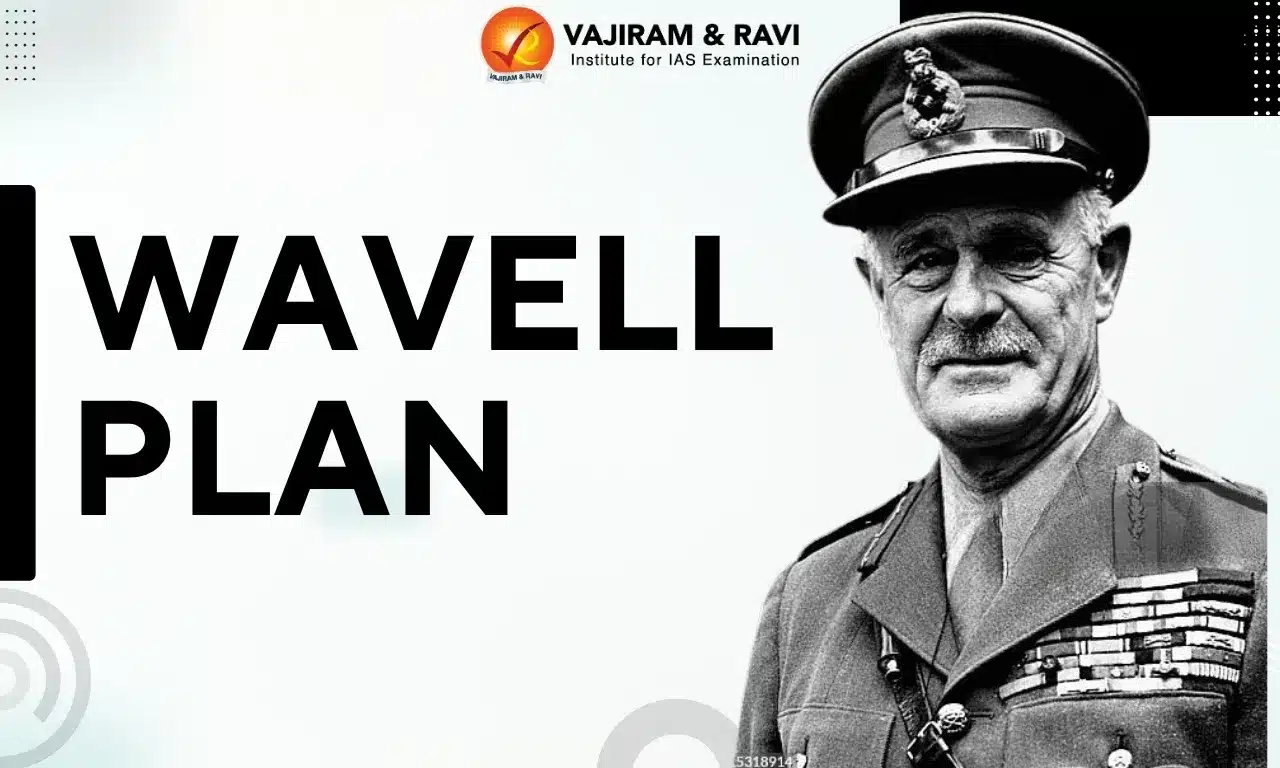
The Wavell Plan, named after the Viceroy of India, Lord Wavell, was first introduced during the Shimla Conference in 1945. It aimed to address India’s growing demand for self-governance by restructuring the Viceroy’s Executive Council, providing equal representation for both Hindus and Muslims. The plan sought to resolve the political deadlock by offering separate communal representations in governance.
The Shimla Conference was convened specifically to secure an agreement on the Wavell Plan. However, it failed as the Indian National Congress and the Muslim League could not reach a consensus. Disagreements, particularly over the League's demand to be the sole representative of Muslims, prevented the plan's implementation and led to the collapse of negotiations.
Wavell Plan - Shimla Conference Background
In the backdrop of the Second World War and increasing demands for Indian self-governance, the British government, under the leadership of Prime Minister Winston Churchill, recognized the urgency of resolving the constitutional stalemate in India.
- Furthermore, the British position in India was at best precarious due to the Quit India Movement and a rise in revolutionary activity.
- With the general election approaching in England in 1945, the ruling Conservative Party sought to appear committed to finding a solution to India's constitutional crisis.
In the backdrop of these factors, Churchill's government authorized Lord Wavell, the Viceroy of India, to initiate negotiations with Indian leaders. This led to the proposal of the Wavell Plan in June 1945.
Wavell Plan - Shimla Conference Proposals
The Shimla Conference was called in July 1945 to discuss the Wavell Plan. Leaders from the Congress, the Muslim League, and other political groups were invited. Among the notable figures present at the meeting were Mohammad Ali Jinnah, the leader of the All India Muslim League, and Maulana Abul Kalam Azad, the president of the Indian National Congress. The key proposals of the Wavell Plan discussed in the Shimla Conference:
- Reconstitution of the Viceroy’s Executive Council, with all members except the Viceroy and the Commander-in-Chief being Indians.
- Caste Hindus and Muslims to have equal representation in the Executive Council.
- Under the Government of India Act of 1935, the reconstituted Council would function as an interim government that would not be accountable to the Central Assembly.
- The Governor-General would exercise his veto based on the advice of ministers.
- Political parties were expected to submit a joint list of nominees for the Executive Council. If they could not agree, separate lists could be submitted.
- Negotiations for a new constitution were to be considered after the war ended.
Wavell Plan Congress Stand
The Congress strongly opposed the Wavell Plan, viewing it as an attempt to limit the party’s representation to only caste Hindus. Congress insisted on its right to nominate members from all communities, arguing that it represented the interests of all Indians, not just Hindus. Abul Kalam Azad’s presence as Congress's representative at the Shimla Conference underscored their commitment to including Muslim voices.
Wavell Plan Muslim League Stand
The Muslim League demanded that all Muslim members of the Executive Council be its nominees, fearing that including other minority representatives—such as those from the Depressed Classes, Sikhs, and Christians—whose interests aligned with Congress, would reduce the League to a one-third minority. Additionally, the League sought a form of veto power in the council, insisting that decisions opposed by Muslims should require a two-thirds majority to be approved


Wavell Plan - Shimla Conference Failure
The fundamental reason for the failure of the Shimla Conference was the irreconcilable disagreement between the Muslim League and the Congress. Jinnah's insistence on the Muslim League being the sole representative of Muslims clashed with Congress's broader claim to represent all Indians. Despite Wavell's efforts to mediate, the conference ended without an agreement, further entrenching the political divide. This failure marked a significant step toward the eventual Partition of India, as the Muslim League became more determined in its pursuit of a separate Muslim state.

 Last updated on Oct, 2026
→ UPSC 2027 Notification will be released on 13 January 2027 at upsconline.nic.in.
→ Check Nobel Prize 2026 Winners List here.
→ Download PIB PRiSM Monthly Magazine 2026 here.
→ Check UPSC Monthly Current Affairs Magazine The Recitals here.
→ Check out the latest UPSC Syllabus here.
→ Download UPSC Model Answers for Mains 2026
→ UPSC Mains Question Paper 2026 is out now for Essay & GS Paper 1, 2, 3 & 4.
→ UPSC Calendar 2027 has been released.
→ Enroll in Vajiram & Ravi’s UPSC Mains Test Series 2027 for structured answer writing practice, expert evaluation, and exam-oriented feedback.
→ Join Vajiram & Ravi’s UPSC Mentorship Program 2027 for personalized guidance, strategy planning, and one-to-one support from experienced mentors.
→ Go through the UPSC Mains Previous Year Papers to enhance your preparation.
→ UPSC has released UPSC Toppers List 2025 with the Civil Services final result on its official website.
→ Also check Best UPSC Coaching in India
Wavell Plan - Shimla Conference FAQs
Q1. What are the main features of the Wavell plan of 1945?+
Q2. Was Wavell Plan successful?+
Q3. What is the Wavell Plan?+
Q4. Why did the Simla Conference fail?+
Q5. Who proposed Wavell plan?+
Tags: quest wavell plan