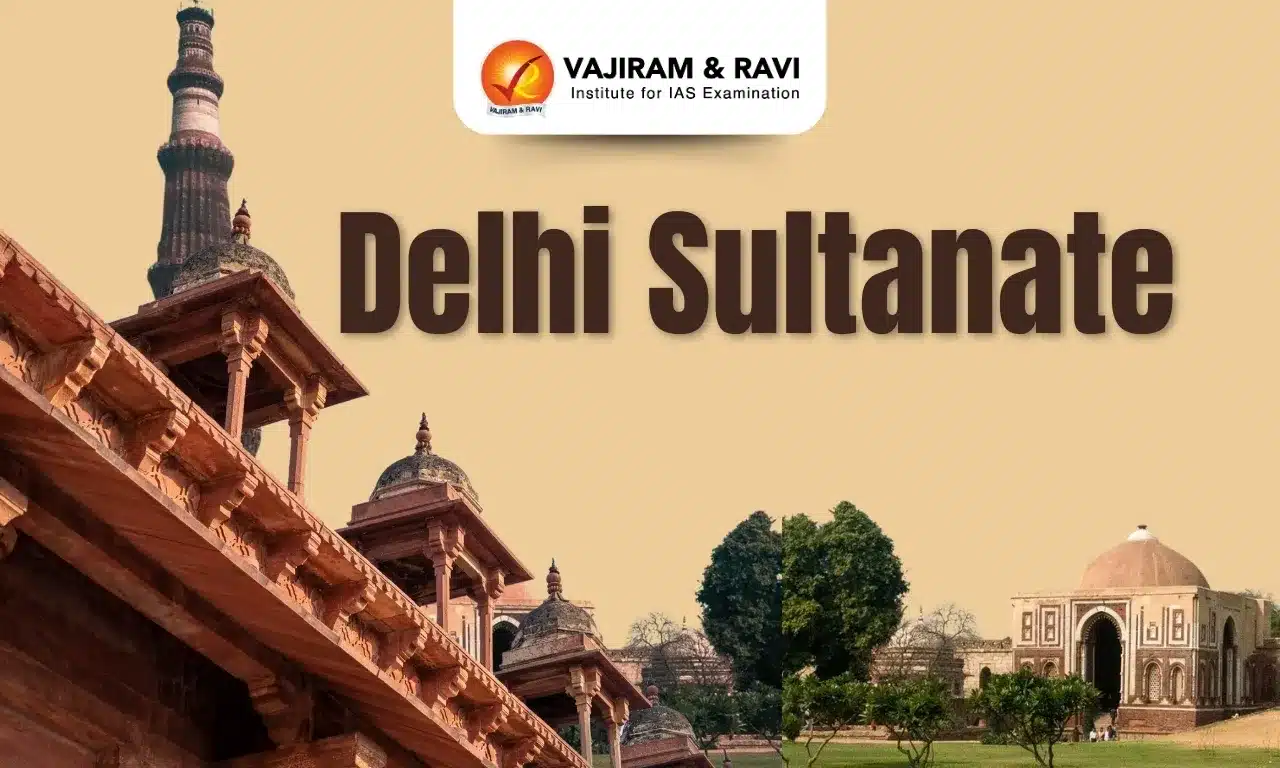
The Delhi Sultanate was a significant period in Indian history, spanning from around AD 1200 to 1526, during which five dynasties ruled substantial parts of North India. The sultanate reached its zenith both geographically and politically in the first half of the fourteenth century under Muhammad bin Tughluq, who died in 1351.
Over the course of three centuries, the Mamluk, Khilji, Tughlaq, Sayyid, and Lodi dynasties collectively formed the Delhi Sultanate, shaping the political and administrative landscape of medieval India.
Delhi Sultanate History
The Delhi Sultanate emerged after the Ghurid conquest of North India. Muhammad of Ghor defeated Prithviraj Chauhan at the Second Battle of Tarain in 1192, creating the political foundation for Turkish rule in northern India.
- Following Muhammad Ghori's death in 1206, his former slave and general, Qutb-ud-din Aibak, founded an independent empire centred in Delhi. This event is widely regarded as the commencement of the Delhi Sultanate.
- The Sultanate lasted around 320 years, with periodic territorial expansion, internal rebellions, Mongol threats, court intrigues, and dynastic upheavals. It concluded in 1526, when Babur defeated Ibrahim Lodi in the First Battle of Panipat.
Founder of Delhi Sultanate
Qutbuddin Aibak is often considered the founder of the Delhi Sultanate. He established his own rule in 1206 CE, following the death of Muhammad Ghori. However, Iltutmish is widely recognised as the Sultanate's true consolidator, having reinforced the Delhi-based kingdom, vanquished competitors, and obtained acknowledgement of his authority.
Delhi Sultanate Capital
Delhi became the principal political centre and capital of the Sultanate. However, the rulers also established or used different administrative centres. For example, Muhammad bin Tughlaq temporarily shifted the capital from Delhi to Daulatabad (Devagiri), although the experiment was eventually abandoned.
Delhi Sultanate Time Period
The Delhi Sultanate lasted from 1206 CE to 1526 CE, covering approximately 320 years. Its rule ended when Babur defeated Ibrahim Lodi at the First Battle of Panipat in 1526, establishing Mughal rule in North India.
Delhi Sultanate Dynasties
During the Delhi Sultanate period, five dynasties ruled Delhi for approximately three hundred years. All these dynasties are collectively referred to as the Delhi Sultanate.
- Mamluk Dynasty (AD 1206–AD 1290) (popularly known as the slave dynasty)
- Khilji Dynasty (AD 1290–AD 1320)
- Tughlaq Dynasty (AD 1320–AD 1412)
- Sayyid Dynasty (AD 1412–AD 1451)
- Lodi Dynasty (AD 1451– AD 1526)
Important Rulers of Delhi Sultanate
The Delhi Sultanate (1206–1526) was ruled by five major dynasties. A few rulers played a particularly important role in its establishment, consolidation, expansion, administration, and eventual decline. Some important rulers are:
- Qutbuddin Aibak (1206–1210): Founder of the Delhi Sultanate; began the construction of Qutb Minar and established the early Turkish rule in North India.
- Iltutmish (1211–1236): Consolidated the Sultanate, strengthened the Iqta system, introduced the silver Tanka and copper Jital, and secured recognition from the Abbasid Caliph.
- Ghiyasuddin Balban (1266–1287): Strengthened the monarchy through centralisation, strict discipline and suppression of rebellious nobles; strengthened frontier defence against the Mongols.
- Alauddin Khalji (1296–1316): Expanded the Sultanate extensively, resisted Mongol invasions, introduced market and price-control measures, and strengthened the military.
- Muhammad bin Tughlaq (1325–1351): Known for ambitious administrative experiments, including token currency, transfer of capital to Daulatabad, and expansion of the sultanate.
- Firuz Shah Tughlaq (1351–1388): Focused on irrigation, canals, public works, and establishment of new towns; promoted welfare-oriented measures.
- Sikandar Lodi (1489–1517): Consolidated Afghan power, expanded the kingdom, and founded Agra in 1504, making it an important administrative centre.
- Ibrahim Lodi (1517–1526): Last Sultan of Delhi; defeated by Babur at the First Battle of Panipat (1526), ending the Delhi Sultanate and beginning Mughal rule.


Delhi Sultanate Administration
The Delhi Sultanate's administration was divided into three levels: central administration, provincial administration, and local administration. The Sultan was the head of the administration and had complete military, administrative, and legal authority. A number of separate departments were created to look after different aspects of administration.
Central Administration
After the seat of the Sultan, the most important office in the Sultanate was the Diwani-Wizarat, headed by the wazir (Prime Minister). He looked after the financial organisation of the state, gave advice to the sultan, and on occasion, led military expeditions at the sultan’s behest.
- Minor Departments under this office:
- Mustaufi-i-Mumalik: Auditor General, in charge of expenditure,
- Mushrif-i-Mumalik: Accountant General, in charge of income,
- Majmuadar: Keeper of loans and balances from the treasury,
- Diwan-i-Waqoof: Introduced by Jalaluddin Khalji to supervise expenditure only.
- Diwan-i-Mustakhraj: set up by Alauddin Khalji to enquire into and realise arrears of revenue payments.
- Diwan-i-Amir Kohi: Set up under Muhammad bin Tughlaq for bringing uncultivated land into cultivation through state support.
- Diwan-i-Arz: It was instituted especially to look after the military organisation of the empire. Headed by the Ariz-i-Mumalik.
- Alauddin Khilji introduced the dagh (branding) and huliyah (description) system and cash payment to soldiers.
- Firuz Tughlaq did away with the system of dagh and huliyah; however, Muhammad Tughlaq continued the dagh system.
- Under Sikandar Lodi, huliyah was referred to as chehrah.
- Diwan-i-Insha: Headed by the Dabir-i-Khas to look after the department of royal correspondence.
- Diwan-i-Riyasat: An important office during the reign of Sultan Alauddin Khilji, it registered all commodity supplies and upheld market standards.
- Diwan-i-Risalat: It was headed by the Sadr-us-Sadr, who was responsible for the administration of justice and looked after religious matters.
- Diwan-i-Mazalim: Headed by the Amir-i-Dad in the absence of the Sultan. His role was to supervise the qadis, kotwal (police), and muhtasib (executive officer who supervised and enforced public morals and public conveniences).
- Small departments: intelligence [like the Barid-i-Mumalik], the royal household [headed by the Wakil-i-Dar], court ceremonies [led by the Amir-i-Hajib], and royal bodyguards [under the Sar-i-Jandar].
Provincial Administration
The Governor of the Province was the chief executive officer deputed by the centre. The Sultanate comprised provinces (iqta) placed in charge of governors called wali or muqti; later, provinces were partitioned into shiqs (administered by shiqdars) for administrative convenience, and then shiqs were partitioned into Pargana (local administration).
- Function of the Governor: collection of revenue, maintaining law and order and keeping the opposition to central authority under control, and maintaining a military unit under his command.
- Sahib-i-Diwan: maintained financial accounts of the provincial income and expenditure.
Local Administration
Several villages formed a pargana, but villages and parganas were independent units of administration and yet interrelated areas over which officials commanded administrative powers.
- The villages were under the administrative supervision of the 12 Administrative and Institutional Structures, following a set of officials:
- Muqaddam (the village headman)
- Patwari (village accountant)
- Khut (village headman)
- The important pargana officials were:
- Chaudhary (highest local rural magnate responsible to the government for collecting land revenue)
- Mutasarrif or amil (revenue collector)
- Karkun (accountant)
Army Organisation
Barani, in his Tarikh-i-Firoz Shahi, discusses the army organisation of the Delhi Sultanate. The contingents stationed at Delhi were called Hasham-i-qalb and included, among others, royal slaves and guards. Provincial contingents were called hasham-i-atraf.
- Garrisons are mentioned in the time of Qutbuddin Aibak, which were placed under Kotwals.
- The central government directly paid soldiers in cash during the Khiljis and Tughlaqs. Soldiers were sometimes paid through itlaq (drafts).
Delhi Sultanate Economy
Since the economy in the Indian subcontinent was predominantly agricultural, the primary source of income for the state was land revenue. To some extent, the taxation principles followed by the Delhi Sultanate were based on the Hanafi School of Muslim Law.
Revenue Administration
The state held large tracts of land [khalisa], which were tilled by farmers maintained by the centre and from where all the revenue came to the central treasury through the agency of officials called 'amils'.
- Hukm-i-misahat: Policy of actual measurement of land introduced by Alauddin Khilji.
- Mawas: Regions that refused to pay land tax or kharaj.
- Iqta: Revenue assignment that the muqti held at the pleasure of the Sultan.
- Khalisa: A territory whose revenues were directly collected for the Sultan's own treasury was designated khalisa.
- Kharaj (land tax): A share in the produce of the land and not a rent on the land.
- Revenue officers: Ummal, Mutasarrif, Mushrif, Muhassilan, Navisindagan.
- Agrarian measures of Alauddin Khilji:
- Increased revenue collection by enhancing the demand.
- Introduced direct collection, and peasants should pay tax in kind and not in cash.
- Agrarian measures of Mohammad Tughlaq:
- Introduced the practice of giving agricultural loans named Sondhar.
- To promote agriculture, a new ministry called the Diwan-i Amir-i Kohi was established.
- Firuz Tughlaq imposed a separate tax – jizya – distinct from kharaj on the peasants. He also imposed an irrigation tax (haqq-i sharb) in Haryana.
- Currency System: The coins continued to depict the goddess Lakshmi, a bull, and a horseman, etc. Only the name of the new ruler in a corrupt form got inscribed over it in Nagari script. These coins were called Dehliwal.
- Iltutmish (1210–36) introduced gold and silver tankas and a copper jital.
- Muhammad Tughlaq introduced Token Currency of copper and brass alloy and reckoned it at the value of a silver tanka. For the first time, a Persian inscription was found on a coin.
Delhi Sultanate Trade
The inland trade developed at two levels: Short-distance village-town trade in bulk commodities (food grains) and long-distance inter-town trade in high-value goods (luxury items).
- Foreign Trade: During the Sultanate period, overland and overseas trade flourished.
- Seaborne Trade: Gujarat was connected to the Persian Gulf (Hormuz, Basra ports) and the Red Sea (Aden, Mocha, and Jeddah). Through these ports, commodities were transported to the Mediterranean Sea, establishing connections with Europe.
- Imports and Exports: The two principal items of import were horses and precious metals, viz., gold and silver, especially silver.
- Brocade and silk were imported from Alexandria, Iraq, and China.
- The Sultanate of India exported grain and textiles primarily.
- Some of the Persian Gulf regions depended on India for their food supply. Besides, slaves were exported to Central Asia, indigo to Persia, and numerous other commodities.
- Commercial Classes: Sources of the Delhi Sultanate mention two types of merchants:
- Karwanis or Nayaks: merchants specialising in carrying grains.
- Multanis: long-distance trade was in the hands of these merchants.
Delhi Sultanate Religion and Society
In both Hindu and Muslim families, ceremonies started with the child's birth. Among the Hindus, upanayana samskara (marks a child's entrance into the fold of education) and dvija ceremonies were performed. Among the Muslims, Bismillah Khani (sending the child to the maktab) and circumcision ceremonies were performed.
- Marriage: Among the Hindus, marriage within the sub-caste was allowed, but intermarriage with other varnas was forbidden. As for the Muslims, there was freedom in choosing a wife or a husband.
- Caste: Caste was still the dominant category in marking social differences. The Smriti texts continued to emphasise that punishing the wicked and upholding the Chatur-varna (four-fold caste) social order by the force of arms was the duty of the Kshatriya.
- Position of Women: There was almost no change in the lifestyle of the upper-caste Hindu women during this period. Women were subordinate to men in every walk of life.
- The birth of a daughter was considered a symbol of dishonour for the father. Early marriages of girls were prevalent.
- Education: Education was limited to upper-class women. For example, Raziya shows that the Muslim aristocracy also imparted education to their daughters.
- Social evils: Ibn Battuta mentions the ‘Sati’ practice; however, prior permission for one wanting to be a sati had to be taken from the Sultan. The practice of Jauhar was also prominent among Rajputs.
- Property rights: Widows had the right to inherit and dispose of their son-less husband’s private property.
- Custom of purdah: Purdah was practised by both Hindu and Muslim aristocracy, keeping women secluded in inner quarters.
- Slaves and Servants: Most noblemen referred to themselves as the slaves of the Sultan. Slaves were generally bought for domestic service because of their special skills.
- Religious Aristocracy: The Sultanate administration accorded a special place to the ulema. Ulema helped the ruler in theological matters.
- Those associated with the administration of justice and religious law were known as 'dastarbahdan'.
Delhi Sultanate Technological Changes
The Delhi Sultanate period witnessed important technological developments in irrigation, textiles, paper production and construction. These innovations contributed to changes in agricultural productivity, craft production and urban life.
- Persian Wheel: The geared saqiya or Persian wheel enabled more efficient lifting of water from wells and supported the expansion of well irrigation.
- Spinning Wheel: The charkha emerged as an important textile technology during the Sultanate period. Its earliest clear literary reference in India is associated with Isami's Futuh-us-Salatin (1350).
- Improved Textile Technology: The period saw wider use of technologies such as the cotton gin, improving the processing of cotton and supporting the growth of textile production.
- Construction Technology: Greater use of the true arch, dome, and lime mortar transformed building techniques and enabled the construction of larger and more durable structures
- Irrigation Canals: Firuz Shah Tughlaq promoted the construction and renovation of canals to expand irrigation and agricultural production.
Delhi Sultanate Art and Architecture
The Delhi Sultanate (1206–1526) introduced and developed an Indo-Islamic architectural tradition by combining Persian and Central Asian elements with established Indian craftsmanship and building techniques. Key features include:
- Arches and domes: The widespread use of true arches and domes became a major feature of Sultanate architecture.
- Minarets: Tall minarets became prominent architectural elements, with the Qutb Minar being the most famous example.
- Indo-Islamic synthesis: Persian and Central Asian architectural forms were combined with Indian decorative motifs and craftsmanship.
- Calligraphy: Arabic inscriptions and Quranic verses were widely used as architectural decoration.
- Geometric and floral motifs: Buildings commonly featured geometrical patterns, floral designs, and lotus and bell motifs.
- Local craftsmanship: Indian stone-cutters and craftsmen played an important role in constructing and decorating Sultanate monuments.
Delhi Sultanate Decline
The decline of the Delhi Sultanate was a gradual process caused by weak central authority, succession conflicts, provincial revolts and the emergence of powerful regional states. The process intensified after the invasion of Timur in 1398 and culminated in the defeat of Ibrahim Lodi by Babur in 1526.
- Weak Successors: After strong rulers such as Alauddin Khalji and Muhammad bin Tughlaq, ineffective successors weakened central authority and administrative control.
- Provincial Revolts: Distant provinces increasingly asserted independence. The establishment of regional powers such as the Bahmani Kingdom(1347) and Vijayanagara Empire (1336) reduced Delhi's territorial influence.
- First Battle of Panipat (1526): Babur defeated Ibrahim Lodi, bringing the Delhi Sultanate to an end and establishing the foundation of the Mughal Empire.
Delhi Sultanate and Mughal Empire Difference
The Delhi Sultanate and the Mughal Empire were two major periods of Muslim rule in India, with the Delhi Sultanate lasting from 1206 to 1526 and the Mughal Empire ruling from 1526 to 1857.
|
Basis |
Delhi Sultanate |
Mughal Empire |
|
Time period |
1206–1526 |
1526–1857 |
|
Founder |
Qutb-ud-din Aibak |
Babur |
|
Major dynasties |
Mamluk, Khalji, Tughlaq, Sayyid, Lodi |
Mughal Dynasty |
|
Political base |
Turkish, Afghan, and Central Asian ruling groups |
Turko-Mongol dynasty with a broader imperial structure |
|
Administrative system |
Iqta system |
Mansabdari and jagirdari system |
|
Provincial officials |
Muqtis or iqtadars |
Subahdars, mansabdars, jagirdars |
|
Land revenue |
Kharaj, iqta assignments, local intermediaries |
Zabti system, Todar Mal’s revenue reforms, jagirs |
|
Military organisation |
Cavalry-based army, iqtadar contingents |
Mansabdari system, artillery, cavalry, imperial army |
|
Architecture |
Early Indo-Islamic style |
Mature Mughal style with large gardens, domes, marble, symmetry |
Delhi Sultanate UPSC PYQs
Q1: What were the major technological changes introduced during the Sultanate period? How did those technological changes influence Indian society? (UPSC Mains 2023)
Q2: With reference to Indian history, consider the following statements :
- The first Mongol invasion of India happened during the reign of Jalal-ud-din Khalji.
- During the reign of Ala-ud-din Khalji, one Mongol assault marched up to Delhi and besieged the city.
- Muhammad-bin-Tughlaq temporarily lost portions of the north-west of his kingdom to Mongols.
Which of the statements given above is/are correct? (UPSC Prelims 2022)
(a) 1 and 2
(b) 2 only
(c) 1 and 3
(d) 3 only
Ans: (b)
Q3: With reference to Indian history, which of the following were known as "Kulah-Daran"? (UPSC Prelims 2022)
(a) Arab merchants
(b) Qalandars
(c) Persian calligraphists
(d) Sayyids
Ans: (d)
Q4: Consider the following statements:
- It was during the reign of Iltutmish that Chengiz Khan reached the Indus in pursuit of the fugitive Khwarezm prince.
- It was during the reign of Muhammad bin Tughluq that Taimur occupied Multan and crossed the Indus.
- It was during the reign of Deva Raya II of the Vijayanagara Empire that Vasco da Gama reached the coast of Kerala.
Which of the statements given above is/are correct? (UPSC Prelims 2021)
(a) 1 only
(b) 1 and 2
(c) 3 only
(d) 2 and 3
Ans: (a)
Q5: With reference to medieval India, which one of the following is the correct sequence in ascending order in terms of size? (UPSC Prelims 2021)
(a) Paragana- Sarkar- Suba
(b) Sarkar-Paragana-Suba
(c) Suba-Sarkar-Paragana
(d) Paragana-Suba-Sarkar
Ans: (a)

 Last updated on Oct, 2026
→ UPSC 2027 Notification will be released on 13 January 2027 at upsconline.nic.in.
→ Check Nobel Prize 2026 Winners List here.
→ Download PIB PRiSM Monthly Magazine 2026 here.
→ Check UPSC Monthly Current Affairs Magazine The Recitals here.
→ Check out the latest UPSC Syllabus here.
→ Download UPSC Model Answers for Mains 2026
→ UPSC Mains Question Paper 2026 is out now for Essay & GS Paper 1, 2, 3 & 4.
→ UPSC Calendar 2027 has been released.
→ Enroll in Vajiram & Ravi’s UPSC Mains Test Series 2027 for structured answer writing practice, expert evaluation, and exam-oriented feedback.
→ Join Vajiram & Ravi’s UPSC Mentorship Program 2027 for personalized guidance, strategy planning, and one-to-one support from experienced mentors.
→ Go through the UPSC Mains Previous Year Papers to enhance your preparation.
→ UPSC has released UPSC Toppers List 2025 with the Civil Services final result on its official website.
→ Also check Best UPSC Coaching in India
Delhi Sultanate FAQs
Q1. What are the five dynasties of the Delhi Sultanate?+
Q2. Who was the founder of the Delhi Sultanate?+
Q3. Who defeated the Delhi Sultanate?+
Q4. What was the Delhi Sultanate known for?+
Q5. Who came first, the Delhi Sultanate or the Mughals?+
Tags: delhi sultanate quest UPSC Medieval History Notes