Government health schemes in India aim to achieve universal health coverage, financial protection and accessible, affordable and quality healthcare through insurance, primary healthcare, disease-control programmes, maternal and child services, medicines, diagnostics and digital health infrastructure. The policy framework has gradually shifted from disease-specific interventions towards a continuum of preventive, promotive, primary, secondary and tertiary healthcare.
Ayushman Bharat provides an umbrella framework for healthcare interventions, while the National Health Mission (NHM) addresses key public-health priorities through targeted programmes. Complementary initiatives, including Jan Aushadhi, free diagnostics and dialysis services, seek to reduce household expenditure and improve access. Despite progress in coverage, infrastructure and health outcomes, government health schemes in India continue to face challenges related to public financing, human resources, regional disparities and digital exclusion.
Government Health Schemes in India
Government health schemes in India are public programmes created to give affordable or free medical care to citizens. They aim to reduce high out-of-pocket medical costs for low-income families and vulnerable groups.
- Flagship initiatives like Ayushman Bharat PM-JAY offer cashless hospitalisation coverage up to ₹5 lakh per family per year.
- Other programmes, such as the Central Government Health Scheme (CGHS) and Employees' State Insurance (ESI), serve specific employee and worker segments.
Ayushman Bharat Umbrella Health Framework
Ayushman Bharat represents India's integrated approach to universal health coverage by combining comprehensive primary healthcare with financial protection for hospitalisation and digital health infrastructure.
- Ayushman Bharat–Pradhan Mantri Jan Arogya Yojana (AB-PMJAY): It provides health assurance of up to ₹5 lakh per family per year for secondary and tertiary hospitalisation, primarily covering vulnerable households.
- Since October 2024, the scheme has also been extended to all citizens aged 70 years and above through the Ayushman Vay Vandana initiative.
- Ayushman Arogya Mandirs (AAMs): They provide comprehensive primary healthcare by upgrading Sub-Health Centres and Primary Health Centres, covering services such as maternal and child health, communicable diseases, NCD screening, mental health, ENT and ophthalmic care, teleconsultation and wellness services.
- More than 1.86 lakh AAMs were functional by August 2026.
- Pradhan Mantri Ayushman Bharat Health Infrastructure Mission (PM-ABHIM): It strengthens India's health-system preparedness through surveillance laboratories, critical-care facilities, block public-health units and other health infrastructure.
- The mission has an approved outlay of approximately ₹64,180 crore for 2021–22 to 2025–26.
- Ayushman Bharat Digital Mission (ABDM): It provides the digital backbone of India's health system through ABHA health accounts, interoperable health records and registries of healthcare facilities and professionals, facilitating continuity and portability of healthcare services.
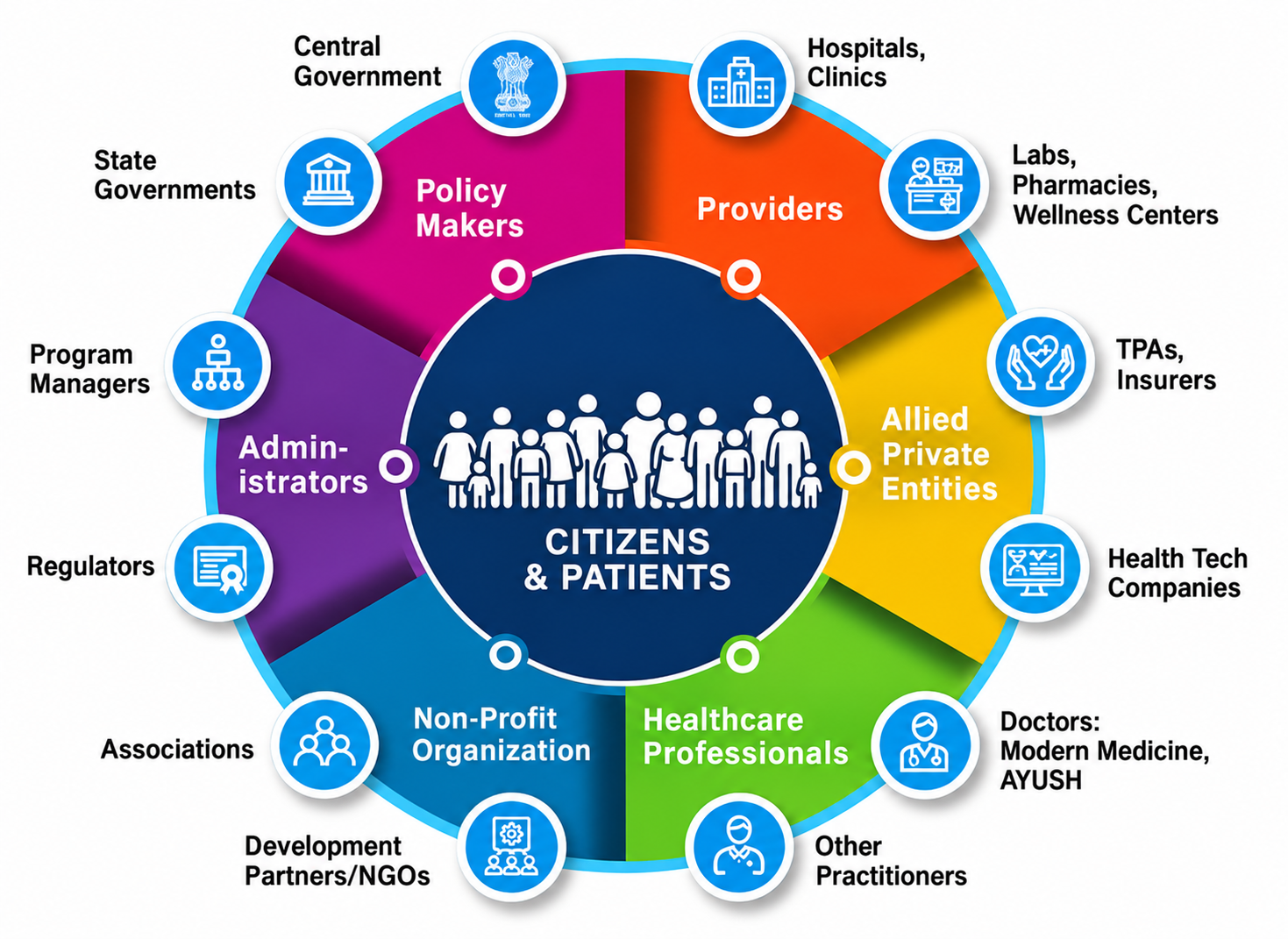
- ABDM Ecosystem is described in the diagram below.
National Health Mission - Targeted Public-Health Programmes
The National Health Mission (NHM) focuses on strengthening public healthcare and addressing major maternal, child, communicable, non-communicable and adolescent health challenges, particularly among vulnerable populations.
- Maternal health: Janani Suraksha Yojana (JSY) promotes institutional deliveries.
- Janani Shishu Suraksha Karyakram (JSSK) provides free and cashless services to pregnant women and sick newborns.
- Pradhan Mantri Surakshit Matritva Abhiyan (PMSMA) provides assured antenatal care, and SUMAN seeks to ensure dignified, respectful and zero-denial maternal and newborn healthcare.
- Child health: Home-Based Newborn Care (HBNC), Home-Based Care for Young Child (HBYC) and Rashtriya Bal Swasthya Karyakram (RBSK) provide home-based support, early identification and screening of health conditions among children.
- Immunisation: The Universal Immunisation Programme (UIP) provides vaccines against major vaccine-preventable diseases, while Mission Indradhanush, launched in 2014, seeks to increase full immunisation coverage.
- U-WIN, introduced as a digital platform, supports registration and tracking of vaccination services.
- Nutrition and adolescent health: Anaemia Mukt Bharat (AMB) follows a 7×7×7 strategy to address anaemia, while Weekly Iron and Folic Acid Supplementation (WIFS)
- Mothers' Absolute Affection (MAA) and Adolescent Friendly Health Centres address micronutrient deficiency, breastfeeding and adolescent health needs.
- Communicable diseases: The National TB Elimination Programme (NTEP), Pradhan Mantri TB Mukt Bharat Abhiyaan, malaria-elimination interventions and programmes targeting kala-azar, lymphatic filariasis and leprosy seek to reduce disease transmission, morbidity and mortality.
- Non-communicable diseases: The National Programme for Prevention and Control of Non-Communicable Diseases (NP-NCD) provides screening and management through District NCD Clinics, Day Care Cancer Centres and Cardiac Care Units, addressing the growing burden of chronic diseases.
- Mental health: Tele-MANAS, launched in October 2022, provides accessible tele-mental-health services through the toll-free number 14416, with services available in multiple Indian languages.
Schemes for Affordability and Healthcare Access
Affordability-focused government health schemes in India seek to reduce out-of-pocket expenditure by making essential medicines, diagnostics, dialysis and emergency transport more accessible to vulnerable populations.
- Pradhan Mantri Bharatiya Janaushadhi Pariyojana (PMBJP): It provides quality generic medicines at substantially lower prices through Jan Aushadhi Kendras, improving affordability for patients requiring regular medication.
- AMRIT Pharmacies: Established in 2015, Affordable Medicines and Reliable Implants for Treatment (AMRIT) outlets provide medicines, implants and other medical products at significantly discounted prices.
- Free Diagnostics Service Initiative: It seeks to provide essential diagnostic tests free of cost across public health facilities, with the number and range of tests varying according to the level of the facility.
- Pradhan Mantri National Dialysis Programme: It provides free dialysis services to eligible patients in public healthcare facilities and reduces the financial burden associated with long-term renal care.
- Emergency ambulance services - 108/102: These services provide emergency transportation and dedicated maternal and child healthcare transport, improving timely access to institutional care.
Digital Health and AI Initiatives
Digital health is increasingly becoming an important component of government health schemes in India, supporting health records, interoperability, telemedicine, claims processing and technology-enabled clinical decision-making.
- Ayushman Bharat Digital Mission (ABDM): It creates an interoperable digital health ecosystem through ABHA accounts, digital health records and healthcare-provider and facility registries.
- Aarogya Setu 2.0: The expanded platform focuses on personal health-record functionality and integrated access to digital health services.
- Ayushman Sarathi: It uses a conversational interface to help PM-JAY beneficiaries access information and navigate scheme-related services through a WhatsApp chatbot.
- National Health Claims Exchange (NHCX): It aims to standardise and streamline digital health insurance claims and improve interoperability among stakeholders.
- Drug Registry, Unified Health Interface (UHI) and e-Sushrut: These initiatives strengthen interoperability and digital connectivity across different components of the healthcare ecosystem.
- AI-enabled healthcare: Tools such as AI-based clinical decision support on eSanjeevani, Cough Against TB and MadhuNetrAI demonstrate the use of artificial intelligence for telemedicine, disease detection and screening.
- Strategy for AI in Healthcare for India (SAHI): It provides a national policy direction for responsible adoption of artificial intelligence in healthcare, with emphasis on innovation, accessibility and patient-centric applications.
Budgetary Support to the Health Sector
Public expenditure is a critical determinant of the capacity of government health schemes in India to deliver affordable and universal healthcare. The Union Budget 2026–27 provides substantial allocations to major health programmes.
- PM-JAY: The Budget Estimate for 2026–27 is ₹9,500 crore, compared with ₹9,000 crore in the Revised Estimate for 2025–26, representing an increase of approximately 5.56%.
- National Health Mission: It receives ₹39,390 crore in 2026–27, compared with ₹37,100.07 crore in the previous year's Revised Estimate.
- PM-ABHIM: Its allocation rises to ₹4,770 crore, representing a significant increase over the 2025–26 Revised Estimate of ₹2,845 crore.
- ICMR: The allocation increases to ₹4,000 crore, supporting biomedical research and health innovation.
- National AIDS and STD Control Programme: It receives ₹3,477 crore, supporting prevention, testing, treatment and control of HIV/AIDS and sexually transmitted infections.
- Overall health allocation: The Ministry of Health and Family Welfare receives approximately ₹10,653,000 in 2026–27, reflecting continued public investment in healthcare.
Government-backed Healthcare and Social Security Programmes
The Central Government Health Scheme (CGHS) and the Employees' State Insurance (ESI) are two major government-backed healthcare and social security programmes in India that serve distinct populations and operate under different funding models.
- Central Government Health Scheme (CGHS): A comprehensive healthcare programme introduced in 1954 to provide medical care to working and retired central government employees and their families.
- Target Beneficiaries: Central government employees, pensioners, Members of Parliament, Supreme Court/High Court judges, and their eligible dependents. Key benefits are listed below
- Outpatient Department (OPD) care, medicines, and diagnostic tests at CGHS wellness centres and empanelled private clinics.
- Inpatient/hospitalisation care and surgeries at government and empanelled private hospitals.
- Alternative medicine systems under AYUSH (Ayurveda, Yoga, Unani, Siddha, and Homoeopathy).
- Maternity, child health, and family welfare services.
- Funding: Financed primarily by the Central Government, with beneficiaries making a nominal monthly subscription based on their pay matrix level.
- Employees' State Insurance (ESI / ESIC): A self-financing social security and health insurance programme managed by the ESIC for organised and private sector workers.
- Target Beneficiaries: Employees earning up to ₹21,000 per month in covered commercial and industrial establishments. Key benefits are listed below.
- Comprehensive medical care for workers and dependents through ESI facilities.
- Financial cash benefits for sickness, maternity, and workplace injuries or disablement.
- Funding: Jointly contributed by employers and employees via wage percentages.
Government Health Schemes in India Impact
The expansion of government health schemes in India has improved healthcare coverage, financial protection, infrastructure and several key health outcomes, although progress remains uneven across regions and population groups.
Coverage and Financial Protection
- AB-PMJAY coverage: By June 2026, approximately 45.5 crore Ayushman Cards had been issued, with around 12.69 crore hospitalisations covered under the scheme, involving expenditure of approximately ₹1.92 lakh crore.
- Hospital network: Around 38,466 public and private hospitals were empanelled under AB-PMJAY, expanding access to secondary and tertiary healthcare.
- Household savings: Government estimates indicate savings of over ₹1.25 lakh crore for families in 2024–25 through PM-JAY.
- Out-of-pocket expenditure: The share of OOPE in Total Health Expenditure declined from 64.2% in 2013–14 to 43.4% in 2022–23 (NHA data), indicating that financial protection remains an unfinished challenge.
- Government Health Expenditure: Government health expenditure increased from 1.13% of GDP in 2014–15 to 1.43% in 2022–23, although it remains below the National Health Policy 2017 target of 2.5% of GDP.
Health Outcomes
- Maternal Mortality Ratio: It declined from 130 per 1,00,000 live births in 2014–16 to 87 in 2022–24, reflecting improvements in maternal healthcare.
- Under-five mortality: It declined from 48 per 1,000 live births in 2015 to 28 in 2023.
- Neonatal mortality: It declined from 28 per 1,000 live births in 2015 to 17 in 2023.
- Zero-dose children: The proportion declined from 0.11% in 2023 to 0.06% in 2024, indicating progress in immunisation coverage.
- TB incidence: It declined from 237 per 1,00,000 population in 2015 to 195 in 2023, with further decline reported during 2015–24.
- Malaria: Between 2015 and 2023, malaria cases and deaths reportedly declined by approximately 80.5% and 78.4%, respectively.
- Life expectancy: India's life expectancy increased substantially over the long term, reaching approximately 70.3 years in 2023, compared with 49.7 years in 1973.
Infrastructure and Human Capital Expansion
- Medical colleges: The number of allopathic medical colleges increased from approximately 387 to 818, expanding medical education and healthcare capacity.
- AIIMS: The number of AIIMS institutions increased from 6 to 22, strengthening tertiary healthcare and medical education.
- Medical seats: MBBS seats increased to approximately 1,28,976, while postgraduate seats reached around 86,360 in 2025-26.
- Jan Aushadhi network: The number of Jan Aushadhi Kendras crossed 18,646 by February 2026, expanding access to affordable generic medicines.


Government Health Schemes in India Challenges
Despite significant expansion of health schemes, financing gaps, human-resource shortages, implementation weaknesses, changing disease patterns, and digital exclusion continue to constrain the effectiveness of India's health system.
- Unmet NHP Target: The National Health Policy, 2017, envisaged increasing public health expenditure to 2.5% of GDP by 2025.
- However, combined Centre and State expenditure remains below this target, limiting the capacity to expand and strengthen public healthcare.
- Uneven Fiscal Responsibility: States increasingly bear a substantial share of public health expenditure, while the Union Government's relative contribution remains a concern, particularly for financially weaker states.
- Regional Disparities: Differences in fiscal capacity, healthcare infrastructure and administrative capabilities result in significant variations in the availability, quality and accessibility of healthcare across states and districts.
- Rural Specialist Shortage: Community Health Centres continue to face substantial vacancies among specialist doctors, particularly physicians, surgeons, obstetricians and paediatricians, weakening the delivery of specialised care in rural areas.
- Rural–Urban Imbalance: Healthcare professionals and advanced medical facilities remain disproportionately concentrated in urban centres, creating significant access barriers for rural, remote and underserved populations.
- Uneven Workforce Distribution: Aggregate doctor-population ratios can conceal considerable State-level and rural–urban disparities, as the availability of registered doctors does not necessarily reflect the actual distribution of practising professionals.
- PM-JAY Audit Concerns: The CAG's 2023 Performance Audit of PM-JAY identified irregularities in beneficiary databases and claims, including multiple beneficiaries linked to invalid mobile numbers and treatment claims involving beneficiaries recorded as deceased.
- Fraud and Leakage: Irregularities highlight the need for stronger beneficiary verification, hospital audits, data validation and technology-enabled fraud detection to ensure that public resources reach genuine beneficiaries.
- NCD Transition: Non-communicable diseases (NCDs) account for a major share of deaths in India, increasing the demand for long-term treatment, specialised care and sustained health-system financing.
- Rising Chronic Diseases: The increasing prevalence of diabetes, cardiovascular diseases, cancer and obesity requires continuous screening, early diagnosis, treatment and long-term follow-up rather than short-term interventions.
- Double Burden: India faces a dual challenge of unfinished communicable and maternal-child health priorities alongside a rapidly growing NCD burden, placing additional pressure on healthcare infrastructure and resources.
- Digital Divide: The rapid expansion of ABHA and ABDM does not automatically ensure equitable access to digital healthcare, particularly among populations with limited digital resources or capabilities.
- Barriers to Adoption: Lack of smartphones, inadequate internet connectivity, low digital literacy, limited awareness and difficulties in linking identity documents can restrict access, particularly for elderly, rural and economically vulnerable populations.
- Risk of Exclusion: Excessive dependence on app-based and digitally mediated healthcare services may unintentionally exclude those who have the greatest difficulty navigating digital systems, thereby creating a digital equity gap within the healthcare system.
Government Health Schemes in India Way Forward
India's next phase of health-sector reform should focus not merely on expanding coverage, but on ensuring that coverage translates into accessible, affordable, quality and accountable healthcare.
- Increase public health expenditure: Establish a credible roadmap towards the 2.5% of GDP target under the National Health Policy, while ensuring that additional spending strengthens core public-health systems.
- Strengthen rural healthcare workforce: Introduce better hardship allowances, improved working conditions, career incentives, rational deployment and appropriate linkages between rural service and postgraduate opportunities.
- Improve primary healthcare: Prioritise Ayushman Arogya Mandirs and NHM-based primary care, preventive services and early screening to reduce avoidable demand for expensive tertiary treatment.
- Strengthen NCD infrastructure: Expand District NCD Clinics, cancer screening, cardiac-care facilities and long-term treatment capacity alongside the expansion of insurance coverage.
- Improve scheme data integrity: Strengthen beneficiary verification, real-time claims monitoring, third-party audits and AI/ML-based fraud detection under PM-JAY.
- Bridge the digital divide: Combine ABDM expansion with assisted registration through ASHAs, Anganwadi workers and AAMs, especially in low-connectivity and low-literacy areas.
- Promote federal cooperation: Strengthen Centre–State coordination, predictable financing and state-specific health strategies to address regional disparities.
- Adopt an outcome-based approach: Evaluate schemes not merely through cards issued, hospitals empanelled or beneficiaries registered, but through reduced mortality, improved health outcomes, lower OOPE and patient satisfaction.
- Integrate preventive and curative care: Move towards a comprehensive health system that combines health promotion, prevention, early diagnosis, treatment, rehabilitation and palliative care across the life cycle.
- Improve quality and accountability: Strengthen accreditation, patient-safety standards, grievance redressal and independent evaluation of scheme performance.
Government Health Schemes in India UPSC PYQs
Q1. With reference to Ayushman Bharat Digital Mission consider the following statements: (UPSC Prelims 2022)
- Private and public hospitals must adopt it.
- As it aims to achieve universal health coverage, every citizen of India should be part of it ultimately.
- It has seamless portability across the country.
Which of the statements given above is/are correct?
(a) 1 and 2 only
(b) 3 only
(c) 1 and 3 only
(d) 1, 2 and 3
Ans: (b)

 Last updated on Oct, 2026
→ UPSC 2027 Notification will be released on 13 January 2027 at upsconline.nic.in.
→ Check Nobel Prize 2026 Winners List here.
→ Download PIB PRiSM Monthly Magazine 2026 here.
→ Check UPSC Monthly Current Affairs Magazine The Recitals here.
→ Check out the latest UPSC Syllabus here.
→ Download UPSC Model Answers for Mains 2026
→ UPSC Mains Question Paper 2026 is out now for Essay & GS Paper 1, 2, 3 & 4.
→ UPSC Calendar 2027 has been released.
→ Enroll in Vajiram & Ravi’s UPSC Mains Test Series 2027 for structured answer writing practice, expert evaluation, and exam-oriented feedback.
→ Join Vajiram & Ravi’s UPSC Mentorship Program 2027 for personalized guidance, strategy planning, and one-to-one support from experienced mentors.
→ Go through the UPSC Mains Previous Year Papers to enhance your preparation.
→ UPSC has released UPSC Toppers List 2025 with the Civil Services final result on its official website.
→ Also check Best UPSC Coaching in India
Government Health Schemes in India FAQs
Q1. Who is eligible for PMJAY?+
Q2. How has Ayushman Bharat contributed to India’s healthcare transformation?+
Q3. What is Pradhan Mantri Swasthya Suraksha Yojana (PMSSY)?+
Q4. What are the major challenges facing India's healthcare system?+
Q5. How can India improve healthcare delivery?+
Tags: government health schemes in india quest UPSC Social Justice Notes