Muhammad Ghori (1173-1206) was a prominent ruler of the Ghurid dynasty who was crucial in establishing Muslim rule in the Indian subcontinent. Born in present-day Afghanistan, he expanded his empire through military campaigns in northern India. His decisive victory over Prithviraj Chauhan in the Second Battle of Tarain (1192) marked a turning point, paving the way for further expansion.
Building on this success, Ghori launched another expedition in 1194, crossing the Yamuna River and advancing towards Kanauj. He faced Raja Jaichandra in the Battle of Chandawar and secured another decisive victory. These successive triumphs established Turkish rule in northern India, shaping its political landscape for centuries.
Muhammad Ghori History
Muhammad Ghori, also known as Muizzuddin Muhammad bin Sam or Shahabuddin Muhammad, ascended the throne of Ghazni in 1173 CE and played a key role in shaping mediaeval Indian history. His elder brother Ghiyathuddin ruled Ghur, but Ghori focused on power and expansion, recognising India’s vast wealth and its political, religious, social, and military weaknesses.
- Sultan of the Ghurid Empire: As co-ruler of the Ghurid dynasty with his brother Ghiyath al-Din Muhammad from 1173 to 1202 CE, and as sole ruler until his death in 1206 CE, Mu'izz al-Din Muhammad is credited with initiating Muslim rule in India and South Asia.
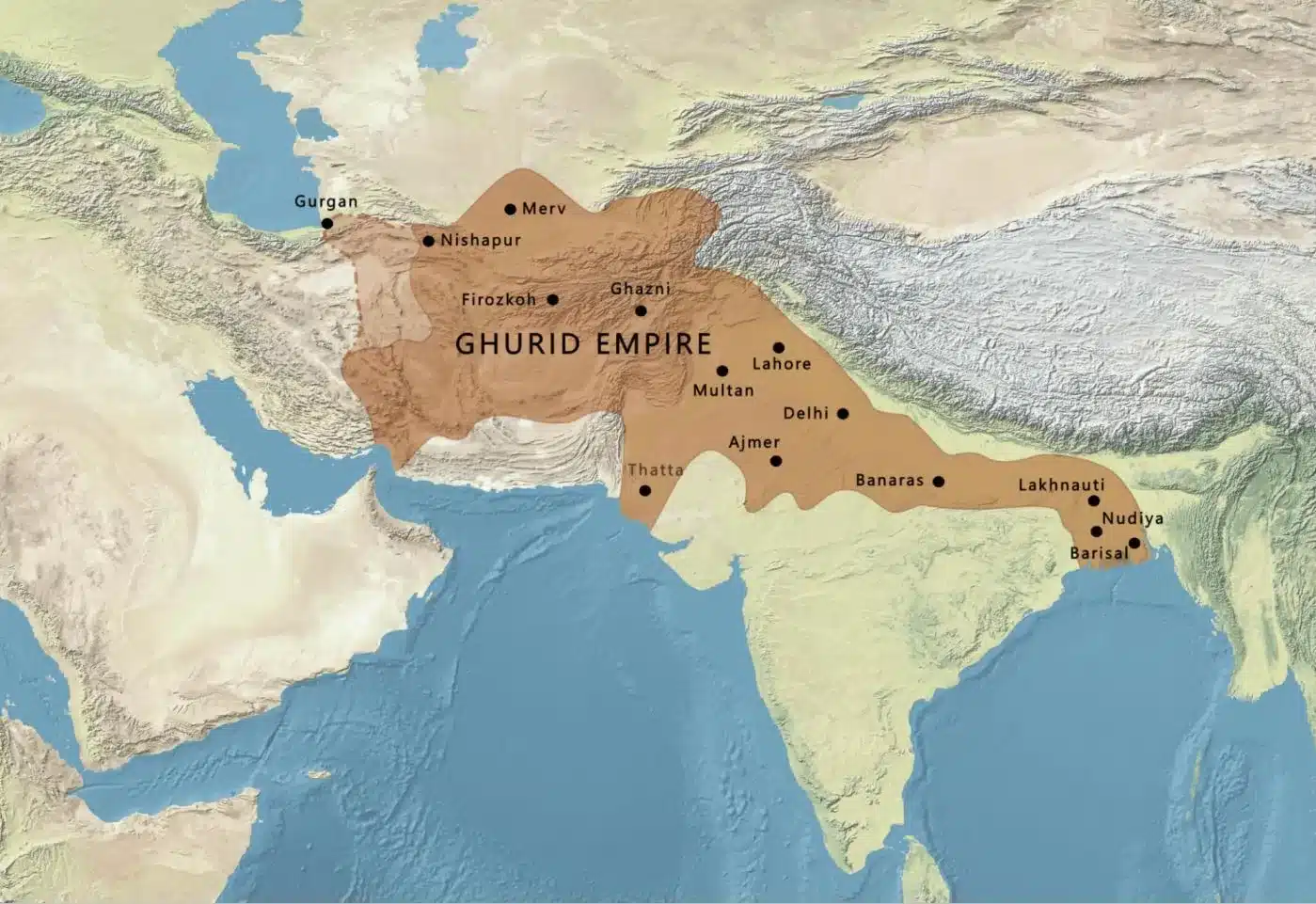
- Extent of Ghori’s Empire: His empire spanned parts of present-day Afghanistan, India, Pakistan, Bangladesh, Iran, Tajikistan, and Turkmenistan.
- Legacy: Through strategic conquests and the appointment of capable generals, Muhammad Ghori ensured stability, ultimately establishing the Turkish Sultanate, which left a lasting impact on Indian history.
Muhammad Ghori Ghurid Dynasty
The rise of the Ghurid dynasty took place amid significant geopolitical changes in the mid-12th century. During this period, a group of Turkish tribesmen, who followed Buddhist and pagan beliefs, shattered the Seljuk Turks, creating a power vacuum. The details of the Ghurid Dynasty are discussed in detail below:
- New Powers in the West: In this context, two new powers rose, namely the Khwarizmi Empire in Iran and the Ghurid Empire in northwest Afghanistan.
- Rise of the Ghurids: The Ghurids, who were the vassals of Ghazni, soon overpowered the Khwarizmi Empire under Sultan Alauddin, who earned the title Jahan-Soz ("the world burner") for ravaging Ghazni in retaliation for his brothers' mistreatment.
- Conflict with Khwarizmi Empire: The Khwarizmi Empire curtailed Ghurid ambitions in Central Asia, leading to disputes over Khorasan, which was eventually seized by the Khwarizm Shah.
- Shift of Focus to India: With no other options, the Ghurids turned their attention to India, where Muhammad Ghori’s conquests would alter the region's history.
Muhammad Ghori Conquests
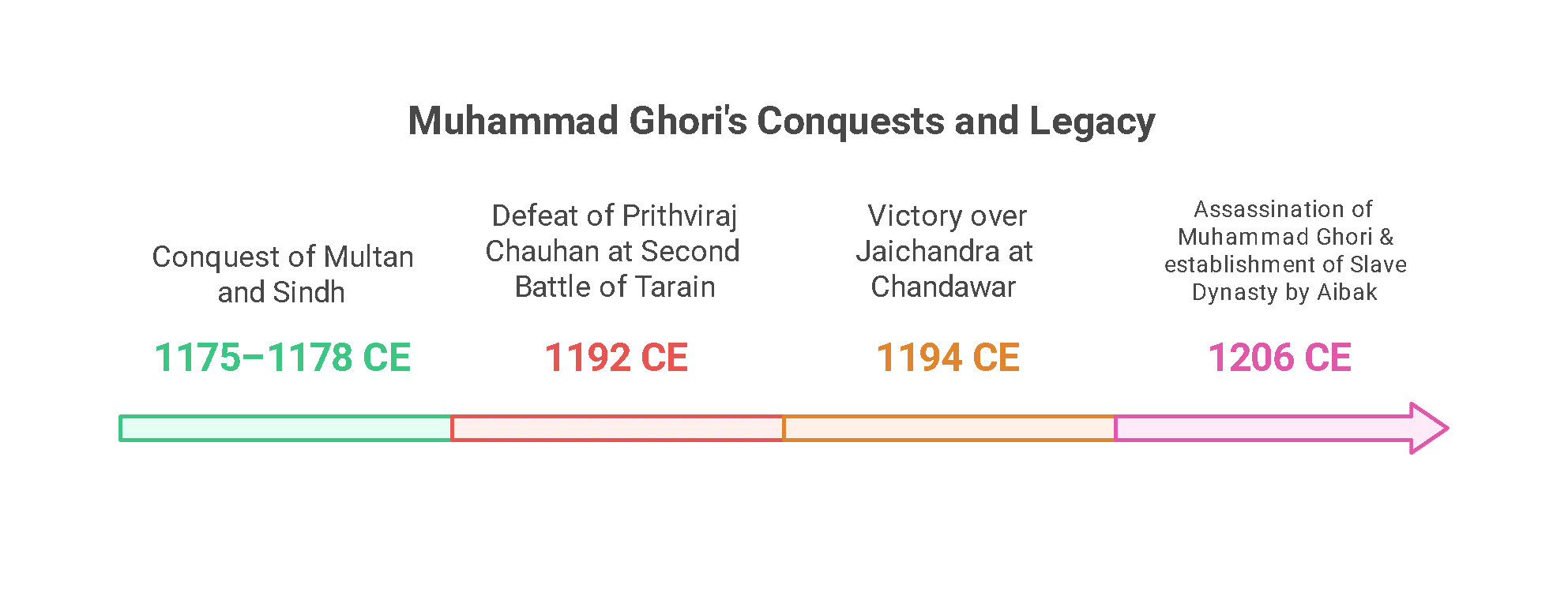
Muhammad Ghori, the real founder of the Islamic empire in India, first conquered Multan and Sindh (1175–1178 CE), then advanced into Punjab and Lahore. After defeating Prithviraj Chauhan at the Second Battle of Tarain (1192 CE), he captured Delhi and Ajmer and defeated Jaichandra at Chandawar (1194 CE).
- Delegating power to Qutbuddin Aibak, Ghori’s empire expanded further, but he was assassinated in 1206 CE, leaving Aibak to establish the Slave Dynasty.
Muhammad Ghori’s Conquest of Multan and Upper Sindh
Ghori launched his first expedition against Multan around 1175 CE, proceeding through the Gomal Pass, and achieved significant success. During the same campaign, he also captured Uchch in Upper Sindh from the Bhatti Rajputs and established a fort there, solidifying his control over the region.
Muhammad Ghori’s Conquest of Gujarat
Ghori attempted to conquer Gujarat in 1178 CE but was defeated by Chalukya Ruler Solanki Bhima II and Queen Naikidevi at the Battle of Kayadara near Mount Abu. Despite this setback, Ghori remained determined to establish a strong base in Punjab before continuing his conquests in India.
Muhammad Ghori’s Conquest of Punjab and Lahore
Ghori launched a series of conquests against the Ghaznavid possessions in Punjab between 1179 and 1186 CE. As a result, he conquered Peshawar in 1179 and Sindh in 1182 and eventually secured Punjab and Lahore. By around 1190 CE, having achieved control over Multan, Sindh, and Punjab, Ghori paved the way for his subsequent conquest of the Gangetic Doab.
Muhammad Ghori’s Conquest of Ganga Valley
After the First Battle of Tarain, Ghori returned to Ghazni, leaving the administration of Indian affairs to his trusted general, Qutbuddin Aibak. Over the next two years, the Turks successfully overran parts of the Upper Doab without facing significant opposition from the Gahadavalas.
- Expansion of Turkish Control: Between 1192 and 1206, Turkish forces expanded their control over the Ganga-Jamuna Doab, Bihar, and Bengal.
- Confronting the Gahadavalas: To solidify their hold on the region, the Turks first had to confront the powerful Gahadavala kingdom of Kanauj.
- The Gahadavala ruler, Jaichandra, had ruled peacefully for two decades but lacked military prowess, having suffered a previous defeat from the Sena king of Bengal.
Battle of Chandawar
The Battle of Chandawar was fought between Muhammad Ghori and Jaichandra, the ruler of Kannauj, after Ghori crossed the Jamuna with 50,000 cavalry and advanced towards Kannauj. Jaichandra nearly triumphed before being struck by an arrow, leading to his death and the complete defeat of his forces.
- Aftermath of Battle: After defeating Jaichandra, Muhammad Ghori moved towards Banaras, which was ravaged, and several temples were destroyed.
- Expansion of Turkish Control: The Turks expanded their control over a vast region, reaching the borders of Bihar.
- Foundation for Turkish Rule: The battles of Tarain and Chandawar laid the foundation for Turkish rule in northern India. However, consolidating these gains proved to be a challenging task, which took the Turks nearly fifty years.
- Qutbuddin Aibak's Role: After the Battle of Chandawar, Ghori appointed his trusted slave general, Qutbuddin Aibak, as the viceroy to manage Indian affairs.


Muhammad Ghori and Prithviraj Chauhan War
Ghori's expansion in the region coincided with the growing power of the Chauhans in North India. The Chauhan rulers had successfully defeated several Turkish invasions, most likely from the Punjab region and had taken control of Delhi from the Tomars by mid-century. Their expansion towards Punjab led to a direct clash with the Ghaznavid rulers, setting the stage for an inevitable conflict between Muhammad Ghori and Prithviraj Chauhan.
First Battle of Tarain
The First Battle of Tarain (1191 CE) marked a significant clash between Muhammad Ghori and Prithviraj Chauhan. After securing Punjab, Ghori aimed to advance into the Gangetic Doab, which brought him into conflict with Prithviraj, who had captured Delhi and sought to extend his control over Punjab and the Ganga Valley.
- Cause of Conflict: The conflict began over the control of Tabarhinda (Bhatinda).
- Outcomes: In the battle near Karnal (modern Haryana), Ghori’s forces were decisively defeated, and he narrowly escaped death.
- Although Prithviraj conquered Bhatinda, he failed to establish a strong garrison, allowing Ghori to regroup and strategise his next move.
Second Battle of Tarain
Second Battle of Tarain (1192 CE) became a pivotal moment in Indian history as Muhammad Ghori emerged victorious over Prithviraj Chauhan. Despite having a larger army, the Indian forces were outmatched by the superior organisation and skill of the Turkish cavalry. The details of the battle are mentioned below:
- Superior Turkish Forces: Led by Ghori, the Turkish army was highly mobile, utilising advanced technologies like horseshoes to prolong the life of horses and iron stirrups, which enhanced control and striking power during combat.
- The battle resulted in a heavy loss for Prithviraj’s forces, with the Turkish cavalry's superior organisation and skill proving decisive.
- Though Prithviraj Chauhan initially managed to escape, he was eventually captured near Saraswati (Sirsa).
- Temporary Rule of Ajmer: After his capture, Prithviraj was briefly allowed to rule Ajmer, as shown by coins bearing his name alongside Muhammad Ghori’s.
- Prithviraj’s Execution: Despite this reprieve, Prithviraj was later executed on charges of conspiracy, marking the end of his rule.
Muhammad Ghori's Other Campaigns
Muhammad Ghori, after securing initial victories in northern India, focused on consolidating and expanding his rule by launching further campaigns across different regions. These efforts were aimed at fortifying his stronghold in the upper Ganga valley and extending Turkish control.
- Campaigns in Western and Southern Regions: The Turks invaded the western and southern regions of the upper Ganga Valley, besieging strategic forts like Bayana and Gwalior in 1195-96 CE.
- Conquest of Bundelkhand and Chandela: The Turks seized regions like Bundelkhand, Khajuraho, Mahoba, and Kalinjar from the Chandela rulers, despite the Chandela state's power.
- Expansion into Eastern Regions: Muhammad Ghori's forces expanded into Bihar and Bengal, with Muhammad-bin-Bakhtiyar Khalji (another general of Muhammad Ghori) conquering Bihar in 1197 CE and Bengal in 1202 CE while also destroying the Nalanda University and Vikramshila university.
- Muhammad-bin-Bakhtiyar Khalji was then officially appointed as the governor of Bengal.
- Conflict with the Khwarizmi Empire (1203): In 1203, Muizzuddin suffered a major defeat at the hands of the Khwarizmi ruler, which forced the Ghurids to abandon their ambitions in Central Asia. This defeat, however, allowed the Turks to concentrate solely on consolidating their gains in India.
Muhammad Ghori Cultural Influence
Muhammad Ghori's campaigns in India led to cultural exchange between the Islamic world and the Indian subcontinent, impacting art and architecture. The various developments under his rule are mentioned below:
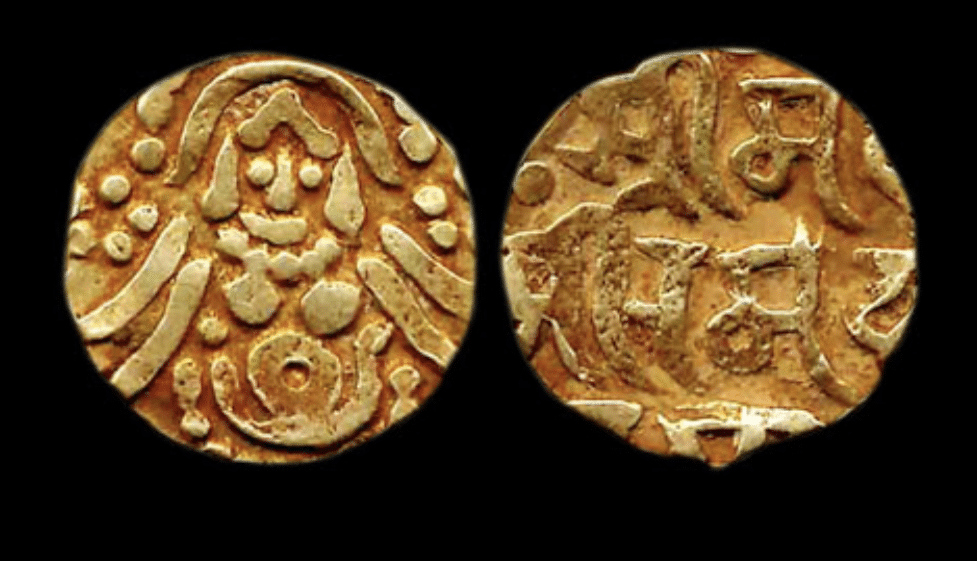
- Coins: He issued ‘Lakshmi type’ coins where the Goddess is on one side and his name in Nagari on the obverse side. He also issued coins after defeating a ruler.
- For example, after defeating Prithviraj in the Second Battle of Tarain, Ghori minted coins that closely resembled Prithviraj's coins.
- The coins had “Prithvirajadeva” on one side and the words ”Sri Muhammad Sam” on the other.
- Architectural Developments: Adhai-din-ka-Jhonpra, built on the order of Muhammad Ghori in 1198, was once a Jain temple but was later restored as a mosque.
- Ghori erected seven arched walls and engraved them with calligraphic verses from the Holy Quran, adding to its fascinating legends.
Muhammad Ghori Death
Muhammad Ghori's defeat in Central Asia led to various opponents rising against him in India, including the Khokhars, a fierce tribe from western Punjab. They severed communication between Lahore and Ghazni, prompting Ghori to lead his final campaign in 1206.
- Final Campaign Against the Khokhars (1206): Ghori launched a punitive campaign, employing large-scale massacres to crush the rebellion.
- Death of Muhammad Ghori (1206): After successfully quelling the Khokhars, Ghori was assassinated by a fanatic from a rival sect on his return journey to Ghazni.

 Last updated on Oct, 2026
→ UPSC 2027 Notification will be released on 13 January 2027 at upsconline.nic.in.
→ Check Nobel Prize 2026 Winners List here.
→ Download PIB PRiSM Monthly Magazine 2026 here.
→ Check UPSC Monthly Current Affairs Magazine The Recitals here.
→ Check out the latest UPSC Syllabus here.
→ Download UPSC Model Answers for Mains 2026
→ UPSC Mains Question Paper 2026 is out now for Essay & GS Paper 1, 2, 3 & 4.
→ UPSC Calendar 2027 has been released.
→ Enroll in Vajiram & Ravi’s UPSC Mains Test Series 2027 for structured answer writing practice, expert evaluation, and exam-oriented feedback.
→ Join Vajiram & Ravi’s UPSC Mentorship Program 2027 for personalized guidance, strategy planning, and one-to-one support from experienced mentors.
→ Go through the UPSC Mains Previous Year Papers to enhance your preparation.
→ UPSC has released UPSC Toppers List 2025 with the Civil Services final result on its official website.
→ Also check Best UPSC Coaching in India
Muhammad Ghori FAQs
Q1. Who killed Muhammad Ghori?+
Q2. Muhammad Ghori came from which country?+
Q3. How many times has Ghori attacked India?+
Q4. Who defeated Muhammad Ghori?+
Q5. Why did Prithviraj lose to Ghori?+
Tags: muhammad ghori quest UPSC Medieval History