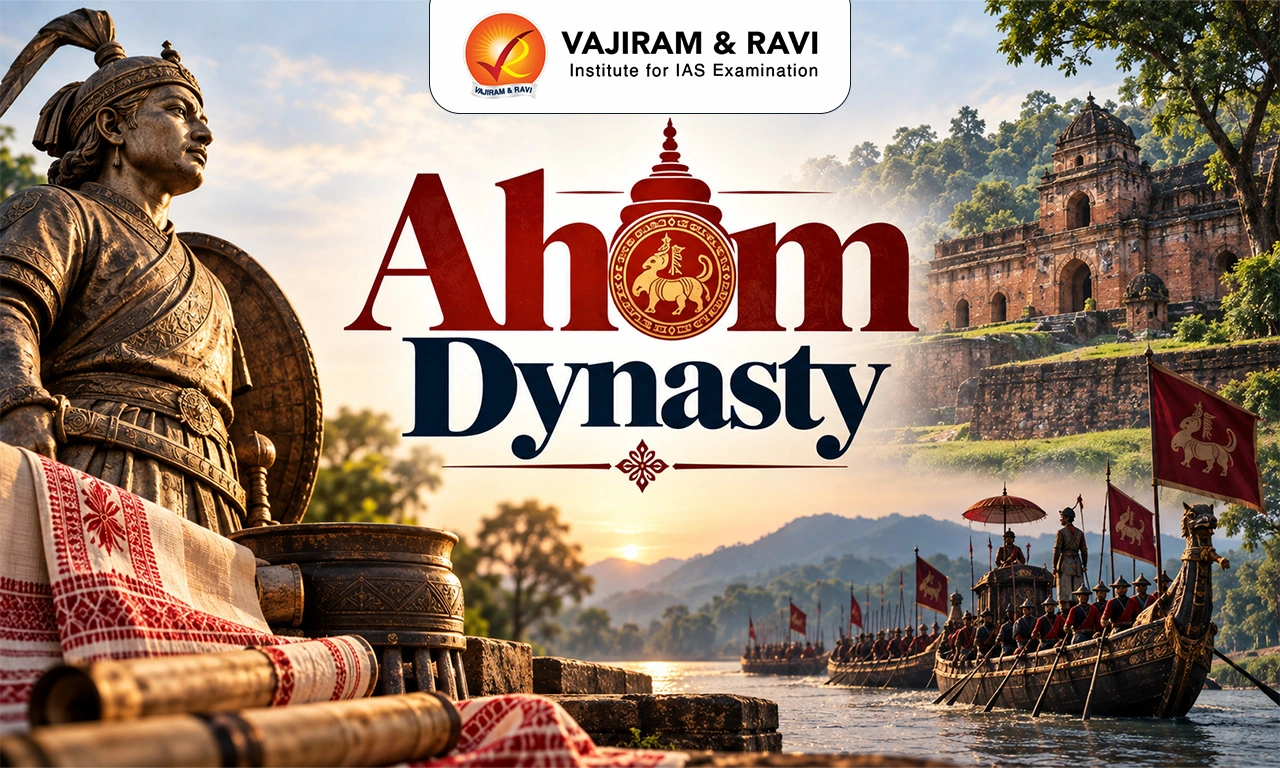
The Ahom Dynasty (1228–1826), founded by Sukaphaa, a Tai prince from Mong Mao, ruled the Brahmaputra Valley of Assam for nearly six centuries. They brought their own Tai beliefs and customs, later embracing Hinduism while preserving their unique cultural identity. Under great rulers like Suhummung (Dihingia Raja), Suklenmung (Garhgayan Raja), Pratap Singha, Jayadhvaj Singha, Gadadhar Singha, and Rudra Singha, the Ahom kingdom expanded territorially, strengthened its administration, and flourished culturally.
The Ahoms promoted Vaishnavism, Shaivism, and Shaktism, building magnificent temples and Satras, granting revenue-free lands, and appointing Bahatiya paiks for their service. Renowned for their military prowess and tolerance, the Ahoms repelled Mughal invasions, achieving a decisive victory at the Battle of Saraighat (1671) under Lachit Borphukan, leaving a lasting legacy of unity, culture, and sovereignty in Assam.
Ahom Dynasty History
The Ahom Dynasty was a medieval kingdom in the Brahmaputra Valley in Assam. It retained its sovereignty for almost six centuries. It had a profound effect on the political and social life in the region.
- Although later referred to as the Ahom kingdom during colonial and subsequent periods, it was a predominantly multi-ethnic state, with the Ahoms themselves comprising less than 10% of the population by the end of their rule.
- In the 17th century, the Ahoms repelled successive Mughal invasions, culminating in Lachit Borphukan’s decisive victory at Saraighat (1671), which defeated the Mughal Empire's invading forces.
- After a phase of turmoil, the Ahom kingdom regained stability under the Tungkhungia dynasty, founded by Gadadhar Singha.
- The kingdom’s strength declined with the Moamoria Rebellion and eventually succumbed to a series of Burmese invasions.
- With the defeat of the Burmese after the First Anglo-Burmese War and the Treaty of Yandabo in 1826, control of the kingdom passed into British hands.
Ahom Dynasty Time Period
The Ahom Dynasty ruled the Ahom Kingdom in Assam for nearly six centuries, from 1228 to 1826 CE. In the 17th century, the Ahoms successfully resisted Mughal expansion, notably at the Battle of Saraighat (1671). Their independent rule ended after the Treaty of Yandabo (1826).
Ahom Dynasty Founder
The founder of Ahom dynasty was Sukapha, a Tai prince who entered Assam in 1228 CE. He established the Ahom kingdom in the Brahmaputra Valley and laid the foundation of a powerful state that ruled Assam for nearly 600 years.


Ahom Dynasty Rulers
Several notable rulers shaped the trajectory of the Ahom Kingdom. Rulers such as Sukaphaa, Rudra Singha, and Gadadhar Singha played pivotal roles in the expansion and prosperity of the Ahom Kingdom.
Suhummung (Suhungmung) or Dihingia Raja (1497-1539)
Suhummung, son of Supimpha, was one of Assam’s most dynamic Ahom rulers.
- Shifting the capital to Bakata, his 42-year reign marked the first major expansion since Sukaphaa.
- He annexed the Bhuyan region (1512), defeated the Chutiyas (1520), and sacked Dimapur (1526), transforming the Ahom kingdom into a powerful multi-ethnic state.
- Suhummung also repelled Muslim invasions by Nusrat Shah (1527) and Turbak (1532), securing Ahom supremacy in the Brahmaputra valley.
- Emphasising inclusivity, he adopted the title Swargadeo, introduced Hindu courtly practices, and founded seven royal houses, laying a strong foundation for Assam’s political unity and dynastic stability.
Suklenmung or Garhgayan Raja (1539–1552)
Suklenmung (Garhgayan Raja), son of Suhummung, shifted the Ahom capital to Garhgaon and strengthened his father’s expanding kingdom.
- A capable ruler and military leader, he repelled Bir Chilarai’s Koch invasion (1546), consolidating Ahom control over the Chutiya and Kachari territories while keeping the Bhuyans under check.
- He promoted public works, including the Garhgaon tank, embankments at Kahikuchi and Changinimukh, and the Naga Ali road to the hills.
- Suklenmung also introduced the first Ahom coins, octagonal and inscribed with royal legends.
- Upholding his father’s Hindu-leaning yet inclusive religious policy, he maintained harmony between Ahom and Hindu traditions.
Sukhampha or Khora Raja (1553-1603)
Sukhampha, also called Khora Raja, held the longest reign in the Ahom dynasty, lasting 50 years.
- The defining event of his reign was the 1562 conflict with the Kochs, led by Chila Rai, whose forces advanced deep into Ahom territory.
- Forced to concede, the Ahom king signed a treaty acknowledging Koch supremacy, ceding land north of the Brahmaputra, and paying indemnity.
- However, the Ahoms soon regained Narayanpur.
- His reign also saw the spread of Vaishnavism in Assam, driven by saints like Sankardeva, Madhabdev, and Haridev.
Pratap Singha (1603–1641) or Burha Raja
Susengpha or Swargadeo Pratap Singha reigned in one of the most dynamic periods of Ahom history.
- Despite his age at accession, his 38-year rule was marked by territorial expansion, administrative reform, and cultural growth.
- He crushed Bharali and Subansiri rebellions, reasserted control over the Kacharis, and introduced the Posa system to maintain peace with hill tribes.
- Pratap Singha successfully resisted Mughal invasions under Jahangir and Shah Jahan, concluding with the Treaty of Koliabar (1639), which defined clear boundaries.
- A patron of religion and culture, he built Shiva temples at Dergaon and Bishnath, granted lands to Brahmins, and upheld Ahom traditions.
- His population census (Paikar Piyalar Kakat) showcased his administrative foresight and vision.
Jayadhvaj Singha (1648–1663)
After Pratap Singha’s reign, internal unrest led to the Sutamala ascending the throne in 1648, taking the Hindu name Jayadhvaj Singha.
- He strengthened Ahom authority by defeating Naga and Miri incursions (1650, 1655) and securing peace with the Jaintia kingdom (1657).
- Guided by Damodaria Brahmins, he undertook public works like roads and tanks.
- His reign was marked by the Mughal invasion under Mir Jumla (1662–1663).
- To reclaim Guwahati lost in the 1639 treaty, Jayadhvaj Singha advanced west during the Mughal succession crisis, capturing Guwahati and the Brahmaputra Valley up to the Sankosh River.
- In response, Aurangzeb dispatched Mir Jumla (1662), who captured Garhgaon after several Ahom retreats.
- However, floods and famine crippled the Mughal forces, enabling the Ahoms to recover.
- The conflict ended with the Treaty of Ghiladhari Ghat (1663), imposing a temporary Mughal victory and heavy indemnity, though the gains were short-lived and destructive.
Chakradhvaj Singha (1663–1670)
After Jayadhwaj Singha, the new ruler was Supungmung, who assumed the Hindu name Chakradhvaj Singha.
- During his reign, Mughal attacks resumed, which were met with fierce Ahom resistance under Bir Lachit Barphukan, the “Shivaji of Eastern Bharat.”
- King Chakradhvaj renewed the war, accusing the Mughals of violating the 1663 treaty by retaining occupied lands and prisoners.
- Determined to reclaim Guwahati, he appointed Lachit Barphukan to lead the campaign.
Ahom Dynasty Religion
The Ahoms maintained a liberal and syncretic approach with respect to religion.
- The Ahoms, originally Tai people, followed an ancestral faith blending Buddhism and animism.
- Influenced early by Hindu ideas, traced to a 9th-century monk Chandragupta of Magadha, they brought sacred texts like Min Mang Phura Lung and Pung-Gao-Kham (a Tai Ramayana) when Sukapha led them into Assam in the 13th century.
- After establishing their kingdom, the Ahoms gradually adopted Hinduism with a liberal, syncretic outlook.
- Under Sudangpha, Hindu rituals gained royal prominence. Later, Vaishnavism flourished with royal patronage from Jayadhwaj Singha (1648–1663) to Sulikpha (1679–1681).
- Despite this, Ahom rulers retained traditional customs, adopting dual names, one Sanskrit (Hindu) and one Tai, at coronation.
- From Gadadhar Singha’s reign, royal preference shifted toward Shaktism; he halted grants to Vaishnava satras and built the Umananda Shiva temple at Guwahati.
- Rudra Singha, a staunch Sakta, invited priests from Bengal but upheld religious tolerance, supporting Vaishnava monasteries and Ahom priests alike.
- Thus, the Ahom state fostered a tri-religious synthesis of Shaktism, Shaivism, and Vaishnavism, while preserving indigenous Tai-Ahom traditions, reflecting a uniquely liberal and inclusive religious policy.
Vaishnavism in Assam
The most significant religious development in the Ahom-era Assam was the rise of Vaishnavism under Srimanta Sankardeva (1449–1568).
- Emerging during a period dominated by Shakti worship and diverse cults, Sankardeva led a powerful religious reform movement that reshaped Assamese society.
- His philosophy, ‘Eksarana Nama Dharma’, preached devotion to a formless Supreme God, Vishnu, emphasising faith, equality, and surrender as the sole path to salvation.
- Rejecting caste distinctions, Sankardeva’s inclusive message united people from all communities through worship in the common Assamese language.
- He institutionalised his movement through three key institutions:
- Nama-Kirtana: Collective prayers promoting unity and devotion,
- Satra: Monastic centres for teaching, art, and administration,
- Namghar: Village prayer halls serving as both spiritual and social hubs.
- Sankardeva’s egalitarian and devotional movement transformed Assam’s religious, cultural, and social life, laying the foundation for a unified Assamese identity under the Ahoms.
Ahom Dynasty Administration System
The society of the Ahom Dynasty was deeply rooted in its customs and conventions, forming the foundation of its administrative structure. The Ahom administrative system differed from conventional models, lacking clear divisions of central, provincial, and local governance.
- King: Authority was centralised in the Swargadeo (King), assisted by the Patramantri, an elite council of ministers led by the three hereditary Gohains. The king ruled in consultation with them, following a collective and advisory governance model.
- Major decisions were discussed in the Barchora (Council Chamber).
- About 12 Phukans and 20 Baruas from noble families managed civil affairs, under the supervision of the Barbarua, aided by the Chorar Phukans.
- Officials: Supporting officials included Dihingia Phukan, Chetiya Phukan, Pani Phukan, Deka Phukan, Rajkhowas, and Panidihingias, along with Katakis (messengers), Kakatis (clerks), Dolois (astrologers), and Neogs (civil and military staff).
- Local Administration: Governors like Sadiya Khowa Gohain, Marangi Khowa Gohain, and Salal Gohain oversaw frontier defence, law and order, revenue, and justice.
- Royal family members often served as Meldagia or Melkhowa Rajas to manage local governance.
- Judicial System: The king’s court was the highest authority, with Nyaya Sodha Phukan presiding in the king’s absence. Appeals could move upward from the Barbarua and Phukan courts.
- At the village level, minor disputes were resolved in Namghars or village assemblies (Meldowan) through consensus or majority decisions, showcasing a participatory system of local justice.
Paik System or Khel System
The Paik System was a unique corvée (forced or obligation-based) labor and military recruitment system used by the Ahom kingdom in medieval Assam, India.
- Structure: Every male aged 16–50 rendered service to the state and formed its militia for three months annually.
- They were organised into khels, or occupational groups, based on their trades, such as boat-building or agriculture.
- Administrative Hierarchy: Bara (20 paiks), Saikia (100 paiks), Hazarika (1,000 paiks), and Phukan (6,000 paiks).
- Land Grants: Paiks were allotted two puras of land but had no hereditary rights.
Ahom Dynasty Architecture
The archaeological monuments of the Ahom dynasty can be classified into various types, including dol-devalayas (temples), royal palaces, stone bridges, moidams (burial mounds), garhs (forts), and aali (embankments).
- During the Ahom era, dol-devalayas (temple complexes) formed the largest group of pucca monuments.
- The earliest, Naag Shankar Devalaya (1480 AD), built under Swargadeo Susenpha, marks the beginning of this architectural tradition.
- Prominent examples include the Siva Dol, Devi Dol, Vishnu Dol, Ganesh Mandir, and Surya Mandir at Sibsagar, and the Joy Dol, Vishnu Dol, and Siva Dol at Joysagar.
- The Siva Dol at Dergaon features subsidiary shrines of Devi, Vishnu, Ganesh, and Surya.
- The Joy Dol at Joysagar is particularly noted for its superior craftsmanship, while the Nati Gukhai Dol near Gaurisagar exemplifies Ahom terracotta architecture in the Gauri style.
- Dol devalayas were structured in three parts: Naatghar, Jagmohan, and Garbhagriha, and often reflected North Indian Nagara style influences.
- Bricks and stones from the Naga Hills were used, bonded with a unique mortar of mustard oil, lime, jaggery, urad dal, fish, and copal.
- Major palaces of the Ahom period include
- Kareng Ghar (Garhgaon) and Talatal Ghar: Both seven-storeyed (three underground, three above, and one at ground level) showcase Mughal-inspired architecture and the engineering brilliance of the Ahoms.
- The Rang Ghar: A two-storied royal pavilion, it is adorned with arched entrances and carved crocodile motifs on its roof.
- Ahom architecture is distinguished by its rich sculptural ornamentation, depicting flora, fauna, deities, and human figures in stone, brick, wood, and terracotta.
Ahom Moidams - The Mound-Burial System of the Ahom Dynasty
Recently, Moidams from Charaideo, Assam, have been officially inscribed on the UNESCO World Heritage Sites List.
- Located at the foothills of the Patkai Ranges in eastern Assam, the site serves as the royal necropolis of the Tai-Ahom dynasty.
- Over a span of 600 years, the Tai-Ahom built moidams that harmonised with the surrounding hills, forests, and water bodies, creating a sacred landscape.
- Banyan trees, along with species used for coffins and bark manuscripts, were planted, and artificial water bodies were also developed.
- Ninety moidams – hollow vaults built of brick, stone or earth – of different sizes are found within the site.
- They contain the remains of kings and other royals together with grave goods such as food, horses and elephants, and sometimes queens and servants.
- The Tai-Ahom rituals of “Me-Dam-Me-Phi” and “Tarpan” are practised at the Charaideo necropolis.
- Although moidams exist in various parts of the Brahmaputra Valley, the ones located at this site are considered truly exceptional.
Ahom Dynasty Literature
Ahom literature is primarily composed of Buranjis, which are considered valuable assets in the Ahoms' history. The subject matter that these Buranjis reflect is described below:
- Buranjis include discussions of the political events of their time, and they accurately capture the dates of important historical events, descriptions of various wars, their strategies, results, etc.
- The life stories of the kings, queens, ministers, and other people from the royal family, direct speech of these people, and the description of the dynasties, etc., are included in the Buranjis.
- The Buranjis provide detailed accounts of warfare, weaponry, official records, royal titles, and other aspects of the Ahom court.
- The Buranjis about the neighbouring states give us a picture of the various events of those places and the political relationship between the states.
- The language used for writing Buranji is basically oral prose language.
Ahom-Mughal Conflict
The Mughal emperors Jahangir, Shah Jahan, and Aurangzeb were driven by a strong ambition for political dominance and territorial expansion in Northeast India.
- The first clash between the Mughals and the Ahoms took place in 1615 during the Battle of Samdhara.
- The hostilities continued through several major engagements, including the Battle of Alaboi (1669) and the Battle of Saraighat (1671), and lasted until 1682, when the Ahoms achieved a decisive victory at the Battle of Itakhuli. This triumph ended Mughal attempts to control Assam permanently.
- Among these encounters, the Battle of Saraighat (1671) stands out as the last major Mughal effort to conquer Assam.
Battle of Saraighat
The Mughal Empire, seeking to capture Assam’s fertile and strategic lands, launched a major invasion in 1671 under Raja Ram Singh, advancing up to the Brahmaputra River.
- Despite being outnumbered and outgunned, Lachit Borphukan displayed remarkable strategic brilliance by using the Brahmaputra’s terrain to his advantage.
- He fortified the riverbanks with earthen embankments, creating strong defensive positions, and launched relentless attacks with a fleet of boats equipped with cannons and flaming arrows.
- The Mughals, though superior in numbers and weaponry, were overwhelmed by Lachit’s tactics and the Ahom army’s mastery of local geography.
- The decisive defeat forced Raja Ram Singh to retreat to Rangamati, ending Mughal expansion into Assam.
- The Battle of Saraighat stands as a lasting testament to Lachit Borphukan’s courage, leadership, and devotion to his homeland, after which the Ahoms fortified Guwahati to secure their eastern frontier permanently.
Ahom Dynasty Decline
Ahom Kingdom, after nearly six centuries of political dominance in Assam, gradually weakened because of internal conflicts, administrative disruption, the Moamoria Rebellion, and repeated Burmese invasions. The decline ultimately resulted in the loss of Ahom sovereignty following the Treaty of Yandabo in 1826.

 Last updated on Oct, 2026
→ UPSC 2027 Notification will be released on 13 January 2027 at upsconline.nic.in.
→ Check Nobel Prize 2026 Winners List here.
→ Download PIB PRiSM Monthly Magazine 2026 here.
→ Check UPSC Monthly Current Affairs Magazine The Recitals here.
→ Check out the latest UPSC Syllabus here.
→ Download UPSC Model Answers for Mains 2026
→ UPSC Mains Question Paper 2026 is out now for Essay & GS Paper 1, 2, 3 & 4.
→ UPSC Calendar 2027 has been released.
→ Enroll in Vajiram & Ravi’s UPSC Mains Test Series 2027 for structured answer writing practice, expert evaluation, and exam-oriented feedback.
→ Join Vajiram & Ravi’s UPSC Mentorship Program 2027 for personalized guidance, strategy planning, and one-to-one support from experienced mentors.
→ Go through the UPSC Mains Previous Year Papers to enhance your preparation.
→ UPSC has released UPSC Toppers List 2025 with the Civil Services final result on its official website.
→ Also check Best UPSC Coaching in India
Ahom Dynasty FAQs
Q1. Did Ahoms defeat Mughals?+
Q2. Who is the founder of the Ahom dynasty?+
Q3. Are Ahoms Hindu?+
Q4. Which Ahom king ruled for 21 days?+
Q5. Who was the last king of the Ahom Kingdom in Assam?+
Tags: ahom dynasty quest UPSC Medieval History Notes