




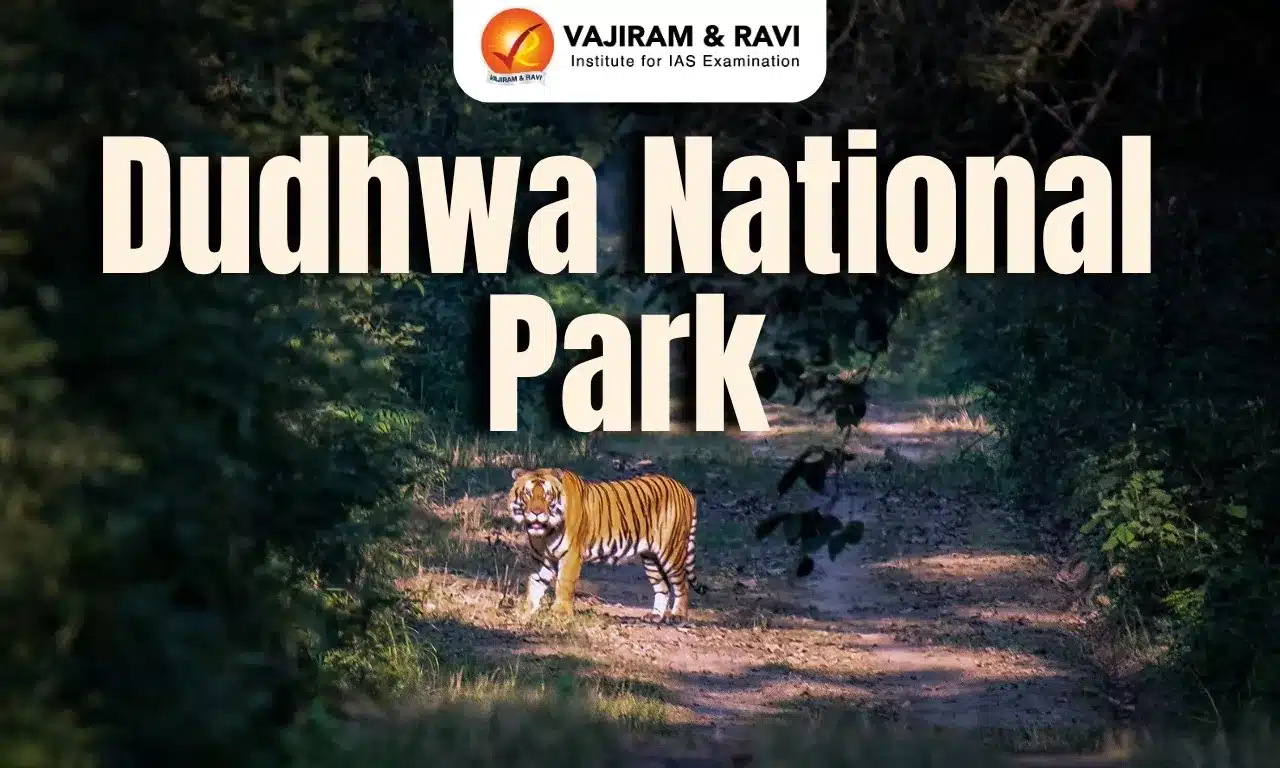
Dudhwa National Park is located in Lakhimpur Kheri district of Uttar Pradesh, near the Indo- Nepal border. It is an integral part of the Dudhwa Tiger Reserve, which also includes Kishanpur and Katerniaghat Wildlife Sanctuaries, collectively representing the rich biodiversity of the Terai region. The Dudhwa National Park is home to Bengal tigers, Indian rhinoceroses, swamp deer (barasingha), elephants, leopards, and numerous bird species. The park's ecosystem consists of moist deciduous forests, vast grasslands, and swamps, providing an ideal habitat for various wildlife species. It was declared as Dudhwa National Park in 1977 and later included in the Dudhwa Tiger Reserve in 1987.
Dudhwa Tiger Reserve
Dudhwa Tiger Reserve covers an area of 1,284.3 km². It includes three large forest fragments, with the Mohana River forming its northeastern boundary with Nepal. The reserve is unique as the only wildlife habitat in Uttar Pradesh where rhinos and tigers coexist. Classified as an IUCN Category II National Park, it serves as the last natural habitat of the Royal Bengal Tiger in the state, with a recorded population of 107 tigers as of 2021. The reserve is home to 38 mammal species, 16 reptile species, and a diverse range of bird species, making it one of the finest forests in India.
Dudhwa National Park History
Dudhwa Tiger Reserve was established in 1987 under Project Tiger when Kishanpur Wildlife Sanctuary and Dudhwa National Park were brought under its protection. Project Tiger, launched by the Government of India in 1973, aimed to conserve the declining tiger population. In 2000, Katarniaghat Wildlife Sanctuary was also included in the reserve.
After India's independence, the Dudhwa forest faced severe invasion, leading to large-scale agricultural conversion. The region, due to its proximity to Nepal, also became a hotspot for poaching and illegal wildlife trade.
Indian conservationist Billy Arjan Singh played a crucial role in the park’s conservation. In 1977, he urged then-Prime Minister Indira Gandhi to declare the area a wildlife sanctuary. His efforts led to the successful reintroduction of tigers and leopards into the park. He even brought a tiger cub named Tara from the UK's Twycross Zoo and, with government approval, released her into Dudhwa National Park. His conservation initiatives significantly shaped the wildlife protection efforts.





Dudhwa National Park Flora
The Dudhwa National Park region features diverse forest types, including Tropical Moist Deciduous Forest, Swamp and Riparian Forest, Dry Deciduous Forest, and Tropical Semi-Evergreen Forest.
The park's rich flora includes trees such as Terminalia tomentosa, Adina cordifolia, Shorea robusta, Eugenia jambolana, Dalbergia sissoo, and Bombax malabaricum. These trees contribute to the park’s ecological balance, supporting a wide range of animal and bird species.
Dudhwa National Park Fauna
Dudhwa National Park is home to a rich diversity of wildlife, including more than 47 mammal species, 35 reptile species, 10 amphibian species, 37 butterfly species, and 449 bird species. Rare mammals such as tigers, leopards, giant flying squirrels, pangolins, leopard cats, hispid hares, swamp deer, fishing cats, and one-horned rhinos thrive in its dense forests and grasslands.
The park also shelters important reptile species, including crocodiles, Indian tent turtles, terrapin batagur baska, Gangetic soft-shelled turtles, gharials, shell terrapins, eastern hill terrapins, and spotted terrapins.
Dudhwa Tiger Reserve Interesting Facts
- The Dudhwa Tiger Reserve is strategically divided into core, buffer, and corridor areas to ensure effective wildlife conservation.
- The core area consists of Kishanpur Wildlife Sanctuary and Dudhwa National Park, separated by 15 km of agricultural land.
- The corridor connects Kishanpur Wildlife Sanctuary, Dudhwa National Park, and Katerniaghat Wildlife Sanctuary, facilitating animal movement.
- The buffer zone includes the forests of South Kheri, North Kheri, and Shahjahanpur, providing an extended habitat for wildlife.
- Dudhwa Tiger Reserve is a significant representation of the Terai ecosystem.
- Conservation efforts led to the relocation of seven rhinos from Assam and Nepal in 1984-85.
- The reserve is also home to half of the global population of barasinghas and shelters over 450 bird species out of the 1350 found in India.
- Women weavers in the reserve benefit from technological advancements in their looms, enhancing their livelihood opportunities.

 Last updated on March, 2026
→ UPSC Final Result 2025 is now out.
→ UPSC has released UPSC Toppers List 2025 with the Civil Services final result on its official website.
→ Anuj Agnihotri secured AIR 1 in the UPSC Civil Services Examination 2025.
→ UPSC Marksheet 2025 is now out.
→ UPSC Notification 2026 & UPSC IFoS Notification 2026 is now out on the official website at upsconline.nic.in.
→ UPSC Calendar 2026 has been released.
→ Check out the latest UPSC Syllabus 2026 here.
→ UPSC Prelims 2026 will be conducted on 24th May, 2026 & UPSC Mains 2026 will be conducted on 21st August 2026.
→ The UPSC Selection Process is of 3 stages-Prelims, Mains and Interview.
→ Prepare effectively with Vajiram & Ravi’s UPSC Prelims Test Series 2026 featuring full-length mock tests, detailed solutions, and performance analysis.
→ Enroll in Vajiram & Ravi’s UPSC Mains Test Series 2026 for structured answer writing practice, expert evaluation, and exam-oriented feedback.
→ Join Vajiram & Ravi’s Best UPSC Mentorship Program for personalized guidance, strategy planning, and one-to-one support from experienced mentors.
→ Shakti Dubey secures AIR 1 in UPSC CSE Exam 2024.
→ Also check Best UPSC Coaching in India
Dudhwa National Park FAQs
Q1. Which city is Dudhwa National Park in?+
Q2. Why is Dudhwa National Park famous?+
Q3. What is the best time to visit Dudhwa National Park?+
Q4. Which is the nearest station to Dudhwa?+
Q5. How many tigers are in Dudhwa?+
Tags: dudhwa national park