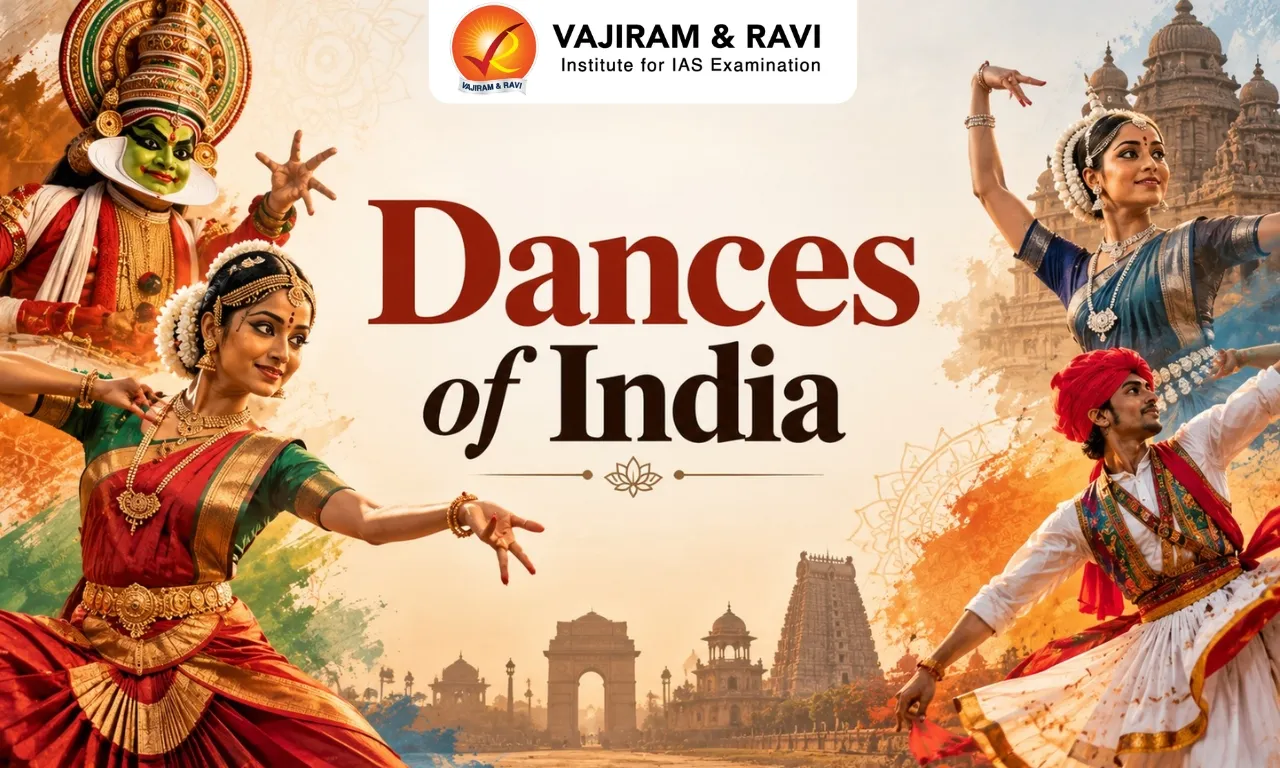
Folk dances of India are community-based traditions shaped by local customs, festivals, occupations, beliefs, and social practices. Passed mainly through generations, forms such as Bhangra, Garba, Bihu, Ghoomar and Lavani reflect India’s regional diversity and collective cultural identity.
Their significance extends beyond entertainment, as they strengthen community bonds, preserve oral traditions and provide livelihoods for performers. However, declining participation, weak intergenerational transmission, commercialisation and changing social spaces pose challenges to their continuity.
Folk Dances of India About
Folk dances are community-based dance traditions rooted in the everyday life, festivals, rituals, occupations and beliefs of different regions. Unlike highly codified classical forms, they generally retain strong local character and are transmitted through community participation and oral traditions.
- India has a wide range of folk dances, with forms varying according to regional customs, costumes, music, and social occasions.
- Bhangra, Garba, Bihu, Ghoomar, and Dandiya Raas are among the well-known examples, reflecting the cultural diversity of different parts of the country.
Also Check: Classical Dances of India
Folk Dances of India Historical Background
Folk dances in India developed over centuries through community life, agricultural practices, seasonal festivals, religious rituals, and local traditions.
- Ancient Period: Community dances developed alongside religious ceremonies, seasonal celebrations and collective social practices. Prehistoric rock paintings at Bhimbetka provide evidence of early human activities represented through group figures.
- Religious and Ritual Traditions: Over time, folk dances became associated with harvests, village festivals, local deities, and life-cycle ceremonies. For example, Garba evolved as a devotional tradition linked to Navaratri in Gujarat.
- Regional and Community Development: Different communities developed distinctive dance forms reflecting their occupations, beliefs and local histories. Chhau, for instance, incorporates martial movements, epic narratives and regional folklore in eastern India.
- Transmission Across Generations: Folk dances were traditionally preserved through observation, imitation, oral instruction and participation in community events rather than solely through formal institutions.


Famous Folk Dances of India Region-wise 2026
India’s folk dances vary across regions, reflecting local customs, festivals, occupations, beliefs, and community traditions.
North India
Northern folk dances largely express agrarian traditions, seasonal celebrations, weddings and community festivities.
- Bhangra (Punjab): Traditionally associated with agricultural celebrations and later developed as a widely recognised Punjabi folk dance.
- Giddha (Punjab): A prominent women’s folk dance performed during festivals, weddings and social gatherings.
- Ghoomar (Rajasthan): A graceful group dance marked by circular movements and colourful traditional attire.
- Rouf (Jammu and Kashmir): A traditional women’s dance performed during festivals and other celebratory occasions.
- Chholiya (Uttarakhand): A ceremonial dance traditionally associated with weddings and other auspicious occasions.
West India
Western India has diverse folk traditions closely linked with religious festivals, social celebrations, and regional cultural practices.
- Garba (Gujarat): A popular community dance closely associated with Navratri celebrations.
- Dandiya Raas (Gujarat): A rhythmic group dance traditionally performed with decorated sticks, particularly during Navratri.
- Lavani (Maharashtra): Combines energetic movements with music and poetic expression and forms an important part of Maharashtra’s folk tradition.
- Fugdi (Goa): A traditional women’s dance performed during festivals and social occasions.
South India
Southern folk dances are closely connected with local festivals, religious traditions, and community celebrations.
- Kolattam (Tamil Nadu): A group dance involving coordinated movements with decorated sticks.
- Karagattam (Tamil Nadu): A traditional dance involving the balancing of decorated pots on the head.
- Dollu Kunitha (Karnataka): A vigorous drum-based dance traditionally performed during community and religious occasions.
- Thiruvathirakali (Kerala): A women’s group dance performed in a circular formation during Thiruvathira celebrations.
- Dappu (Andhra Pradesh): A rhythmic folk performance centred on the traditional frame drum.
East India
Eastern folk dances reflect regional festivals, agricultural cycles, community traditions and distinctive performance practices.
- Dalkhai (Odisha): A prominent folk dance of western Odisha performed during festivals and community celebrations.
- Purulia Chhau (West Bengal): Combines vigorous movements, martial elements and elaborate masks.
- Jhumair (Jharkhand): A community folk tradition performed during festivals and social gatherings.
- Jat-Jatin (Bihar): A traditional folk dance reflecting aspects of rural social life.
North-East India
Folk dances of the North-East are closely connected with indigenous communities, agricultural cycles, festivals, and collective celebrations.
- Bihu (Assam): Closely associated with Bihu festivals and Assamese agricultural and cultural traditions.
- Wangala (Meghalaya): Associated with the Garo community and post-harvest celebrations.
- Cheraw (Mizoram): Known as the bamboo dance, involving coordinated movements between bamboo poles.
- Chang Lo (Nagaland): Traditionally associated with the Chang Naga community and festive occasions.
- Hojagiri (Tripura): Associated with the Reang/Bru community and noted for balancing movements.
Central India
Central Indian folk dances preserve the traditions of rural and tribal communities and are often connected with festivals, harvests, and social gatherings.
- Matki (Madhya Pradesh): Traditionally performed by women during social and festive occasions.
- Sua (Chhattisgarh): Primarily performed by women and associated with the harvest season.
- Karma (Madhya Pradesh and Chhattisgarh): Connected with the Karma festival and performed by several tribal communities.
List of Folk Dances of India With States 2026
Folk dances of India represent the customs, festivals, occupations, and cultural identities of different regions and communities. The following state-wise list highlights major folk dances of India.
|
State / UT |
Major folk and tribal dances |
|
Andhra Pradesh |
Dhimsa, Kolatam, Veeranatyam, Dappu |
|
Arunachal Pradesh |
Ponung, Popir, Aji Lamu, Bardo Chham |
|
Assam |
Bihu, Bagurumba, Jhumur |
|
Bihar |
Jat-Jatin, Jhijhiya, Kajari, Bidesia |
|
Chhattisgarh |
Panthi, Raut Nacha, Sua, Saila |
|
Goa |
Fugdi, Dhalo, Dekhni, Ghode Modni |
|
Gujarat |
Garba, Dandiya Raas, Tippani, Padhar |
|
Haryana |
Phag, Dhamal, Loor, Khoria |
|
Himachal Pradesh |
Nati, Chham, Chhapeli, Dangi |
|
Jharkhand |
Paika, Jhumair, Karma, Sarhul |
|
Karnataka |
Dollu Kunitha, Veeragase, Kamsale, Yakshagana |
|
Kerala |
Theyyam, Padayani, Kummattikali, Thiruvathirakali |
|
Madhya Pradesh |
Matki, Rai, Grida, Bhagoria |
|
Maharashtra |
Lavani, Koli, Lezim, Dhangari Gaja |
|
Manipur |
Lai Haraoba, Pung Cholom, Thang Ta, Khamba Thoibi |
|
Meghalaya |
Nongkrem, Wangala, Shad Suk Mynsiem, Laho |
|
Mizoram |
Cheraw, Khuallam, Chheihlam, Sarlamkai |
|
Nagaland |
Chang Lo, Zeliang, traditional Naga warrior dances |
|
Odisha |
Dalkhai, Ghumura, Mayurbhanj Chhau, Paika |
|
Punjab |
Bhangra, Giddha, Sammi, Luddi |
|
Rajasthan |
Ghoomar, Kalbelia, Bhavai, Kachhi Ghodi, Terah Taali |
|
Sikkim |
Singhi Chham, Yak Chham, Maruni, Chu Faat |
|
Tamil Nadu |
Kummi, Karagattam, Kavadi Attam, Kolattam |
|
Telangana |
Perini Shivatandavam, Gusadi, Lambadi, Dappu |
|
Tripura |
Hojagiri, Garia, Lebang Boomani |
|
Uttar Pradesh |
Charkula, Raslila, Nautanki, Dhobiya |
|
Uttarakhand |
Chholiya, Jhora, Chhapeli, Langvir Nritya |
|
West Bengal |
Purulia Chhau, Gambhira, Dhunuchi, Raibenshe |
|
Andaman and Nicobar Islands |
Nicobari community dances |
|
Chandigarh |
Bhangra, Giddha |
|
Dadra and Nagar Haveli and Daman and Diu |
Tarpa, Bhawada, Dhol |
|
Delhi |
Regional folk traditions; Bhangra and Giddha among community traditions |
|
Jammu and Kashmir |
Rouf, Dumhal, Kud, Bhand Pather |
|
Ladakh |
Jabro, Shondol, Cham |
|
Lakshadweep |
Lava, Kolkali, Parichakali |
|
Puducherry |
Kolattam, Kummi and regional Tamil folk dances |
Indian Folk Dances in UNESCO Intangible Heritage
India has several folk and traditional performing art forms recognised on the UNESCO Representative List of the Intangible Cultural Heritage of Humanity. As of October 2026, Garba of Gujarat, Chhau dance, Mudiyettu, and Kalbelia folk songs and dances of Rajasthan are among the Indian dance traditions inscribed on this list.
- Chhau Dance of Odisha, Jharkhand and West Bengal (2010): A traditional dance combining martial movements, storytelling and folklore. Some styles use elaborate masks, particularly in Seraikella and Purulia Chhau.
- Kalbelia Folk Songs and Dances of Rajasthan (2010): Performed by the Kalbelia community, this dance is characterised by swirling movements inspired by serpentine motions, accompanied by traditional folk music.
- Garba of Gujarat (2023): A devotional community dance performed especially during Navaratri in honour of the goddess. Participants traditionally dance in circular formations accompanied by rhythmic music and singing.
- Mudiyettu of Kerala (2010): A traditional ritual theatre and dance drama from Kerala that enacts the mythological battle between Goddess Kali and the demon Darika.
Folk Dances of India Significance
Folk dances of India are more than forms of entertainment; they preserve local traditions while connecting communities with their history, festivals, and social life.
- Cultural Heritage: Folk dances preserve regional customs, music, costumes, stories and performance traditions, sustaining India’s intangible cultural heritage.
- Community Identity: Regional dance forms strengthen a shared sense of identity by bringing communities together around common cultural practices.
- Festival and Ritual Life: Many folk dances are closely woven into harvests, festivals, weddings, and religious occasions, giving cultural expression to collective celebrations.
- Intergenerational Continuity: Regular community performance enables traditional knowledge, movements, songs and practices to pass from one generation to the next.
- Social Cohesion: Group performances create spaces for participation and interaction, strengthening community relationships and collective belonging.
- Livelihood Generation: Performances, festivals, cultural programmes and tourism create opportunities for dancers, musicians, artisans and associated cultural workers.
- Tourism Promotion: Distinctive dance traditions contribute to cultural tourism by offering visitors an insight into the heritage and social life of different regions.
Folk Dances of India Challenges
Folk dances of India face challenges from urbanisation, declining intergenerational transmission, commercialisation, and limited institutional support, threatening the preservation of traditional knowledge and regional cultural identities.
- Declining Community Participation: Industrialisation, changing lifestyles, and new media can reduce collective participation in traditional performances, weakening their connection with local communities.
- Weak Intergenerational Transmission: Traditional knowledge depends heavily on learning from experienced practitioners. When younger generations move away from traditional cultural spaces or show less interest, transmitting specialised techniques and associated practices becomes difficult.
- Economic Insecurity of Artists: Many traditional performers face limited and irregular livelihood opportunities, making sustained practice difficult, particularly where performances depend on local patronage.
- Commercialisation and Standardisation: Adaptation for tourism, entertainment and mass media can alter traditional forms. Excessive commercialisation may separate a dance from its original social, ritual or cultural context.
- UNESCO highlights the need to safeguard traditions while allowing them to remain living and evolving practices.
- Changing Cultural Spaces: Urbanisation and migration can reduce the village, temple or community spaces in which traditional dances were historically practised and transmitted.
- Limited Institutional Coordination: Effective preservation requires cooperation among communities, governments, cultural institutions, universities and NGOs.
Folk Dances of India Government Measures
The Government of India supports the preservation and promotion of folk dances of India through financial assistance, training, cultural institutions, festivals and documentation.
- Sangeet Natak Akademi: The Akademi supports folk and traditional performing arts through training, documentation, research, festivals and recognition of practitioners.
- Guru–Shishya Parampara: Financial assistance is provided to institutions and organisations for training programmes that help transmit traditional performing arts from experienced practitioners to younger generations.
- Financial Assistance: The Ministry of Culture provides financial grants up to ₹2.00 crores under the Financial Assistance to Cultural Organisations with National Presence component of the Kala Sanskriti Vikas Yojana (KSVY) to support groups preserving traditional, folk, and tribal performing arts.

 Last updated on Oct, 2026
→ UPSC 2027 Notification will be released on 13 January 2027 at upsconline.nic.in.
→ Check Nobel Prize 2026 Winners List here.
→ Download PIB PRiSM Monthly Magazine 2026 here.
→ Check UPSC Monthly Current Affairs Magazine The Recitals here.
→ Check out the latest UPSC Syllabus here.
→ Download UPSC Model Answers for Mains 2026
→ UPSC Mains Question Paper 2026 is out now for Essay & GS Paper 1, 2, 3 & 4.
→ UPSC Calendar 2027 has been released.
→ Enroll in Vajiram & Ravi’s UPSC Mains Test Series 2027 for structured answer writing practice, expert evaluation, and exam-oriented feedback.
→ Join Vajiram & Ravi’s UPSC Mentorship Program 2027 for personalized guidance, strategy planning, and one-to-one support from experienced mentors.
→ Go through the UPSC Mains Previous Year Papers to enhance your preparation.
→ UPSC has released UPSC Toppers List 2025 with the Civil Services final result on its official website.
→ Also check Best UPSC Coaching in India
Folk Dances of India FAQs
Q1. What are 7 popular folk dances in India?+
Q2. What are the 20 most popular dances in India?+
Q3. What is the main folk dance of India?+
Q4. What are the 10 most popular dances?+
Q5. Which folk dance is popular in India? +
Tags: folk dances of india quest UPSC Art and Culture Notes