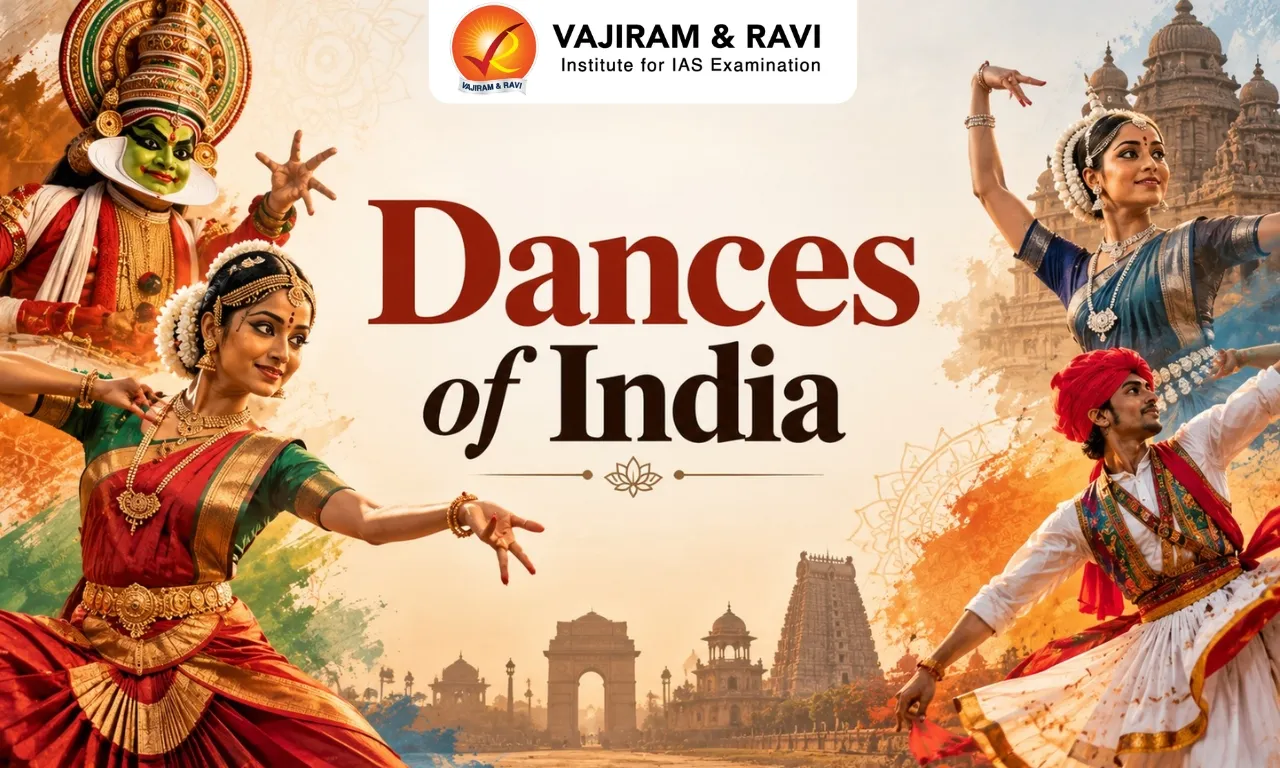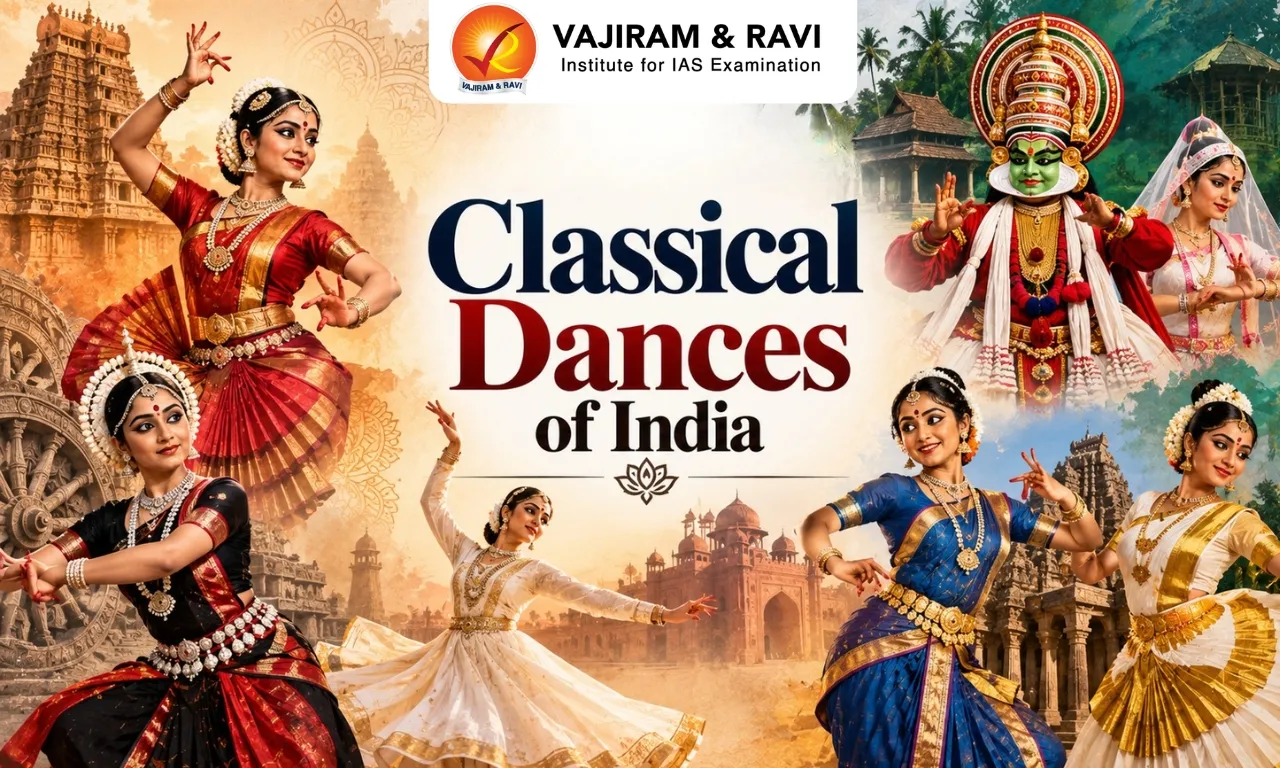
Classical Dances of India are traditional performing arts that integrate movement, music, expression, and storytelling, rooted in India’s cultural and theatrical traditions. They often draw on mythology, devotional literature, regional artistic traditions and narrative expression.
There are 8 Indian classical dances, which include Bharatanatyam, Kathak, Kathakali, Kuchipudi, Odissi, Manipuri, Mohiniyattam, and Sattriya. However, they face challenges such as limited patronage, high training costs, commercialisation, and declining youth participation, requiring stronger institutional support and cultural education.
Classical Dances of India About
The classical dances of India are a type of performance art that stems from the age-old Hindu theatre music tradition outlined in the Natya Shastra, an ancient Sanskrit literature on performance arts penned by the sage Bharata Muni and dating back to between 200 BC and 200 AD.
- The Natya Shastra is regarded as one of the most comprehensive texts ever published on the subject of performance art, covering practically every aspect of it, from stage techniques and costumes to gestures and expressions, and even the metaphysical foundations behind esthetic delight.
Also Check: Dances of India
Classical Dances of India History
The history of classical dances of India spans thousands of years, reflecting India's religious beliefs, cultural traditions and artistic excellence. From ancient temple rituals to royal courts and modern international stages, these dances have evolved while preserving their traditional roots.
- Ancient Origins: Indian classical dance has deep roots in ancient religious and cultural traditions. Archaeological evidence, temple sculptures and the bronze image of Nataraja, depicting Lord Shiva as the cosmic dancer, highlight its historical and spiritual significance.
- Natya Shastra: Written by Bharata Muni, the Natya Shastra (c. 200 BCE–200 CE) systematised the principles of Indian dance, music and drama. It remains a foundational text for classical performing arts.
- Temple Traditions: During ancient and mediaeval periods, Devadasis performed ritual dances in temples as offerings to deities during religious ceremonies and festivals.
- Mediaeval Period: Royal patronage encouraged the development of dance traditions. Kathak, particularly in North India, incorporated Persian and Central Asian influences during the Mughal period.
- Colonial Period: The Anti-Nautch movement and anti-Devadasi legislation weakened traditional temple dance practices.
- Revival and Recognition: In the twentieth century, Rukmini Devi Arundale founded Kalakshetra in 1936. The establishment of the Sangeet Natak Akademi in 1952 strengthened the preservation and promotion of Indian classical dances.


Classical Dances of India Features
The classical dances of India blend Tandava (vigorous movements) and Lasya (graceful expression), using Mudras, Abhinaya, and rhythmic patterns to convey emotions and stories rooted in the Natya Shastra. The following are the key features of Indian Classical Dances:
- Basic concept: There are two basic aspects to Indian classical dances: Tandava (movement and rhythm) and Lasya (grace, bhava, and rasa).
- Core Elements: The three main components are Natya (the dramatic element of the dance, i.e., the imitation of characters), Nritta (the basic dance movements), and Nritya (the expressive component, such as mudras or gestures).
- Rasa: The nine rasas are love, heroism, pathos, humour, anger, fear, disgust, wonder, and peace. The Natya Shastra, written by Bharata Muni, is the most important source for Indian aestheticians in determining the characteristics of dances.
- Structured Movements: Classical dances follow a specific set of movements and gestures known as Mudras, which are symbolic hand gestures.
- Expressive Elements: The dances often narrate stories through facial expressions, known as Abhinaya, conveying emotions and themes.
- Rhythmic Patterns: Indian classical dances are accompanied by intricate rhythmic patterns and musical compositions.
List of Classical Dances of India With States 2026
Sangeet Natak Akademi, India's National Academy for Music, Dance, and Drama, recognises eight classical dances of India. It is important to note that the Ministry of Culture has recognised nine classical dance forms, including Chhau. The following is the list of Indian classical dances:
- Bharatanatyam (Tamil Nadu)
- Kathak (North India)
- Odissi (Odisha)
- Kathakali (Kerala)
- Kuchipudi (Andhra Pradesh)
- Manipuri (Manipur)
- Sattriya (Assam)
- Mohiniyattam (Kerala)
8 Classical Dances of India
India has eight classical dance forms officially recognised by the Sangeet Natak Akademi, rooted in the ancient Sanskrit text Natya Shastra.
Bharatanatyam
Bharatanatyam (also known as Sadir or Dasi Attam) is one of the oldest classical dances of India, with origins in Tamil Nadu. It is believed to have evolved over 2000 years ago, drawing inspiration from the ancient Tamil text Natya Shastra, written by Bharata Muni. Traditionally performed by Devadasis in temples, symbolising devotion to deities. In the 20th century, it was revived as a stage art by figures like Rukmini Devi Arundale.
- Source & Codification: Based on performance and aesthetic principles outlined in classics such as Bharata's Natyashastra and enriched by Tamil, Telugu, and Sanskrit compositions; the Tanjore Quartet (19th century), Ponniah, Chinnaiah, Sivanandam, and Vadivelu codified the present recital format.
- Themes: Based on Nritta (pure dance) and Nritya (expressive dance); focuses on Bhakti (devotion) and Shringara (love); narratives drawn from Ramayana, Mahabharata, and Puranas.
- Music: Bharatanatyam music is derived from southern India's Carnatic system. The ensemble includes a vocalist, Mridangam, violin/flute/veena, and Nattuvanar (conductor with cymbals).
- Mudras and Postures: Uses a series of hand gestures known as Mudras to convey meaning and tell stories. One of the most important mudras is 'Katakamukha Hasta', in which three fingers are joined to represent 'Om'.
- Costume & Presentation: Dancers wear silk sarees, temple jewellery, ghungroos, and expressive makeup; typically performed in solo (ekacharya lasyam) style.
- Dancers: Rukmini Devi Arundale, Yamini Krishnamurthy, Padma Subramaniam, Mrinalini Sarabhai, and others are prominent proponents of Bharatanatyam dance.
Kathak Dance
Kathak, the principal classical dance of North India, derives its name from Katha (story) and Kathakar (storyteller). It originated as a narrative art form where storytellers depicted episodes from the epics and Puranic tales to the common people.
- Mughal Empire Patronage: Over time, Kathak flourished under Mughal patronage, acquiring elements of grace and refinement, and later developed further in the princely courts of Lucknow, Jaipur, and Raigarh.
- Footwork: Kathak is distinguished by its intricate tatkar (footwork) and pirouettes, and it is primarily a rhythm-based dance. A recital begins with Amad, Gat Nikas, Paran, Tatkar, and reflects the dance’s primarily rhythm-based character.
- Music: Kathak utilises Hindustani music, particularly Thumri, accompanied by instruments such as the Tabla, Pakhawaj, Sarangi, and Sitar. It developed a special connection with Kathak dance in the court of Wajid Ali Shah in Lucknow in the nineteenth century.
- Spins: It is characterised by swift chakkars (spins) with rhythmic grace.
- Expressions: Strong use of abhinaya (facial expressions, hand gestures) for storytelling.
- Costumes: Elaborate Anarkali-style dresses (women) or kurta-churidar (men), with jewellery and makeup.
- Dancers: Birju Maharaj, Lacchu Maharaj, Sitara Devi, Damayanti Joshi, etc., are famous Kathak dancers.
Odissi Dance
Odissi, a classical dance of Odisha (eastern India), originated as a temple dance performed by maharis. Named after Odra Nritya from the Natya Shastra, it was revived in the 20th century by dancers like Kelucharan Mohapatra as a recognised classical art form.
- Source & Theme: Rooted in Vaishnavism; narratives mainly depict Krishna-Radha lore. Lyrics from Gitagovindam and Oriya poetry by medieval and early modern poets form the repertoire.
- Mudras & Footwork: Uses mudras and postures to convey emotions; codified footwork includes Pada Bheda, gaits (Chalis), and spins (Bhramaris).
- Postures: Characterised by fluid movements, graceful postures, Tribhanga (three-bend) positions, and Chowk posture representing masculinity. The torso moves while the lower body is mostly static.
- Expressions (Nritya): Hand gestures and facial expressions play a key role in storytelling, portraying grace, sensuality, and beauty; the body forms intricate geometric patterns, giving the style the epithet “mobile sculpture.”
- Costume & Presentation: Dancers wear traditional Odissi sarees, silver jewellery, intricate hair ornaments, and facial makeup.
- Famous Odissi Dancers: Sonal Mansingh and Kelucharan Mohapatra are prominent performers in the Odissi dance.
Kathakali Dance
Kathakali, meaning “story play", originated in Kerala in the 17th century under royal patronage. It combines music, dance, and drama, primarily depicting stories from the Ramayana and Mahabharata, and is closely related to Koodiyattam.
- Themes: Most Kathakali recitals depict the eternal conflict between good and evil. Its themes are based on stories from the epics and Puranas. It is also known as the 'ballad of the East'. Kathakali songs are written in Manipravalam, a language that combines Malayalam and Sanskrit.
- Music: Music is important to convey the entire drama to the viewers. Different compositions of music are used during performances to give depth to the drama.
- Expressions (Abhinaya): Uses hand gestures and Navarasas (nine facial expressions) to convey emotions; eye and eyebrow movements are central.
- Performance: Staged in open-air theatres or temple grounds; begins in the evening and may continue until daybreak, accompanied by Maddalam drumming.
- Costume & Makeup: Characters are distinguished by face colors (green – heroes/divinities, red/black – villains), large skirts, and elaborate headdresses, reflecting their nature.
- Famous Kathakali Dancers: Ramankutty Nair, Margi Vijayakumar and Kalamandalam Gopi are prominent Kathakali Dance artists.
Kuchipudi Dance
Kuchipudi, a classical dance of Andhra Pradesh, originated in the 7th-century Bhakti movement and was named after the village Kuchelapuram. Revived in the 20th century by Balasaraswati, Ragini Devi, and Lakshminarayan Sastri, it evolved into a dance-drama with solo and female performances.
- Technique: Integrates Nritta (pure dance), Nritya (expressive dance), and Natya (drama with mudras); Nritta involves intricate patterns and jatis.
- Themes: Primarily Bhagavata Purana stories; emphasis on Shringara rasa (romantic love).
- Expressions: Combines speech, abhinaya (mime), and dance; dancers portray multiple characters through rapid mime and symbolic gestures, highlighting movement and emotion.
- Music: Performed to Carnatic music in Telugu, with violin and mridangam as main instruments.
- Famous Kuchipudi Dancers: Radha Reddy and Raja Reddy, Yamini Krishnamurthy, Indrani Rahman, etc., are famous Kuchipudi dancers.
Manipuri Dance
Manipuri, a classical dance of Manipur (northeastern India), is rooted in the Vaishnava faith of the Meitei community. It depicts Radha-Krishna lore, with subtle, circular movements performed primarily by women, and was revived in the 18th century by Raja Bhag Chandra and popularised by Rabindranath Tagore at Shantiniketan.
- Themes: Manipur's temples remain among the primary staging venues for the dance. Primarily based on Radha-Krishna stories, performed in temple settings.
- Movement: Introverted and continuous circular movements; artists do not make direct eye contact with the audience.
- Mudra: Subtle hand gestures integrated into movements; Nagabandha mudra forms the body into an ‘8’-shaped curve.
- Expressions: Subdued facial expressions, even in vigorous masculine dances.
- Music: Accompanied by Sankirtana (Kirtan), pung drum, flute, khartals, and dhol; compositions of Jayadeva and Chandidas are used.
- Division: Two main forms, Jagoi (gentle, lasya) and Cholom (vigorous, tandava); Jagoi is prominent in Ras Leela and votive performances.
- Famous Manipuri Dancers: Famous dancers associated with Manipuri dance include Nayana, Suverna, Ranjana, and Darshana.
Sattriya Dance
Sattriya, a classical dance of Assam, was introduced in the 15th century AD by Vaishnava saint Sankaradeva in Sattras (Vaishnava monasteries). Rooted in the Bhakti movement, it combines Nritta, Abhinaya, hasta, and footwork, and primarily depicts Krishna-related devotional themes.
- Theme: Devotional; based on mythological stories of Vishnu. Performed mainly by male monks (Bhokots) during rituals and festivals. Influenced by Assamese forms like Ojapali and Devdasi.
- Instruments & Music: Accompanied by khol (drum), manjira (cymbals), and flute, with devotional songs called Borgeets composed by Sankaradeva.
- Strict Rules: Emphasises codified hasta mudras, footwork, rhythmic syllables, posture, and combines Lasya and Tandava elements.
- Divisions: Bhaona-related repertoire: Gayan-Bhayanar Nach to Kharmanar Nach.Independent dance numbers: Chali (graceful), Jhumura (vigorous), Rajagharia Chali, Nadu Bhangi, etc.
- Ankia Naat & Bhaona: Musical dramas in Brajavali (mix of Assamese and Maithili), depicting Lord Krishna’s stories.
- Costumes: Males wear dhoti and pagri (turban); females wear Assamese jewellery (Ghuri), Chador, and Pat silk waistcloths.
- Famous Sattriya Dancers: Famous Sattriya dancers include Jatin Goswami and Anupama Bhuyan.
Mohiniyattam Dance
Mohiniyattam, Kerala’s classical solo dance, means "dance of Mohini," the celestial enchantress of Hindu mythology. Developed under the Travancore kings (Kartika Tirunal and Swati Tirunal, 18th–19th centuries), it emphasises graceful, feminine movements and subtle expressions, making it ideal for female performers.
- Source: Mentioned in Vyavahara Mala (1709) by Mazhamagalam Narayanan Namboodiri and Ghoshayatra by Kunjan Nambiar.
- Movement: Characterised by gentle, sliding footwork and fluid torso movements; movements are restrained and feminine, borrowing elements from Nangiar Koothu, Kaikottikali, and Tiruvatirakali.
- Focus on Acting: Emphasis on abhinaya, expressing sentiments in Padams and Pada Varnams with a wide facial expression range.
- Gestures: Uses 24 hand gestures based on Hastalakshana Deepika, with elements from Natya Shastra, Abhinaya Darpana, and Balarambharatam; gestures are natural (gramya) and realistic (lokadharmi).
- Music and Instruments: Mridangam, Veena, Flute, Kuzhitalam (cymbals), Edakka (primary percussion), and Maddalam rhythms. Dance moves are synchronised with music.
- Costume: Traditional white/off-white sarees with gold brocade, minimal facial makeup, and Ghungroo (ankle bells).
- Famous Mohiniyattam Dancers: Famous proponents include Sunanda Nair, Kalamandalam Kshemavathy, Madhuri Amma, Jayaprabha Menon, etc. The classical dances of India are a testament to the country's rich cultural heritage and artistic expression.
Classical Dances of India Significance
The classical dances of India are not merely performing arts; they preserve India’s intangible cultural heritage, regional traditions, mythology, and artistic knowledge through generations. Their significance extends from cultural identity to education, social cohesion, and India’s cultural diplomacy.
- Cultural Heritage: Classical dances preserve traditional movements, music, costumes, narratives, and artistic practices, keeping India’s diverse intangible heritage alive.
- Transmission of Knowledge: The Guru–Shishya tradition enables specialised knowledge, techniques,ues and performance practices to pass from one generation to another.
- Spiritual Expression: Classical dance combines movement, expression, music and narrative to communicate religious, philosophical and mythological themes, linking artistic practice with spiritual traditions.
- Livelihood & Artistic Careers: Training institutions, performances, festivals, scholarships and awards create opportunities for dancers, teachers, musicians and other associated artists.
- Global Cultural Diplomacy: Classical dance provides a medium for presenting India’s cultural traditions internationally and strengthening cultural contacts with other countries.
Classical Dances of India UPSC PYQs
Q1: With reference to Manipuri Sankirtana, consider the following statements: (UPSC Prelims 2017)
- It is a song and dance performance.
- Cymbals are the only musical instruments used in the performance.
- It is performed to narrate the life and deeds of Lord Krishna.
Which of the statements given above is/are correct?
(a) 1, 2 and 3.
(b) 1 and 3 only
(c) 2 and 3 only
(d) 1 only
Ans: (b)
Q2: With reference to the famous Sattriya dance, consider the following statements: (UPSC Prelims 2014)
- Sattriya is a combination of music, dance and drama.
- It is a centuries-old living tradition of Vaishnavites of Assam.
- It is based on classical Ragas and Talas of devotional songs composed by Tulsidas, Kabir and Mirabai.
Which of the statements above is/are correct?
(a) 1 only
(b) 1 and 2 only
(c) 2 and 3 only
(d) 1, 2 and 3
Ans: (b)
Q3: How do you distinguish between Kuchipudi and Bharatanatyam dances? (UPSC Prelims 2012)
- Dancers occasionally speaking dialogues are found in Kuchipudi dance but not in Bharatanatyam.
- Dancing on the brass plate by keeping the feet on its edges is a feature of Bharatanatyam, but Kuchipudi dance does not have such a form of movement.
Select the correct answer using the code given below:
(a) 1 only
(b) 2 only
(c) Both 1 and 2
(d) Neither 1 nor 2
Ans: (a)

 Last updated on Oct, 2026
→ UPSC 2027 Notification will be released on 13 January 2027 at upsconline.nic.in.
→ Check Nobel Prize 2026 Winners List here.
→ Download PIB PRiSM Monthly Magazine 2026 here.
→ Check UPSC Monthly Current Affairs Magazine The Recitals here.
→ Check out the latest UPSC Syllabus here.
→ Download UPSC Model Answers for Mains 2026
→ UPSC Mains Question Paper 2026 is out now for Essay & GS Paper 1, 2, 3 & 4.
→ UPSC Calendar 2027 has been released.
→ Enroll in Vajiram & Ravi’s UPSC Mains Test Series 2027 for structured answer writing practice, expert evaluation, and exam-oriented feedback.
→ Join Vajiram & Ravi’s UPSC Mentorship Program 2027 for personalized guidance, strategy planning, and one-to-one support from experienced mentors.
→ Go through the UPSC Mains Previous Year Papers to enhance your preparation.
→ UPSC has released UPSC Toppers List 2025 with the Civil Services final result on its official website.
→ Also check Best UPSC Coaching in India
Classical Dances of India FAQs
Q1. Are there 8 or 9 classical dance forms in India?+
Q2. What is the 9th classical dance of India?+
Q3. What are the 20 dances of India?+
Q4. How many classical dances are there in India in 2026?+
Q5. What are the 7 stages of Bharatanatyam in order?+
Tags: classical dances of india quest UPSC Art and Culture Notes